
绿色交通

Search documents
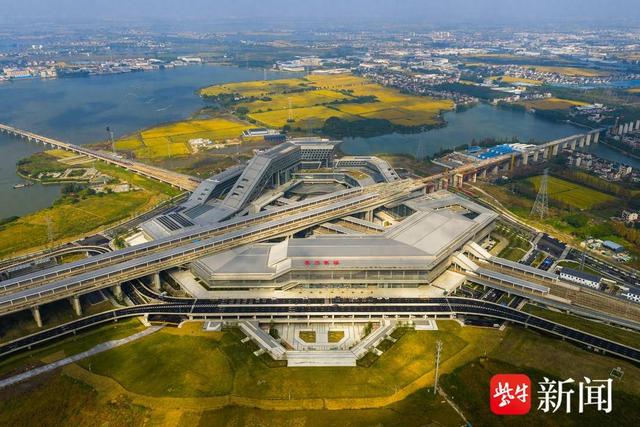
智慧绿色双擎驱动,苏州全力构建现代化综合交通运输体系
Xin Lang Cai Jing· 2026-01-25 14:09
Core Viewpoint - Suzhou has made significant advancements in building a modern comprehensive transportation system over the past five years, achieving a prominent position as a national transportation hub, which supports high-quality urban development and enhances public welfare. Group 1: Infrastructure Investment - During the "14th Five-Year Plan" period, Suzhou invested over 130 billion yuan in transportation infrastructure, leading to a historic leap in railway development with 168.17 kilometers of new rail lines, creating a rapid access network for all county-level nodes within 30 minutes of high-speed rail [3][5]. Group 2: Road and Water Transport - The highway network has expanded to 638 kilometers, ranking first in the province, with 34 inter-regional roads completed to enhance connectivity [5]. - Suzhou's water transport capabilities have been significantly enhanced, with the addition of 69.2 kilometers of new third-level waterways and a total of 242.4 kilometers of thousand-ton-level waterways, establishing Suzhou Port as a benchmark for inland ports [7]. Group 3: Air Transport and Logistics - Suzhou has proactively developed low-altitude economy, becoming one of the first cities in the country to manage air traffic, with 297 low-altitude takeoff and landing points and 476 low-altitude routes established [8]. - The city has seen a more than 10% annual growth in container multimodal transport, with the Suzhou Port's container shipping network covering over 30 ports in countries such as Russia, Japan, and Vietnam [8][9]. Group 4: Public Transportation and Accessibility - The urban rail transit system has reached 346 kilometers, the longest among prefecture-level cities in China, facilitating seamless connections with Shanghai's metro [10]. - Public transport services have been diversified, achieving 100% connectivity for neighboring districts and counties, with innovative routes catering to various community needs [10]. Group 5: Smart and Green Transportation - Suzhou is committed to innovation and sustainable development in transportation, having successfully implemented smart traffic projects and hosted the 29th Intelligent Transportation World Congress [12]. - The city has made significant strides in green transportation, eliminating 12,000 old high-emission trucks and achieving 100% coverage of shore power facilities at ports [14]. Group 6: Future Goals - Looking ahead to the "15th Five-Year Plan," Suzhou aims to transform its transportation development from scale expansion to quality and efficiency, targeting the establishment of an international railway hub and a national container trunk port by 2030 [16].

大幅下调税费 扩建充电网络 柬埔寨加快普及电动车
Ren Min Ri Bao· 2026-01-15 22:03
Group 1 - The total registration of electric vehicles in Cambodia reached 10,568 units by September 2025, with a noticeable increase in the number of electric vehicles on the streets of Phnom Penh, including brands like BYD and SAIC MG [1] - The Cambodian government aims to increase the number of electric vehicles to 30,000 and electric motorcycles and tricycles to 720,000 and 20,000 respectively by 2030, as outlined in the "Electric Vehicle Development Policy (2024-2030)" [1] - In August 2025, the Cambodian government announced significant reductions in annual road taxes for three categories of electric vehicles, lowering the barriers for green transportation [1] Group 2 - Cambodia's fuel demand is entirely reliant on imports, and increasing the level of vehicle electrification could enhance the country's energy security and economic resilience, potentially contributing up to 2.9% to economic growth if 60% of vehicles are replaced with electric ones by 2050 [2] - The Cambodian electric vehicle market is still in its early stages but has significant growth potential, with Chinese companies expected to inject new momentum into the industry due to their mature technology and supply chains [2] - BYD's passenger car factory in the Sihanoukville Special Economic Zone is set to begin construction in April 2025, with a planned annual production capacity of 10,000 units, while XPeng Motors entered the Cambodian market in October last year [2]
极寒验真章!吉利远程新能源商用车冰博会交出硬核答卷
Xin Hua Wang· 2026-01-07 08:40
Core Viewpoint - The 2026 Harbin International Ice and Snow Economy Expo showcased Geely Holding Group's innovative achievements in green transportation, snow equipment, and the entire ecological field, highlighting its commitment to sustainable solutions in extreme weather conditions [1] Group 1: Product Innovations - Geely presented multiple alcohol-hydrogen electric products, emphasizing their advancements in technology [1] - The Geely remote alcohol-hydrogen electric snow removal vehicle is designed to meet high-intensity snow removal demands with stable power [1] - The Geely remote alcohol-hydrogen electric bus achieved over 600 km range without degradation at temperatures as low as -40°C, providing a reliable technological solution for winter transportation in northern regions [1]

交通大省迈向交通强省
Xin Hua Ri Bao· 2026-01-07 06:29
Core Viewpoint - The transportation system in Jiangsu province has made significant advancements since the "14th Five-Year Plan," aligning with national strategies to build a strong transportation network and modernize the transportation system, thereby supporting the province's economic development and demonstrating its leadership role in the country [1][2]. Investment and Infrastructure Development - The total investment in transportation infrastructure reached 1 trillion yuan, which is 1.6 times that of the "13th Five-Year Plan" [2]. - The province has achieved a highway network of 5,540 kilometers, with an increase of 615 kilometers since 2020, and 48.4% of highways are six lanes or more, ranking second nationally [4]. - The high-speed railway network has expanded to 2,594 kilometers, with an increase of 379 kilometers since 2020, leading in area density among provinces [4]. Logistics and Transportation Efficiency - The ratio of social logistics costs to regional GDP decreased from 13.8% in 2020 to 12.7%, which is 1.3 percentage points lower than the national average [3]. - Jiangsu has established 42 multi-modal transport hubs and operates 152 multi-modal transport lines, with waterway freight accounting for approximately 38.9% of total freight volume, exceeding the national average by 21.4 percentage points [5][6]. Passenger Transport and Connectivity - The province has opened 37 international passenger routes, including new intercontinental routes from Nanjing to Sydney, Melbourne, and Paris [8]. - Daily average train operations exceed 750 pairs, leading in passenger volume in the Yangtze River Delta region [9]. - Urban rail transit has reached 1,279 kilometers across nine cities, ranking second nationally [10]. Safety and Modernization - By 2024, the number of road transport safety incidents and fatalities is expected to decrease by over 60% compared to the end of the "13th Five-Year Plan" [15]. - The province has built 21,000 video monitoring facilities on highways, leading the nation in density [16]. Innovation and Digital Transformation - Jiangsu is the only province in the transportation sector with two national-level innovation platforms and has been recognized for its digital transformation in transportation infrastructure [13]. - The province has developed a unified digital transportation platform and achieved a 99.64% coverage rate for shore power at ports [14]. Talent Development and Community Engagement - The province has implemented high-level talent initiatives, with numerous individuals recognized as national and provincial labor models and craftsmen [19]. - Community engagement efforts include the establishment of 373 "Driver's Homes" and the promotion of integrity education within the transportation system [18].
阿利耶夫最新涉华表态
Xin Lang Cai Jing· 2026-01-06 16:24
Core Viewpoint - The relationship between Azerbaijan and China has upgraded from a strategic partnership to a comprehensive strategic partnership, injecting strong momentum into bilateral relations [2] Group 1: Bilateral Relations - The signing of a joint statement in 2025 to establish a comprehensive strategic partnership is a significant achievement in Azerbaijan's diplomatic efforts, signaling a commitment to strengthen ties between the two governments and enterprises [2] - Azerbaijan has chosen China as a strategic partner for the development of green energy and green transportation, highlighting the professionalism, quality, and efficiency demonstrated by Chinese companies in project execution [2] Group 2: Economic Engagement - Chinese enterprises are actively participating in the construction of photovoltaic and wind power projects in Azerbaijan, indicating a robust engagement in the renewable energy sector [2] - The local assembly project of Chinese brand electric buses has successfully commenced production, showcasing the practical collaboration between the two countries [2]

阿塞拜疆总统:阿中关系升级为双边关系发展注入强劲动能
Xin Hua She· 2026-01-06 11:11
Group 1 - The core viewpoint of the article is that the relationship between Azerbaijan and China has upgraded from a strategic partnership to a comprehensive strategic partnership, injecting strong momentum into bilateral relations [1] - Azerbaijan's President Aliyev highlighted that China is one of the major global powers, and the joint statement signed in 2025 to establish a comprehensive strategic partnership is a significant achievement in Azerbaijan's diplomatic field [1] - The involvement of Chinese companies in Azerbaijan's photovoltaic and wind power projects, as well as the successful production of locally assembled electric buses, demonstrates the effectiveness of this partnership [1] Group 2 - Azerbaijan has chosen China as a strategic partner for the development of green energy and green transportation, with Chinese companies showcasing professionalism, quality, and construction efficiency in project execution [1]
北京市新能源汽车充电桩增至47.9万个
Xin Lang Cai Jing· 2026-01-04 20:04
Group 1: Electric Vehicle Infrastructure Development - The city aims to optimize the layout of charging infrastructure during the "14th Five-Year Plan" period to meet the growing demand for electric vehicle charging and support the development of the electric vehicle industry [1] - The number of charging piles in the city increased from 230,000 to 479,000, and the number of battery swap stations rose from 158 to 360 [1] - The total charging volume for electric vehicles increased from 1.5 billion kWh to 3.5 billion kWh [1] Group 2: Coal Consumption and Energy Transition - By 2025, the city plans to reduce coal consumption by approximately 12.33 million tons, bringing the total coal consumption down to around 250,000 tons [2] - The "coal-to-electricity" program aims to upgrade the distribution network, with 1.37 million households participating [2] - The city has completed a transaction of 1.526 billion kWh for green electricity to replace reduced electricity from gas-fired power plants [2] Group 3: Green Transportation Initiatives - By 2025, the proportion of green travel in the central urban area is expected to reach 76.5%, an increase of 2.5 percentage points from 2020 [3] - The electrification rate of operational vehicles in the transportation sector is projected to exceed 46% by the end of 2025, with 100% of taxi vehicles being electric [3] - The city is focusing on building a green freight transport system, with a goal of achieving a 12% green transport ratio for goods by 2025 [3]
截至2025年底,北京巡游出租车新能源化率已达100%
Xin Jing Bao· 2026-01-04 09:00
Group 1 - The core viewpoint of the articles highlights Beijing's commitment to transforming its transportation sector towards greener alternatives, aiming for significant reductions in energy consumption and carbon emissions by 2025 [1][2] - By the end of 2025, the proportion of new energy vehicles in the city's transportation sector is expected to exceed 46%, with 100% of taxi operations transitioning to new energy vehicles [1] - The total energy consumption in the transportation sector is projected to be around 2.5 million tons, a decrease of approximately 21% compared to the end of the 13th Five-Year Plan [1] - Carbon emissions from operational vehicles are expected to be controlled at around 2.9 million tons, reflecting a 30% reduction from the end of the 13th Five-Year Plan [1] Group 2 - By 2025, the green travel ratio in the central urban area is anticipated to reach 76.5%, indicating a growing public willingness to adopt environmentally friendly transportation options [2] - The city is focusing on establishing a green freight transport system that integrates rail and new energy vehicles, with a target of achieving a 12% green transport ratio for goods by 2025 [2] - Ongoing efforts include enhanced management of road cleanliness, with a reported 12% reduction in mechanical cleaning debris and a 21% reduction in manual cleaning debris on the Fifth Ring Road [2] - The automotive repair industry is undergoing pollution prevention improvements, with a shift to more efficient technologies for paint and coating processes [2] - Looking ahead to the 15th Five-Year Plan, the city aims to further optimize travel, transport, and energy structures, targeting a carbon emission cap by 2030 that does not exceed historical peak levels [2]
济源—新安高速正式通车 一条路“拨千斤”
He Nan Ri Bao· 2026-01-02 23:22
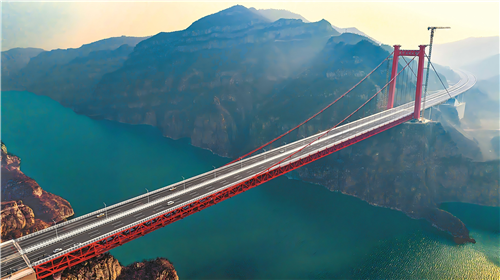
Core Insights - The Jiyuan-Xinan Expressway (JX Expressway) is set to officially open on December 30, 2025, significantly reducing travel time between Jiyuan and Xinan from two hours to just 20 minutes, transforming regional connectivity [4][8]. Infrastructure Development - The JX Expressway spans approximately 48 kilometers, featuring the Yellow River Sanxia Bridge, which is 1,688.5 meters long with a main span of 555 meters, marking it as the largest bridge in Henan province and a significant engineering landmark globally [5]. - The bridge employs innovative design techniques, including a unique "return cable" system that minimizes environmental impact and reduces material usage by approximately 20,000 cubic meters of concrete and 1,200 tons of steel [6][7]. Economic Impact - The expressway enhances regional transportation, allowing Jiyuan to achieve "town-to-town" expressway connectivity and forming a "half-hour commuting circle" with Luoyang, thus upgrading the overall traffic network [10]. - Logistics efficiency is expected to improve by about 70%, reducing transportation costs for industrial raw materials and finished products, which will benefit local businesses and drivers [10]. - The expressway is anticipated to stimulate tourism by connecting various scenic spots, promoting a cross-border tourism route that integrates ecological and geological attractions [10]. Regional Development - The JX Expressway is aligned with national and provincial strategies to optimize regional economic layouts and promote coordinated development, facilitating deeper integration between Jiyuan and Luoyang [12]. - The expressway serves as a critical link between the northwest of Henan and the southeast of Shanxi, enhancing economic collaboration and resource sharing between the two regions [13]. - The project is expected to attract various industries to the expressway corridor, with initial agreements for projects worth 8.7 billion yuan, projecting a development blueprint of 20 billion yuan in output [13].
“绘”就便民路 “融”暖百姓心
Xin Lang Cai Jing· 2025-12-29 00:38
Group 1 - The "My Bus, My City" initiative showcases Nanning's public transport development through integration, supported by the Nanning Natural Resources Bureau's multi-dimensional planning and comprehensive element guarantees [1] - The approved "Nanning Urban Spatial Overall Plan (2021-2035)" emphasizes green transportation, aiming to enhance service quality and travel experience for citizens [1] - Nanning aims to establish a multi-layered public transport system, with a backbone of large and medium-capacity rail transit, conventional buses as the foundation, and supplementary unique transport options [1] Group 2 - A "green channel" for major project approvals has been established to expedite planning and land approval processes for rail transit, ensuring the smooth operation of lines 1-5 and paving the way for the construction of line 6 [2] - The average daily passenger flow for public transport in the city is 1.55 million, indicating a growing preference for green travel among citizens [2] - Nanning has built and put into use 93 bus stations in the central urban area, providing essential hardware support for the efficient operation of conventional buses and meeting daily commuting needs [2]