
资源品

Search documents
数说公募主动权益基金四季报:规模/份额双降、周期/金融配置权重上升
SINOLINK SECURITIES· 2026-02-03 02:53
1. Report Industry Investment Rating - No relevant content provided 2. Core Viewpoints of the Report - In Q4 2025, after nearly a year of upward trend, the A - share market started to move sideways and fluctuate, with wide - based indices showing mixed performance. Large and mid - cap value indices significantly outperformed growth indices, and the active equity fund scale and share decreased while the issuance quantity and scale slightly increased [3][8]. - The average stock position of equity funds slightly shrank, and the Hong Kong stock position also declined. Institutions increased the allocation in cyclical and financial sectors and adjusted the allocation in technology, medicine, and consumption sectors [3]. - The performance of theme funds in various industries was differentiated. Cyclical theme funds performed the best, while pharmaceutical theme funds performed the worst [3]. - Among the top 20 fund companies in terms of active equity fund scale, the scale changes compared to Q3 were mixed, with some companies' rankings changing [3]. - In Q4, the active equity fund most heavily held by FOF in terms of holding ratio and quantity was "Fuguo Steady Growth" [3]. 3. Summary by Related Catalogs 3.1 Fund Market Overview - **Performance Review**: In Q4 2025, the A - share market moved sideways and fluctuated after a year - long upward trend. Only the Shanghai Composite Index rose by 2.22% among wide - based indices, while others like the Shenzhen Component Index and the ChiNext Index declined. In terms of style, large and mid - cap value indices outperformed growth indices. The Hang Seng Index and related Hong Kong stock indices also declined [8]. - **Industry Index Performance**: Except for 9 industries such as medicine and beauty care, the remaining 22 industries in the Shenwan 31 - industry index achieved positive returns in Q4. Resources and military industries performed well, while the pharmaceutical industry was weak overall. The top 5 industries in terms of increase were non - ferrous metals (16.25%), petroleum and petrochemicals (15.31%), communication (13.61%), national defense and military industry (13.1%), and light industry manufacturing (7.53%) [11]. - **Equity Fund Performance**: In Q4 2025, ordinary stock - type funds, partial - stock hybrid funds, and flexible allocation funds declined by 1.94%, 1.60%, and 0.04% respectively, while balanced hybrid funds rose by 0.87%. In terms of risk, balanced hybrid funds with lower stock positions had the best drawdown performance, and flexible allocation funds showed better risk - return performance in the long - term [31]. - **Scale and Share**: By the end of Q4 2025, the total scale of active equity funds was 3.81 trillion yuan, a slight decrease of 4.53pct compared to the previous quarter, and the total share was 2.56 trillion shares, a decrease of 2.91pct. Among them, partial - stock hybrid funds had the largest scale, and balanced hybrid funds had the smallest scale [34]. - **Newly Issued Fund Situation**: In Q4, the number and scale of newly issued active equity funds slightly increased. A total of 100 funds were newly issued, with a total scale of 441.67 billion yuan, an increase of 4.72 billion yuan compared to the previous quarter. Partial - stock hybrid funds had the largest newly issued scale [36]. 3.2 Fund Holding Characteristics - **Stock/Hong Kong Stock Position**: In Q4 2025, the equity fund position slightly shrank, with the average stock position at 88.05%, a decrease of 0.88 percentage points compared to the end of the previous quarter. The Hong Kong stock position also decreased, with the average investment market value of Hong Kong stocks accounting for 11.62% of the net value, a decrease of 1.85 percentage points compared to the previous quarter [43]. - **Heavy - Holding Stock Sector Allocation**: In Q4, technology was the most heavily held sector by active equity funds. Except for cyclical, manufacturing, and financial sectors, the proportion of other sectors decreased. Institutions increased the allocation in cyclical and financial sectors and adjusted the allocation in technology, medicine, and consumption sectors [48]. - **Heavy - Holding Stock Industry Allocation**: The electronics industry was still the largest heavily - held industry by equity funds, but the allocation ratio decreased, and non - ferrous metals were significantly increased. The concentration of the top five industries slightly decreased from 58.58% in Q3 to 58.40% [50]. - **Individual Stock Level**: The top 10 individual stocks in terms of heavy - holding market value accounted for by equity funds were Zhongji Innolight, Xinyisheng, CATL, Tencent Holdings, Zijin Mining, Alibaba - W, Cambricon - U, Luxshare Precision, SMIC, and Kweichow Moutai. The market value proportion of Zhongji Innolight, Xinyisheng, and Ping An of China increased significantly, while that of Industrial Fuxing, Alibaba - W, and EVE Energy decreased relatively more [52]. - **Heavy - Holding Stock Market Value and Concentration**: The market value style of equity fund holdings continued to strengthen towards mid - and large - cap stocks. The concentration of the top 50, 100, and 200 heavy - holding stocks slightly decreased, but basically continued the previous trend [61]. 3.3 Fund Company Analysis - **Scale Ranking**: In Q4 2025, the scale changes of the top 20 fund companies in terms of active equity fund scale compared to Q3 were mixed. The top 5 institutions were E Fund, China Europe Asset Management, GF Fund, Fuguo Fund, and Huatai - PineBridge Fund. Among the companies ranked 6 - 20, the equity scale of Yongying Fund further increased, and its ranking rose by 2 places [64]. - **TOP20 Fund Company Heavy - Holding Industries**: The first - largest heavily - held industries of the top 20 fund companies were mainly electronics and medicine and biology. Dacheng Fund's first - largest heavily - held industry was non - ferrous metals, showing certain differences [65]. - **TOP20 Fund Company Heavy - Holding Stocks**: In Q4, the average concentration of the top three heavy - holding stocks of the top 20 fund companies in terms of active equity fund scale was 14.27%, and the concentration of the top five heavy - holding stocks was 21.04%, slightly increasing compared to the previous quarter. Xingquan Fund had the highest concentration of the top three heavy - holding stocks [67]. 3.4 Theme Fund Analysis - **Fund Performance**: In Q4, the performance of theme funds in various industries was differentiated. Cyclical theme funds performed the best, with a quarterly increase of 10.10%, followed by financial and manufacturing theme funds. Pharmaceutical theme funds had the worst performance, with a quarterly decline of 13.15% [71]. - **Pharmaceutical and Consumption Themes**: In pharmaceutical theme funds, the sub - sectors with a relatively high market value proportion in heavy - holding stocks were chemical preparations and other biological products. The sub - sectors with a relatively large increase in heavy - holding proportion were medical R & D outsourcing and traditional Chinese medicine. In consumption theme funds, the sub - sectors with a relatively high market value proportion were liquor and agriculture, forestry, animal husbandry, and fishery. The sub - sectors with a relatively large increase in heavy - holding proportion were food processing and social services [75]. - **Technology and New Energy Themes**: In technology theme funds, the sub - sectors with a relatively high market value proportion in heavy - holding stocks were artificial intelligence and consumer electronics industries. The sub - sectors with a relatively large increase in heavy - holding proportion were optical modules and IDC. In new energy theme funds, the sub - sectors with a relatively high market value proportion were energy storage and solid - state batteries. The sub - sectors with a relatively large increase in heavy - holding proportion were resource stocks and solid - state batteries [79]. 3.5 FOF Holding Analysis - **High - Holding - Ratio Funds**: In Q4 2025, the active equity fund with the highest holding ratio among FOF heavy - holding funds was "Fuguo Steady Growth", with a fund manager of Fan Yan. The fund's holding market value accounted for 2.53% of the total market value of all heavy - holding funds, an increase of 0.13% compared to the previous quarter [81]. - **High - Holding - Quantity Funds**: In Q4 2025, the active equity fund most heavily held by FOF in terms of quantity was still "Fuguo Steady Growth", followed by "Bodaojiu Hang" and "China Europe Dividend Premium Selection" [83]. - **Ratio/Quantity Changes**: In Q4 2025, the active equity funds with the largest increase in holding ratio and quantity among FOF heavy - holding funds were "Huatai - PineBridge Extended Growth Theme" and "China Europe Dividend Premium Selection" respectively [85]. - **New - Generation Fund Managers**: Among the active equity funds managed by new - generation fund managers with less than 3 years of management experience, the fund with the highest holding ratio among FOF heavy - holding funds in Q4 was "Rongtong Industrial Trend Selection", with a fund manager of Li Jin. The fund's holding market value accounted for 0.70% of the total market value of all heavy - holding funds, a quarter - on - quarter increase of 0.37% [87]. - **Holding Own Funds**: Different FOF institutions such as E Fund, China Europe Asset Management, Invesco Great Wall, Fuguo Fund, Huatai - PineBridge Fund, and Xingzheng Global Fund had different situations in holding their own equity funds, with different scales and top - held funds [89][91][94][96][98].





港股复盘 | 港股遭遇“黑色星期一” 恒生科技指数跌超3% 贵金属板块遭遇重挫
Mei Ri Jing Ji Xin Wen· 2026-02-02 08:57
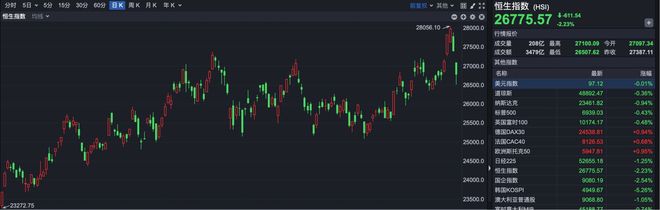
Market Overview - The Hong Kong stock market experienced a significant decline on February 2, with the Hang Seng Index closing at 26,775.57 points, down 611.54 points, representing a drop of 2.23% [1][2] - The Hang Seng Tech Index also fell, closing at 5,526.31 points, down 191.87 points, a decrease of 3.36% [2] Sector Performance - Precious metals stocks were heavily impacted, with Shandong Gold (HK01787) and Chifeng Jilong Gold (HK06693) both dropping over 12%. Other companies like Lingbao Gold and Jiangxi Copper fell more than 9%, while Zijing Mining dropped over 5% [4] - In the automotive sector, shares of Xpeng Motors (HK09868) fell by 6%, and NIO (HK09866) dropped over 4% [5] - Semiconductor stocks also faced declines, with Hua Hong Semiconductor falling over 11% [6] - Technology stocks generally declined, with Bilibili dropping over 4%, and major companies like Baidu, NetEase, Kuaishou, and Alibaba falling over 3% [7] Investment Insights - Citigroup's recent commodity report indicated that current gold prices have significantly priced in future uncertainties, suggesting that while there may be short-term price increases, valuations are at "extreme levels" [5] - Despite the downturn, southbound capital saw a small inflow, with net purchases of Hong Kong stocks exceeding 1.9 billion HKD by the end of the trading day [7] Future Outlook - Huatai Securities believes the current market correction is a technical pullback due to rapid previous gains and hawkish signals from the Federal Reserve. They suggest focusing on sectors with clearer benefits, such as AI and semiconductor manufacturing [10] - Morgan Stanley notes that the recent bull market has led to profit-taking ahead of the Lunar New Year, but geopolitical uncertainties may enhance the attractiveness of Chinese assets, predicting that the Hong Kong market could outperform the A-share market in the short term [10]

1月行情落幕!港股、A股慢牛延续,黄金白银高位“踩刹车”
Ge Long Hui A P P· 2026-01-31 05:59
Market Overview - In January 2026, global markets exhibited significant divergence, with structural trends dominating the month [1] - A-shares and Hong Kong stocks experienced upward movements, with the Shanghai Composite Index rising over 3% and the Hang Seng Index increasing by more than 6% [1] - The U.S. stock market reached historical highs but faced consolidation by the end of the month, with all three major indices still showing monthly gains exceeding 1% [1] A-shares Performance - The A-share market showed a steady upward trend in January, with the Shanghai Composite Index up 3.76%, the ChiNext Index up 4.47%, and the Shenzhen Composite Index up 5.03% [2] - The non-ferrous metals sector led the gains with a 22.59% increase, followed by media, oil and petrochemicals, construction materials, and basic chemicals, which saw increases of 17.94%, 16.31%, 13.31%, and 12.72% respectively [3] Hong Kong Market Performance - The Hong Kong market also trended upwards in January, with the Hang Seng Index leading with a 6.85% increase, while the Hang Seng China Enterprises Index and the Hang Seng Tech Index rose by 4.53% and 3.67% respectively [5] - The optical communication sector was the standout performer, surging by 32.34%, followed closely by the paper industry with a 31.76% increase [6] Precious Metals - January witnessed a remarkable rally in precious metals, with gold and silver prices rising sharply due to expectations of interest rate cuts by the Federal Reserve and ongoing central bank purchases [8] - Gold prices increased by over 16%, while silver prices surged more than 34% during the month, marking them as the most notable assets in this rally [8] Industrial Metals and Energy - The industrial metals market also performed strongly, with LME nickel rising over 9% and LME copper increasing by 8.97% [10] - The energy market saw WTI crude oil futures rising over 14%, reaching $65.88 per barrel, and Brent crude oil futures also increasing by over 14%, priced at $70.04 per barrel [10] Future Market Outlook - The focus for February is expected to remain on interest rate expectations, dollar movements, and geopolitical risks [12] - Analysts suggest that the A-share market may experience a healthy adjustment, with a shift towards a more sustainable "slow bull" market, driven by earnings growth and profitability improvements [12] - For the Hong Kong market, a positive outlook is maintained, with expectations of a structural rebound supported by earnings recovery, improved liquidity, and policy support [13]

市场分析:传媒酿酒行业领涨,A股小幅上行
Zhongyuan Securities· 2026-01-29 09:14
分析师:张刚 登记编码:S0730511010001 相关报告 zhanggang@ccnew.com 021-50586990 传媒酿酒行业领涨 A 股小幅上行 《市场分析:煤炭有色行业领涨 A 股小幅上 行》 2026-01-28 《市场分析:金融半导体领涨 A 股小幅上 行 》 2026-01-27 《市场分析:金融有色行业领涨 A 股小幅整 ——市场分析 理 》 2026-01-26 联系人: 李智 电话: 0371-65585629 风险提示:海外超预期衰退,影响国内经济复苏进程;国内政 策及经济复苏进度不及预期;宏观经济超预期扰动;政策超预期 变化;国际关系变化带来经济环境变化;海外宏观流动性超预期 收紧;海外波动加剧。 本报告版权属于中原证券股份有限公司 www.ccnew.com 请阅读最后一页各项声明 第1页 / 共7页 地址: 郑州郑东新区商务外环路10号18楼 地址: 上海浦东新区世纪大道 1788 号 T1 座 22 楼 证券研究报告-市场分析 发布日期:2026 年 01 月 29 日 投资要点: ◼ A 股市场综述 周四(01 月 29 日)A 股市场先抑后扬、小幅震荡上行,早盘股 ...
每天5分钟,读懂盘前“必答题”
Di Yi Cai Jing Zi Xun· 2026-01-28 11:01
Core Insights - The A-share market is experiencing significant structural characteristics with accelerated sector rotation, highlighting the importance of efficient and high-quality information for investment decisions [1] Group 1: Key Features of "Pre-Market Gold" - The service provides a concise summary of market insights before trading begins, focusing on areas that may present investment opportunities [1][6] - It delivers rapid updates on major brokerage opinions, allowing investors to quickly understand what large funds are focusing on [2] - The service curates 1-2 high-potential thematic opportunities daily, analyzing event catalysts, industry logic, and capital movements [3] Group 2: Information Filtering - The service filters out noise from macro and industry news, highlighting key information that truly impacts sectors and stock prices [4] - It organizes critical company announcements from the night and early morning, capturing valuable signals and potential market reactions [5] Group 3: Advantages of Choosing "Pre-Market Gold" - The service saves time by providing a brief that replaces hours of information gathering and reading [6] - It focuses on practical content directly related to secondary market investments, offering actionable decision-making information [7] - The service integrates authoritative sources from brokerages, media, and company announcements to minimize information loss [8] - It aims to establish a systematic pre-market preparation habit by providing timely updates every trading day [9] Group 4: Recent Content Preview - Recent highlights include a resurgence in brokerage earnings, the breakthrough of Shanghai's intelligent computing scale, and a focus on performance lines amid market adjustments [10] - Other notable mentions are the rise in storage chip prices, increased gold demand due to seasonal consumption, and advancements in AI and high-end manufacturing sectors [11][12]
资金轮动速度加快,机构:“科技赛道+资源品”或为春节前最主要投资线路!| 华宝3A日报(2026.1.27)
Xin Lang Cai Jing· 2026-01-27 11:29
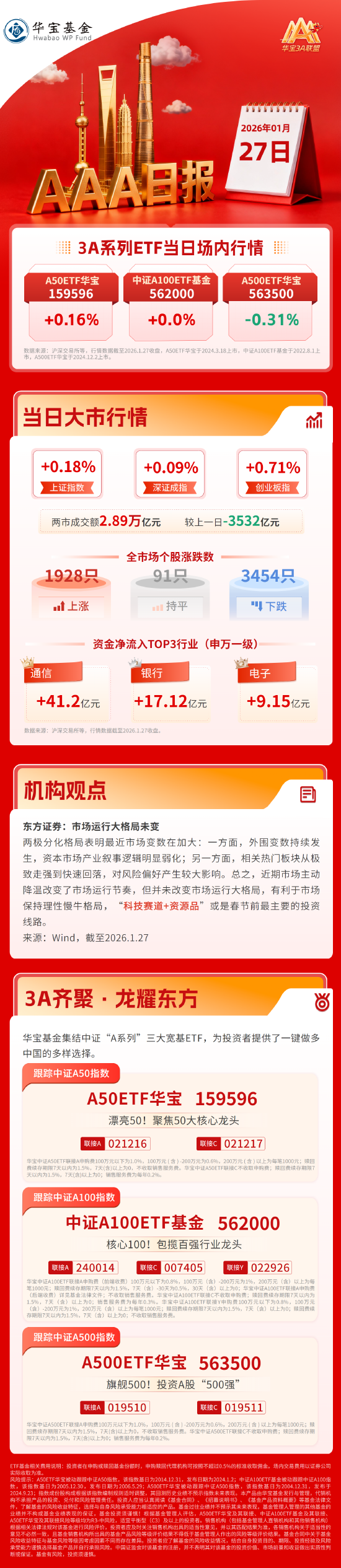
华宝 泰 金 wabao WP Fund A N A B 2026年01月 lll 3A系列ETF当日场内行情 ■ 中证A100ETF基金 A50ETF华宝 A500ETF华宝 159596 562000 563500 +0.16% +0.0% -0.31% 数据来源:沪深交易所等,行情数据截至 「F华宝于2024.3.18上市,中证A100ETF基金于2022.8.1上 市,A500ETF华宝于2024.12.2 当日大市行情 na +0.18% +0.71% +0.09% 创业板指 上证指数 深证成指 两市成交额2.89万亿元 较上一日-3532亿元 全市场个股涨跌数 1928 = 01日 3454只 =1 上涨 == "| 下跌 资金净流入TOP3行业(申万一级) i角信 +17.12元元 机构观点 东方证券:市场运行大格局未变 两极分化格局表明最近市场变数在加大:一方面,外围变数持续发 生,资本市场产业叙事逻辑明显弱化;另一方面,相关热门板块从极 致走强到快速回落,对风险偏好产生较大影响。总之,近期市场主动 降温改变了市场运行节奏,但并未改变市场运行大格局,有利于市场 保持理性慢牛格局,"科技赛道+资 ...
市场分析:金融有色行业领涨,A股小幅整理
Zhongyuan Securities· 2026-01-26 09:14
Market Overview - On January 26, the A-share market experienced slight fluctuations after reaching resistance at 4160 points, with the Shanghai Composite Index closing at 4132.61 points, down 0.09%[7] - The total trading volume for both markets was 32,810 billion yuan, above the median of the past three years[3] Sector Performance - Financial, pharmaceutical, non-ferrous metals, and petroleum sectors performed well, while aerospace, electronic chemicals, computer equipment, and semiconductors lagged[3] - Over 60% of stocks in the two markets declined, with non-ferrous metals and precious metals leading the gains, while aerospace and semiconductor sectors saw significant outflows[7] Valuation Metrics - The average price-to-earnings (P/E) ratios for the Shanghai Composite and ChiNext indices were 16.91 times and 54.02 times, respectively, above the median levels of the past three years, indicating a suitable environment for medium to long-term investments[3][13] Investment Strategy - Investors are advised to adopt a balanced allocation strategy, focusing on AI, high-end manufacturing, and cyclical sectors, as well as resource and consumer sectors for future investment opportunities[3] - Short-term investment opportunities are recommended in the financial, pharmaceutical, petroleum, and coal industries[3] Risk Factors - Potential risks include unexpected overseas economic downturns, domestic policy changes, and macroeconomic disturbances that could impact recovery[4]
“专业买手”,持仓曝光!
中国基金报· 2026-01-24 04:10
Core Viewpoint - The latest heavy holdings of public FOFs reveal a strong preference for bond funds and ETFs, indicating a cautious investment strategy in the current market environment [2][4]. Group 1: FOF Heavy Holdings - As of the end of Q4 2025, bond funds dominate the top 50 holdings of FOFs, with 40 out of 50 being bond-related [4]. - The top five funds favored by FOFs include Hai Fudong Zhongzheng Short Bond ETF, Guotai Lixiang Short and Medium-term Bond C, and others, with Hai Fudong holding a market value exceeding 5.98 billion yuan [4][5]. - The total market value of the top 50 funds held by FOFs reflects a significant investment in passive index products, highlighting a shift towards index-based strategies [4][5]. Group 2: Active Equity Fund Holdings - The top active equity fund held by FOFs is Xingquan Commercial Model Preferred A, with a total holding value of 406.73 million yuan, held by 16 FOFs [8][9]. - Other notable active equity funds include E Fund Information Industry Selected C and E Fund Supply Reform, both with substantial holdings, indicating a diversified approach within equity investments [8][9]. Group 3: Fund Increases - The most increased fund in Q4 2025 was Hai Fudong Zhongzheng Short Bond ETF, which saw an increase of 2.69 billion yuan, bringing its total holding value to 5.98 billion yuan [10][12]. - Other funds with significant increases include Guotai Lixiang Short and Medium-term Bond C and Jingshun Changcheng Short Bond F, each with increases exceeding 600 million yuan [11][12]. Group 4: Sector Focus - FOF managers are increasingly optimistic about sectors such as technology, resources, and non-bank financials, with a focus on gold and rare earth stocks as key investment areas [13][14]. - The strategy includes a long-term asset allocation approach, emphasizing consumer sectors and non-bank financials, while also exploring overseas bond markets and REITs [14][15].
博道基金张建胜:追求成长但不为高溢价“买单”
Zhong Guo Zheng Quan Bao· 2026-01-13 22:53
Core Viewpoint - The current market equates "investing in technology" with "buying AI," with popular sectors like optical modules seen as entry points into the AI trend. However, fund manager Zhang Jiansheng from Bodao Fund adopts a unique investment style that focuses on early-stage opportunities rather than chasing hot stocks, achieving significant returns through a diversified approach [1][2]. Investment Strategy - Zhang's investment framework emphasizes a "bottom-up, moderately diversified, and balanced growth" approach, with a strong focus on valuation and drawdown control. His cautious risk preference stems from his early career experiences during market volatility [2][3]. - He employs a "left-side trading" strategy, setting target market value ranges for companies and gradually selling once stock prices enter these pre-set areas, avoiding high premium purchases [2][3]. Market Insights - Zhang believes that leading companies with high market attention require deep industry knowledge to generate excess returns. He prefers to identify "left-side" targets with lower market attention and reasonable valuations, which helps manage downside risks [3][4]. - His portfolio is diversified across high-end manufacturing, TMT, and consumer sectors, with no single industry exceeding 25% of holdings, resulting in better drawdown control compared to other growth-style fund managers [3][4]. Portfolio Construction - Zhang's focus on valuation allows him to uncover opportunities in less popular market segments, such as his early 2024 positioning in the Hong Kong stock market and the innovative drug sector in 2025, where he aimed to capitalize on valuation recovery [4][5]. - He combines valuation assessments with industry trend analysis, as seen in his 2025 investments in semiconductor storage, where he identified low valuations alongside positive industry signals [5][6]. Future Market Outlook - Zhang maintains an optimistic view on the A-share market, supported by a significant decrease in risk premiums, ongoing regulatory support, and signs of corporate earnings recovery [6][7]. - He plans to focus on three main areas in 2026: AI applications, resource sectors benefiting from "re-industrialization" and "re-globalization," and valuation recovery opportunities in traditional industries like chemicals and consumer goods [6][7][8].
博道基金张建胜: 追求成长但不为高溢价“买单”
Zhong Guo Zheng Quan Bao· 2026-01-13 22:29
Core Viewpoint - The current market equates "investing in technology" with "buying AI," with many investors viewing optical modules as a ticket to the AI market. However, some fund managers, like Zhang Jiansheng from Baodao Fund, adopt a different approach by focusing on growth without chasing extreme hot stocks, achieving significant returns through early-stage investments in various sectors [1][2]. Investment Strategy - Zhang Jiansheng's investment framework emphasizes a "bottom-up, moderately diversified, and balanced growth" approach, with a strong focus on valuation and drawdown control. His cautious risk preference stems from early career experiences during market volatility [2]. - His investment style features distinct left-side trading characteristics, where he sets target market values for companies and gradually sells once stock prices reach predetermined levels, avoiding high premium purchases [2][3]. Market Insights - Zhang believes that leading companies with high market attention and expectations require deep industry knowledge to generate excess returns. He prefers to identify "left-side" targets with lower market attention and reasonable valuations, which helps manage downside risks [3][4]. - His portfolio construction strategy involves limiting single industry holdings to no more than 25%, maintaining a balanced allocation across high-end manufacturing, TMT, and consumer sectors, which aids in drawdown control [3][4]. Valuation Focus - Zhang's emphasis on valuation allows him to uncover opportunities in less popular market segments, such as his early 2024 positioning in the Hong Kong stock market and the 2025 focus on the innovative drug sector, where he aims to profit from valuation recovery [4][5]. - He recognizes that low valuations do not guarantee stock price increases; thus, identifying marginal changes in industry dynamics is crucial. His investment in semiconductor storage reflects a dual assessment of valuation and industry trends [5][6]. 2026 Market Outlook - Zhang maintains an optimistic view of the A-share market, supported by three key factors: a significant decrease in risk premiums, ongoing regulatory support for capital markets, and signs of corporate earnings recovery [6][7]. - In terms of investment focus for 2026, he highlights three areas: AI, particularly in storage and connectivity, resources and high-end manufacturing benefiting from "re-industrialization" and "re-globalization," and valuation recovery opportunities in traditional industries like chemicals and consumer sectors [6][7].