
跨界并购

Search documents
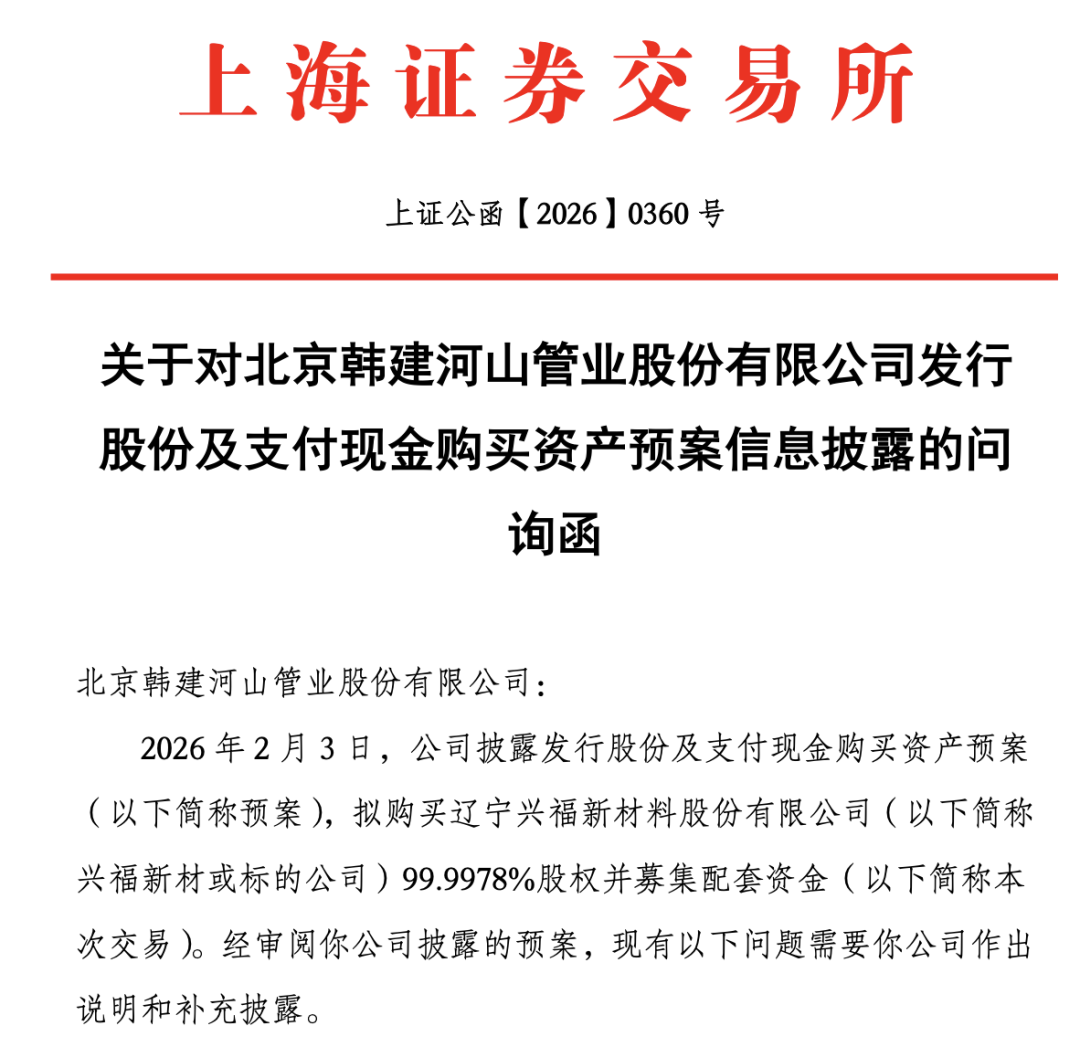
韩建河山并购,上交所火线问询
Shen Zhen Shang Bao· 2026-02-03 13:40
Core Viewpoint - A significant capital restructuring is underway as Han Jian He Shan plans to acquire 99.9978% of Liaoning Xingfu New Material Co., Ltd. to diversify its revenue streams and create a second growth curve amid declining performance in its core business [1][11]. Group 1: Acquisition Details - Han Jian He Shan intends to issue shares and pay cash to acquire the majority stake in Xingfu New Material, which specializes in aromatic products and advanced engineering plastics [1]. - The acquisition is aimed at enhancing the company's income and profit growth potential, as the company currently operates in the prestressed concrete pipe and concrete additives sectors [1]. - The transaction's asset price is yet to be finalized, and the company plans to raise funds from up to 35 specific investors to support the acquisition [1]. Group 2: Financial Performance of Target Company - Xingfu New Material's projected revenues from 2022 to 2025 are 777 million, 609 million, 401 million, and 386 million yuan, respectively, indicating a downward trend [4]. - The company's net profit attributable to shareholders is expected to fluctuate significantly, with figures of 101 million, 136 million, -736,700, and 10.06 million yuan over the same period, reflecting substantial volatility [4]. - The Shanghai Stock Exchange has requested further clarification on the reasons behind the target company's declining revenue and performance volatility compared to industry peers [4][7]. Group 3: Financial Condition of Han Jian He Shan - As of Q3 2025, Han Jian He Shan's cash reserves are only 68 million yuan, raising concerns about its ability to finance the acquisition and related costs [6]. - The company has reported consecutive losses from 2022 to 2024, totaling 356 million, 308 million, and 231 million yuan, indicating a persistent decline in profitability [8][10]. - The company anticipates a net loss of 8 to 12 million yuan for 2025, marking a fourth consecutive year of losses [9][10]. Group 4: Market and Regulatory Concerns - The Shanghai Stock Exchange has raised questions regarding the cash payment arrangements for the acquisition and the potential impact on the company's debt repayment capacity and operational viability [6][7]. - The stock price of Han Jian He Shan experienced a notable increase just before the announcement of the acquisition, prompting scrutiny from regulatory authorities regarding potential insider trading [6][11]. - The company has acknowledged the challenges in its current business environment and the need for new revenue growth points due to uncertain industry prospects [11].


300310宣布:10年前豪掷10亿元收购的子公司破产,财产已完成分配,公司仅分得83万元!
Xin Lang Cai Jing· 2026-02-03 06:16
炒股就看金麒麟分析师研报,权威,专业,及时,全面,助您挖掘潜力主题机会! 原标题:300310宣布:10年前豪掷10亿元收购的子公司破产,财产已完成分配,公司仅分得83万元!此 前称收购时遭遇合同诈骗,已起诉 宜通世纪(维权)(SZ300310)斥资10亿元跨界并购过来的标的,如今走到了破产终结的结局,而宜 通世纪仅获得83万元的破产财产分配。 2月2日晚间,宜通世纪发布公告称,其曾经的全资子公司深圳市倍泰健康测量分析技术有限公司(以下 简称"倍泰健康")破产程序终结。 这起曾被寄予厚望、旨在跨界智慧医疗的收购,最终演变为一场"噩梦"。从2018年倍泰健康"爆雷"开 始,宜通世纪不仅要因其业绩崩盘计提巨额商誉减值,还惹了一身的麻烦。 公司仅获83万元分配款 宜通世纪最新公告显示,公司近日收到广东省深圳市中级人民法院出具的《民事裁定书》,其债务人倍 泰健康被法院裁定终结破产程序。 公告显示,倍泰健康的破产清算申请于2023年11月13日被法院受理,倍泰健康于2026年1月26日被法院 裁定宣告破产。 据倍泰健康的《破产财产分配方案》,宜通世纪作为债权人,可获得分配的破产财产金额约83万元。宜 通世纪在公告中表示 ...

国防部:“You wish”
券商中国· 2026-01-29 08:38
Group 1 - The Chinese Ministry of Defense commented on the release of an animation video by military enterprises from Sweden, the UK, the US, and Japan, which depicted the sinking of Chinese naval vessels, suggesting that these companies are using such content to promote their own weaponry capabilities [1] - The spokesperson, Colonel Jiang Bin, noted that the Swedish military enterprise has already removed the related video and urged other parties to take appropriate actions as well [1] - The statement included a dismissive remark towards the self-congratulatory nature of such actions, indicating that the companies should reconsider their approach [1]
华立股份再次跨界并购 股价抢跑遭质疑 超低交易对价合理性待解
Xin Lang Cai Jing· 2026-01-29 08:16
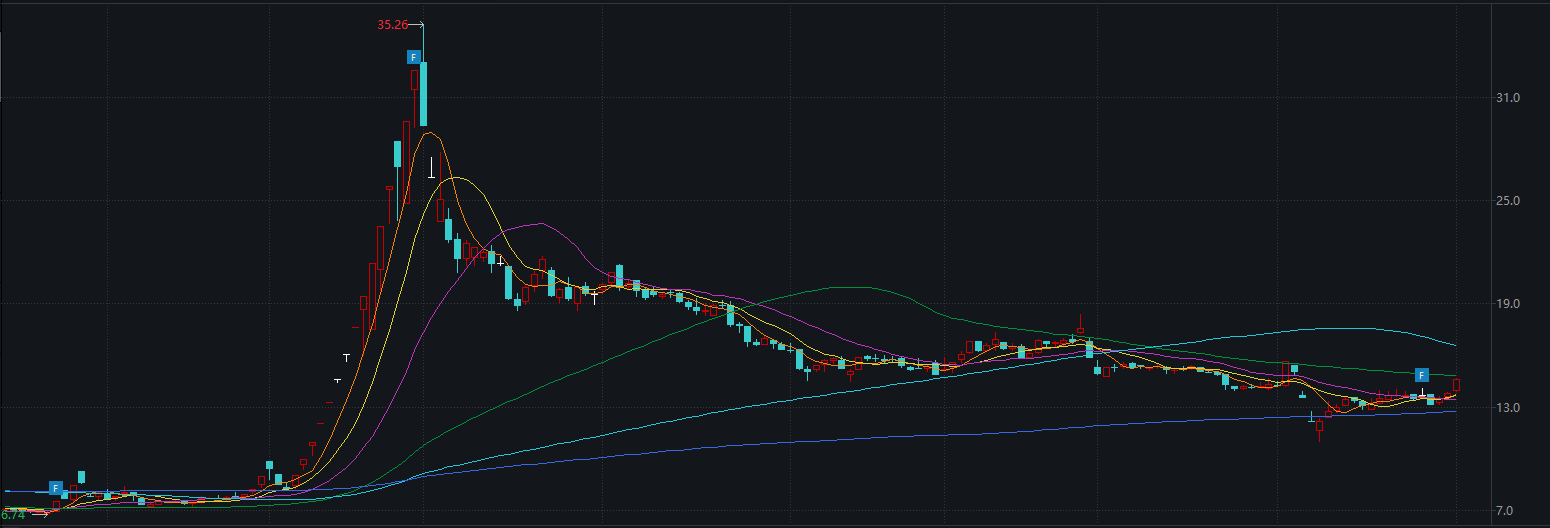
Core Viewpoint - Huali Co., Ltd. is attempting a third cross-border acquisition in 2024, raising questions about the rationale behind its rapid expansion into unrelated business areas [1][5]. Group 1: Acquisition Attempts - Huali Co., Ltd. announced plans to acquire a 19% stake in Shenghui Clean at a price of 47.5 million HKD [1]. - The company has made three cross-border acquisition attempts since 2024, with the first being a 51% stake in Suzhou Shangyuan Intelligent for 358 million CNY, focusing on smart water management, which is unrelated to its core business [2]. - The second attempt involved acquiring a 51% stake in Zhongke Huilian, a government software company, but the deal was terminated due to a lack of consensus on key terms [5]. Group 2: Stock Performance and Market Reaction - Following the announcement of the acquisition of Shangyuan Intelligent, Huali's stock price surged nearly 300%, from 8.23 CNY to 32.55 CNY, within 15 trading days [3]. - On the day of announcing the acquisition of Zhongke Huilian, Huali's stock also hit the daily limit up [4]. - The stock price similarly jumped on the announcement of the acquisition of Shenghui Clean, with Shenghui's shares rising by 26.19% on the same day [5]. Group 3: Financial Performance of Shenghui Clean - Shenghui Clean's revenue from 2023 to the first half of 2025 showed fluctuations: 636 million CNY in 2023, 674 million CNY in 2024, and 359 million CNY in the first half of 2025, with corresponding net profits of 27.89 million CNY, 49.23 million CNY, and 7.94 million CNY [7]. - The volatility in Shenghui Clean's profits is attributed to changes in the fair value of a financial asset, which saw a gain of 37.26 million CNY in 2024 and a loss of 25.39 million CNY in 2025 [7]. - Huali's acquisition price of 0.128 HKD per share for Shenghui Clean is significantly lower than the market price of 1.06 HKD per share at the time of the announcement [10]. Group 4: Concerns Raised by Regulators - The Shanghai Stock Exchange has issued inquiries regarding the rationale behind Huali's rapid cross-border acquisitions and the decision-making process involved [5][6]. - Concerns have been raised about potential insider trading, as Huali's stock price has consistently surged on acquisition announcements [6]. - The exchange has requested Huali to clarify the pricing rationale for the acquisition of Shenghui Clean and to disclose any relationships between involved parties [10].

哥伦比亚总统候选人,坠机遇难
券商中国· 2026-01-29 01:07
Group 1 - The article reports that the HK4709 flight of Satena Airlines crashed in the Norte de Santander province of Colombia, resulting in the death of all 15 people on board, including a congressman and a presidential candidate [1] - The flight went missing in an area with severe weather conditions at the time of the incident [1]

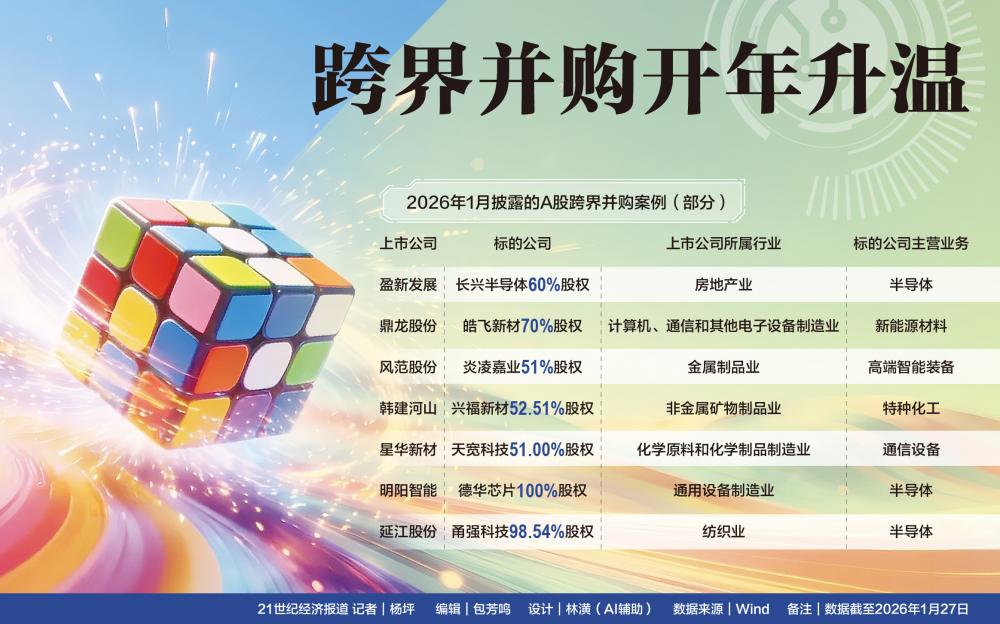
A股开年297单并购,跨界扎堆半导体
2 1 Shi Ji Jing Ji Bao Dao· 2026-01-29 00:26
Core Viewpoint - The A-share merger and acquisition (M&A) market remains active in early 2026, with over 297 disclosed M&A cases, including 12 major asset restructurings, highlighting a focus on strategic emerging industries like semiconductors and artificial intelligence [1] Group 1: M&A Activity - In January 2026, several companies, including Yingxin Development, Kangxin New Materials, and Dinglong Co., announced cross-industry M&A plans, particularly traditional manufacturing firms transitioning towards semiconductors and high-end equipment [1] - Notably, four out of eight disclosed cross-industry M&A cases involved semiconductor assets [5] - Companies like Kangxin New Materials and Mingyang Smart Energy are pursuing acquisitions to enhance their capabilities in the semiconductor sector, with Kangxin planning to acquire a 51% stake in Wuxi Yubang Semiconductor Technology for 392 million yuan [6][7] Group 2: Regulatory Scrutiny - Regulatory bodies have heightened scrutiny over cross-industry M&A transactions, focusing on the authenticity of disclosures and the reasonableness of valuations, as seen with inquiries sent to companies like Kangxin New Materials and Windfan Co. [1][10] - The Shanghai Stock Exchange has raised concerns regarding the feasibility of performance commitments made by companies, such as Kangxin's promise of significant profit growth for the acquired company, which exceeds historical performance [11][12] - The regulatory stance indicates a willingness to support beneficial cross-industry mergers while strictly monitoring those that appear speculative or high-risk [2][14] Group 3: Industry Trends and Challenges - Traditional enterprises facing stagnant core business performance are increasingly seeking cross-industry M&A as a means to rejuvenate growth and avoid potential delisting, which could lead to a "zombie" status [8] - Many of the companies engaging in cross-industry M&A have reported declining profits, with firms like Yanjiang Co. and Han Jian Heshan projecting losses in the coming years [7][8] - The trend of cross-industry M&A is seen as a necessary step for companies to enhance their operational quality and adapt to changing market conditions, despite the associated regulatory challenges [8][14]
A股开年297单并购,跨界扎堆半导体
21世纪经济报道· 2026-01-29 00:12
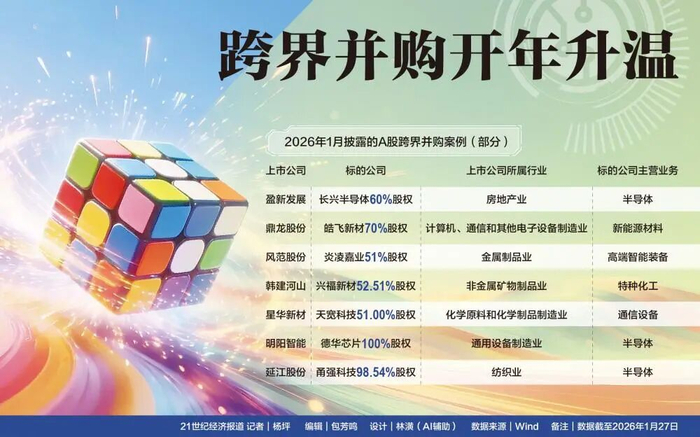
Core Viewpoint - The A-share merger and acquisition (M&A) market remains active in early 2026, with over 297 disclosed M&A cases, including 12 major asset restructurings, particularly in strategic emerging industries like semiconductors and artificial intelligence [1][6]. Group 1: M&A Activity - In January 2026, several companies, including Yingxin Development, Kangxin New Materials, and Dinglong Co., announced cross-industry M&A plans, with many traditional manufacturing firms transitioning towards semiconductors and high-end equipment [1][3]. - Notable cross-industry M&A cases include: - Yingxin Development acquiring 60% of Changxing Semiconductor for 520 million yuan [8]. - Kangxin New Materials planning to acquire 51% of Wuxi Yubang Semiconductor for 392 million yuan [8]. - Mingyang Smart Energy's acquisition of 100% of Dehua Chip Technology [8]. Group 2: Regulatory Scrutiny - Several cross-industry M&A cases have attracted regulatory attention due to concerns over the authenticity of disclosures and valuation rationality, with companies like Kangxin New Materials and Fengfan Co. receiving inquiry letters from regulators [2][12]. - The regulatory stance is supportive of cross-industry M&A that enhances company quality but is strict against speculative and high-risk transactions [2][15]. Group 3: Financial Performance and Challenges - Many companies engaging in cross-industry M&A face challenges in their core business performance, with some reporting continuous losses: - Yanjiang Co. has struggled with net profits below 30 million yuan [9]. - Kangjian Heshan is projected to incur a net loss of 8 to 12 million yuan in 2025 [9]. - Fengfan Co. anticipates a net loss of 320 to 380 million yuan in 2025 [9]. Group 4: Market Dynamics - The recent regulatory framework encourages compliant companies to pursue cross-industry M&A for industrial transformation and growth, reviving interest in cross-industry deals that had previously declined [5][6]. - The market is witnessing a surge in cross-industry M&A cases, with at least eight disclosed in early 2026, four of which involve semiconductor assets [7].

跨界并购开年升温
2 1 Shi Ji Jing Ji Bao Dao· 2026-01-28 23:12
Core Viewpoint - The A-share merger and acquisition (M&A) market remains active in early 2026, with over 297 disclosed M&A transactions, including 12 major asset restructurings, highlighting a focus on strategic emerging industries like semiconductors and artificial intelligence [1] Group 1: M&A Activity - In January 2026, several companies, including Yingxin Development, Kangxin New Materials, and Dinglong Co., announced plans for cross-industry mergers, particularly transitioning from traditional manufacturing to sectors like semiconductors and high-end equipment [1] - Notably, there have been at least eight disclosed cross-industry M&A cases this year, with four involving semiconductor assets [4] - Companies like Kangxin New Materials and Mingyang Smart Energy are actively pursuing acquisitions in the semiconductor sector, indicating a trend of traditional firms seeking new growth avenues through M&A [5][6] Group 2: Regulatory Scrutiny - Regulatory bodies have heightened scrutiny over cross-industry mergers, focusing on the authenticity of disclosures and the reasonableness of valuations, particularly for transactions that appear speculative or high-risk [1][7] - The Shanghai Stock Exchange has issued inquiries regarding the feasibility of performance commitments and the rationale behind significant valuation increases in recent M&A proposals [8][9] - Cases such as Kangxin New Materials' acquisition of Wuxi Yubang Semiconductor have drawn immediate regulatory attention due to concerns over inflated performance promises compared to historical performance [8][10] Group 3: Market Dynamics - The recent regulatory framework encourages well-structured cross-industry mergers that align with business logic and support industry transformation, aiming to revitalize previously stagnant cross-industry M&A activities [3] - Traditional companies facing stagnant core business performance are increasingly turning to cross-industry M&A as a means to rejuvenate growth and avoid potential delisting, despite the inherent risks involved [6][11] - The market is witnessing a shift where companies with weak main business operations are seeking new development momentum through strategic acquisitions, which could enhance the overall quality of listed companies [6]
A股跨界并购扎堆半导体 监管紧盯并购真实性
Xin Lang Cai Jing· 2026-01-28 23:06
Core Viewpoint - The A-share merger and acquisition (M&A) market remains active in early 2026, with over 297 disclosed M&A transactions, including 12 major asset restructurings as of January 28, 2026 [1]. Group 1: M&A Activity - Strategic emerging industries, particularly in semiconductors and artificial intelligence, are the core areas for listed companies' M&A activities [2]. - In January 2026 alone, several companies, including Yingxin Development, Kangxin New Materials, and Dinglong Co., announced plans for cross-industry mergers, indicating a trend of traditional manufacturing companies transitioning towards high-tech sectors [2][4]. - Notably, there have been at least eight disclosed cross-industry M&A cases this year, with four targeting semiconductor assets [4]. Group 2: Regulatory Scrutiny - Regulatory bodies have heightened scrutiny over cross-industry mergers, focusing on the authenticity of disclosures and the reasonableness of valuations [2][10]. - Companies like Kangxin New Materials and Fengfan Co. have received inquiry letters from regulators regarding their cross-industry M&A plans, highlighting concerns over speculative practices and high-risk transactions [2][10]. - The Shanghai Stock Exchange has raised questions about the feasibility of performance commitments made by companies involved in these transactions, particularly when historical performance has been poor [11][12]. Group 3: Financial Performance and Challenges - Many companies pursuing cross-industry mergers are facing challenges in their core business operations, with some reporting continuous losses [7][8]. - For instance, Yingxin Development and Han Jian Heshan have been struggling with profitability, prompting them to seek new growth avenues through M&A [7][8]. - The financial data of targeted companies, such as YB Semiconductor, shows significant projected losses, raising concerns about the viability of these acquisitions [4][11].



A股跨界并购扎堆半导体,监管紧盯并购真实性
2 1 Shi Ji Jing Ji Bao Dao· 2026-01-28 12:15
Core Viewpoint - The A-share merger and acquisition (M&A) market remains active in early 2026, with over 297 disclosed M&A cases, including 12 major asset restructurings, highlighting a focus on strategic emerging industries like semiconductors and artificial intelligence [1] Group 1: M&A Activity - In January 2026, several companies, including Yingxin Development, Kangxin New Materials, and Mingyang Smart Energy, planned cross-industry mergers, particularly transitioning from traditional manufacturing to sectors like semiconductors and high-end equipment [1][4] - Notably, four out of eight disclosed cross-industry M&A cases involved semiconductor assets, indicating a strong interest in this sector [4] - Companies like Yingxin Development and Kangxin New Materials are pursuing acquisitions to enhance their business capabilities amid challenges in their core operations [6][7] Group 2: Regulatory Scrutiny - Regulatory bodies have heightened scrutiny over cross-industry mergers, focusing on the authenticity of disclosures and the reasonableness of valuations, particularly for cases involving Kangxin New Materials and others [2][8] - The Shanghai Stock Exchange issued inquiries regarding the feasibility of performance commitments and the rationale behind significant valuation increases in recent M&A cases [9][10] - There is a clear distinction in regulatory attitudes, supporting beneficial cross-industry mergers while strictly monitoring those perceived as speculative or high-risk [2][8] Group 3: Financial Performance and Challenges - Many companies engaging in cross-industry M&A have faced declining core business performance, with some reporting net profits below 30 million yuan in recent years [6][7] - For instance, Kangxin New Materials and Windfan Co. are expected to incur losses in 2025, raising concerns about the sustainability of their M&A strategies [6][10] - The need for traditional companies to pursue cross-industry mergers is driven by the risk of stagnation or "zombie" status if they fail to adapt and innovate [7]