防御性板块

Search documents
ETF龙虎榜 | 提前埋伏 收获逆势上涨!
Zhong Guo Zheng Quan Bao· 2025-11-04 14:01
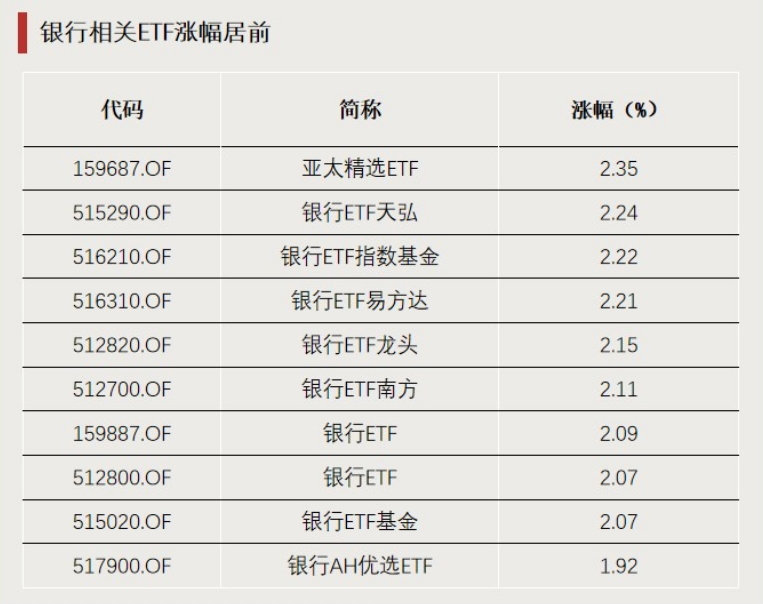
Group 1: Market Overview - On November 4, A-shares experienced a volume contraction adjustment, while bank stocks rose against the trend, leading to significant gains in related ETFs, with 9 out of the top 10 ETFs being bank-related [1][4] - The rise in bank stocks is attributed to a "defensive switch" in capital, as investors seek safer investments amid increased market volatility in the fourth quarter [6][11] Group 2: ETF Performance - The top-performing ETFs on November 4 included bank-related ETFs, with notable gains such as Xiamen Bank rising nearly 6% and the Tianhong Bank ETF increasing by 2.24% [4][5] - The total trading volume of ETFs on November 4 was approximately 500.5 billion yuan, with a decrease of nearly 60 billion yuan from the previous day [8] Group 3: Bond ETFs - The trading activity of Sci-Tech bond ETFs remained robust, with 5 such ETFs exceeding 9 billion yuan in trading volume on November 4, and the total scale of bond ETFs surpassing 700 billion yuan [2][8] - The newly issued 24 Sci-Tech bond ETFs this year have collectively reached a scale of 252.34 billion yuan, indicating strong market interest in this segment [2] Group 4: Sector Rotation - There has been a noticeable shift in capital towards defensive sectors, with significant net inflows into ETFs related to securities, banks, liquor, and innovative pharmaceuticals, reflecting a strategy to mitigate risks [3][11] - The banking sector, having previously underperformed, is now attracting attention due to its perceived investment value after recent adjustments [6][11]

招银国际每日投资策略-20251104
Zhao Yin Guo Ji· 2025-11-04 03:46
Market Overview - The Hang Seng Index closed at 26,158, up 0.97% for the day and 30.40% year-to-date [1] - The Shanghai Composite Index rose 0.55% to 3,977, with a year-to-date increase of 18.64% [1] - The US markets showed mixed results, with the Dow Jones down 0.48% and the S&P 500 up 0.17% [1] Sector Performance - The Hang Seng Financial Index increased by 2.09%, with a year-to-date rise of 33.73% [2] - The Hang Seng Property Index rose by 1.53%, reflecting a year-to-date increase of 22.48% [2] - The energy, financial, and consumer staples sectors led the gains in the Hong Kong market, while materials and consumer discretionary sectors declined [3] Economic Indicators - The 7-day reverse repo rate in China decreased to 1.4%, while the 10-year government bond yield is at 1.79% [3] - The US manufacturing PMI fell to 48.7, indicating economic contraction for eight consecutive months [3] - The dollar index reached a three-month high, reflecting a strengthening dollar [3] Company Insights: Haier Smart Home - Haier's management maintains a cautious outlook for FY26, projecting mid to high single-digit sales growth and over 10% net profit growth [4] - The air conditioning segment is expected to see over 10% sales growth in the next 3-5 years, driven by enhanced R&D and digital inventory management [5] - The Casa Di brand aims for over 15% sales growth in FY26, focusing on innovation and expansion of high-end experience stores [6] Company Insights: China Life - China Life reported a nearly doubled net profit in Q3 FY25, reaching 1,260 million RMB, a 92% year-on-year increase [9] - The company benefited from rising market interest rates and a strong performance in investment services, with total investment income increasing by 41% year-on-year [9] - The new business value growth forecast has been raised to 38% for the year [9] Company Insights: China Pacific Insurance - China Pacific Insurance's Q3 FY25 net profit grew by 91.5% to 158 million RMB, driven by improved underwriting and investment income [10] - The company achieved a combined ratio improvement, with the car insurance and non-car insurance ratios both showing positive trends [10] - The investment service performance saw a significant increase, with total investment income reaching 359 million RMB, a 33% year-on-year growth [10] Company Insights: BYD Electronics - BYD Electronics is optimistic about revenue growth in 2026, driven by upgrades in North American client products and expansion in the automotive sector [11] - The company anticipates a 50% increase in revenue from foldable smartphones and a 20% increase from automotive business [11] - The AI server business is projected to generate sales of 5 billion RMB [11] Company Insights: Baker Hughes - Baker Hughes has been included in the newly named Hang Seng Semiconductor Industry Index, which is expected to enhance market liquidity and attract investor attention [12] - The strategic optimization of the index aims to improve the investability of Hong Kong's semiconductor companies [12]
连续分红13个月的红利港股ETF(159331)盘中飘红,市场聚焦防御性板块配置价值
Mei Ri Jing Ji Xin Wen· 2025-10-24 03:29
Group 1 - The Hong Kong stock market's performance will heavily depend on the Federal Reserve's interest rate policy and changes in US-China relations, with a preference for high-dividend, low-valuation defensive sectors amid high uncertainty [1] - Despite short-term pressure on the technology sector, there may be rapid recovery opportunities if the external environment improves, highlighting the sector's high elasticity [1] - High-dividend sectors such as banking and coal are favored for their strong anti-drawdown characteristics, reflecting the market's preference for stable returns [1] Group 2 - The Dividend Hong Kong Stock ETF (159331) tracks the Hong Kong Stock Connect High Dividend Index (930914), which selects 30 securities with continuous dividends, good liquidity, and outstanding dividend yields from the Hong Kong Stock Connect range, focusing on traditional high-dividend industries like finance, energy, and industrials [1] - Since September 2024, the Dividend Hong Kong Stock ETF (159331) has distributed dividends for 13 consecutive months, indicating its consistent performance [2]
帮主郑重10月17日收评:A股跌麻了?下周别慌,这招能扛住!
Sou Hu Cai Jing· 2025-10-17 08:17
Market Overview - The A-share market experienced a significant decline, with the Shanghai Composite Index dropping nearly 2%, and the Shenzhen Component and ChiNext Index falling over 3%, while the North China 50 Index saw a decline of almost 4% [3] - Approximately 90% of the over 4,700 stocks in the market fell, indicating a heavy selling pressure despite an increase in trading volume compared to the previous day [3] Sector Performance - Previously strong sectors such as solar energy, energy storage, and semiconductors faced substantial declines, with leading stocks like Yangguang Electric Power dropping over 10% [3] - Conversely, defensive sectors like gas and precious metals showed resilience, with stocks such as Guo Xin Energy and Western Gold experiencing gains [3] Investment Strategy - For investors holding quality stocks with solid fundamentals, it is advised not to panic sell during this market correction, as selling at low prices could waste previous patience [3][4] - Investors who are currently in cash or lightly invested should avoid rushing to "catch the falling knife," and instead consider small positions in defensive sectors that performed well during the downturn [3]
市场普跌,发生了什么?
Sou Hu Cai Jing· 2025-10-17 05:06
Core Viewpoint - The A-share market is experiencing a downward trend characterized by pressure on technology growth stocks and active defensive sectors, with funds shifting towards undervalued defensive sectors and regional thematic concepts [1] Market Performance - A-share market opened lower and continued to decline, with the Shanghai Composite Index down 1% at 3877.2 points, Shenzhen Component down 1.99%, ChiNext down 2.37%, and the Sci-Tech 50 Index down 2.62%, indicating significant adjustments in the technology growth sector [2] - Over 4100 stocks in the market declined, while gains were concentrated in defensive sectors like banking and coal, with trading volume at 1.19 trillion yuan, indicating a shift in fund allocation [2] - The Hong Kong market also saw declines, with the Hang Seng Index down 1.61% and the Hang Seng Tech Index down 2.81%, as semiconductor, consumer electronics, and photovoltaic sectors faced collective pressure [2] Industry Hotspots and Driving Logic - Defensive sectors and regional themes led the gains, with the banking sector up 0.37% and large state-owned banks reaching historical highs, driven by low valuations and high dividend yields attracting risk-averse funds [3] - Gold stocks strengthened due to heightened geopolitical tensions and increased demand for safe-haven assets, while coal stocks saw a slight increase of 0.37% amid expectations of rising energy prices [3] - In the Hong Kong market, structural opportunities emerged with retail and airline stocks performing well, supported by positive operational data from the airline industry [3] Underperforming Sectors and Driving Logic - The technology growth sector faced collective declines, particularly in the new energy industry chain, with photovoltaic, energy storage, and charging pile indices dropping over 4% due to concerns over "anti-involution" policies and market sentiment cooling [4] - The semiconductor and consumer electronics sectors were under pressure from global semiconductor cycle adjustments and slowing demand growth for AI chips [4] - The automotive sector also faced challenges, with slowing sales growth for new energy vehicles and downward adjustments in performance expectations for component manufacturers [4] Investment Strategy Recommendations - The market is in a structural transition period characterized by "high valuation digestion and low valuation rebound," with policy expectations and industry recovery trends expected to guide future directions [5] - It is recommended to focus on three main lines for investment: identifying structural opportunities in the technology growth sector, particularly in the AI industry chain; monitoring innovative pharmaceuticals for clinical approvals and international expansion; and exploring long-term trends in military and solid-state battery sectors [5] - For cyclical and resource sectors, attention should be paid to "policy and supply-demand" dual drivers, with precious metals like gold and copper benefiting from global easing expectations and domestic infrastructure investment recovery [6]
持仓观望?
第一财经· 2025-10-16 10:31
Core Viewpoint - The A-share market is experiencing a divergence with defensive sectors like coal, banking, and insurance showing strength, while cyclical sectors such as small metals and steel are undergoing corrections [4][8]. Market Performance - The market fluctuated around the 3900-point mark, closing slightly up by 0.10% [4]. - The Shenzhen Component Index was dragged down by a pullback in the technology sector, while the ChiNext Index was driven up by growth in tech stocks [4]. Trading Volume - The total trading volume of the two markets decreased by 6.83%, indicating a shift to a "wait-and-see" defensive mode [6]. - The Shanghai market saw a larger decrease in volume compared to the Shenzhen market, suggesting a pause in the flow of funds towards small and mid-cap stocks [6]. Fund Flow - Institutional investors are cautiously reallocating funds, withdrawing from previously high-performing sectors like small metals and steel, and moving towards defensive sectors supported by policies, such as coal and insurance [8]. - Retail investors are also showing caution, preferring low-valuation, high-dividend stocks over high-volatility, high-valuation ones [8]. Investor Sentiment - The sentiment among retail investors is cautious, with 75.85% indicating a defensive stance [9]. - The overall market saw 4168 stocks decline, reflecting a bearish sentiment [10]. Positioning - As of October 16, 26.26% of investors increased their positions, while 15.50% reduced their holdings, with 58.24% remaining unchanged [13].

机构称市场风格或向防御性较强板块倾斜,国企红利ETF(159515)调整蓄势
Sou Hu Cai Jing· 2025-10-13 03:30
Core Points - The China Securities State-Owned Enterprises Dividend Index (000824) decreased by 0.87% as of October 13, 2025, with Shen Property A (000011) leading the gain at 4.73% [1] - The U.S. government has adjusted its technology export control policies towards China, leading to new uncertainties in the global supply chain and increased market volatility [1] - Since April, there has been a significant divergence in performance between dividend and technology sectors, indicating a potential market shift towards defensive sectors [1] Group 1: Index Performance - The China Securities State-Owned Enterprises Dividend Index (000824) has seen a decline of 0.87% [1] - The top-performing stock in the index is Shen Property A (000011), which increased by 4.73% [1] - The index's ETF (159515) has undergone adjustments [1] Group 2: Market Dynamics - The U.S. has included controlling subsidiaries of entities on its entity list in its export regulations, prompting China to implement export controls on critical materials [1] - The market is experiencing increased volatility due to these policy changes, affecting global supply chains [1] - Analysts suggest a shift in market style towards dividend and low-position blue-chip stocks, which may act as a stabilizing force during market corrections [1] Group 3: ETF Composition - The China Securities State-Owned Enterprises Dividend Index comprises 100 listed companies with high and stable cash dividend yields [2] - As of September 30, 2025, the top ten weighted stocks in the index account for 17.15% of the total index [2] - The ETF closely tracks the performance of the index, providing exposure to high-dividend state-owned enterprises [2]
重回“人气王”,主力资金爆买五大行!百亿银行ETF(512800)逆市涨逾1%,量能激增119%
Xin Lang Ji Jin· 2025-09-23 12:11
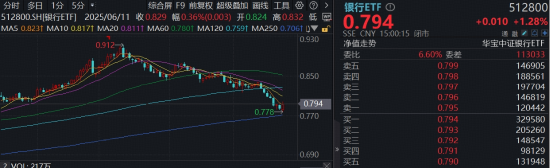
Group 1 - The banking sector showed strong performance in the market, with Nanjing Bank leading the gains at 4.78%, and several major banks like Industrial and Commercial Bank of China, Agricultural Bank of China, and China Construction Bank also seeing significant increases [1] - As of September 24, 2024, Nanjing Bank recorded a net increase of 6.54 billion yuan in shareholding by major shareholders, indicating optimistic expectations for the bank [1] - The Bank ETF (512800) experienced a notable increase in trading volume, with a daily turnover of 1.967 billion yuan, reflecting a 119% increase compared to the previous period [1] Group 2 - The banking sector has transitioned from a one-sided upward trend to a "slow bull" market, suggesting a more balanced investment strategy that includes both growth and cyclical stocks [2] - The banking ETF (512800) has seen a cumulative decline of 13.67% since its peak on July 11, 2024, highlighting an attractive valuation opportunity [3] - The average static dividend yield for listed banks has risen to 4.3%, and the average static price-to-book (PB) ratio has dropped to 0.61x, indicating a potential for higher equity returns [3] Group 3 - There has been a significant inflow of funds into the banking sector, with a net inflow of 4.519 billion yuan on a single day, making it the top sector for capital inflow [4] - In a low-interest-rate environment, the banking sector's low valuation and high dividend yield continue to attract long-term capital, particularly from insurance funds [5] - The Bank ETF (512800) has seen a net inflow of 406 million yuan over the past two days, with a total net inflow of 1.64 billion yuan over the last 20 days [5] Group 4 - The Bank ETF (512800) is a highly efficient investment tool that tracks the performance of 42 listed banks in A-shares, maintaining a significant scale and liquidity in the market [7]





ava爱华集团热点:非农数据大幅下修 三大指数 黄金再走高
Sou Hu Cai Jing· 2025-09-10 07:29
Group 1 - The U.S. Labor Department's preliminary benchmark revision data revealed a downward adjustment of 910,000 non-farm jobs for the year ending in March, marking the largest downward revision since 2000, indicating a weak labor market [1][3] - The unemployment rate rose to 4.3% in August, the highest in four years, with job losses accelerating in cyclical-sensitive industries [3] - Despite weak employment data, the stock market remained optimistic, with the Dow Jones up 0.43% to 45,711.34 points, the S&P 500 rising 0.27% to 6,512.61 points, and the Nasdaq increasing 0.37% to 21,879.49 points [1] Group 2 - The yield curve for U.S. Treasuries steepened, with the 2-year yield dropping to 3.47%, the lowest since 2022, and the 10-year yield down by 8 basis points, reflecting deteriorating long-term growth expectations [4] - The bond market has fully priced in a 50 basis point rate cut in September, with the annual rate cut expectation rising to 72 basis points [4] - Gold prices surged, with COMEX gold reaching a historical high of $3,715, supported by strong buying interest, as indicated by Goldman Sachs' report of an 8:1 buying power ratio [4] Group 3 - Defensive sectors such as utilities and consumer staples outperformed the market, reflecting concerns over economic slowdown [4] - The market is facing a policy balancing act for the Federal Reserve amid political pressure and inflation risks, with a potential 50 basis point cut in September possibly undermining policy credibility [4] - Upcoming PPI/CPI data will be crucial in adjusting market expectations, with potential inflation surprises possibly leading to profit-taking in gold [4]

缩量,今日市场情绪指数来了
第一财经· 2025-09-03 12:59
Market Overview - The three major A-share indices showed mixed performance, with the Shanghai Composite Index exhibiting a "high open and low close" characteristic, while the ChiNext Index was the only one to close higher among the three indices [4] - A total of 277 stocks rose, indicating a broad market decline despite some sectors performing well [4] Trading Volume - The trading volume in the two markets decreased significantly, down approximately 510.9 billion yuan compared to the previous trading day, reflecting a decline in market activity and a strong wait-and-see sentiment among investors [5] Capital Flow - There was a clear risk-averse characteristic in institutional capital, with major funds withdrawing from high-valuation technology sectors and moving into undervalued defensive sectors [7] - Northbound funds significantly reduced holdings in semiconductor and AI chip sectors, while showing slight inflows into gold and banking sectors [7] - Retail investors maintained high leverage levels, indicating a defensive stance, with enthusiasm for market participation remaining relatively unchanged [7] Investor Sentiment - Retail investor sentiment showed a mixed picture, with a notable percentage of investors either increasing or decreasing their positions, reflecting uncertainty in market direction [12][15]