黄金定价

Search documents
三轮黄金上涨周期复盘,黄金如何定价?
Hua Er Jie Jian Wen· 2025-11-19 13:56
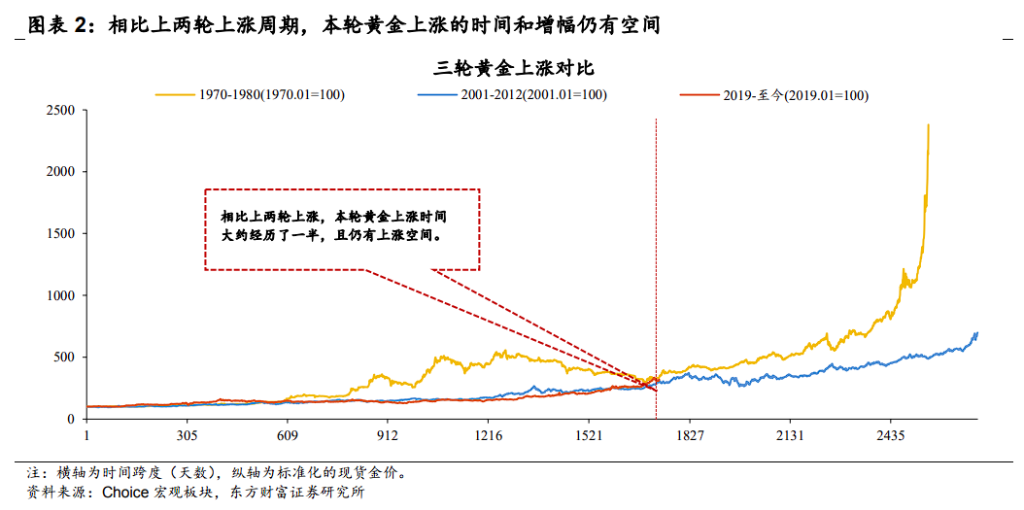
Core Viewpoint - The current gold price uptrend, which began in 2019, has lasted for six years with a cumulative increase of 219%, raising market concerns about future price movements [1][2]. Group 1: Historical Context - Gold has experienced three major uptrends since 1968, with the first from 1970 to 1980 (highest increase of 2323%) and the second from 2001 to 2012 (highest increase of 599%) [2]. - The current uptrend, starting in 2019, has shown a cumulative increase of 219% over six years, which is shorter in duration compared to previous cycles [3]. Group 2: Monetary Attributes - The dollar has depreciated nearly 100% against gold since 1970, with a 35% decline in 2025 alone, driven by increasing fiscal deficits and monetary supply [9]. - The relationship between the dollar index and gold prices has been negative, with the dollar index dropping nearly 10 percentage points since 2025, benefiting gold prices [9]. - Economic and political uncertainties have increased the U.S. economic policy uncertainty index significantly since early 2025, impacting the dollar's credibility [11]. Group 3: Commodity Attributes - Central bank gold purchases have surged from 255 tons in 2020 to 1089 tons in 2024, with an average annual growth rate of 44%, increasing their share of total demand from 5% to 22% [15]. - Jewelry demand has decreased from approximately 50% before 2020 to 32% in the first three quarters of 2025, indicating a shift in demand dynamics [15]. - Global gold reserves have increased significantly, with European countries showing high reserve ratios, contributing to upward pressure on gold prices [15]. Group 4: Financial Attributes - The traditional negative correlation between real interest rates and gold prices has weakened since 2021, as high inflation distorts real interest rates and enhances gold's anti-inflation properties [22]. - Real interest rates have increased by 213% during the current cycle, contrasting with previous cycles where they remained near zero or negative [38]. - The ratio of the S&P 500 to gold prices is approaching historical averages, suggesting that gold may be fully valued relative to equities, yet still has room for growth compared to previous cycles [22]. Group 5: Key Variables for Future Price Movements - The report identifies three critical variables that will influence future gold prices: geopolitical risks, growth in gold reserves, and changes in real interest rates [25][32]. - The geopolitical risk index has risen by 72% since 2019, reflecting heightened global tensions due to events like the COVID-19 pandemic and the Russia-Ukraine conflict [28][31]. - Global gold reserves have increased by 167% during the current cycle, a significant rise compared to previous periods, indicating a strategic shift among central banks [35].

ETF策略系列:黄金ETF配置及基于对数收益率的择时策略
Yin He Zheng Quan· 2025-11-07 13:22
Core Insights - The report highlights the strong performance of gold assets, with significant price increases in both international and domestic markets, leading to a historic high in China's gold ETF scale [1][4][30] - China's gold reserves have been steadily increasing, reaching 2,068 tons by the end of September 2023, ranking fourth globally, which is crucial for financial security and optimizing foreign exchange reserves [1][9][10] - The domestic gold ETF market has rapidly developed due to rising investment demand, with a total of 63 ETFs and a market size exceeding 1,200 billion yuan, marking a year-on-year increase of 63.1% [1][34] - The report discusses the complex pricing factors of gold, emphasizing the inverse relationship between gold prices and the real yield of U.S. Treasury bonds, as well as gold's role as a safe-haven asset during market volatility [1][36] - A quantitative strategy for gold ETF timing is proposed, showing annualized returns of 12.3% since 2020, with a maximum drawdown of -12.5% [1] Domestic Gold Asset Development Status - China's gold reserves have shown a steady growth trend, with the People's Bank of China continuously increasing its holdings, reflecting the importance of gold in stabilizing financial security and enhancing international payment capabilities [9][10] - In the first half of 2023, domestic gold production was 158.5 tons, with a slight year-on-year decrease of 1.1%, while gold imports increased by 12.3% [10][12] Global Gold Demand Trends - Global gold demand reached a record high in the third quarter of 2023, with total demand of 1,200 tons, a year-on-year increase of 12%, driven primarily by investment demand [12][14] - The demand for gold jewelry has decreased in weight but increased in value due to rising prices, with global gold jewelry consumption dropping 6% to 400 tons in the third quarter of 2023 [13][24] Gold Pricing Factors - The report identifies U.S. Treasury real yields as a primary pricing factor for gold, with gold prices inversely related to these yields, influenced by U.S. economic data [36] - Gold's safe-haven attribute is highlighted, as demand increases during market turmoil, with supply and demand dynamics also playing a critical role in gold pricing [1][36] Gold Price Time Series Model - A time series prediction model for gold ETF logarithmic returns has been constructed, aiding investment decision-making [1] Huashan Gold ETF Timing Strategy - The Huashan Gold ETF timing strategy has provided specific operational guidance for investors, achieving an annualized return of 12.3% since 2020 [1]
黄金究竟值多少钱?别瞎猜了,“底价+上限”都算出来了
华尔街见闻· 2025-10-30 09:33
Core Viewpoint - The article discusses the valuation of gold, highlighting its "floor price" and "ceiling price" amidst rising gold prices and the disconnect from traditional pricing mechanisms like the US dollar's real interest rates [3][6]. Group 1: Gold's Floor Price - The estimated "floor price" of gold is around $1,600 per ounce, which reflects the intrinsic value derived from the costs associated with mining and refining gold [9][26]. - The All-In Sustaining Cost (AISC) is a key metric for determining the ongoing costs of gold mining, with the latest data showing a global average AISC of $1,456 per ounce as of Q3 2024 [19][20]. - The AISC is expected to rise due to inflationary pressures and increased operational costs, with projections for AISC in Q3 2025 ranging from $1,350 to $1,650 per ounce [20][27]. Group 2: Gold's Ceiling Price - The article estimates the ceiling price of gold to be between $40,000 and $70,000 per ounce based on global wealth comparisons, with a more practical ceiling around $5,000 per ounce [37][48]. - The valuation of gold against global monetary supply suggests a price of over $12,000 per ounce, but this is considered an overestimate due to the nature of currency and trade dynamics [44][48]. - The analysis indicates that the long-term nominal price of gold is likely to exceed $5,000 per ounce, driven by various dynamic factors affecting the market [48].

中信建投:谁在主导这轮黄金新高?沪金溢价由正转负,西方ETF资金主导
Xuan Gu Bao· 2025-10-09 00:40
Core Viewpoint - The structure of surface gold inventory shows that while financial demand has a small share, it exhibits significant volatility, dominating the trend changes in gold prices. Non-financial demand, despite its larger share, primarily provides support without determining the trend [1][4]. Group 1: Investor Profile and Demand Structure - The gold market participants can be categorized into two main types: financial investment participants and non-financial investment participants. The former drives the trend of gold prices, while the latter provides bottom support [5][7]. - Financial demand is characterized by high volatility, with financial instruments (such as ETFs and futures) showing more than double the volatility of net consumption (jewelry and technology gold) since 2000, although their accumulation speed is lower [7][8]. - Non-financial investment participants mainly contribute to private sector consumption demand (jewelry and technology gold) and long-term holdings (coins and bars), which tend to have limited volatility in fund flows [11][12]. Group 2: Recent Trends in Gold Prices - Since late August, gold prices have broken out of a consolidation pattern, with financial investment participants (particularly the ETF market) driving the new highs [13]. - Financial tools (ETFs) have seen a rebound in fund inflows, with total holdings rebounding but still 6% lower than the peak in Q4 2020 [14]. - Central bank gold purchases have slowed but remain a significant support, with Q2 purchases at 166 tons, down 33% from the previous quarter [15]. Group 3: High-Frequency Tracking Dimensions - Three high-frequency tracking dimensions are provided to capture the trends behind gold price movements: 1. **ETF Regional Structure**: Western markets have regained dominance in ETF inflows, reflecting a shift in macro pricing narratives from "de-dollarization" to interest rate paths [19]. 2. **COMEX Gold Futures Positions**: There is a disconnection between COMEX "fast money" positions and gold prices, with current holdings being slightly low relative to price levels [20]. 3. **Regional Price Differences**: The shift from positive to negative premiums in Shanghai gold indicates a cooling of investment in non-Western regions, while the normalization of premiums in New York and London suggests that speculative "hot money" may still be in a wait-and-see mode [21].

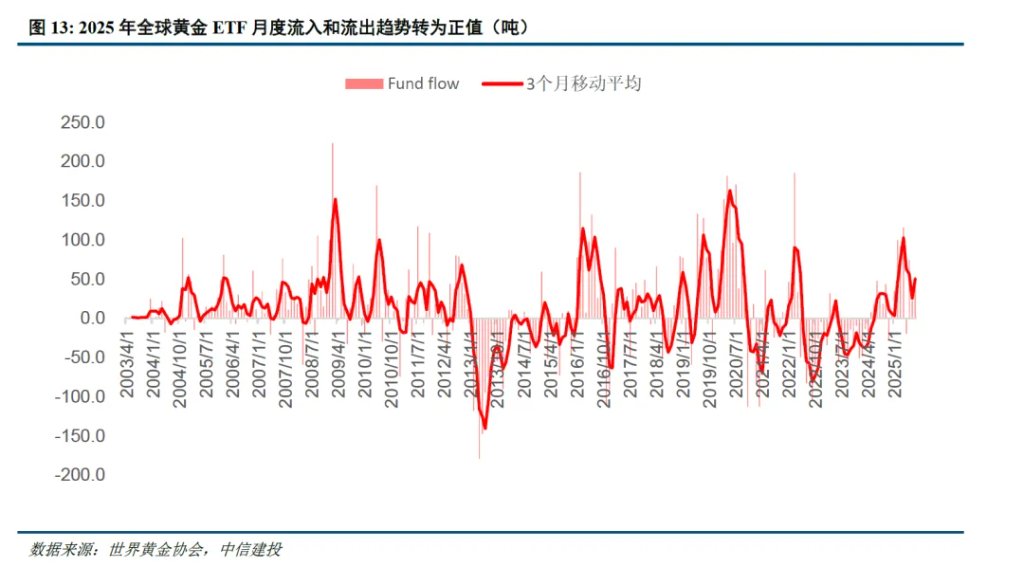
从宏观上如何理解本轮权益资产重估:一个框架系列
郭磊宏观茶座· 2025-09-25 00:06
Group 1 - The article discusses the macro perspective on the recent revaluation of equity assets, summarizing insights from eleven reports that form a methodological series [1] - It identifies five asset classes that have performed notably well since early 2025, including precious metals, non-ferrous metals, emerging market stocks, major market tech stocks, and alternative assets [6] - The article outlines three main themes behind these asset performances: the weakening of dollar credit and "soft decoupling" of assets, the reshaping of global supply chains and "backup" supply, and a new wave of technological revolution and industrial layout [1][6] Group 2 - The article analyzes the acceleration of technological innovation in China, using the pharmaceutical industry as an example to observe the release of the "engineer dividend" in the economy [2][9] - It discusses the relationship between the appreciation of the RMB and asset appreciation, noting that the exchange rate is influenced by purchasing power parity, interest rate differentials, and risk premiums [2][11] Group 3 - The article identifies five key drivers behind the recent pricing recovery of equity assets, including total recovery, broad-based growth improvement, increased asset activity among residents, medium to long-term capital entering the market, and rising credit risk premiums on dollar assets [2][13] - It explains the phase of divergence between equity market performance and economic indicators, using the "Changjiang Business School BCI" to represent economic fundamentals and "Wind All A" for the equity market [2][13] Group 4 - The article explores the relationship between liquidity and asset pricing, indicating that liquidity affects financial market asset pricing through opportunity costs and the availability of financing [3][13] - It summarizes five characteristics of high-growth narratives in the equity market, observed during specific periods, including macro risk clearance, low traditional asset profitability, ample liquidity, sticky expected returns, and the presence of industry narratives [3][14] Group 5 - The article presents a "5+1" timing framework for high-growth narratives, which has yielded a cumulative return of 1147.47% since 2006, with an annualized return of 13.96% and an annualized excess return of 2.98% [4][15] - It builds an analytical framework for understanding the recent rise in gold prices, incorporating its financial, monetary, commodity, and safe-haven attributes, along with a quantitative monitoring system for gold price indicators [4][16]

美联储政策预期下的黄金波动观察
Sou Hu Cai Jing· 2025-08-14 11:35
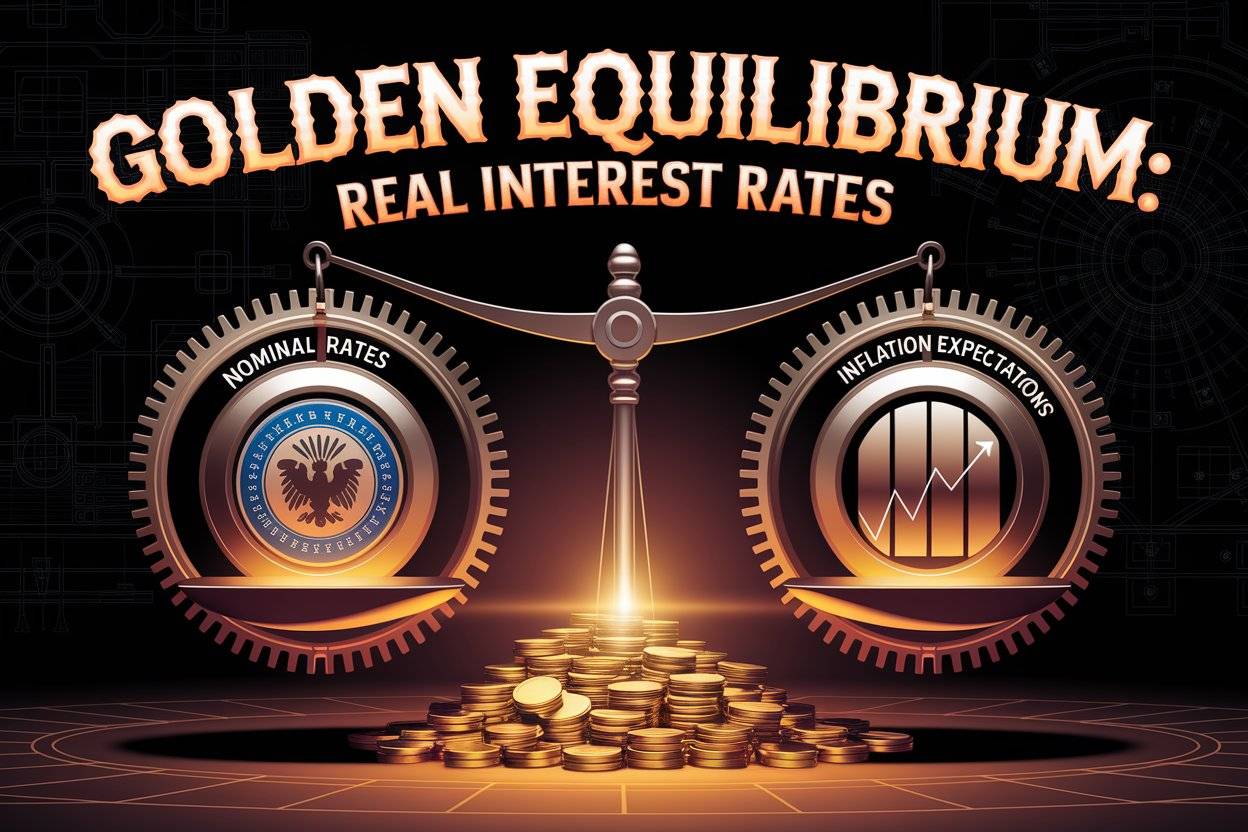
Core Viewpoint - Recent market expectations regarding a shift in the Federal Reserve's monetary policy have increased, drawing investor attention to gold prices after a period of adjustment [1] Group 1: Gold Pricing Dynamics - The core anchor for gold pricing is the real interest rate level, which is the nominal interest rate minus inflation expectations [3] - When the market anticipates the end of the Fed's rate hike cycle and potential rate cuts, downward pressure on nominal rates increases, which could lower real interest rates if inflation does not decline rapidly [3] - A weaker dollar, resulting from reduced interest rate attractiveness, may indirectly benefit gold prices [3] Group 2: Market Sentiment and Technical Analysis - Current gold holding data, such as ETF holdings and futures positions, indicate that market sentiment remains cautious, lacking a consensus bullish outlook [3] - Gold prices need to effectively break through key resistance areas to confirm a momentum shift [3] Group 3: Investment Strategy Considerations - Investors should differentiate between "event-driven trading" and "trend opportunities" when participating in gold based on rate cut expectations [3] - For short-term volatility based on policy signals, close monitoring of economic data and Fed statements is essential, along with strict stop-loss discipline [3] - For medium-term opportunities based on declining real interest rates, attention should be paid to inflation resilience and the long-term trend of the dollar [3] Group 4: Risk Management and Market Volatility - During periods of policy transition, fluctuating market expectations may exacerbate volatility [5] - Investors are advised to maintain patience and focus on the relationship between real interest rate changes and gold price movements, rather than solely betting on the timing of policy shifts [5] - Balancing portfolio allocation and strict risk management remain foundational strategies to navigate uncertainty [5]
【广发宏观陈礼清】黄金定价的十个交易面观测指标
郭磊宏观茶座· 2025-04-24 14:38
报告摘要 开年以来黄金的表现位列大类资产前列,近期波动加大。关于黄金定价,目前研究多基于基本面角度,比如供求关系、全球货币体系变化、主要经济体赤字率、实 际利率等,我们这里想要补充的一个视角是交易层面。我们从十个维度——黄金价格形态、期货持仓结构、库存及其衍生指标、交割前瞻、期现基差、黄金租赁成 本、期限结构、期权未平仓合约对比、隐含波动率、ETF持仓变动初步构建了一套实时监测金价位置的指标体系。 指标一 (价格形态):COMEX黄金期货RSI。RSI是相对强弱指数,对金价变动相对最敏感的是日线级别的6日RSI。常用的判断标准是以20\80分别为超卖、超买 区间。在黄金基本面仍处"顺风"时,RSI在强势行情中可能回调幅度并不会很大,甚至可能长时间维持在50以上。3月28日COMEX黄金期货6日RSI突破80提示黄金 具有"超买风险",此后"超买状态"维持4个交易日。COMEX黄金收盘价自4月2日的3190.3美元/盎司回调6.0%至8日的2998.3美元/盎司。与此同时,4月2-8日,6日 RSI自87.04快速回落至31.55。4月中下旬以来,随着金价的上扬,RSI(6日)再度接近80阈值(4月21日为82 ...
【广发宏观陈礼清】黄金定价的十个交易面观测指标
郭磊宏观茶座· 2025-04-24 14:38
Core Viewpoint - The performance of gold has been strong since the beginning of the year, but recent volatility has increased. The article emphasizes the importance of trading perspectives in addition to fundamental factors such as supply-demand dynamics, global monetary system changes, and economic deficits. A comprehensive indicator system has been developed to monitor gold price positions across ten dimensions [1][8]. Group 1: Price Dynamics - The COMEX gold futures RSI indicates that the 6-day RSI is particularly sensitive to price changes. As of March 28, the RSI surpassed 80, signaling "overbought risk," leading to a 6% price correction from $3190.3 to $2998.3 per ounce between April 2 and April 8. The RSI then approached 80 again by April 21, suggesting high trading activity and potential for increased short-term volatility [2][11][14]. Group 2: Futures Positioning - The COT report shows that speculative long positions in gold futures have fluctuated, with the latest data indicating a drop to 44.30% as of April 15, still historically high but reflecting increased market divergence. This suggests a potential for profit-taking among long positions as prices rise, while also indicating a return to a more normalized range [3][16][20][23]. Group 3: Inventory Indicators - COMEX gold inventory has shown a significant increase, reaching a peak of 4507 million ounces in early April before declining to 4280 million ounces. This trend indicates a shift towards physical delivery and a new round of inventory depletion. Key derivative indicators suggest limited future inventory growth and a need for time to match consumption levels [4][25][27]. Group 4: Delivery Outlook - The number of registered COMEX gold warehouse receipts has risen sharply to a historical high of 2425.38 million receipts by April 7, reflecting strong market expectations for future delivery. However, by April 22, this number had decreased to 2130.67 million, indicating a potential decline in delivery demand expectations [5][30][32]. Group 5: Basis and Cost Indicators - The price difference between New York and London gold has narrowed significantly, indicating a return to normal trading conditions. As of April 22, the basis had dropped to $12.63 per ounce from a high of $54.91, suggesting limited arbitrage opportunities [6][35][36]. Group 6: Leasing Costs - Gold leasing rates have shown a significant decline, indicating improved liquidity in the physical market. The relationship between forward rates and gold prices has shifted, with current conditions suggesting a decrease in physical demand [7][38][41]. Group 7: Futures Structure - The COMEX futures curve remains in a contango structure, with prices for future contracts indicating a bullish sentiment, although the rate of increase has slowed. This suggests that while there is still optimism about future prices, the momentum is not accelerating [8][42]. Group 8: Options Market Sentiment - The distribution of open interest in gold options shows a divergence in market sentiment, with call options concentrated in the $3200-$3450 range. This indicates uncertainty about future price movements among market participants [9][44].

金属与材料:黄金股与黄金的“剪刀差”收敛时间到了吗?
Tianfeng Securities· 2025-04-16 01:23
Investment Rating - The industry investment rating is maintained at "Outperform the Market" [1] Core Insights - The report discusses the convergence of the "scissors difference" between gold stocks and gold prices, indicating a potential opportunity for investment as market conditions evolve [2][20] - The divergence between gold as a commodity and gold stocks is attributed to different asset properties and the complexity of pricing factors affecting gold prices and stock performance [2][19] - The report highlights that the sensitivity of gold mining profits to gold prices is expected to increase, enhancing the likelihood of performance growth for gold stocks [3][21] Summary by Sections Section 1: Divergence and Convergence of Gold Prices and Stocks - Gold as a physical commodity is influenced by inflation expectations, safe-haven demand, and the global credit environment, while gold stocks are affected by corporate profitability and operational costs [2] - The current market dynamics show a complex purchasing power behind gold prices, making price predictions more challenging [2] - The report identifies three phases of price movement for gold stocks and gold, including periods of repair, divergence, and subsequent repair [8][18] Section 2: Recovery Drivers for Gold Stocks - The weakening of the US dollar's credit is accelerating the upward trend in gold prices, which is expected to positively impact gold mining profits [3] - The report notes that as gold prices rise, the performance of gold stocks is likely to improve, with a higher probability of sustained growth in earnings [3][21] Section 3: Valuation and Market Position - As of April 1, 2025, the precious metals index PE is at 19.51, indicating it is at a low historical level, suggesting potential for valuation recovery [4][22] - The report recommends focusing on specific gold companies such as Chifeng Jilong Gold Mining, Shandong Gold, and others, as they are positioned to benefit from the expected rise in gold prices [4][22] Section 4: Future Outlook - The report anticipates that the upward movement in gold prices will become a consensus, with gold stocks expected to experience significant recovery in both space and momentum [21] - The convergence of gold prices and gold stocks is seen as a window of opportunity for investors, driven by the weakening of the US dollar's credit and the anticipated performance growth of gold companies [20][21]