
降息路径

Search documents
2026 年 3 月美联储议息会议点评:按兵不动,等风来
Changjiang Securities· 2026-03-19 06:13
Group 1: Federal Reserve Meeting Outcomes - The Federal Reserve decided to maintain the federal funds rate at 3.50%-3.75% with an 11-1 voting outcome, aligning with market expectations[4] - The statement indicated a significant reduction in rate cut expectations, with Powell mentioning the possibility of future rate hikes and the need to anchor inflation expectations[2] - The dot plot showed a decrease in divergence among members, with over 70% expecting a maximum rate cut of 25 basis points (BP) within the year[2] Group 2: Economic Outlook - Economic growth forecasts for 2026, 2027, and 2028 were revised upward to 2.4%, 2.3%, and 2.1% respectively, compared to previous estimates of 2.3%, 2.0%, and 1.9%[6] - The unemployment rate forecast for 2027 was adjusted to 4.3%, an increase of 0.1 percentage points (pp) from earlier predictions[6] - Inflation expectations for 2026 and 2027 were raised, with the Personal Consumption Expenditures (PCE) forecast increased to 2.7% and 2.2%, respectively[6] Group 3: Risks and Future Considerations - The report highlighted increased uncertainty due to geopolitical tensions, particularly the U.S.-Iran conflict, and the impact of tariffs on the economy[5] - The Fed is likely to remain on hold until the new chair is appointed, with potential rate cuts of up to 50 BP anticipated later in the year depending on economic conditions[2] - There is a risk of inflation exceeding expectations, which could hinder the Fed's ability to cut rates[21]
金价重返5,000美元上方,本周关键美国数据公布在即
Xin Lang Cai Jing· 2026-02-09 16:00
Core Viewpoint - Gold prices have rebounded above the $5,000 mark due to a weakening dollar, with traders awaiting key U.S. data later this week [1] Group 1: Market Performance - New York gold futures rose by 1.4% to $5,050.80 per ounce, while the dollar index fell by 0.2% to 97.41 [1] - Silver prices increased by 6% to $81.55 per ounce [1] Group 2: Investor Sentiment - Analysts from Australia and New Zealand Banking Group noted that investors reaffirmed their long-term bullish outlook on gold [1] - Despite recent sell-offs, large institutional investors remain optimistic about gold, supported by the People's Bank of China, which has increased its gold holdings for the 15th consecutive month [1] Group 3: Upcoming Economic Indicators - Traders are currently awaiting U.S. non-farm payroll data and Consumer Price Index (CPI) data for more clues regarding the interest rate path [1]
BBMarkets:美元兑日元低位波动,日元收复跌幅但涨幅受限
Sou Hu Cai Jing· 2026-01-28 08:16
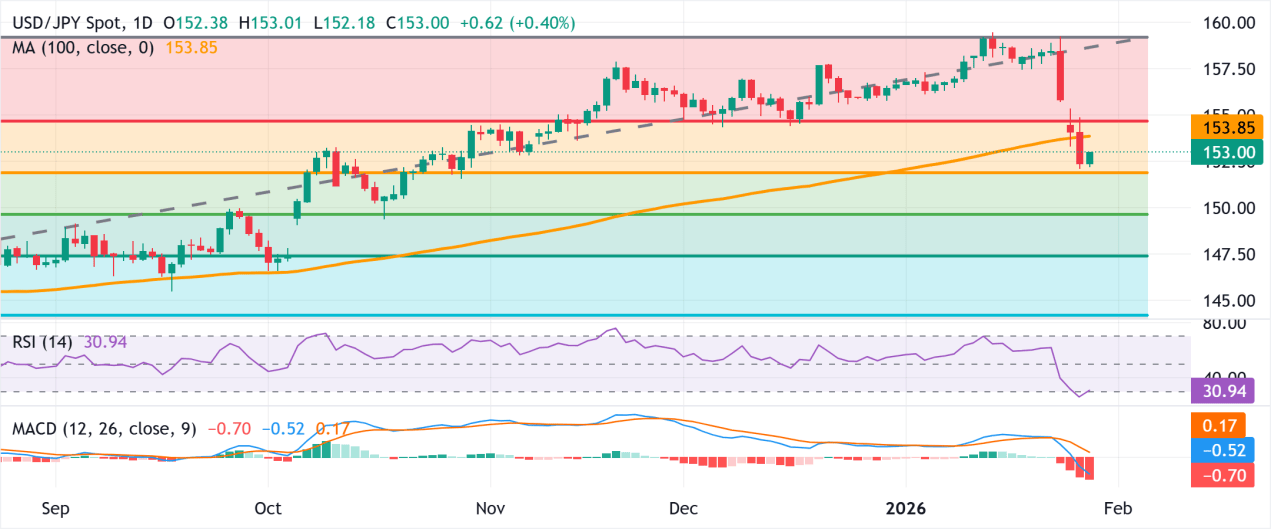
Core Viewpoint - The recent fluctuations in the USD/JPY exchange rate are primarily driven by diverging monetary policy outlooks between the Bank of Japan (BOJ) and the Federal Reserve, with domestic uncertainties in Japan limiting the yen's appreciation potential [1][2]. Group 1: Monetary Policy Outlook - The BOJ's December monetary policy meeting minutes indicate a consensus among committee members to continue raising interest rates, maintaining a normalization pace that began in 2025 [1]. - The BOJ has already raised rates twice in 2025, bringing the policy rate to 0.75%, the highest level since 1995 [1]. - There is increased confidence among BOJ members regarding a positive wage-price cycle, which supports the reduction of monetary easing and clarifies market expectations for future rate hikes [2]. Group 2: Market Reactions and Sentiment - The market anticipates that the Federal Reserve will implement two rounds of rate cuts in 2026, contrasting sharply with the BOJ's tightening stance, which underpins the low-yielding yen [3]. - Speculation about potential intervention by Japanese authorities to support the yen has provided some emotional support, allowing the yen to recover some losses during Asian trading hours [3]. - However, the yen's ability to achieve sustained appreciation is constrained by multiple domestic uncertainties, including concerns over Japan's fiscal health due to proposed tax cuts and increased spending ahead of the upcoming elections [3]. Group 3: Technical Analysis - The USD/JPY exchange rate is directly influenced by the performance of the US dollar, with the upcoming Federal Reserve interest rate decision and subsequent comments from Chairman Powell expected to be critical for the dollar's trajectory [4]. - The dollar's recent rebound faces resistance from concerns about the Fed's independence and economic policy risks stemming from US trade and geopolitical decisions, which may limit the dollar's upward potential [4]. - Technically, the USD/JPY pair is showing signs of short-term pressure, trading below the 100-day simple moving average and under the 154.00 level, indicating a bearish trend [4].

12月25日白银晚评:本周美宏观数据显韧性 银价长期保持上涨趋势
Jin Tou Wang· 2025-12-25 09:20
Group 1 - The core viewpoint of the article highlights the resilience of the U.S. economy, as indicated by strong macroeconomic data and a robust labor market, which is influencing the silver market [3] - The recent increase in silver prices is attributed to heightened risk awareness due to global trade disruptions and energy supply issues, leading investors to seek traditional safe-haven assets like silver [3] - The current trading environment is characterized by low liquidity due to the holiday season, which is amplifying the inflow of funds into gold and silver as macro hedging tools rather than purely speculative assets [3] Group 2 - The latest silver price is reported at $71.94 per ounce, with a trading range between $70.16 and $72.70 [2] - Technical analysis indicates a bullish trend for silver, with key support at $70.65 and potential upward targets at $73.80 and $75.30 [4] - The market is advised to consider buying silver around $70.70, with a target of $75.00 and a stop-loss below $69.50, while monitoring the critical support level at $66.75 for potential buying interest [4]
1225热点追踪:内外盘钯同步大跌,贵金属交易逻辑改变了吗?
Xin Lang Cai Jing· 2025-12-25 07:53
Group 1 - The core point of the article highlights the significant volatility in precious metals, particularly palladium, which experienced a sharp decline of 7.28% to $1,821 per ounce on December 25 [2][5] - The initial surge in precious metals was attributed to technical factors entering an overbought zone, followed by a retreat as risk control measures were implemented and speculative positions exited [2][5] - The market is currently focused on geopolitical events, particularly concerning the U.S.-Venezuela and Russia-Ukraine situations, amidst the backdrop of rapid price fluctuations [2][5] Group 2 - Recent U.S. macroeconomic data indicates strong economic resilience, with the third-quarter GDP growing by 4.3%, marking the fastest growth in two years [2][5] - The number of initial jobless claims for the week ending December 20 fell to 214,000, down from expectations and previous values of 224,000, suggesting no significant pressure in the labor market [2][5] - U.S. Treasury Secretary Yellen supports reassessing the Federal Reserve's inflation target of 2% once inflation stabilizes, advocating for reduced central bank intervention and better coordination with the Treasury [2][5]

12月12日汇市晚评:震荡格局延续 重磅数据与央行讲话成焦点
Jin Tou Wang· 2025-12-12 09:16
Core Viewpoint - The global foreign exchange market is experiencing a cautious trading atmosphere with significant divergence in major currency pairs, focusing on key economic data releases and central bank speeches [1][2]. Currency Analysis - **US Dollar Index**: Currently trading around 98.36, the index recorded its largest single-day drop since September after the Federal Reserve's "hawkish rate cut." The market sentiment has shifted from "end of rate hikes" to "rate cut path," with key support at 98.29-98.52 and potential downside targets at 96.22 if this support is breached [3]. - **GBP/USD**: Trading around 1.3390, the pair shows a strong upward trend supported by the 10-day moving average and market expectations of a Fed rate cut. Key support is at 1.3360, with resistance at 1.3440, and potential volatility expected from upcoming UK GDP data [4]. - **EUR/USD**: Currently at 1.1735, the pair has shown slight recovery after a minor pullback. The market remains cautious due to diverging policies between the ECB and the Fed, with support at 1.1720-1.1730 and resistance at 1.1770-1.1780 [5]. - **USD/JPY**: Trading around 155.68, the pair is in a downtrend after failing to maintain levels above 156.00. Key support is at 155.30, with resistance at 155.90. The divergence in monetary policy continues to influence the exchange rate [6]. Economic Events - Key economic events to watch include speeches from Federal Reserve officials and Canadian wholesale sales data, which may impact market sentiment and currency movements [8]. Additional Market Insights - The Swiss National Bank has maintained interest rates at zero, while other geopolitical developments, such as discussions between Modi and Trump, and the U.S. House's decision on Trump's impeachment, may also influence market dynamics [7].
美联储决议后美元前景 转弱下破风险加剧
Jin Tou Wang· 2025-12-12 02:28
Core Viewpoint - The mid-term outlook for the US dollar has significantly deteriorated following the Federal Reserve's interest rate decision, with a technical shift towards a bearish trend [1] Group 1: Market Reaction - Following the Fed's decision, the dollar index experienced its largest single-day drop since September, closing below the critical level of 98.799 [1] - The dollar index's decline is attributed to the Fed's forward guidance, which did not meet some investors' hawkish expectations, preventing the dollar from recovering most of its losses [1] Group 2: Technical Analysis - Technical analysis indicates an increasing probability of the dollar index testing the lower range of the daily cloud chart between 98.292 and 99.201 [1] - The 14-day momentum indicator is in negative territory, reinforcing the current bearish outlook [1] - A breach below the cloud's lower boundary could open up further downside potential for the dollar index [1] Group 3: Market Logic - The primary narrative in dollar trading has shifted from "end of rate hikes" to "path towards rate cuts" [1] - The Fed has signaled an openness to further rate cuts, which diminishes the dollar's interest rate differential advantage and triggers significant technical selling [1] Group 4: Future Focus - Market attention will be on whether the dollar index can find effective support at the cloud's lower boundary [1] - If this support level is breached, the dollar index may enter a deeper correction, targeting the September low of 96.224 [1] - Upcoming US economic data releases will be closely monitored to assess the Fed's rate cut pace and potential [1]
CA Markets:日美央行预期分化,日元从两周低点反弹能否延续?
Sou Hu Cai Jing· 2025-12-10 05:43
Group 1 - The core viewpoint of the articles highlights the divergence in monetary policy expectations between Japan and the United States, leading to a rebound in the Japanese yen after a three-day decline against the dollar [1][3]. - Market expectations suggest that the Bank of Japan (BoJ) may implement an emergency interest rate hike, supported by recent inflation data, which has strengthened the yen [3][4]. - The Japanese corporate goods price index (CGPI) rose by 2.7% year-on-year, reinforcing the market's bets on an imminent rate hike by the BoJ, despite concerns over Japan's expansionary fiscal policy and economic growth [4]. Group 2 - The Federal Reserve's upcoming policy meeting is anticipated to result in a 25 basis point rate cut, which will significantly influence the short-term direction of the dollar and, consequently, the USD/JPY exchange rate [5]. - Following the Fed's decision, market attention will shift to the BoJ's policy meeting scheduled for December 18-19, which will be crucial for determining the next phase of the USD/JPY exchange rate [5]. - Technical analysis indicates that the USD/JPY has broken through a key resistance level at 155.30, signaling a potential bullish trend, with further upward movement expected if it surpasses the 157.00 mark [6][8].

黄金收评丨FOMC前市场情绪谨慎,交易员等待数据指引,金价午后跳水
Sou Hu Cai Jing· 2025-12-09 07:53
Group 1 - The market has fully digested the interest rate cut expectations, leading to cautious sentiment ahead of the FOMC meeting, resulting in fluctuations in gold prices [1] - As of the close of A-shares, COMEX gold futures traded around $4209 per ounce, with the China Gold ETF (518850) down 0.71%, the gold stock ETF (159562) down 3.28%, and the non-ferrous metals ETF (516650) down 3.27% [1] - Market participants are focused on the upcoming FOMC meeting for guidance on interest rates, dot plots, potential resumption of balance sheet expansion, and comments from Fed Chair Powell, which will provide insights into future rate cuts and influence the dollar's movement [1] Group 2 - Traders are also monitoring upcoming U.S. economic data, including ADP weekly employment changes and JOLTS job openings, which may impact dollar price dynamics and provide some momentum for gold prices [1] - According to Everbright Futures, market sentiment remains cautious as the U.S. stock market retreated overnight, the dollar index returned to 99 points, and the ten-year Treasury yield reached a two-month high, putting pressure on gold prices [1] - Ahead of the significant FOMC meeting, gold prices are expected to maintain high volatility [1]