A股慢牛行情

Search documents
金融大家评 | 如何看待中国股市“慢牛”行情?
清华金融评论· 2025-11-29 09:48
Group 1 - The core viewpoint of the article discusses the current state of the Chinese stock market, particularly the significance of the 4000-point level, which is seen as both an opportunity and a challenge. Experts debate whether this level is a starting point or a peak, and the need for structural reforms to ensure sustainable growth in the capital market is emphasized [2][3][4]. Group 2 - The article outlines that the A-share market has entered a structural bull market driven by policies and capital, with a potential increase in market capitalization to GDP ratio from 60% to 100% over the next 5-10 years. Key trends include optimizing the funding structure, re-evaluating blue-chip values, and a shift of household wealth from real estate to equities [3][4]. - The foundation for a "slow bull" market is identified as the continuous growth of corporate profits, which requires expanding consumer demand, accelerating the elimination of underperforming companies, and increasing mergers and acquisitions. The challenges posed by the ongoing real estate downturn are acknowledged [4][5]. - The article highlights the need for significant reforms in the capital market during the "14th Five-Year Plan" period, focusing on restructuring the ecosystem to prioritize investor protection over the interests of issuers. This includes reforming the supply side and enhancing the funding side to attract larger institutional investors [6][7].


大幅增持股票!37万亿元险资投向这些领域→
Guo Ji Jin Rong Bao· 2025-11-17 13:35
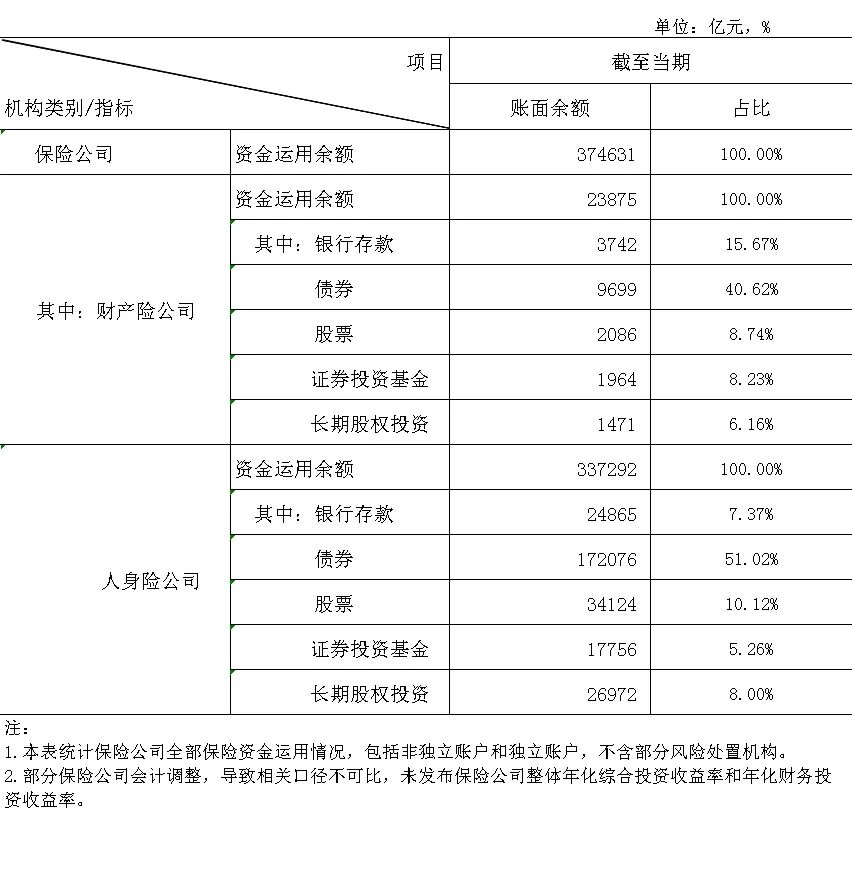
Core Viewpoint - The latest data from the National Financial Regulatory Administration reveals that the total investment balance of insurance companies has exceeded 37 trillion yuan, reaching 37.46 trillion yuan, a growth of 12.6% compared to the beginning of the year [1][4]. Investment Allocation - As of the end of Q3, the investment balance of life insurance companies is 33.73 trillion yuan, while property insurance companies hold 2.39 trillion yuan [1]. - The combined investment in stocks and securities investment funds by life and property insurance companies reached 5.59 trillion yuan, an increase of 1.49 trillion yuan from the beginning of the year, representing a growth rate of 36.2% [6]. - The proportion of stocks and securities investment funds in the total investment balance rose from 12.3% at the beginning of the year to 14.9% [6]. Stock Investment Trends - By the end of Q3, the investment in stocks by life and property insurance companies amounted to 3.62 trillion yuan, up 1.19 trillion yuan from 2.43 trillion yuan at the beginning of the year, marking a nearly 50% increase [7]. - Life insurance companies' stock investment accounted for 10.12%, while property insurance companies' stock investment reached 8.74% [7]. - There have been 24 instances of insurance capital acquiring stakes in listed companies this year, matching the total number of acquisitions from the previous four years combined [7]. Bond Investment Dynamics - The total investment in bonds by life and property insurance companies reached 18.18 trillion yuan, an increase of 2.25 trillion yuan from 15.92 trillion yuan at the beginning of the year, with a growth rate of 14.1% [10]. - The proportion of bonds in the total investment balance slightly decreased to 48.5% from 49.3% at the end of Q2 [11]. - Life insurance companies' bond investments amounted to 17.21 trillion yuan, while property insurance companies held 969.9 billion yuan in bonds [11]. Future Outlook - Analysts expect that the investment balance of insurance funds will continue to grow at a double-digit rate throughout the year, driven by the rapid increase in premium income [4]. - The stability of long-term interest rates is anticipated to ease the pressure on the yield of fixed-income investments for insurance companies [12].
险资万亿布局,稳守银行股
Huan Qiu Wang· 2025-11-17 07:37
Core Viewpoint - Insurance funds have shown strong market entry momentum in the first three quarters of 2025, with a significant increase in stock holdings and a proactive asset allocation strategy in the current market environment [1][2]. Group 1: Insurance Fund Performance - By the end of Q3, the book balance of stocks held by insurance funds surged by 1.19 trillion yuan compared to the end of last year, marking an increase of nearly 50%, reaching 3.62 trillion yuan [1]. - When including securities investment funds, the core equity asset scale has approached 5.6 trillion yuan, reflecting a growth of approximately 1.5 trillion yuan since the beginning of the year [1]. - In Q3 alone, the core equity asset scale increased by 864 billion yuan, with stocks contributing 552.4 billion yuan to this growth [1]. Group 2: Factors Driving Increased Holdings - Multiple factors are driving the recent significant increase in insurance fund holdings, including favorable policy guidance, the need for stable returns in a low-interest-rate environment, and the positive trend in the capital market, particularly the "slow bull" market in A-shares [2]. Group 3: Investment Preferences - Insurance funds have a clear investment path, with bank stocks being a major focus, accounting for 51.92% of the total market value of nearly 640 billion yuan in heavy holdings [4]. - In addition to traditional defensive sectors, insurance funds have also increased holdings in cyclical and consumer sectors such as steel, telecommunications, agriculture, and food and beverage [4]. - The investment strategy reflects a "dividend stocks + growth stocks" approach, with a broad coverage in sectors like electronics, pharmaceuticals, power equipment, machinery, and automobiles [4]. Group 4: Stock Selection Strategy - Insurance funds prioritize high-dividend stocks with stable earnings as a "ballast" in their portfolios to fill the net investment income gap in a low-interest-rate environment, while also selecting quality growth companies in emerging industries for excess returns [5]. - There are differences in stock selection preferences between life insurance and property insurance companies, with life insurers favoring low price-to-book ratio, high-dividend large-cap stocks, while property insurers tend to prefer higher price-to-earnings ratios and lower dividend yields [5]. - Equity investment has become a decisive factor in the profitability of insurance companies, with expectations for improved A-share market conditions to enhance the investment ecosystem for insurance funds [5].

开盘:三大指数集体低开 贵金属板块跌幅居前
Xin Lang Cai Jing· 2025-11-04 02:12
Market Overview - The three major indices opened lower, with the Shanghai Composite Index at 3973.46 points, down 0.08%, the Shenzhen Component Index at 13373.55 points, down 0.23%, and the ChiNext Index at 3190.40 points, down 0.20% [1] International Relations - Chinese Premier Li Qiang and Russian Prime Minister Mishustin held the 30th regular meeting, emphasizing mutual support and cooperation in various fields to strengthen the comprehensive strategic partnership [1] - The Chinese Foreign Ministry reiterated the importance of implementing the consensus reached between the leaders of China and the U.S. to stabilize economic cooperation [1] Export Control and Tourism - The Chinese Ministry of Commerce held constructive talks with the European Commission regarding export controls, aiming to stabilize supply chains [2] - China has decided to resume group tours for its citizens to Canada, considering the demand and local tourism conditions [2] - A unilateral visa exemption policy for 45 countries, including France and Germany, has been extended until December 31, 2026 [2] Corporate Developments - TSMC announced a price increase of approximately 3%-5% for advanced processes below 5nm starting January 2026 [3] - Strongray Technology plans to invest 70 million yuan to acquire a 35% stake in a liquid cooling company that supplies NVIDIA [3] - Aters stated that due to oversupply in the upstream polysilicon sector, there are no plans for self-built or acquired polysilicon production lines [3] Stock Market Movements - Stocks such as *ST Gaohong received a delisting decision, while TCL Technology's restructuring plan was not approved by creditors [4] - The U.S. stock market showed mixed results, with the Nasdaq up 0.46% and the Dow down 0.48% [4] Economic Indicators - The U.S. Treasury Department estimated a borrowing of $569 billion for the fourth quarter, a decrease of $21 billion from previous estimates [6] - Federal Reserve officials indicated a willingness to consider further interest rate cuts in December [5]
4000点拉锯战下,上证综指ETF(510760)带你“提前站上5100点”
Mei Ri Jing Ji Xin Wen· 2025-11-03 06:33
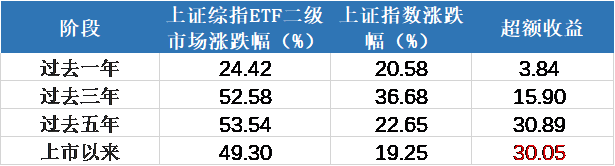
Core Insights - The Shanghai Composite Index ETF (510760) has achieved significant excess returns, allowing investors to effectively "stand on 5100 points" ahead of the market, with a reported excess return of 30.05% since its launch [1][2]. Performance Summary - The ETF has outperformed the Shanghai Composite Index since its inception, with a secondary market return of 49.3% compared to the index's 19.25%, resulting in an excess return of 30.05% [2][3]. - Over the past year, the ETF's market return was 24.42%, while the Shanghai Composite Index returned 20.58%, yielding an excess return of 3.84% [3]. - In the past three years, the ETF achieved a return of 52.58% against the index's 36.68%, leading to an excess return of 15.90% [3]. Dividend Yield and Strategy - The ETF benefits from a dividend yield exceeding 2%, which enhances its return base. The index's total market capitalization weighting, particularly with "state-owned enterprises," contributes to this yield [4]. - The ETF's performance is bolstered by the inclusion of dividend income, as the fund's benchmark is based on the net price index, which does not account for dividends [4]. Market Outlook - The outlook for the A-share market remains positive, supported by ongoing growth policies, active market sentiment, and easing monetary policy. The ETF is seen as a key channel for investing in quality Chinese assets [5]. - The ETF has shown a notable excess return of 50.45% compared to the CSI 300 Index since its inception, further highlighting its strong performance [5][6]. Cost Efficiency - The ETF is positioned as a cost-effective investment tool, with a management fee of 0.15% per year and a custody fee of 0.05% per year, making it one of the lowest-cost options in the market [6].
东吴证券执委丁文韬:资本市场活力强劲多重利好提振A股
Zheng Quan Shi Bao· 2025-10-09 18:21
Core Viewpoint - The current A-share market is driven by five main factors: robust economic recovery, proactive "anti-involution" policies, significant technological advancements, the introduction of new regulatory frameworks, and favorable global liquidity conditions [1] Group 1: Market Drivers - The Chinese economy is showing strong resilience, providing solid support for the stock market [1] - The central government's "anti-involution" policies are improving the economic supply-demand structure and boosting corporate profitability [1] - Major technological breakthroughs in China are leading to asset revaluation [1] - The release of the new "National Nine Articles" establishes a solid institutional foundation for the high-quality development of the capital market [1] - The decline of the overseas dollar cycle is creating a marginally loose global liquidity environment, benefiting emerging markets, particularly A-shares and Hong Kong stocks [1] Group 2: Market Trends - The capital market is currently vibrant, with the Shanghai Composite Index breaking a ten-year high [1] - A-share market is expected to continue a slow bull trend, supported by both fundamental and valuation recovery [1] - The Chinese economy is transitioning to a high-quality development phase, with new growth drivers gradually replacing old ones [1] - The quality of listed companies in China is improving, with the technology sector now accounting for over 25% of the market capitalization [1] Group 3: Policy and Reform - The "1+6" reform of the Sci-Tech Innovation Board and the "merger and acquisition six articles" are restructuring the capital market ecosystem [2] - The introduction of the fifth set of listing standards expands opportunities for companies in commercial aerospace and AI sectors [2] - The Sci-Tech Innovation Board is creating a dedicated channel for unprofitable companies to go public, enhancing the financing ecosystem [2] - The "merger and acquisition six articles" are accelerating the concentration of quality assets in listed companies, potentially leading to the emergence of billion or even trillion-level industry leaders [2] Group 4: Investment Opportunities - Investment opportunities are suggested in three main areas: the photovoltaic industry chain, traditional industries facing overcapacity, and emerging non-manufacturing sectors like e-commerce [3]

A500ETF嘉实(159351)红盘蓄势,成分股均胜电子两连板!
Xin Lang Cai Jing· 2025-09-17 02:42
Group 1 - The A500 index has shown a slight increase of 0.07% as of September 17, 2025, with notable gains from companies such as Jingsheng Electronics, Sanhuan Group, and others [1] - The A500 ETF managed by Jiashi has seen a trading volume of 3.66 billion yuan with a turnover rate of 3.13% [3] - The A500 ETF's latest scale reached 11.683 billion yuan, with a net value increase of 16.48% over the past six months [3] Group 2 - Financial analysts suggest that the A-share market is likely to maintain a strong oscillating trend, supported by policies aimed at reducing competition and stimulating demand [4] - The top ten weighted stocks in the CSI A500 index account for 19.11%, with notable companies including Kweichow Moutai and CATL [4][6] - Investors without stock accounts can access the A500 ETF Jiashi linked fund for exposure to the top 500 A-share companies [6]


“旗手”率先转涨,资金加速涌入,顶流券商ETF(512000)连续吸金超44亿元,机构:A股第三轮重估渐行渐近
Xin Lang Ji Jin· 2025-09-16 06:36
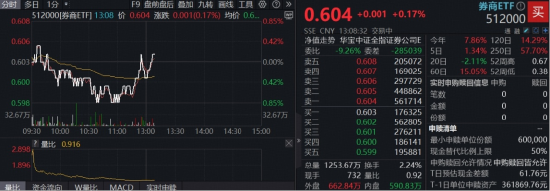
Market Overview - The market experienced a brief surge followed by a pullback, with the leading broker ETF (512000) initially declining by 0.83% before recovering to close up by 0.17% [1] - The trading volume for the broker ETF exceeded 700 million yuan, indicating active trading [1] Broker Sector Performance - Broker stocks showed mixed performance, with Pacific Securities rising over 3%, and several others like First Capital Securities and Great Wall Securities increasing by more than 2% [1] - The broker sector's performance in the first half of the year showed significant improvement year-on-year, highlighting a mismatch between high profitability and low valuation, which enhances the sector's investment appeal [3] ETF Insights - The broker ETF (512000) has surpassed 33 billion yuan in size, setting a new historical high, with an average daily trading volume of 957 million yuan this year [5] - The ETF passively tracks the CSI All Share Securities Companies Index, encompassing 49 listed broker stocks, with nearly 60% of its holdings concentrated in the top ten leading brokers [5] Market Sentiment and Future Outlook - Analysts suggest that the A-share market is in a "slow bull" phase, with high-growth sectors remaining a priority [3] - The continuous inflow of funds into the broker ETF, totaling 4.426 billion yuan over 13 consecutive trading days, reflects strong market sentiment [3]
创业板:涨幅3%成交额破3万亿,25-26年营收增速约20%
Sou Hu Cai Jing· 2025-08-25 13:31
Core Viewpoint - The A-share market continues to rise, with the ChiNext board showing strong performance due to low valuations and solid fundamentals [1] Market Performance - The Shanghai Composite Index increased by 1.51%, reaching 3883.56 points, while the ChiNext surged by 3% to 2762.99 points [1] - The market has been strong since last week, driven by a relatively calm global macro environment and optimistic expectations for a Federal Reserve rate cut [1] Key Drivers - Major technology leaders, particularly in the domestic chip sector, are leading the market rally [1] - Non-bank financials are also contributing to the upward movement of the indices [1] - The market reacted positively to the Federal Reserve Chairman's speech on August 22, interpreted as a dovish signal, increasing the likelihood of a rate cut in September [1] Trading Activity - The trading volume exceeded 30 trillion yuan for the second time in history, indicating accelerated capital inflow into A-shares [1] - The ChiNext, as a hub for growth stocks, is benefiting significantly from this trend [1] Valuation and Growth Potential - The ChiNext's price-to-earnings (PE) ratio stands at 39.39x, with a 10-year percentile of 33.23% and a 5-year percentile of 52.35%, indicating lower valuations compared to other broad indices [1] - Strong fundamentals are supported by dual drivers of policy and liquidity, with projected revenue compound annual growth rate (CAGR) of approximately 20% and net profit CAGR of about 29% from 2025 to 2026 [1] Market Outlook - Historical performance during bull markets shows significant potential, with an expected rebound of approximately 74.58% from September 24, 2024, to August 15, 2025 [1] - Investors are advised to be cautious of short-term market spikes and to consider entering during pullbacks, while the ChiNext index remains a core target for the second wave of the A-share bull market [1]

谁在入市?A股“慢牛”众生相
Bei Jing Shang Bao· 2025-08-20 13:49
Group 1 - The A-share market has recently experienced significant growth, with the Shanghai Composite Index reaching a nearly ten-year high and the total market capitalization surpassing one trillion yuan for the first time [1][3] - Analysts suggest that the current market trend is characterized as a "slow bull" and "long bull" market, contrasting with the rapid bull market of 2015 [3][10] - Various types of investors, including insurance funds, foreign capital, retail investors, and private equity, are contributing to the market's upward momentum [3][4] Group 2 - Insurance funds have significantly increased their equity investment ratios, with property insurance companies holding 195.5 billion yuan in stocks, a year-on-year increase of 1.64 percentage points [4] - Foreign investment has reversed a two-year trend of net selling, with a net increase of 10.1 billion USD in domestic stocks and funds in the first half of 2025 [4] - The private equity sector has also seen growth, with the total management scale of private equity funds reaching 20.86 trillion yuan, a 4.77% increase from the end of 2024 [5] Group 3 - Despite the overall market enthusiasm, some retail investors remain cautious, as indicated by the new account openings and fund sales data [6] - The number of new A-share investor accounts opened in 2025 has reached 14.56 million, but this is still lower compared to earlier months [6] - The current market sentiment is mixed, with some investors redeeming active equity funds while passive index products are seeing significant growth [7] Group 4 - The potential inflow of household savings into the stock market is estimated to be between 5 trillion and 7 trillion yuan, which could exceed previous market upswings [8] - Market analysts believe that the current bull market is likely to continue, with a focus on sector rotation and potential recovery in previously lagging value stocks [9][10] - The overall economic fundamentals in China are strong, supporting the bullish outlook for the stock market [10]