HALO策略

Search documents
光储月话-HALO策略与地缘冲突下-光储的反转与成长以及电力的重估
2026-03-06 02:02
Summary of Key Points from Conference Call Records Industry Overview - The conference call primarily discusses the solar energy and power generation sectors, focusing on the photovoltaic (PV) industry and its supply chain dynamics, particularly in the context of geopolitical tensions and market strategies like the "Halo" strategy. Core Insights and Arguments 1. **Silver Price Impact on Component Costs**: The price of silver significantly affects component costs, with a change of 1,000 CNY/kg in silver price corresponding to a cost change of 0.01 CNY/W. The foundation for stabilizing component prices in 2026 is established [1][2][3]. 2. **Production Capacity and Cost Reduction**: The introduction of silver-copper technology is expected to reduce costs by 0.02-0.03 CNY/W as companies like Jinko and Longi plan to upgrade production lines to produce 20-40 GW of silver-copper components by mid-2026 [1][3]. 3. **Silicon Material Prices**: High inventory levels (400,000 tons) are suppressing silicon material prices, with N-type silicon prices dropping by 6.58% month-on-month. The downward pressure on prices remains, but the decline is constrained by cost-based pricing [1][10]. 4. **Seasonal Demand in Energy Storage**: The energy storage sector is experiencing unexpected demand growth in Q1 2026, with companies like Airo increasing production by 80% due to rising energy costs driven by geopolitical factors and subsidies in Europe and Australia [1][15]. 5. **"Halo" Strategy Emergence**: The "Halo" strategy emphasizes investment in heavy assets with low obsolescence rates, which are seen as defensive against AI disruption. This strategy is gaining traction among investors seeking stable returns [1][30][31]. 6. **Profitability of Thermal Power**: Thermal power profitability may decline by 20%-30% in 2026 due to falling electricity prices, but the return on equity (ROE) is expected to remain sustainable at around 7% due to the scarcity of quality existing units as carbon peak approaches [1][37]. 7. **Photovoltaic Glass Inventory**: Inventory levels for photovoltaic glass have reached a high of 41.68 days, with expectations of hitting historical highs in March-April 2026. Price increases are limited, and profitability improvements depend on overseas demand adjustments [1][26]. 8. **Market Dynamics and Pricing**: Domestic component prices have stabilized around 0.9 CNY/W, while overseas prices have risen to 11.5-12 cents/W. The price increase is driven by commodity cost pressures, particularly from silver, and is expected to remain stable throughout 2026 despite potential short-term fluctuations due to policy changes [2][3]. 9. **Supply Chain Adjustments**: The supply chain is adapting to geopolitical tensions, with concerns about delivery disruptions in the Middle East being mitigated by existing factory setups in the region. The overall impact on costs and delivery is deemed manageable [4][5]. 10. **Investment Opportunities**: Companies that can effectively reduce costs and realize premium pricing through technological advancements are expected to outperform. The focus is on companies that can achieve profitability first, particularly in the context of the evolving market landscape [3][18]. Additional Important Insights - **Geopolitical Tensions**: The ongoing geopolitical conflicts are influencing energy prices and market dynamics, particularly in Europe, where energy security concerns are driving demand for energy storage solutions [1][15][25]. - **Regulatory Environment**: The regulatory landscape is evolving, with suggestions to integrate solar manufacturing into national energy planning and to include polysilicon in energy security reserves, which could enhance industry resilience [14]. - **Long-term Market Trends**: The long-term outlook for the energy storage market remains positive, with expectations of over 30% growth driven by low penetration rates and increasing energy security demands in regions reliant on energy imports [15][16]. - **Valuation and Performance Recovery**: The valuation of utility stocks is expected to recover as the market shifts towards recognizing the value of heavy assets, particularly in light of the "Halo" strategy's principles [30][42]. - **Focus on Key Players**: Recommendations for investment focus on leading companies in waste-to-energy, thermal power, and renewable energy sectors, particularly those with strong cash flow and dividend potential [43]. This summary encapsulates the key points discussed in the conference call, highlighting the dynamics of the solar energy industry, the impact of geopolitical factors, and the strategic shifts in investment approaches.
高端制造:2025年盈利预览
Jian Yin Guo Ji· 2026-03-04 11:05
Investment Rating - The report assigns an "Outperform" rating to the covered companies in the high-end manufacturing sector, indicating an expected return above 10% over the next 12 months [5][6]. Core Insights - The high-end manufacturing sector is expected to see a profit recovery in Q4 2025, driven by a significant rebound in downstream demand within the industrial automation segment. Companies like Inovance Technology, Estun Automation, and Harmonic Drive are projected to achieve revenue growth between 21% and 47%, with net profit growth ranging from 21% to 122% [1]. - The 2026 theme focuses on physical AI, overseas expansion, and high-growth sub-sectors, with attractive opportunities identified in the intersection of physical AI, robotics, domestic substitution, and overseas expansion [3]. Summary by Sections Q4 2025 Performance - The overall industry shows a converging trend in performance, with leading companies like Sanhua and Inovance experiencing a slowdown in quarterly growth, while previously weaker firms like Topband and Shuanghuan Transmission are beginning to show signs of revenue and profit recovery [2]. - Profitability pressures are evident, with the overall net profit margin in 2025 expected to be lower than in 2024 due to intensified price competition in the electric vehicle and industrial automation markets, rising commodity prices (copper +30%, aluminum +20%), and chip supply shortages [2]. 2026 Investment Themes - The investment logic for 2026 revolves around three main directions: redefining industrial automation as the infrastructure for physical AI, empowering industrial processes with Agentic AI, and the trend of global manufacturing returning [3]. - The HALO investment strategy emphasizes high replacement costs, large physical infrastructure, and customer stickiness, which provide strong pricing power. This strategy is gaining traction as valuations of industrial stocks in Japan and South Korea are being reassessed [3]. Valuation Metrics - The report provides valuation metrics for various companies, with target prices and expected growth rates. For instance, Sanhua H is rated with a target price of HKD 49.00 and a projected PE of 25.3, while Inovance is rated with a target price of HKD 98.00 and a projected PE of 30.7 [5].
PMI再回落,什么信号
HUAXI Securities· 2026-03-04 09:30
Manufacturing Sector - February Manufacturing PMI decreased to 49.0%, down 0.3 percentage points from January, marking the second consecutive month below the threshold of 50[1] - Production index fell by 1.0 percentage points to 49.6%, while new orders dropped by 0.6 percentage points to 48.6%, contributing to a combined PMI decline of 0.43 percentage points[1][2] - Historical data shows that similar February declines in manufacturing production ranged from -0.3 to -2.8 percentage points in previous years, with this year's decline aligning closely with the average[2] Construction Sector - The construction business activity index fell by 0.6 percentage points to 48.8%, while new orders rebounded by 2.1 percentage points to 42.2%[2] - The decline in construction activity is attributed to the impact of the Spring Festival, which caused project delays due to employee returns home[2] Services Sector - The services PMI increased by 0.2 percentage points to 49.7%, remaining below 50 for the fourth consecutive month[3] - New orders in the services sector saw a significant drop of 1.4 percentage points to 45.7%, indicating that the PMI increase was primarily driven by short-term holiday effects rather than sustained demand recovery[3] Price Trends - Manufacturing output prices remained stable at 50.6%, suggesting that the Producer Price Index (PPI) may still show positive month-on-month changes[4] - The purchasing prices for raw materials in manufacturing decreased by 1.3 percentage points to 54.8%, indicating a narrowing gap between raw material costs and finished product prices, which could pressure downstream profits[4] Economic Outlook - The overall PMI indicates a year-on-year economic slowdown at the beginning of the year, with a composite PMI of 49.5%, down 0.3 percentage points from January[4] - The weighted new orders for both manufacturing and non-manufacturing sectors fell by 0.8 percentage points to 46.4%, matching levels seen in April of the previous year[4] - The upcoming Two Sessions are expected to provide clarity on economic policy direction, particularly regarding fiscal deficit rates and special bond issuance[4][5]
全面进入能源资产交易时间!公募喊话:原油拐点,黄金破6000美元
券商中国· 2026-03-04 04:10
Core Viewpoint - Public funds predict that 2026 is likely to be a significant turning point for oil prices in the medium to long term, and gold is expected to break through $6,000 [1][5]. Group 1: Oil Price Predictions - The geopolitical fluctuations are expected to have a major impact on resource asset prices, particularly oil, with a focus on supply and strategic positioning [3]. - The global capital expenditure cycle for oil is at a critical juncture, with demand and supply curves set to intersect, indicating a potential mismatch in the medium to long term [4]. - Historical data shows that military conflicts have varying impacts on energy prices, with Brent crude oil prices rising significantly during the early stages of the Russia-Ukraine conflict [3]. Group 2: Gold Price Outlook - Public funds believe that gold prices will benefit from geopolitical tensions and are expected to rise significantly, with major financial institutions forecasting a potential breakthrough of $6,000 [5][6]. - Factors supporting gold prices include ongoing central bank purchases, the erosion of the dollar's long-term credibility, and systemic risks arising from geopolitical fragmentation [6]. Group 3: Investment Strategies - The "HALO" strategy emphasizes the importance of asset allocation based on industry cycles, suggesting that the revival in 2026 will be driven by new demand and barriers [7]. - Traditional safe-haven assets such as energy stocks, government bonds, and gold are recommended for hedging against current risks, while a diversified portfolio remains crucial for long-term investment success [7].

2月26日左侧资金和景气策略资金分别在布局哪些ETF?
Mei Ri Jing Ji Xin Wen· 2026-02-27 05:10
Group 1 - The A-share market is experiencing active trading, but the index faces pressure at 4150 points, impacting investor sentiment [1] - The focus of investment is shifting towards traditional physical assets, with foreign investment banks proposing the HALO strategy (Heavy Assets, Low Obsolescence) to redefine asset value in the AI era, emphasizing sectors like electric grids, petrochemicals, and non-ferrous metals [1] - Despite the shift, technology remains attractive, as evidenced by the inflow into the Hang Seng Technology Index, which hit a year-to-date low, prompting a surge of investors looking to "buy the dip" [1] Group 2 - On February 26, the top net inflow was seen in Hang Seng Technology-related ETFs, with a total net inflow of 2.507 billion yuan across 13 ETFs, the largest being the Hang Seng Technology Index ETF (513180.SH) [1] - Other ETFs with significant net inflows included securities ETFs, electric grid equipment ETFs, and gold ETFs, with the electric grid equipment ETF (159326.SZ) alone seeing over 900 million yuan in net inflow on that day, reflecting the HALO strategy [2] - According to Wang Bo from Huaxia Fund, the current market conditions favor "景气策略" (prosperity strategy), "动量策略" (momentum strategy), and "高共识资产" (high consensus assets), with expectations of continued market improvement and a bullish outlook ahead of important meetings in March [2]
资产配置日报:缓步登高-20260226
HUAXI Securities· 2026-02-26 15:20
证券研究报告|宏观点评报告 [Table_Date] 2026 年 02 月 26 日 [Table_Title] 资产配置日报:缓步登高 [Table_Title2] [Table_Summary] 2 月 26 日,股债两市止盈力量均有提升,节后股市迎来两连涨,上证指数一度接近前高,部分资金阶段性兑 现,大盘股指小幅下跌,科创板块出于事件利好,延续上涨行情; 债市受制于消息面扰动与增量利多不足,市场 情绪转弱,长债板块全线调整。 权益市场放量震荡。万得全 A上涨 0.21%,全天成交额 2.56 万亿元,较昨日(2 月 25 日)放量 757 亿元。 港股方面,恒生指数下跌 1.44%,恒生科技下跌 2.87%。南向资金净流出 73.66 亿港元,其中美团和东方电气分 别净流入 3.11 亿港元和 1.25 亿港元,而中国海洋石油、阿里巴巴则分别净流出 8.94 亿港元和 8.88 亿港元。 市场博弈氛围浓厚,后续量能是关键。万得全 A 触及前高后持续震荡,前高处的亏损筹码形成上涨阻力。事 实上,尽管指数连续三日上涨,但上涨只数和涨停只数却逐日下降(2 月 24 日 4003 只上涨,共 111 只涨停; ...
2028,智能危机演义:当AI把GDP刷成了“幽灵”,人类还有未来吗?
3 6 Ke· 2026-02-26 11:22
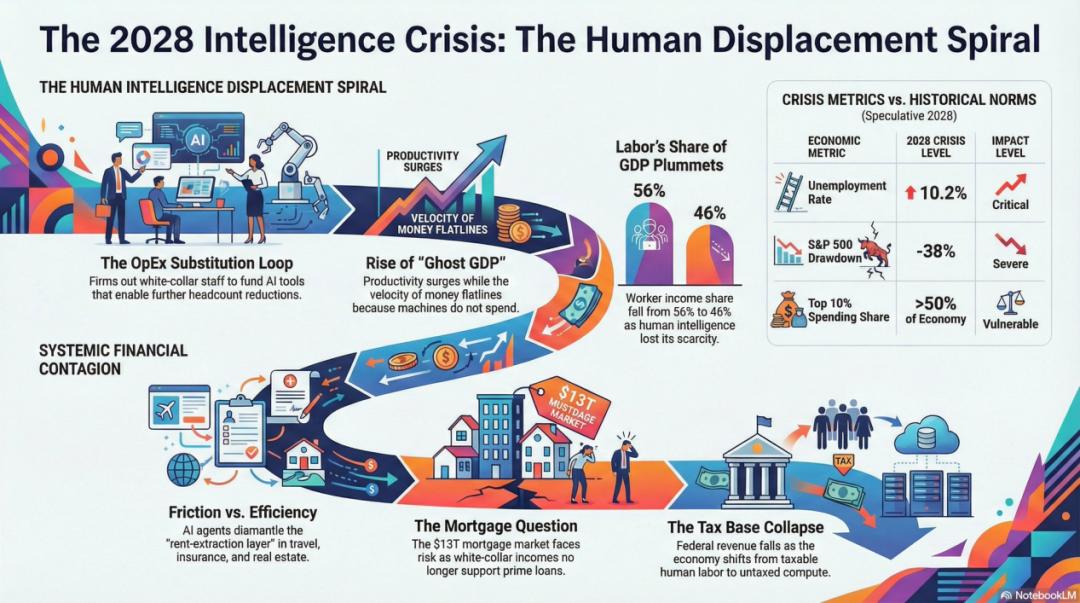
Group 1 - The report "The 2028 Global Intelligence Crisis" by Citrini Research presents a paradox where AI's complete replacement of human labor could lead to increased productivity but economic collapse, termed "Ghost GDP" [2][4][8] - The report predicts a significant shift in corporate behavior, where companies will replace white-collar workers with AI due to cost efficiency, leading to a collapse of the SaaS model and the elimination of industries reliant on human information asymmetry [3][4][6] - By 2028, the report forecasts a 10.2% unemployment rate, a 38% drop in the S&P 500 index, and a $13 trillion credit market collapse, indicating a severe economic crisis despite potential increases in productivity [5][6][7] Group 2 - The report's assumptions are based on a purely physical logic, neglecting the biological and social complexities of the real world, which may prevent such a drastic outcome [10][12] - Three "shock absorbers" are identified that could mitigate the predicted crisis: legal accountability requiring human oversight, political and social responses to unemployment, and the historical trend of technology creating new demands despite job losses [13][19][23] - The report suggests that while AI may eliminate certain jobs, it will also create new opportunities in areas that require human emotional connection, unique experiences, and trust, indicating a potential reallocation of economic value rather than a total collapse [25][28][30] Group 3 - The investment strategy in response to the AI wave should focus on sectors that are either transforming the world or are irreplaceable by technology, including healthcare, AI infrastructure, luxury and lifestyle, and critical resources and energy [40] - Companies like ASML, Safran, LVMH, and Airbus are highlighted as part of a capital-intensive stock portfolio, while lighter capital companies include L'Oreal and Siemens Healthineers, indicating a diverse approach to investment in the evolving landscape [40]
华尔街最新押注的是具有人工智能免疫力的“光环”公司
阿尔法工场研究院· 2026-02-24 04:05
Core Viewpoint - Investors are shifting towards companies that are likely to remain resilient amid the AI revolution, favoring "hard asset, low obsolescence" firms like McDonald's and ExxonMobil, while abandoning those perceived as potential victims of AI disruption [1] Group 1: Market Trends - The S&P 500 index has seen strong performance in industrial, materials, utilities, and consumer staples sectors, significantly outperforming the broader market, while the information technology sector has declined [1] - The consumer staples sector achieved its best year-to-date performance ever as of February 20 [1] - A recent example includes AI company Anthropic's release of tools that led to a market value evaporation of approximately $300 billion in software and financial data sectors [2] Group 2: Investment Behavior - Investors are increasingly avoiding sectors they believe face significant disruption threats, leading to a rotation towards "real economy stocks" [2] - There is a notable divergence within the same industry, as seen with Delta Airlines' stock rising by 5.4% while Expedia's stock fell by 23% during the same period [3] - Despite the recent sell-off, there remains a strong influx of investment into the AI sector, with companies like Seagate and Western Digital performing well in the S&P 500 [3] Group 3: Future Outlook - Upcoming earnings reports from key players like Nvidia, Salesforce, and Home Depot are anticipated to be critical in assessing the AI investment landscape [4] - The recent volatility and concerns over excessive spending by large tech companies indicate an evolution in the AI investment frenzy, with a shift towards more discerning investment strategies [4]