
人工智能(AI)

Search documents
从400万元到2500万元:一位退休医生的“三股七债”投资铁律
经济观察报· 2026-02-13 05:04
在波谲云诡的金融市场里,普通人如何真正留住财富?他应对 这个复杂金融世界的"处方",竟是一道简单的数学题和一条不 容逾越的铁律。 作者:蔡越坤 封图:图虫创意 2026年的第一声资本惊雷,并非源于人工智能(AI)或是机器人等科技创新,而是来自黄金、白 银等有色金属。 国际金价以一种近乎癫狂的姿态连创历史新高,最高触及5626.8美元/盎司,带动A股有色金属板 块"脱离地心引力"般暴涨22.59%;随后金价在1月30日上演 "高台跳水",创下近40年来最大单 日跌幅,部分热门有色个股暴跌20%…… 当被问及最近是否会盯黄金、有色这类狂热与动荡的板块时,62岁的吴凯说:"我从来不去看这些 板块,因为我喜欢分散配置。我也不追热门,因为热门行业行情更容易暴涨暴跌,我内心承受不 了。 他补充说,当散户注意到某个板块狂热的时候,相关个股已经涨得很高,此时再入场很可能就接过 了上涨的"最后一棒"。 在A股市场,有人追逐热点、频繁交易;有人执着于个股研判,博弈行业风口。吴凯是一名退休内 科医生,没有金融科班背景,却用 20年时间穿越了2008年金融危机、2015年股票市场异常波 动、2022年熊市乃至信托爆雷潮等市场巨震,将 ...


诺奖经济学家克鲁格曼批特朗普MAGA成MASA:2025年1月以来美国新增就业较2024年同期锐减近90万
Sou Hu Cai Jing· 2026-02-13 04:41
Group 1 - Paul Krugman, a Nobel laureate, argues that Trump's "Make America Great Again" (MAGA) policies are leading the U.S. economy into stagnation, coining the term "Make America Stagnant Again" (MASA) [1] - The latest U.S. employment report shows significant sampling error, with a 90% confidence interval estimating 130,000 new jobs, but actual data fluctuating between 77,000 and 152,000, highlighting the volatility of monthly employment data [1] - Since January 2025, the U.S. has added only 359,000 jobs, a decrease of nearly 900,000 compared to the same period in 2024, indicating that the job market is nearing complete stagnation [1] Group 2 - Trump's immigration policies have two major negative impacts: reduced immigration leads to a significant drop in tax revenue, hindering economic growth, and creates labor shortages in sectors like elder care, agriculture, and meat processing, which local residents are unwilling to work in [2] - Research indicates that preventing immigration and deporting foreign workers could increase mortality rates among the elderly in the U.S. [2] - Krugman highlights a contradiction in the Trump administration's narrative, which claims that immigrants take jobs from locals while simultaneously blaming job losses on reduced immigration, suggesting that these policies are misleading and detrimental to American citizens [2] Group 3 - The development of artificial intelligence (AI) complicates the employment issue in the U.S., with a Goldman Sachs report indicating that AI could lead to a period of no job growth as companies utilize AI to achieve more with fewer workers [2] - Constantin Burgi, an economics professor, notes that the decoupling of job growth from economic growth typically occurs during structural transformation phases, and if job growth remains stagnant for years, many positions may permanently disappear [2] - Laura Ullrich, head of economic research at Indeed, argues that if the U.S. economy remains strong, new job creation should not stay at low levels for an extended period, as low hiring, low firing, and low turnover rates cannot be sustained long-term [2]
消息称字节跳动自研芯片团队已超千人,已形成四大产品线
Feng Huang Wang· 2026-02-13 03:02
Group 1 - ByteDance is advancing its self-developed chip strategy, expanding its chip team to over 1,000 members, with more than half focused on AI chips, totaling over 500 people [1] - The company has undergone a team restructuring, with the former head of chip business, Wang Jian, no longer overseeing the division, and the heads of AI chip and DPU teams, Shi Yunfeng, and CPU team head, Yu Hongbin, reporting directly to Vice President Yang Zhenyuan [1] - ByteDance's chip business began in 2020 and has developed four product lines: AI chips for large model inference, server CPUs for general computing in data centers, VPUs for video decoding and content review, and DPUs for network optimization in data centers [1] Group 2 - By the end of 2025, ByteDance has reportedly secured nearly 120,000 NVIDIA cards (A100, A800, H800) and close to 1 million NVIDIA H20, L20, and L40 chips [2] - The company is developing an AI chip codenamed SeedChip and is in talks with Samsung Electronics for foundry services, aiming to ensure a supply of advanced chips, with plans to receive chip samples by the end of March [1] - ByteDance plans to produce at least 100,000 chips for AI inference tasks this year, with a goal to gradually increase production to 350,000 chips [1]
从400万元到2500万元:一位退休医生的“三股七债”投资铁律
Jing Ji Guan Cha Wang· 2026-02-13 02:54
2026年的第一声资本惊雷,并非源于人工智能(AI)或是机器人等科技创新,而是来自黄金、白银等有色金属。 国际金价以一种近乎癫狂的姿态连创历史新高,最高触及5626.8美元/盎司,带动A股有色金属板块"脱离地心引力"般暴涨22.59%;随后金价在1月30日上演 "高台跳水",创下近40年来最大单日跌幅,部分热门有色个股暴跌20%…… 这不仅是策略,更是原则。所谓"三股七债",即穿透后股票类资产占30%,债券类资产占70%。这个比例既源于"100–年龄"的经典公式,也结合了他对A股 剧烈波动的清醒认知。"62岁,理论可配38%的股票,因为A股波动比较大,我主动降至30%。"他说。 回顾过去几年的投资经历,2022年至2024年,A股持续下跌,上证指数从3700点跌至2700 点附近,其间虽有阶段性反弹,但整体处于熊市周期,他的股票类 资产的仓位持续低于27%,于是他不断用投资债基获得的收益补仓;2024年,在政策利好推动下,"9·24"行情启动,他的股票类资产的仓位很快突破33%。 于是,他按纪律卖出部分权益类资产,恢复"三股七债"的比例。 当被问及最近是否会盯黄金、有色这类狂热与动荡的板块时,62岁的吴凯说: ...
日经BP精选:“灭绝”的日本LNG运输船建造能力会复活吗?
日经中文网· 2026-02-13 02:46
Group 1 - The Japanese government will officially discuss the restoration of liquefied natural gas (LNG) carrier construction capabilities, with conclusions expected around spring 2026 [6] - Approximately 34% of Japan's total power generation, which is about 1 trillion kWh, relies on natural gas-fired power generation, making it the highest among major energy sources, surpassing coal at around 30% [6] - Future electricity demand is anticipated to surge due to the expansion of artificial intelligence (AI) applications, with projected demand increasing from approximately 805.9 billion kWh in 2024 to 852.4 billion kWh by 2034 [6]

海外存储巨头业绩爆表,半导体设备ETF(561980)高开领涨,国产替代逻辑再强化!
Sou Hu Cai Jing· 2026-02-13 02:40
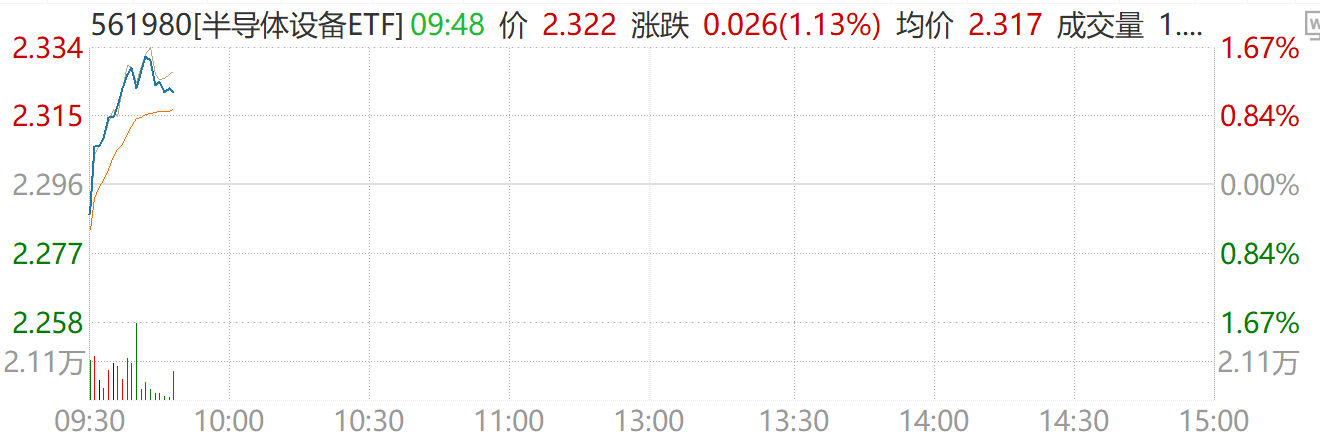
Core Viewpoint - The semiconductor equipment and materials sectors are experiencing significant market gains driven by both supply-demand dynamics and an upward economic cycle, with a notable performance from the semiconductor equipment ETF (561980) [1][3]. Group 1: Market Performance - The semiconductor equipment ETF (561980) opened over 1% higher and rose by 1.26% to a latest scale of 3.515 billion yuan, with net inflows of funds on the previous trading day [1]. - Key stocks in the sector, such as Rich Technology and Tuojing Technology, saw gains exceeding 5% and 4% respectively, while other companies like Chipone, Northern Huachuang, and Huafeng Measurement Control also experienced increases [1]. Group 2: Catalysts for Growth - The strong performance in the equipment and materials sectors is primarily attributed to overseas storage companies reporting high growth and the positive impact of the South Korean semiconductor market reaching new highs [3]. - Kioxia, a major global storage chip manufacturer, reported a significant increase in its annual revenue and net profit targets, exceeding analyst expectations by approximately 35% to 60%, driven by robust demand for high-performance storage products from AI servers and the high-end smartphone market [3]. Group 3: Industry Trends - The semiconductor industry is witnessing a price surge in storage chips from 2025 to 2026, which is expected to enhance the profitability of chip design companies and wafer manufacturers, thereby increasing their willingness to expand production and capital expenditures [5]. - The semiconductor equipment ETF (561980) tracks the CSI Semiconductor Industry Index, with over 90% weight in upstream sectors, and the top ten constituent stocks accounting for about 75% [5]. Group 4: Sales Data and Localization - According to SIA, global semiconductor sales are projected to reach $78.88 billion by December 2025, reflecting a year-on-year growth of 37.1% and a quarter-on-quarter increase of 2.7%, marking 26 consecutive months of positive year-on-year growth [8]. - China's semiconductor sales are expected to reach $21.29 billion, with a year-on-year growth of 34.1% and a quarter-on-quarter growth of 3.8%, indicating an overall upward cycle [8]. - The domestic semiconductor equipment industry in China is transitioning from "catching up" to "keeping pace," with a projected increase in localization rates for wafer manufacturing equipment from 25% in 2024 to 30% by 2026 [8].
铜冠金源期货商品日报-20260213
Tong Guan Jin Yuan Qi Huo· 2026-02-13 02:33
投资咨询业务资格 沪证监许可[2015]84 号 商品日报 20260213 联系人 李婷、黄蕾 电子邮箱 jytzzx@jyqh.com.cn 主要品种观点 宏观:美股科技抛售加剧,A 股延续分化修复 海外方面,1 月 CPI 发布前夕,市场避险情绪明显升温。围绕人工智能可能引发行业结 构性重塑的担忧加剧,部分资金出现阶段性"反 AI 交易",一方面担忧 AI 对传统软件与部 分科技子行业形成盈利挤压,另一方面对企业大规模 AI 投入的回报确定性产生疑虑,进而 放大了科技板块的抛售压力,风险偏好快速收缩下,跨资产同步承压:纳指跌超 2%,黄金 下挫逾 3%,白银跌幅超过 10%,铜、油回落超 2%,10Y 美债利率回落至 4.1%。当前市场 仍处于高波动环境,今日重点关注美国 1 月 CPI 数据发布。 国内方面,在中美两国元首预计 4 月会晤及特朗普拟访华背景下,美方暂缓多项针对中 国的关键技术与安全限制措施(涵盖电信、网络设备及新能源商用车等领域),双方就高层 互访保持沟通。春节假期前处于经济数据与政策真空期,A 股周四延续震荡分化格局。中小 盘与成长风格相对占优,科创 50、中证 500 收涨,而沪深 ...
AI投资人:1-5年内AI将消灭 50%入门级白领岗位
阿尔法工场研究院· 2026-02-13 02:33
Core Viewpoint - The article emphasizes that the release of GPT-5.3 Codex and Claude Opus 4.6 on February 5, 2026, marks a critical turning point in AI capabilities, impacting knowledge workers sooner and more broadly than anticipated [2]. Group 1: AI's Rapid Advancement - The author compares the current perception of AI to the early days of the COVID-19 pandemic, suggesting that many are underestimating the scale and speed of AI advancements [3]. - The pace of AI improvements has accelerated significantly, with new models showing substantial enhancements in capabilities and shorter intervals between releases [4]. - The author describes a personal experience where AI independently completed tasks with high quality, indicating a shift in how AI can be utilized in various fields [4]. Group 2: Implications for Knowledge Work - AI's ability to write code is seen as a strategic advantage, enabling the development of more advanced AI systems, which could eventually impact all knowledge work sectors, including law, finance, and healthcare [5]. - The article discusses the ongoing debate about AI's progress, asserting that those who claim AI has hit a wall are likely using outdated models or have a vested interest in downplaying its capabilities [7]. - A timeline of AI advancements is provided, illustrating rapid progress from basic arithmetic capabilities in 2022 to the potential for AI to handle significant coding tasks by 2025 [7][8]. Group 3: Future Workforce Changes - Predictions suggest that AI could eliminate 50% of entry-level white-collar jobs within 1-5 years, with the author noting that this is a conservative estimate [11]. - The article highlights that AI is a general substitute for cognitive work, making it challenging for workers to transition to new roles as AI continues to improve across various domains [11]. - The author emphasizes that the latest AI models exhibit decision-making capabilities that resemble human judgment, raising concerns about job security for many roles that involve computer-based tasks [11]. Group 4: Practical Recommendations - The article provides actionable advice, urging individuals to subscribe to paid versions of AI tools and actively integrate them into their work processes [13][15]. - It encourages users to experiment with AI daily, suggesting that hands-on experience will enhance understanding and adaptability to ongoing changes in the industry [15]. - The author warns that many professionals are currently ignoring AI's potential, and those who leverage it effectively will gain a competitive advantage [14]. Group 5: Broader Implications of AI - The article concludes with a discussion on the potential societal impacts of AI, including both positive advancements in fields like medicine and negative consequences such as increased surveillance and security threats [17]. - The author presents a thought experiment about a hypothetical nation with super-intelligent citizens, highlighting the dual-edged nature of AI advancements [17].


AI新催化-产业链全梳理
2026-02-13 02:17
Summary of Key Points from the Conference Call Industry Overview - The AI video production industry is transitioning from high-cost, long-cycle, and high-threshold production to low-cost, efficient, and democratized industrial production, reshaping supply and demand dynamics and creating investment opportunities. However, there are concerns about the potential impact of large model capabilities on applications [2][3]. Core Insights and Arguments - The announcement of price increases by cloud service providers like Amazon AWS indicates the growing scarcity of AI cloud infrastructure, confirming the high demand for global AI computing power. The market is expected to replicate the post-Chinese New Year rally seen in 2025 [2][3]. - The release of models such as CloudOps 4.6 and Zhizhu GLM 5 marks a shift in AI from chatbots to customized team collaboration executors, which is anticipated to drive exponential growth in the industry by 2026 and change digital work patterns for businesses and individuals [2][5]. - Investment opportunities in domestic computing power related to AI applications are promising, with recommendations for GPU companies like Cambricon and self-developed ASIC chips from internet firms. Attention is also drawn to the expected price increases in target materials, with companies like Jiangfeng Electronics, OLAI New Materials, and Ashi Chuang being highlighted [2][6]. Investment Opportunities - The price increase of CCL (copper foil substrate) is expected to manifest in Q1 2026, with a projected overall positive performance for 2026-2027. Beneficiary companies include Nanya New Materials, Shengyi Technology, and Huazheng New Materials [2][8]. - In the AI hardware sector, there are significant investment opportunities related to domestic computing power, particularly due to the high power consumption of various AI applications, especially video-related ones [6][7]. Military Applications of AI - AI is primarily applied in military fields for situational awareness and unmanned operations, with Palantir's $4.3 billion large order demonstrating the substantial commercial potential of AI in military situational awareness [4][10][11]. - The development of unmanned operations is expected to accelerate significantly, with a focus on increasing the proportion of unmanned equipment in military operations [12][13]. Communication Chain Opportunities - Opportunities in the AI industry chain within the communication sector are identified in three main areas: AIS cloud services, network endpoints, and computing endpoints. Price increases in related components are anticipated due to the growth of AI applications and model upgrades [14]. Media and Entertainment Sector - The media and internet industry shows significant investment opportunities in AI applications, particularly with ByteDance's CDS 2.0 model, which enhances video production capabilities and efficiency. Companies with strong IP and distribution capabilities are recommended for investment [15]. Gaming Industry Impact - AI technology is expected to significantly enhance game development efficiency and user experience. Companies like Perfect World and KAEYING Network are highlighted as key investment targets due to their innovative projects [16][17]. Pharmaceutical Industry Potential - AI has substantial potential in the pharmaceutical industry, particularly in drug development, where it can shorten development cycles and improve efficiency. Companies like Hongbo Pharmaceutical and others are noted for their advancements in utilizing AI for drug development [18]. Multimodal Model Development - The development of multimodal models is rapidly advancing, with significant improvements in capabilities and usability. Companies like ByteDance and others are leading in this space, indicating a competitive landscape similar to the early stages of text models [19][20][21][22]. Recommended Companies for Investment - In the multimodal direction, companies such as Wanjing Technology, Haitai Ruisheng, and others are recommended for their strong positions in AI creative tools and applications [26]. This summary encapsulates the key insights and investment opportunities discussed in the conference call, providing a comprehensive overview of the current landscape in the AI industry and its various applications across sectors.





未知机构:美光目标价立涨100美元-20260213
未知机构· 2026-02-13 02:15
美光目标价"立涨"100美元? 大摩:AI存储需求太火爆 无惧任何打击!A股推荐香农芯创(300475),海力士的核心下游,具备极强的投资性 价比,叠加MSCI指数调入带来的资金利好,股价至少翻倍以上空间。 2026年02月12日 13:07 近段时间以来,"存储涨价风暴"越刮越猛,美国存储芯片大厂美光科技屡获华尔街大行"点名赞赏"、并上调评级和 目标价。 继瑞银、瑞穗、汇 美光目标价"立涨"100美元? "自美光上次发布业绩指引以来,存储芯片价格大幅上涨,所有终端市场均出现供应短缺局面,我们据此上调公司 盈利预期。 在AI需求保持强劲的背景下,HBM4供应担忧、中国市场相关顾虑及资本支出担忧均不构成核心影响因素。 "报告称。 一直短缺 = 一直涨价 大摩:AI存储需求太火爆 无惧任何打击!A股推荐香农芯创(300475),海力士的核心下游,具备极强的投资性 价比,叠加MSCI指数调入带来的资金利好,股价至少翻倍以上空间。 2026年02月12日 13:07 近段时间以来,"存储涨价风暴"越刮越猛,美国存储芯片大厂美光科技屡获华尔街大行"点名赞赏"、并上调评级和 目标价。 继瑞银、瑞穗、汇丰和德银之后,摩根士 ...
