
先进封装

Search documents
汇成股份涨8.98%,成交额13.32亿元,近5日主力净流入8895.88万
Xin Lang Cai Jing· 2026-01-08 07:34
Core Viewpoint - The company, Hefei Xinhui Microelectronics Co., Ltd., is actively expanding its business in the semiconductor industry, particularly in advanced packaging and storage chip sectors, benefiting from the demand surge driven by AI infrastructure [2][3]. Group 1: Company Developments - On October 14, 2025, the company announced a strategic investment in Hefei Xinfeng Technology Co., Ltd., acquiring a 27.5445% stake and forming a partnership to develop 3D DRAM and other storage chip packaging services [2]. - The company is focusing on advanced packaging technologies, including Chiplet, Fan-out, 3D, and SiP, leveraging its expertise in bump manufacturing as a foundational technology [2]. - As of September 30, 2025, the company reported a revenue of 1.295 billion yuan, a year-on-year increase of 21.05%, and a net profit of 124 million yuan, up 23.21% [9]. Group 2: Business Operations - The main business of Hefei Xinhui Microelectronics is high-end integrated circuit packaging and testing services, with a revenue composition of 90.25% from display driver chip packaging [3][8]. - The company has established a significant customer base in the OLED sector, including major players like Novatek and Raydium [2]. - As of the latest report, overseas revenue accounted for 54.15% of total revenue, benefiting from the depreciation of the Chinese yuan [4]. Group 3: Market Performance - On January 8, the company's stock rose by 8.98%, with a trading volume of 1.332 billion yuan and a market capitalization of 15.815 billion yuan [1]. - The average trading cost of the stock is 16.54 yuan, with the stock price approaching a resistance level of 18.38 yuan, indicating potential for upward movement if the resistance is broken [7].

中微公司跌2.05%,成交额46.47亿元,主力资金净流出2.51亿元
Xin Lang Cai Jing· 2026-01-08 06:30
Core Viewpoint - The stock of Zhongwei Company has experienced fluctuations, with a recent decline of 2.05%, while showing significant growth in the year-to-date and over various trading periods. The company is involved in high-end semiconductor equipment and has reported strong revenue and profit growth. Group 1: Stock Performance - As of January 8, Zhongwei Company's stock price was 345.10 CNY per share, with a market capitalization of 2160.83 billion CNY [1] - The stock has increased by 26.54% year-to-date, with a 23.62% rise over the last five trading days and a 27.70% increase over the last 20 days [1] - The company experienced a net outflow of 2.51 billion CNY in principal funds, with significant buying and selling activity from large orders [1] Group 2: Financial Performance - For the period from January to September 2025, Zhongwei Company achieved a revenue of 80.63 billion CNY, representing a year-on-year growth of 46.40% [2] - The net profit attributable to shareholders for the same period was 12.11 billion CNY, reflecting a year-on-year increase of 32.66% [2] Group 3: Shareholder Information - As of September 30, 2025, the number of shareholders for Zhongwei Company was 60,800, an increase of 29.52% from the previous period [2] - The average number of circulating shares per shareholder decreased by 22.79% to 10,301 shares [2] - The company has distributed a total of 4.96 billion CNY in dividends since its A-share listing [3]

盛美上海跌2.01%,成交额5.51亿元,主力资金净流出3221.79万元
Xin Lang Cai Jing· 2026-01-08 03:10
Core Viewpoint - The stock of Semiconductor Manufacturing International Corporation (SMIC) in Shanghai has shown a significant increase in price and trading activity, reflecting positive financial performance and investor interest in the semiconductor equipment sector [1][2]. Group 1: Stock Performance - As of January 8, SMIC's stock price decreased by 2.01% to 194.03 CNY per share, with a trading volume of 5.51 billion CNY and a turnover rate of 0.64%, resulting in a total market capitalization of 931.66 billion CNY [1]. - Year-to-date, SMIC's stock has risen by 10.21%, with a 9.65% increase over the last five trading days, an 18.31% increase over the last 20 days, and a 7.99% increase over the last 60 days [1]. Group 2: Financial Performance - For the period from January to September 2025, SMIC reported a revenue of 5.146 billion CNY, representing a year-on-year growth of 29.42%, and a net profit attributable to shareholders of 1.266 billion CNY, which is a 66.99% increase compared to the previous year [2]. Group 3: Shareholder Information - As of September 30, 2025, the number of shareholders for SMIC increased to 21,700, up by 85.89%, while the average number of circulating shares per shareholder decreased by 46.20% to 20,098 shares [2]. - The top ten circulating shareholders include significant institutional investors, with notable reductions in holdings for several funds, indicating a shift in investor positions [3].

日月光将涨价20%
半导体行业观察· 2026-01-08 02:13
公众号记得加星标⭐️,第一时间看推送不会错过。 随着人工智能(AI)半导体需求强度远超市场预期,全球封测龙头日月光投控正迎接前所未有的成长 契机。大摩(摩根士丹利,Morgan Stanley)在最新的研究报告中,将日月光投控的投资评等重申为 「买进」,并将目标价从新台币228 元大幅上调至308 元。此一调整,反映了分析师对其2026 年至 2027 年获利成长的强劲信心,特别是看好其在先进封装领域的领先地位及定价权的提升。 报告指出,由于AI 半导体需求极为强劲,加上日月光的产能已趋近极限,预计该公司将在2026 年调 涨后段晶圆代工服务价格,涨幅预期落在5% 至20% 之间,高于原先预期的5-10%。这波涨价主要导 因于半导体通膨压力,日月光已决定将包含基板、贵金属及电费在内的增加成本转嫁给客户。同时, 公司将优先向毛利率较高的AI 客户供货,以优化产品组合。 报告表示,大中华区外包封测(OSAT)的产能利用率(UTR)在2025 年已持续复苏,预计2026 年 将进一步成长。日月光2025 年第三季的产能利用率已达90%,在实务上什至已接近满载,这使其在 2026 年的价格谈判中拥有极强的议价筹码。 ...


中科飞测涨2.04%,成交额4.21亿元,主力资金净流出2200.35万元
Xin Lang Zheng Quan· 2026-01-08 02:03
Core Viewpoint - Zhongke Feimeasure has shown significant stock price growth and financial performance improvements, indicating strong market interest and operational growth in the semiconductor equipment sector [1][2]. Financial Performance - As of September 30, Zhongke Feimeasure reported a revenue of 1.202 billion yuan, representing a year-on-year increase of 47.92% [2]. - The company experienced a net profit loss of 14.6985 million yuan, but this still reflects a year-on-year improvement of 71.67% [2]. - Since its A-share listing, Zhongke Feimeasure has distributed a total of 44.8 million yuan in dividends [3]. Stock Market Activity - On January 8, Zhongke Feimeasure's stock price increased by 2.04%, reaching 182.66 yuan per share, with a trading volume of 421 million yuan and a turnover rate of 0.94% [1]. - The stock has appreciated by 19.39% year-to-date, with a 20.27% increase over the last five trading days and a 41.98% increase over the last 20 days [1]. Shareholder Information - As of September 30, the number of shareholders increased to 13,700, a rise of 40.11%, while the average number of circulating shares per person decreased by 28.63% to 18,131 shares [2]. - Notable institutional shareholders include Nuoan Growth Mixed A and Yongying Semiconductor Industry Selected Mixed A, with the latter being a new entrant among the top ten shareholders [3].

688332,预告业绩暴增
Sou Hu Cai Jing· 2026-01-07 17:42
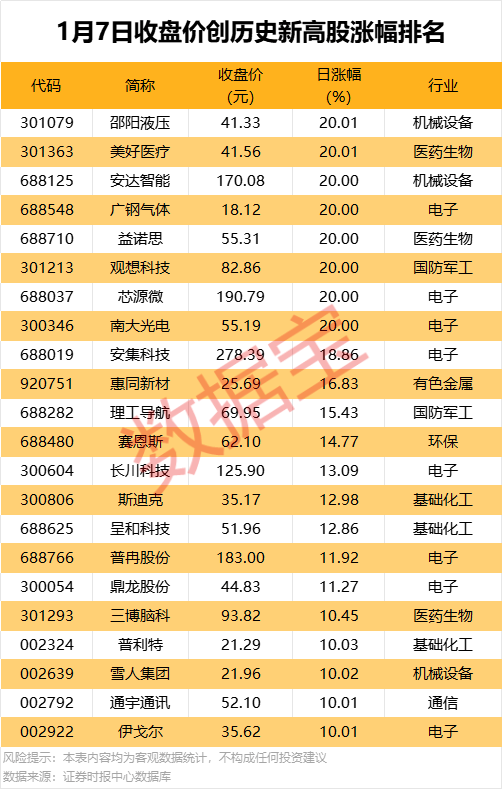
Market Overview - The three major A-share indices experienced a slight increase on January 7, with total trading volume in the Shanghai and Shenzhen markets reaching 2.88 trillion yuan, an increase of over 49 billion yuan compared to the previous day [1] - More than 2,100 stocks closed higher, with notable gains in sectors such as storage chips, state-owned capital holdings, and advanced packaging [1] Historical Highs - A total of 99 stocks reached their historical closing highs, excluding newly listed stocks from the past year. The electronics, machinery equipment, and non-ferrous metals sectors had the highest concentration of stocks hitting new highs, with 27, 13, and 11 stocks respectively [1] - The average increase for stocks that reached historical highs was 7.25%, with stocks like Shaoyang Hydraulic, Meihua Medical, and Nanda Optoelectronics hitting the daily limit [1] Top Gainers - The top gainers among stocks that reached historical highs included: - Shaoyang Hydraulic (41.33 yuan, +20.01%) - Meihua Medical (41.56 yuan, +20.01%) - Andar Intelligent (170.08 yuan, +20.00%) - Nanda Optoelectronics (55.19 yuan, +20.00%) [2] Institutional Activity - In the market, 17 stocks were net bought by institutions, with five stocks seeing net purchases exceeding 1 billion yuan. Notably, Sanbo Brain Science and Shunhao Co. received over 2 billion yuan in net purchases [2] - Conversely, Jin Feng Technology faced the highest net sell-off by institutions, amounting to over 400 million yuan, followed by Meihua Medical and Chip Source Micro with net sells of 371 million yuan and 241 million yuan respectively [3] Northbound Capital Flow - Northbound funds saw net purchases in 14 stocks, with Nanda Optoelectronics, Sanbo Brain Science, and Lei Ke Defense leading with amounts exceeding 1 billion yuan [4] - On the sell side, Jin Feng Technology topped the list with a net sell amount of 92.58 million yuan, followed by Yunhan Chip City and Shunhao Co. with net sells exceeding 40 million yuan [5] Company Announcements - Zhongke Lanyun (688332) projected a net profit increase of 366.51% to 376.51% for 2025, driven by significant growth in the fair value of investments in Moer Thread and Muxi Co. [7] - Su Meida plans to acquire a 16.92% stake in Blue Science High-Tech to achieve control [7] - Baomo Co. is planning a change in control by its actual controller [7] - Puli Te's LCP film products are suitable for use as flexible electrode materials in brain-computer interfaces [7] - Chuanjin Nuo expects a net profit increase of 144.24% to 172.64% for 2025 [7]




CoWoS产能支撑,摩根大通再次上调TPU预期:今明两年出货量有望达370、500万颗
美股IPO· 2026-01-07 16:20
Core Viewpoint - Morgan Stanley has raised its CoWoS capacity forecasts for 2026 and 2027 by 8% and 13% respectively, driven by TSMC's capacity expansion and strong demand for TPUs [1][2]. Group 1: CoWoS Capacity Forecasts - TSMC's CoWoS capacity is expected to reach 115,000 wafers per month by the end of 2026, with additional capacity from external suppliers (mainly ASE and Amkor) contributing 12,000 to 15,000 wafers per month [2]. - The capacity increase is primarily due to rising demand from the ASIC supply chain, with TSMC focusing on CoWoS-L technology while CoWoS-S supply remains stable [2]. Group 2: TPU Demand and Shipments - Morgan Stanley has raised its TPU shipment forecasts for 2026 and 2027 to 3.7 million and 5 million units respectively, reflecting strong market demand and TSMC's ongoing capacity expansion [3][4]. - To meet TPU demand, Broadcom's CoWoS wafer allocation has been increased to 230,000 wafers in 2026 and 350,000 wafers in 2027, while MediaTek is expected to receive 18,000 and 55,000 wafers in the same years [5]. Group 3: Key Players and Projects - NVIDIA's CoWoS allocation for 2026 remains at 700,000 wafers, with slight adjustments in product mix due to HBM4 readiness issues [6]. - AMD's CoWoS forecasts remain unchanged at 90,000 and 120,000 wafers for 2026 and 2027, with potential delays in the MI450 project [6]. - AWS's Trainium project has seen a slight reduction in 2026 shipment expectations to 2.1 million units, with lifecycle totals unchanged [7]. Group 4: Outsourcing and Equipment Suppliers - Due to TSMC's capacity constraints, smaller projects are being outsourced to packaging factories, with ASE expected to benefit from various CPU and TPU projects [8]. - Equipment suppliers are projected to see a 20% to 30% increase in equipment shipments in 2026, driven by strong demand for CoWoS, WMCM, and FOCoS technologies [9].





ASMPT(00522):国产半导体设备替代加速,订单可见度提升驱动估值修复
CAITONG SECURITIES· 2026-01-07 12:13
Investment Rating - The report assigns an "Accumulate" rating for the company, marking its first coverage [2]. Core Insights - The company is positioned to benefit from the accelerating domestic semiconductor equipment replacement and improved order visibility driven by advanced packaging technology [1]. - The company has a comprehensive equipment matrix in advanced packaging, with a leading market share in TCB (Thermal Compression Bonding) and has upgraded its HB (Hybrid Bonding) equipment for mass production [8]. - The company is expected to see significant revenue growth from 2025 to 2027, with projected revenues of HKD 141.14 billion, HKD 165.73 billion, and HKD 189.05 billion, respectively, reflecting year-on-year growth rates of 6.69%, 17.42%, and 14.07% [8]. Summary by Sections 1. Market Performance - The company has experienced a significant market performance shift, with a 44% increase compared to the previous year, while the semiconductor index has shown varied performance [4]. 2. Profit Forecast - The company’s revenue is projected to decline by 24.10% in 2023, followed by a gradual recovery with expected growth rates of 6.69%, 17.42%, and 14.07% from 2025 to 2027 [7]. - The net profit is forecasted to recover from a low of HKD 345 million in 2024 to HKD 1.715 billion by 2027, indicating a strong rebound in profitability [7]. 3. Valuation Recovery - The company is expected to benefit from the long-term trend of advanced packaging, with a clear growth logic supported by order recovery and improved profit structure [8]. - The company’s TCB market share is projected to reach 35%-40% by 2027, with a total potential market exceeding USD 1 billion [66]. 4. Advanced Packaging Growth - The advanced packaging market is anticipated to surpass traditional packaging by 2025, driven by the increasing demand for AI and high-performance computing [36]. - The global advanced packaging market is expected to grow at a CAGR of approximately 10% until 2023, with significant contributions from government policies and diverse downstream demand [37]. 5. Geopolitical and Domestic Market Dynamics - The company is expected to gain market share in China due to the acceleration of domestic substitution and geopolitical factors, with a focus on local supply chain control [8]. - The company has established a strong local presence in China, with a significant portion of its revenue derived from the region, indicating a strategic advantage in the domestic market [35].

财通证券:首次覆盖ASMPT给予“增持”评级 地缘政治+国产替代共振
Zhi Tong Cai Jing· 2026-01-07 10:03
Core Viewpoint - ASMPT is experiencing accelerated recovery in its SMT business driven by the resonance of AI server demand and domestic market needs, entering a new upcycle alongside HBM capacity expansion [1][2][3] Group 1: Advanced Packaging Equipment - The global AI and HPC markets are driving rapid penetration of advanced packaging processes such as TCB and Hybrid Bonding, leading to a sustained increase in equipment demand [1] - The company has a comprehensive equipment matrix in advanced packaging, covering key processes including deposition, TCB, HB, Fan-out, and SiP, with the highest global market share in TCB [1] - With the initiation of HBM capacity expansion and the continuation of advanced logic equipment procurement cycles, the company is expected to gain significant incremental growth during the structural expansion of the industry [1] Group 2: Orders and Profitability - The company has seen a continuous year-on-year increase in new orders for six consecutive quarters, with AI server and domestic demand driving the accelerated recovery of SMT [2] - The improvement in the proportion of advanced packaging, structural enhancements in SMT, and cost optimization have led to a turning point in gross margin and profitability, with significant earnings elasticity expected from 2025 to 2027 [2] Group 3: Market Share and Geopolitical Factors - In the context of U.S. export controls and accelerated domestic substitution, capital expenditure among domestic packaging and testing firms remains high, benefiting the company as the only vendor capable of supplying ECD in packaging equipment [3] - The company is expected to continue benefiting from supply chain autonomy and domestic policy dividends due to its deep local network and leading customer resources [3] Group 4: Investment Outlook - The company is expected to benefit from long-term trends in advanced packaging, order recovery, and improvements in profitability structure, with clear growth logic [3] - Projected revenues for 2025, 2026, and 2027 are estimated at HKD 141.14 billion, 165.73 billion, and 189.05 billion, representing year-on-year growth of 6.69%, 17.42%, and 14.07% respectively, with corresponding net profits of HKD 4.19 billion, 11.13 billion, and 17.15 billion [3]

财通证券:首次覆盖ASMPT(00522)给予“增持”评级 地缘政治+国产替代共振
智通财经网· 2026-01-07 09:54
Core Viewpoint - ASMPT is experiencing accelerated recovery in its SMT business due to the resonance of AI server demand and domestic market needs, while the SEMI sector is entering a new upcycle with the expansion of HBM capacity. The company is rated "Buy" for the first time [1]. Group 1: Advanced Packaging Equipment - The global AI and HPC markets are driving rapid penetration of advanced packaging processes such as TCB and Hybrid Bonding, leading to a sustained increase in equipment demand. The company has a complete equipment matrix in advanced packaging, covering key areas such as deposition, TCB, HB, Fan-out, and SiP, with the highest global market share in TCB. The HB equipment has undergone generational upgrades and is now in mass production. As HBM expansion begins and the equipment procurement cycle for advanced logic continues, the company is expected to gain significant incremental growth during the industry's structural expansion, with increasing revenue and global market share in advanced packaging [2]. Group 2: Orders and Profitability - The company has seen a continuous year-on-year increase in new orders for six consecutive quarters, driven by the resonance of AI server demand and domestic needs, leading to a recovery in SMT. The SEMI sector is also entering a new upcycle with HBM expansion. The increase in the proportion of advanced packaging, improvements in SMT structure, and cost optimization are contributing to a turning point in gross margin and profitability, with significant earnings elasticity expected from 2025 to 2027 [3]. Group 3: Market Share and Geopolitical Factors - In the context of U.S. export controls and accelerated domestic substitution, capital expenditure among domestic packaging and testing companies remains high. As the only packaging equipment manufacturer with ECD supply capabilities, the company is expected to benefit from supply chain autonomy and domestic policy dividends, leveraging its deep local network and leading customer resources [4]. Group 4: Investment Recommendations - The company is expected to benefit from long-term trends in advanced packaging, order recovery, and improvements in profitability structure. Revenue projections for 2025-2027 are estimated at HKD 141.14 billion, 165.73 billion, and 189.05 billion, representing year-on-year growth of 6.69%, 17.42%, and 14.07%, respectively. The projected net profit attributable to shareholders is HKD 4.19 billion, 11.13 billion, and 17.15 billion, with corresponding PE ratios of 85, 32, and 21 times for 2025-2027. The company is rated "Buy" for the first time [4].