光伏反内卷

Search documents
中信建投:反内卷成为当前光伏行业核心矛盾 看好新技术迭代方向
Zhi Tong Cai Jing· 2025-10-16 09:17
Core Viewpoint - The photovoltaic industry is currently experiencing a supply-demand imbalance, with the core issue being the need for capacity clearance driven by anti-involution policies [1][2] Group 1: Industry Overview - The photovoltaic industry is facing high inventory levels, particularly in the silicon material segment, with total inventory expected to be between 400,000 to 500,000 tons [3] - The demand outlook for 2026 is uncertain, and if silicon material output remains at current levels, normalizing inventory levels within that year will be challenging [3] - The anti-involution policies are expected to guide the industry back to reasonable profit levels, with significant undervaluation of certain second-tier leaders and specific segments [4] Group 2: Price Trends and Capacity Management - The rectification of below-cost sales has shown significant results, with silicon material prices rising from 34,000 CNY/ton to approximately 52,000 CNY/ton, surpassing the cost levels of leading enterprises [2] - The new energy consumption standards for polysilicon are expected to be a key method for capacity clearance, with the new standards set to be implemented by the end of 2026 [2][3] - The focus on capacity integration and the elimination of outdated capacity is crucial for the industry's recovery [2] Group 3: Investment Recommendations - The industry is expected to benefit from the anti-involution trend, with leading companies likely to see significant upside potential [4] - Specific companies to watch include Tongwei Co., Ltd. (600438.SH), Daqo New Energy (688303.SH), LONGi Green Energy (601012.SH), JA Solar Technology (002459.SZ), Trina Solar (688599.SH), and others [4] - The BC battery technology is highlighted for its premium pricing and improved margins, with companies like Aiko Solar (600732.SH) and LONGi Green Energy recommended for investment [5] - The TOPCon 3.0 technology is anticipated to achieve higher efficiency, with companies adopting advanced techniques expected to benefit [4]

中信建投:反内卷成为当前行业核心矛盾 看好光伏新技术迭代方向
智通财经网· 2025-10-16 03:00
Core Viewpoint - The photovoltaic industry is currently experiencing an imbalance between supply and demand, with the core issue being the push for capacity clearance driven by anti-involution policies [1] Group 1: Industry Dynamics - The photovoltaic industry is facing a supply greater than demand across all segments, with stable component production in the short term [1] - The implementation of new energy consumption standards for polysilicon is expected to be a significant means of capacity clearance [2] - High inventory levels, particularly in the polysilicon segment, are a concern, with total inventory estimated at 400,000 to 500,000 tons [3] Group 2: Price Trends - The rectification of below-cost sales has shown significant results, with polysilicon prices rising from 34,000 CNY/ton to approximately 52,000 CNY/ton [2] - The price of silicon wafers and batteries has followed the increase in polysilicon prices, while component price increases have been limited [2] Group 3: Investment Recommendations - The company recommends focusing on leading enterprises in the photovoltaic supply chain, such as Tongwei Co., Daqo New Energy, LONGi Green Energy, JA Solar, Trina Solar, and Canadian Solar, which are expected to benefit from the anti-involution trend [4] - The company highlights the potential of BC batteries, which are currently enjoying a premium over TOPCon technology, and suggests monitoring companies like Aiko Solar and LONGi Green Energy [4] - The advancement of TOPCon 3.0 technology is anticipated to enhance component power output, with leading companies likely to benefit from this trend [4] - There is a strong demand for cost reduction strategies in battery production, particularly in silver-free and low-silver solutions, with companies like Aiko Solar and suppliers of paste solutions being of interest [4]
电新行业2025Q3前瞻及策略展望
Changjiang Securities· 2025-10-15 06:08
Group 1: Photovoltaics - The photovoltaic sector is experiencing significant recovery in silicon material prices, while other segments face pressure due to domestic demand decline and inventory adjustments [12][17][33] - Domestic photovoltaic installations decreased in August, with a total of 231GW added from January to August, reflecting a 65% year-on-year increase, but August alone saw a 55% decline [15][17] - The report anticipates a total installation of 270-300GW for the year, driven by seasonal demand in Q4 [17][33] Group 2: Energy Storage - The energy storage sector is witnessing accelerated demand, with significant growth in both domestic and overseas shipments expected in Q3 [38][39] - The report highlights a substantial increase in battery cell shipments, with a year-on-year growth of 146% in Q1 2025 and 88% in Q2 2025 [45][46] - The domestic energy storage market is projected to see a cumulative installation of 29.29GW/73.11GWh from January to August 2025, marking a 54% year-on-year increase [52] Group 3: Lithium Batteries - The lithium battery sector is experiencing rising prices and demand, with production and shipment volumes increasing significantly [70] - The report notes that the global demand for lithium batteries is expected to grow at a compound annual growth rate of 30-40% over the next 3-5 years [67] - The supply chain is tightening, leading to improved profitability across the industry [67] Group 4: Wind Power - The wind power industry is entering a new cycle of growth, with increasing market optimism and demand expected to rise [8] - The report suggests that the wind power sector is poised for a recovery, supported by favorable policies and market conditions [8] Group 5: Power Equipment - The power equipment sector is seeing unexpected growth in overseas markets, while domestic demand is anticipated to rebound [8] - The report emphasizes the importance of international expansion for power equipment manufacturers as a key growth driver [8]




否极泰来?光伏产能调控新政胎动,主产业链集体飘红
Xin Lang Cai Jing· 2025-10-14 11:57
Core Viewpoint - The photovoltaic sector in China is experiencing a significant rally, driven by market rumors regarding new capacity control policies and a multi-billion yuan polysilicon storage platform expected to be finalized soon [1][2]. Group 1: Market Performance - On October 14, the A-share photovoltaic main industry chain saw a collective surge, with stocks like Longi Green Energy and JA Solar hitting their daily limits, and Trina Solar rising over 15% [1]. - The net inflow into the photovoltaic equipment sector reached 1.969 billion yuan, ranking second in the A-share market, with Longi Green Energy being the largest beneficiary [1]. Group 2: Policy Developments - A new capacity control policy is rumored to be jointly issued by six ministries, aiming to prohibit new capacity and limit the operating rates of existing capacity to achieve supply-demand balance [2]. - The Ministry of Industry and Information Technology has held two high-level meetings to discuss the importance of the photovoltaic manufacturing sector and to establish guidelines for regulating competition within the industry [3]. Group 3: Industry Trends - The industry is witnessing a consensus on production control and price stabilization due to ongoing losses and operational pressures, with significant price increases observed in silicon materials and related products [2]. - The photovoltaic sector is facing a phase of insufficient demand, with a notable drop in new installations following a record high in May, leading to a decline in subsequent months [5].




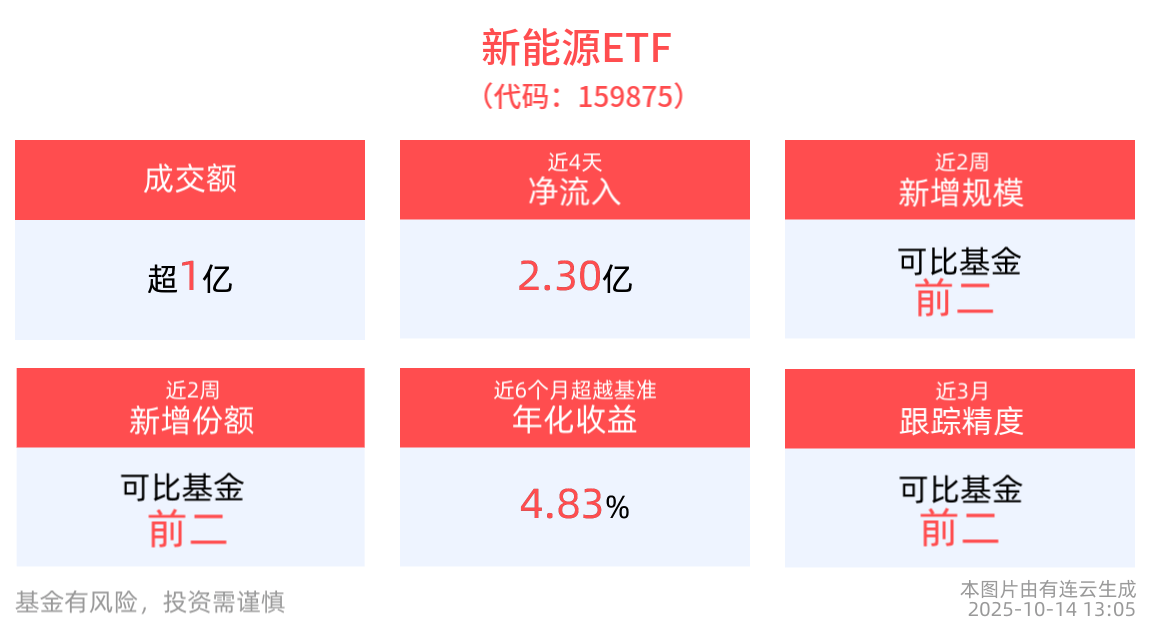
光伏行业“反内卷”持续推进,新能源ETF(159875)近4日“吸金”2.30亿元
Sou Hu Cai Jing· 2025-10-14 05:32
Group 1: Market Performance - The New Energy ETF has seen a turnover rate of 8.32% during trading, with a transaction volume of 1.22 billion yuan [3] - Over the past two weeks, the New Energy ETF's scale has increased by 1.59 billion yuan, indicating significant growth [3] - The number of shares for the New Energy ETF has grown by 279 million shares in the last two weeks, also reflecting substantial growth [3] - In the last four trading days, the New Energy ETF has recorded net inflows on three occasions, totaling 230 million yuan [3] - As of October 13, the New Energy ETF's net value has risen by 60.34% over the past six months, ranking 316 out of 3737 in index stock funds, placing it in the top 8.46% [3] - Since its inception, the New Energy ETF has achieved a maximum single-month return of 25.07%, with the longest consecutive monthly gains being five months and a maximum cumulative increase of 62.44% [3] Group 2: Industry Insights - The photovoltaic industry, facing severe supply-demand imbalances and significant profit pressures, is expected to benefit from the recent political focus on "anti-involution" [4] - The current "anti-involution" efforts in the photovoltaic sector have made progress in two main areas: 1. Price: The price of silicon materials has significantly increased, which is expected to lead to a continuous recovery in downstream prices [4] 2. Capacity: Mergers and acquisitions in silicon material production are ongoing, indicating a positive outlook for the sustainability of the current "anti-involution" trend [4] Group 3: Stock Performance - As of September 30, 2025, the top ten weighted stocks in the CSI New Energy Index include CATL, Sungrow Power, EVE Energy, LONGi Green Energy, Huayou Cobalt, TBEA, China Nuclear Power, Ganfeng Lithium, Lead Intelligent, and Three Gorges Energy, collectively accounting for 45.2% of the index [6]


000969,4连板!A股这个板块大爆发,多股一字封板涨停
Zheng Quan Shi Bao· 2025-10-14 04:55
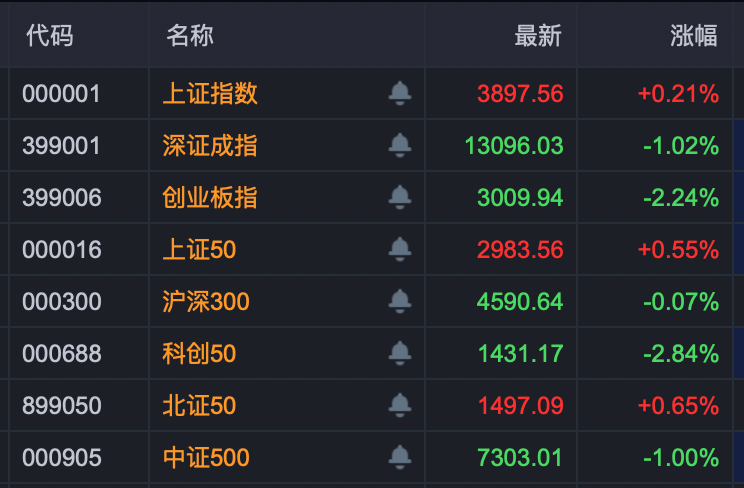
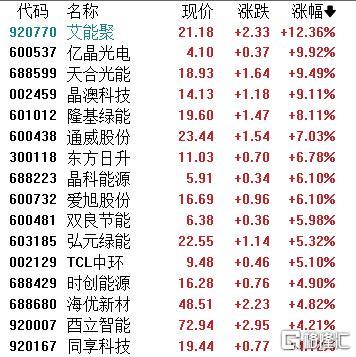
Market Overview - A-shares opened higher but experienced fluctuations, with the Shanghai Composite Index and North China 50 slightly in the green, while the Shenzhen Component, ChiNext, and Sci-Tech 50 indices turned negative [1] - The number of declining stocks outnumbered advancing stocks, with trading volume remaining stable [1] Sector Performance - The photovoltaic, non-ferrous metals, cultivated diamonds, and coal sectors showed significant gains, while communication equipment, semiconductors, consumer electronics, and industrial software sectors faced declines [1] Photovoltaic Sector - The photovoltaic concept stocks surged, with the photovoltaic equipment sector leading the gains, rising nearly 7% at one point, and midday trading volume exceeding the previous day's total [3] - Longi Green Energy hit the daily limit and reached a new high for the year, closing with an 8.11% increase [3] - Other notable performers included Ainuoju and Yijing Photovoltaic, both achieving strong gains of over 10% [3] Non-Ferrous Metals Sector - The non-ferrous metals sector continued to strengthen, with the sector index reaching a historical high [6] - Antai Technology and Chuangjiang New Materials both hit the daily limit, with Antai's stock price reaching a 10-year high [6] - Positive factors such as product price increases and rising downstream demand have led to several companies in the sector issuing profit forecasts, with five out of six companies expecting net profit growth of over 100% year-on-year for the first three quarters of 2025 [9] Profit Forecasts - Chuangjiang New Materials projected a net profit of 350 million to 380 million yuan for the first three quarters of 2025, representing a year-on-year increase of 2057.62% to 2242.56% [10] - Other companies like Northern Rare Earth and Yuyuan New Materials also forecasted significant profit growth, with increases of 272.54% to 287.34% and 101% to 127% respectively [10] - The non-ferrous metals industry is expected to maintain high growth in the first half of 2025, supported by favorable policies and market conditions [10] Policy and Market Dynamics - The photovoltaic industry is a key focus for "anti-involution" governance, with multiple policies introduced to improve pricing mechanisms and combat illegal practices [5] - The average price increase for the four main materials in the photovoltaic supply chain reached nearly 35% in Q3, marking the best quarterly performance in three years [5] - Analysts suggest that the photovoltaic sector is at a turning point, with improving fundamentals and potential for recovery [5]


反内卷新政将至?海外订单密集落地,引爆港A光伏板块
Ge Long Hui· 2025-10-14 04:28
Core Viewpoint - The photovoltaic sector in both Hong Kong and A-shares has shown strong performance, with significant price increases in various companies, driven by multiple favorable factors including price stabilization, policy expectations, and accelerated overseas expansion [1][6][7]. Group 1: Market Performance - The A-share photovoltaic equipment sector has seen substantial gains, with companies like Aiko Solar rising over 12% and LONGi Green Energy increasing by over 8% [1]. - In the Hong Kong market, solar stocks such as Flat Glass Group and Xinyi Solar have also risen by more than 5% [1]. - The photovoltaic sector has experienced a cumulative increase of over 8% since September 24, and a 45% increase from the year's low on April 9 [4]. Group 2: Supporting Factors - The recovery in the photovoltaic supply chain prices has been a key factor supporting market confidence, with prices for polysilicon, wafers, cells, and modules all rising [6]. - There are strong expectations for new policies aimed at regulating photovoltaic capacity, which have further boosted market sentiment [6]. - Recent reports indicate that the photovoltaic industry association held a meeting to discuss industry developments, reflecting high market attention towards policy changes [6]. Group 3: Overseas Expansion - Chinese photovoltaic companies are accelerating their overseas expansion, with significant orders from emerging markets like India, the Middle East, and Africa [7]. - Notable contracts include a 4GW solar project in Saudi Arabia worth approximately 17.65 billion yuan, and various agreements with countries like Pakistan and Iran for solar component supplies [7]. Group 4: Financial Performance and Outlook - Many photovoltaic companies faced pressure in the first half of 2025, with LONGi Green Energy reporting a revenue of 32.813 billion yuan, a year-on-year decline of about 14.83% [8]. - Despite losses, the reduction in loss margins indicates potential recovery, with market expectations shifting towards upcoming quarterly reports [8]. - Analysts believe the industry is entering a bottoming phase, with potential for a turnaround driven by improved fundamentals and policy support [9].

光伏产能调控政策将出台?隆基绿能涨停,板块集体走强
2 1 Shi Ji Jing Ji Bao Dao· 2025-10-14 03:50
Group 1 - The photovoltaic sector experienced a strong rebound, with leading company Longi Green Energy's stock price reaching a peak of 19.94 yuan, a rise of 9.98%, and a total market capitalization of 151.1 billion yuan [2] - The stock price movement is linked to rumors of a "de-involution" in the photovoltaic industry, alongside improvements in the company's fundamentals and favorable industry policies [2] - Regulatory authorities are expected to release a notification to strengthen photovoltaic production capacity control, with industry insiders anticipating significant policy developments [2] Group 2 - There is an expectation of price increases in photovoltaic components, marking a structural adjustment after an 18-month price downturn, with predictions of a rise in prices in the fourth quarter [3] - The price increase is driven by three key factors: controlled production capacity utilization in the polysilicon segment at 55%-70%, a 48% price surge in September, and the exit of outdated PERC production lines from the market [3] - The photovoltaic equipment sector index rose over 3%, with major companies like Trina Solar increasing by over 11%, and other key players such as Aiko Solar and JA Solar also seeing significant gains [3]
【大涨解读】光伏:行业预期“反内卷”新动作,落后产能有望加速出清,海外降息周期也有王推动需求提升
Xuan Gu Bao· 2025-10-14 03:03
Core Viewpoint - The photovoltaic sector experienced a collective surge, with multiple companies such as Yao Pi Glass, Yijing Photovoltaic, and Longi Green Energy reaching their daily price limits, indicating strong market performance and investor interest in the industry [1][2]. Group 1: Market Performance - Yao Pi Glass saw a price increase of 10.04%, reaching 8.22, with a market capitalization of 61.44 billion [2]. - Yijing Photovoltaic's stock rose by 9.92% to 4.10, with a market cap of 48.53 billion [2]. - Longi Green Energy's shares increased by 9.38% to 19.83, with a market capitalization of 1502.73 billion [2]. - Trina Solar and JA Solar also experienced significant gains, with increases of 9.77% and 8.88%, respectively [2]. Group 2: Industry Developments - Reports indicate that important policies regarding capacity regulation in the photovoltaic sector are expected to be released, aimed at addressing internal competition issues [3]. - The National Development and Reform Commission and the State Administration for Market Regulation have announced measures to combat price disorder in the market [3]. Group 3: Institutional Insights - The photovoltaic industry is showing a unified attitude towards price self-discipline, with expectations for continued self-regulatory actions into the second half of 2025 [4]. - The "anti-involution" measures have led to a recovery in multi-crystalline silicon prices, with leading silicon material companies beginning to restore profits [4]. - The photovoltaic glass market has shown signs of recovery since August, with prices significantly rebounding from July lows, benefiting overall industry profitability [4].


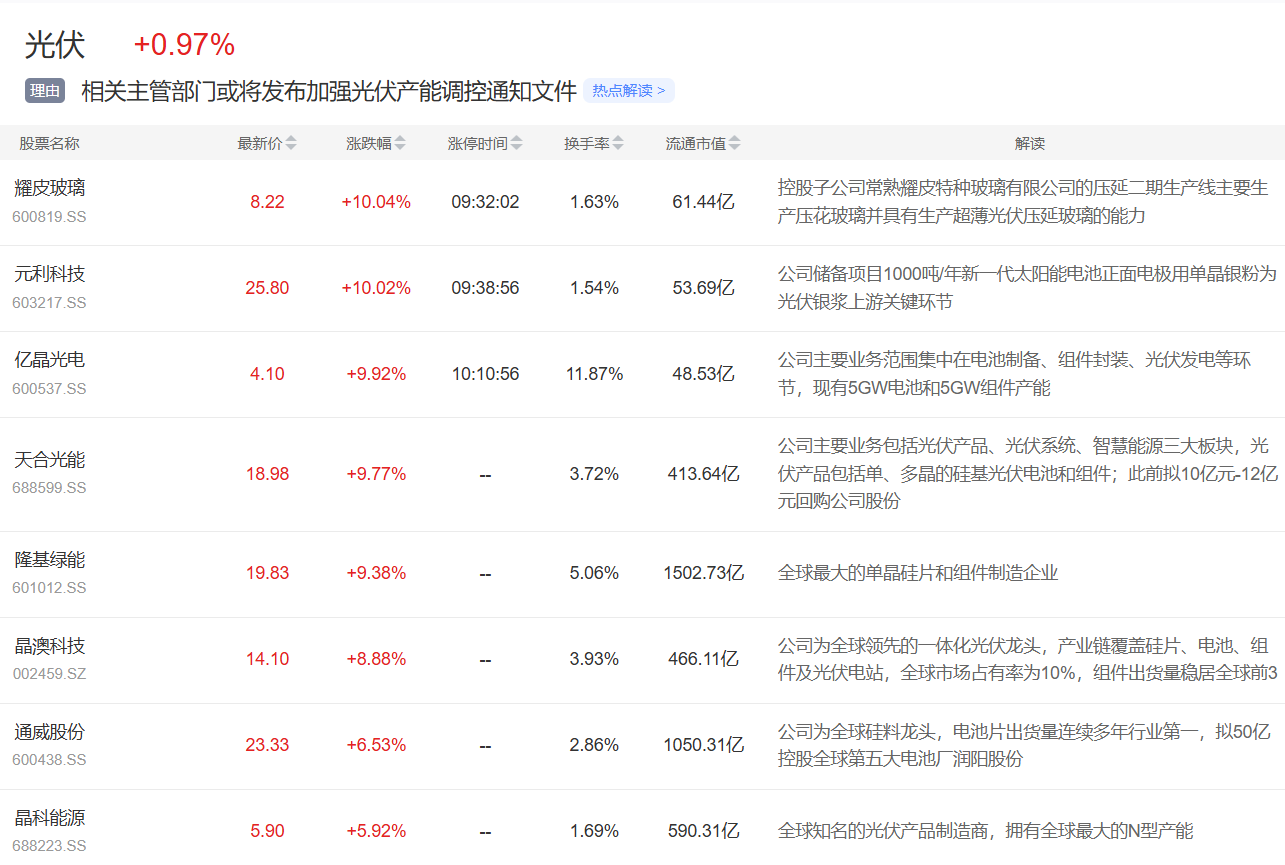
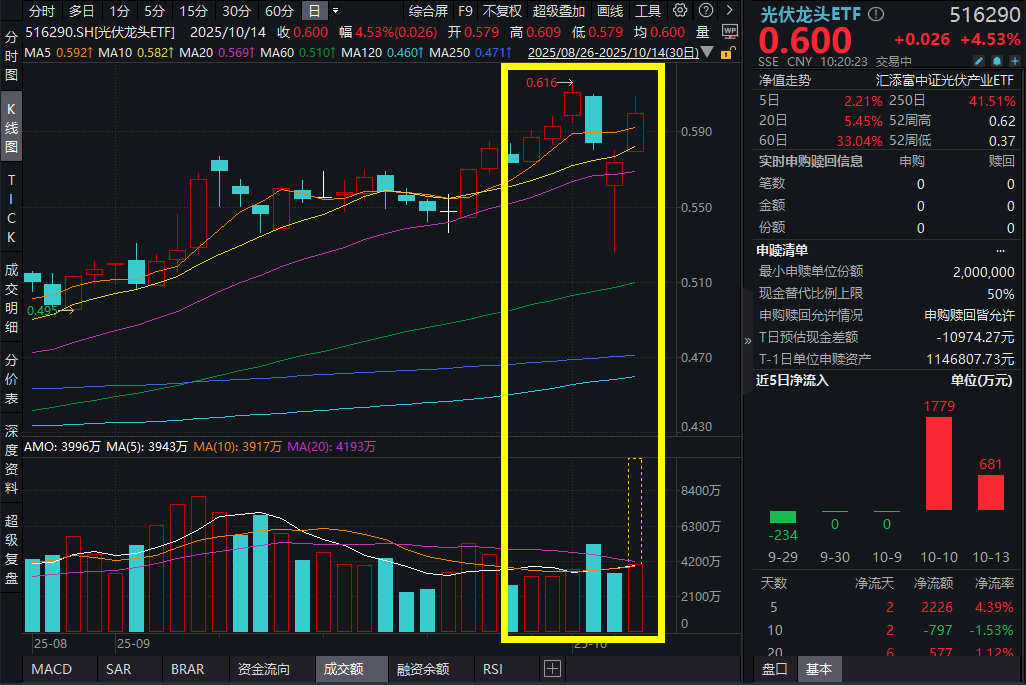
出海订单炸裂,光伏板块暴涨!千亿龙头隆基绿能快速涨停,光伏龙头ETF(516290)强势暴涨超5%,光伏反内卷进展明确,多项利好来袭!
Sou Hu Cai Jing· 2025-10-14 02:42
Core Viewpoint - The A-share market has shown a significant rebound, particularly in the photovoltaic sector, with major ETFs and stocks experiencing substantial gains, indicating a positive shift in investor sentiment and market dynamics [1][3]. Group 1: Market Performance - The photovoltaic sector has seen a strong performance, with the leading ETF (516290) surging by 4.53% and a total net inflow of 680.94 million yuan, accumulating 2.46 billion yuan over the past four trading days [1][3]. - The China Securities Photovoltaic Industry Index (931151) rose by 4.6%, with key stocks like Trina Solar (688599) up by 11.86% and JA Solar (002459) up by 8.57% [3]. Group 2: Policy and Industry Dynamics - Industry insiders anticipate the release of important policies aimed at regulating photovoltaic production capacity, which may help mitigate excessive competition within the sector [4]. - The National Development and Reform Commission and the State Administration for Market Regulation have issued a notice to combat price disorder, reinforcing the "anti-involution" policy direction in the photovoltaic industry [4][5]. Group 3: Demand and Supply Insights - Chinese photovoltaic companies have excelled in overseas markets, securing nearly 25 GW of major orders since September, particularly in the Middle East and South Asia [4]. - The supply side is expected to improve as the industry addresses overcapacity and price competition, with a focus on enhancing profitability across the supply chain [5][6]. Group 4: Future Outlook and Investment Opportunities - The photovoltaic industry's recovery hinges on several factors, including maintaining silicon material prices above production costs, successful price transmission for components, and ongoing technological innovations [6][7]. - The sector is anticipated to experience a fundamental recovery, with a focus on structural opportunities in materials like encapsulants, silicon materials, and battery components [4][5][6].