马太效应

Search documents
马太效应中的ETF:4个月再涨万亿规模,4家公募手握一半“蛋糕”
Sou Hu Cai Jing· 2025-08-26 14:20
Group 1 - The core viewpoint of the article highlights the rapid growth of ETF (Exchange-Traded Fund) assets in China, which surpassed 5 trillion yuan for the first time on August 25, 2023, reaching 5.07 trillion yuan [3][8] - The growth trajectory of ETFs has accelerated significantly, with the scale increasing from 4 trillion yuan to 5 trillion yuan in just four months, compared to previous milestones that took longer to achieve [8][10] - The dominance of leading fund management companies is evident, as the top four firms control half of the total ETF market, indicating a pronounced "Matthew Effect" where larger firms gain more advantages [5][7] Group 2 - As of July 2023, the total scale of public funds in China reached a new high of 35 trillion yuan, reflecting a thriving industry environment that supports the growth of ETFs [3] - Stock ETFs account for the largest share of the ETF market, with a scale of 3.46 trillion yuan, representing 68.15% of the total ETF assets [3] - Recent months have seen significant growth in specific ETFs, such as the Huabao CSI All-Share Securities Company ETF, which increased by 264.14 million shares in one month, and the Fuguo CSI Hong Kong Internet ETF, which grew by 138.48 million shares [3][4] Group 3 - The article notes that seven ETFs have seen over 100% growth year-to-date, all of which are cross-border ETFs, indicating strong performance in this segment [4] - The leading ETF management firms include Huaxia Fund, E Fund, and Huatai-PB Fund, with their respective ETF scales being 8587.87 billion yuan, 7957.01 billion yuan, and 5640.99 billion yuan [5] - The market is expected to continue expanding, driven by increased investor interest in index-based investments and the introduction of new ETF products, including those focused on innovative sectors [9][10]


天佑德酒2025半年报:营收短期承压,现金流大增136%凸显经营韧性
Quan Jing Wang· 2025-08-22 07:52
Core Insights - The white liquor industry is undergoing a deep adjustment period, characterized by a lack of expected V-shaped recovery and a new normal of "slowing overall volume and structural differentiation" [1][12] - The performance of Qinhai Huzhu Tianyoude Qingke Liquor Co., Ltd. (Tianyoude Liquor) reflects broader industry trends, with a significant decline in revenue and net profit in the first half of 2025 [1][5] - Despite challenges, Tianyoude Liquor has shown resilience through improved operating cash flow, indicating effective supply chain and channel management [2][8] Industry Dynamics - The "Matthew Effect" in the white liquor industry is intensifying, leading to pronounced tier differentiation among companies [3] - The growth model has shifted from "volume and price increase" to "volume decrease and stable price," driven by changes in population structure and consumer health awareness [3] - Consumers are becoming more rational, focusing on product value rather than brand prestige, prompting companies to reassess their product strategies [3][5] Company Strategies - Tianyoude Liquor has adopted a multi-dimensional strategy to navigate market pressures, focusing on product coverage across all price segments and enhancing market penetration in weaker areas [5][6] - The company has launched innovative promotional activities targeting core consumption scenarios, such as the "banquet market" in Qinghai [5][6] - A dual strategy of "uphill" and "downhill" is being implemented, enhancing brand presence in high-end segments while expanding product offerings in lower price ranges [6][11] Financial Performance - In the first half of 2025, Tianyoude Liquor reported a revenue of 674 million yuan, a year-on-year decrease of 11.24%, and a net profit of 51.46 million yuan, down 35.37% [1][8] - The company's operating cash flow net amount increased significantly by 136.47%, reflecting effective management of supply chain and channel funds [2][8] - The revenue from Qingke liquor products reached 570 million yuan, accounting for 99.06% of total liquor manufacturing revenue [6] Brand Development - Tianyoude Liquor is focusing on brand elevation through cultural initiatives and lifestyle marketing, aiming to enhance brand affinity and cultural content output [9][12] - The company has successfully engaged younger consumers with innovative products and marketing strategies, such as the "Drunk Beautiful Mountain Festival" [9][12] - Marketing efforts have shifted from traditional product-focused advertising to lifestyle-oriented campaigns, emphasizing the experience associated with the product [9][12] Future Outlook - The strategic choices of liquor companies will determine their future development paths amid industry differentiation [10][11] - For regional leaders like Tianyoude, focusing on core markets and products while avoiding blind national expansion is crucial [11] - Long-term innovation in product categories, taste, and marketing strategies will be essential for capturing the next generation of consumers [11][12]

牛市来了,还适合买宽基指数吗?
雪球· 2025-08-20 08:36
Core Viewpoint - The article discusses the challenges and considerations of identifying "mainline sectors" during a bull market, suggesting that broad-based indices may be a more pragmatic choice for most investors [4][6][18]. Group 1: Mainline Investment Temptation and Identification Challenges - In bull markets, mainline sectors often yield significant excess returns, with data showing that in 2020, the top three industry indices had returns of 190.96%, 138.41%, and 135.19%, while the CSI 300 index only rose by about 27.21% [6][7]. - The difficulty of accurately identifying mainline sectors beforehand is highlighted, as many investors may only realize what the mainline was after the market has moved [8][10]. Group 2: Real Obstacles in Mainline Identification - Three main obstacles to identifying mainline sectors are discussed: 1. Extreme internal differentiation within industries complicates stock selection, as seen in the 2025 market where the ground equipment sector had a 103.73% annual increase, but individual stocks within the sector varied significantly in performance [10]. 2. The acceleration of valuation bubbles poses greater risks than broad indices, as high valuations can lead to significant corrections if industry progress does not meet expectations [10][11]. 3. Behavioral biases can interfere with investment discipline, leading to premature profit-taking or overconfidence, which can result in substantial losses [11]. Group 3: Unique Value of Broad-Based Indices - Broad-based indices offer unique advantages in risk diversification, stable returns, and operational convenience. They provide a better risk-return ratio through cross-industry and cross-market capitalization allocation [12][13]. - Historical data shows that broad-based indices like the CSI 300 had significantly lower maximum drawdowns compared to industry indices during bull and bear markets [13][15]. - The operational convenience of broad-based indices is enhanced by a well-established ecosystem of investment tools, such as ETFs, which lower the barriers for non-professional investors [16]. Group 4: Conclusion and Strategy - The article concludes that while broad-based indices may not outperform leading mainline sectors, they are often a better choice for ordinary investors due to their ability to mitigate emotional trading and provide stable returns [18][19]. - A suggested investment strategy for ordinary investors is the "core-satellite" approach, allocating 60%-80% of the portfolio to broad-based ETFs to capture market beta, while using 20%-40% for selective participation in mainline sectors to manage risk exposure [19].

上市保险中介公司的发展路径与挑战
Sou Hu Cai Jing· 2025-08-20 07:02
Core Viewpoint - The insurance intermediary industry is undergoing a transformation by 2025, facing multiple development paths and challenges due to stricter regulations, intensified market competition, and evolving consumer demands [1] Group 1: Development Paths - Insurance intermediaries need to shift from "scale expansion" to "value creation," balancing short-term profits with long-term value through enhanced professional services and exploring sustainable business models [1] - Companies should leverage technology and digital transformation, utilizing AI and big data to optimize processes and improve customer experience, as seen with Yuanbao Group's AI-driven underwriting system [2] - Focusing on niche markets and differentiated competition is essential, with leading firms developing products for the silver economy and offering "insurance + health management" services [2] - Mergers and acquisitions are crucial for market share expansion, with companies acquiring regional firms or collaborating with tech and financial institutions to enhance service capabilities [2] - Capital operations and global expansion are vital, with firms utilizing stock issuance and asset-backed securities to enhance liquidity and enter emerging markets [2] Group 2: Challenges - The implementation of the "Uniform Pricing and Reporting Policy" has led to a 30% decrease in average commission rates, impacting short-term revenues for intermediaries [2] - Stricter regulations have increased compliance costs, requiring firms to invest in compliance systems and digital auditing tools to mitigate regulatory risks [2] - Smaller intermediaries face survival challenges amid increasing industry concentration, with many struggling to maintain operations and some even surrendering licenses [2] - The contradiction between technology investment and return on investment poses a challenge, as digital transformation requires significant upfront costs with delayed benefits [2] Group 3: Future Direction - The future direction for the industry emphasizes specialization and sustainable development, focusing on building long-term value through innovative and responsible business practices [2]
撤回潮!6家券商撤回基金托管申请
Zhong Guo Ji Jin Bao· 2025-08-20 05:53
Core Viewpoint - Six out of seven brokerages have withdrawn their applications for fund custody qualifications, leaving only Dongwu Securities remaining in the queue [1][2]. Group 1: Regulatory Changes - The China Securities Regulatory Commission (CSRC) has raised the asset requirement for securities firms from 20 billion yuan to 30 billion yuan for fund custody qualifications [4]. - The new regulations also introduced a "holding license" requirement, where institutions with an average custody scale below 5 billion yuan for 36 consecutive months may lose their qualifications [4]. Group 2: Industry Impact - The withdrawal of applications by smaller brokerages is attributed to increased resource demands for system construction, client promotion, and risk control [3]. - Currently, there are 66 financial institutions with custody qualifications, with a significant concentration among the top firms, as the top five brokerages account for 65.71% of the custody volume [5]. Group 3: Future Trends - The custody industry is expected to evolve from basic custody services to value-added services such as performance evaluation and compliance monitoring, forming a "custody+" service model [5]. - Major brokerages like Citic Securities and Guotai Junan are enhancing their service offerings and operational efficiencies to capture a larger market share [6].


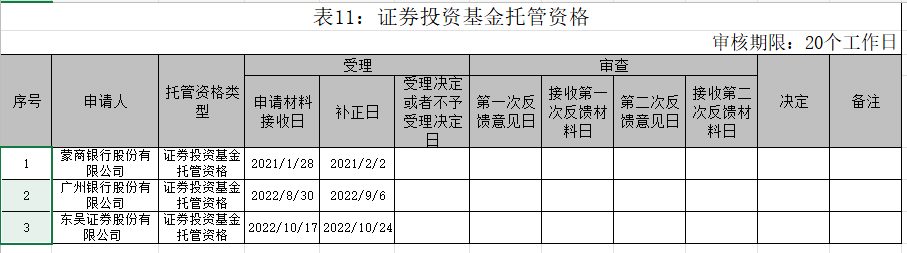
基金托管牌照热度骤降:券商申请潮退,市场格局生变
Sou Hu Cai Jing· 2025-08-19 16:19
Core Viewpoint - The enthusiasm for fund custody licenses has significantly decreased, with only three institutions currently applying for such qualifications, indicating a shift from a broad accessibility to a focus on leading players in the securities industry [1][2][3]. Summary by Sections Current Applications and Trends - As of now, only three institutions are in line to apply for fund custody qualifications: Mongolian Merchants Bank, Guangzhou Bank, and Dongwu Securities, with the latter being the only remaining brokerage firm [2]. - Previously, there were seven brokerages, including Western Securities, Caixin Securities, and others, that had applied for fund custody qualifications, but six have withdrawn their applications within a year [2][3]. Regulatory Changes - The decline in applications is attributed to new regulatory measures that have raised the entry barriers for fund custody licenses, making it difficult for smaller brokerages to meet the requirements [3][4]. - The new regulations, set to be implemented in 2025, include stricter compliance and risk management standards, requiring applicants to have a regulatory rating of at least level 2 or A class and a minimum net asset requirement of 50 billion RMB for banks and 30 billion RMB for securities firms [4]. Market Dynamics - The fund custody business is undergoing a transformation from a focus on scale to a focus on quality, with resources increasingly concentrating among leading firms [3][5]. - The number of qualified institutions has been reported at 66, with a significant portion being larger brokerages, indicating a trend where smaller firms may struggle to compete [6]. Future Outlook - The market is expected to see increased concentration, with stronger firms gaining market share due to higher entry barriers and a more rigorous exit mechanism [7]. - The business model for fund custody is anticipated to evolve from basic services to high-value comprehensive services, emphasizing technology and risk management capabilities [7]. - A differentiated market structure is likely to emerge, where leading brokerages may establish specialized subsidiaries for refined operations, while smaller firms may pivot to providing outsourced services [7].


百年保险资管董事长杨峻:被动投资大发展重塑资管价值创造逻辑
2 1 Shi Ji Jing Ji Bao Dao· 2025-08-18 10:58
Core Viewpoint - The rise of passive investment is reshaping the asset management industry, leading to three profound impacts: the toolization of Beta, the specialization of Alpha, and the intensification of the Matthew effect [1][5]. Group 1: Growth of Passive Investment - Passive funds are experiencing rapid growth across global markets, including the US, Europe, Japan, and China, with ETFs leading this trend [3]. - In China, the management fee for broad-based index ETFs has dropped to 15 basis points (bps), while thematic ETFs range from 20 to 60 bps, compared to 120 bps for active equity funds, highlighting a significant cost advantage for passive products [3][4]. - The new "National Nine Articles" policy supports the establishment of a fast-track approval process for ETFs, enhancing the efficiency of fund registration [3]. - Passive investment aligns with investor preferences, as it has a lower cognitive barrier and clearer investment themes, with pension finance being a significant driver of growth [3]. Group 2: Performance and Market Dynamics - Although there is some debate regarding performance, the difficulty for active equity funds to consistently outperform passive funds is increasing. In the US, only 21% of active funds outperformed passive funds over the past decade, while in China, 58% of active equity funds outperformed their passive counterparts in 2023, a decrease of 5 percentage points from 2022 [4]. - Passive investment products have become essential tools for both institutional and individual investors, meeting demands for transparency, low volatility, and cost efficiency [5]. Group 3: Alpha Specialization and Active ETFs - The challenge for active fund managers is significant, as deep Alpha extraction requires focusing on areas with low pricing efficiency and opaque information. Despite the overall trend, certain sectors like real estate and bonds still show potential for excess returns [6]. - Active ETFs may emerge as a key solution to balance low costs, high liquidity, and excess returns, combining active management capabilities with the transparency and liquidity of ETFs [7]. Group 4: Matthew Effect and Market Concentration - The Matthew effect is intensifying in the asset management industry, with the profitability of global asset management declining from 14.4 bps in 2021 to 11.6 bps in 2023, particularly in North America and the Asia-Pacific regions [8]. - In the passive equity fund sector, the top ten institutions are projected to hold 66% of the market share by 2024, with the top ten ETF providers accounting for 80% of the ETF market, compared to only 46% in the active equity fund space [8].

聚龙湾太古里一期计划年底开业;华润全国首座“万象里”亮相济南;蓝瓶咖啡将开北京首店
Sou Hu Cai Jing· 2025-08-18 06:46
Group 1: Commercial Real Estate Trends - The commercial real estate sector is experiencing a divergence, with leading companies like China Resources Land reporting a rental income of 18.56 billion yuan, a 12.2% increase, while weaker firms like China Evergrande face liquidation [2] - The average rental rate for retail properties under CapitaLand China Trust has decreased by 2.7%, yet occupancy remains high at 96.9%, indicating a scarcity of quality properties [2] - The industry is entering a new phase of competition focused on asset quality and operational capabilities, highlighting a "Matthew Effect" where the strong continue to thrive [2] Group 2: Outlet Market Developments - There is a surge in outlet development, with projects like the 3 billion yuan Panda-themed outlet in Chengdu and a 4 billion yuan "Outlet + Amusement Park" complex in Dongguan [3] - Vipshop's outlet same-store sales have seen double-digit growth, and the company is initiating a 3.48 billion yuan REIT fundraising, reflecting strong market confidence in this sector [3] - The trend indicates a rising concentration in the industry, with large-scale, themed, and experiential projects becoming the norm, putting pressure on smaller, homogeneous traditional outlets [3] Group 3: Retail Sector Transformation - Traditional retail is undergoing significant changes, with companies like Bubugao reporting a net profit of over 200 million yuan, largely due to adopting the "Fat Donglai model" which involves closing inefficient stores and revamping potential ones [4] - The first "Fat Donglai self-reform" store by Metro in Beijing has opened, confirming the replicability of this model [4] - In contrast, brands lacking differentiation and user experience, such as GU and Tsutaya Bookstore, are facing closures, indicating a shift towards user experience-centric retail [4] Group 4: Duty-Free Market Growth - The opening of the first city duty-free stores in Shenzhen and Guangzhou marks a significant development in the duty-free economy, following the implementation of new policies [5] - South Korea's announcement of visa-free entry for Chinese group tourists is expected to boost duty-free shopping, with Lotte Duty-Free strengthening partnerships with Chinese travel agencies [5] - City duty-free stores are anticipated to become a new engine for high-end consumption, creating new shopping experiences through a combination of "duty-free + consumption + experience" [5] Group 5: Consumer Spending Trends - In July, the total retail sales of consumer goods grew by 3.7%, with online retail sales increasing by 9.2% from January to July, accounting for 24.9% of total retail sales [6][7] - Companies like 361 Degrees reported a 45% growth in e-commerce business, while Moutai's net profit increased by 8.89%, indicating resilience in high-end brands [6][7] - The restaurant sector saw only a 1.1% increase in revenue, suggesting consumers are becoming more cautious with service-related spending [6][7]




公募行业分化态势明显 小公司步履维艰
Shang Hai Zheng Quan Bao· 2025-08-17 17:59
Group 1 - The public fund industry is experiencing significant differentiation, with leading companies showing resilience while smaller firms struggle to break even [1][3] - Major fund companies like Huaxia Fund and Yinhua Fund have reported improved performance in the first half of 2025, with Huaxia Fund achieving a revenue of 4.258 billion yuan, a year-on-year increase of 16.05% [1][2] - Huaxia Fund's assets under management reached 2.1 trillion yuan, marking a growth of over 310 billion yuan from the end of last year, and it is the first time its management scale has surpassed 2 trillion yuan [1][3] Group 2 - Smaller fund companies, such as Donghai Fund, are struggling, with Donghai Fund reporting a revenue of 32.69 million yuan and a net loss of 936,100 yuan for the first half of 2025 [2][3] - The total net asset value of public funds reached a historical high of 34.39 trillion yuan by the end of June, highlighting the stark contrast in scale between large and small firms [3][4] - The industry is witnessing a "Matthew Effect," where larger firms leverage their scale, product innovation, and brand influence to solidify their leading positions, while smaller firms seek differentiation to survive [4]
选股哲学的数学原理
猛兽派选股· 2025-08-16 19:19
Core Viewpoint - The article emphasizes the importance of a structured stock selection process, highlighting the need for independent thinking and a clear investment philosophy to identify potential stocks effectively. Group 1: Stock Selection Methodology - The use of stock screening tools is primarily for observing market trends and identifying key phases in stock movements, such as transitions from one stage to another [1] - A systematic approach is advocated, where stocks are prepared in advance based on their expected performance, rather than impulsively buying [1] - The article discusses the significance of understanding market rhythms and using various formulas to identify entry points for investments [1] Group 2: Stock Selection Philosophy - The first mathematical principle of stock selection is "less is more," which emphasizes narrowing down stock choices based on personal investment beliefs, such as focusing on performance growth [3] - The second principle is "compound growth," which suggests that ideal stocks should exhibit minimal drawdowns and consistent upward trends, avoiding erratic price movements [4] - The third principle is the "Matthew Effect," which describes how successful stocks tend to attract more investment, leading to a cycle of increasing returns for those stocks while weaker stocks struggle [5][6] Group 3: Investment Strategies - The article suggests that a focused investment strategy, based on a specific belief system, can lead to more effective stock selection and better overall performance [3] - It highlights the importance of maintaining flexibility in investment positions to adapt to market changes and avoid losses from poor-performing stocks [4] - The discussion on the Matthew Effect illustrates the tendency for stocks that perform well to continue doing so, reinforcing the need for investors to align with strong market trends [5][6]