
国内大循环

Search documents
国家统计局:我国经济实现全年预期目标具备较多有利条件
Zhong Guo Xin Wen Wang· 2025-11-14 07:49
Core Viewpoint - The Chinese economy is maintaining a stable growth trajectory despite facing various risks and challenges, supported by proactive macroeconomic policies and a focus on innovation and market expansion [1][2][3] Group 1: Economic Performance - The GDP growth rate for the first three quarters of the year is 5.2%, positioning China among the leading major economies globally [1] - From January to October, the industrial added value and service production index increased by 6.1% and 5.7% year-on-year, respectively, indicating robust growth [1] - The urban unemployment rate has continued to decline, and consumer prices have shown positive changes, transitioning from a decrease to an increase [1] Group 2: Demand Potential - The total retail sales of consumer goods increased by 4.3% year-on-year in the first ten months, surpassing the growth rate of the previous year [2] - Exports to ASEAN, the EU, and countries involved in the Belt and Road Initiative grew by 9.1%, 4.9%, and 5.9%, respectively, outpacing the overall growth rate of total goods imports and exports [2] - The focus on strengthening domestic circulation and promoting dual circulation is expected to further expand market demand [2] Group 3: New Productive Forces - The integration of technological and industrial innovation is accelerating, with new productive forces such as artificial intelligence, digital economy, and green economy gaining momentum [2] - The manufacturing value added for smart drones and smart vehicle-mounted devices increased by 54.7% and 25.5% year-on-year, respectively, reflecting strong growth in intelligent product manufacturing [2] - Production of bio-based chemical fibers and carbon fibers increased by 18.9% and 12.8%, respectively, indicating robust growth in green materials [2] Group 4: Macroeconomic Policies - Proactive macroeconomic policies are being implemented, including the introduction of 500 billion yuan in new policy financial tools to enhance local government financial capacity and stimulate effective investment [3] - Recent positive changes in market supply and demand have led to improved corporate profitability, with industrial enterprise profits increasing by 3.2% year-on-year from January to September [3] - The successful convening of the 20th Central Committee of the Communist Party has provided a strong impetus for high-quality development, reinforcing confidence in economic growth [3]
从多项细分数据中感知中国活力 10月份国民经济运行出现积极变化
Yang Shi Wang· 2025-11-14 07:08
Core Insights - The national economy in October 2025 maintained a stable and progressive development trend, with industrial production continuing to grow, particularly in equipment manufacturing and high-tech manufacturing sectors [1][8] Economic Performance - In October, the industrial added value of large-scale enterprises increased by 4.9% year-on-year and 0.17% month-on-month, with a cumulative growth of 6.1% from January to October [3] - The production index of the service industry rose by 4.6% year-on-year, with significant growth in information transmission, software and IT services (13.0%), leasing and business services (8.2%), and finance (5.6%) [3] - Consumer Price Index (CPI) increased by 0.2% year-on-year, reversing a decline of 0.3% in the previous month [3] Price Trends - Housing prices rose by 0.1%, while prices for daily necessities and services increased by 1.9%. Transportation and communication prices decreased by 1.5% [5] - Prices in education, culture, and entertainment rose by 0.9%, and healthcare prices increased by 1.4% [5] Trade and Investment - From January to October, general trade imports and exports grew by 2.3%, accounting for 63.4% of total imports and exports, with a 5.9% increase in trade with countries involved in the Belt and Road Initiative [5] - Fixed asset investment decreased by 1.7% year-on-year, attributed to multiple factors, but the investment structure is optimizing, indicating significant potential for future investment [12][14] Challenges and Future Outlook - The national economy faces challenges due to external instability and domestic structural adjustment pressures, necessitating a focus on innovation-driven growth and effective economic quality improvement [7][12] - The government aims to expand domestic demand, stabilize employment, and enhance market expectations while promoting macroeconomic policies to support sustainable growth [12][14]

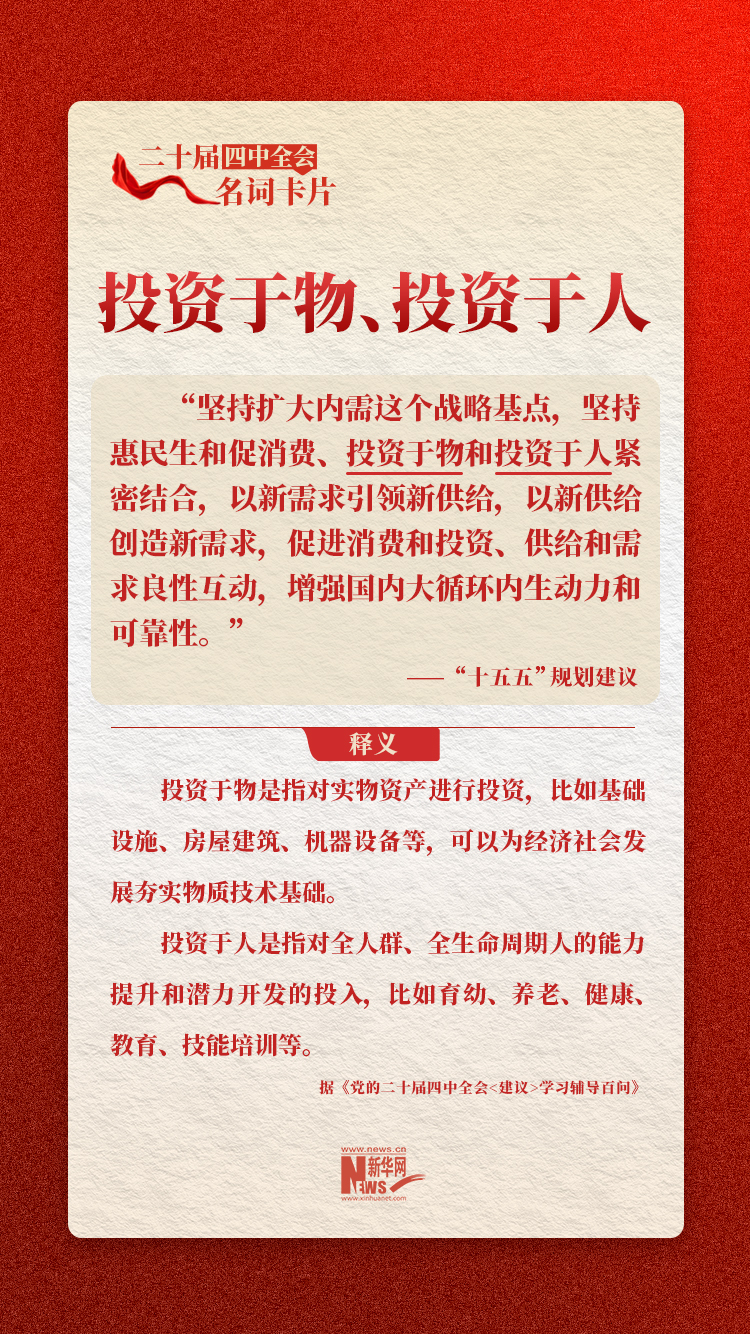
二十届四中全会名词卡片:投资于物、投资于人
Xin Hua Wang· 2025-11-13 13:19
Core Viewpoint - The article emphasizes the importance of balancing investments in physical assets and human capital to drive economic growth and improve living standards in China, highlighting the need for a strategic focus on both areas to enhance domestic demand and supply dynamics [2][8]. Group 1: Investment in Physical Assets - Investment in physical assets has played a crucial role in China's rapid economic development, leading to effective accumulation of physical capital, enhanced production capacity, and improved social productivity [6]. - Such investments are a significant component of total demand, driving economic growth, creating jobs, and increasing residents' wealth and consumption capacity [6]. - Recent investments in food reserves, energy bases, emergency supplies, and industrial backups have strengthened China's economic resilience and risk management capabilities [6]. Group 2: Potential for Further Investment in Physical Assets - There remains substantial potential for further investment in physical assets in China, as per capita capital stock is still relatively low compared to developed countries [7]. - The capital stock structure requires optimization, with some key industries facing insufficient investment and quality issues, necessitating upgrades to outdated machinery, infrastructure, and urban areas [7]. Group 3: Importance of Investment in Human Capital - The urgency of investing in human capital has become increasingly apparent, as the return on investment in physical assets has declined in recent years [8]. - To transition from a capital-intensive to a talent-intensive economy, it is essential to enhance investments in human capital, fostering human capital accumulation and creating a "human capital dividend" [8]. - Increased investment in education, healthcare, and elderly care is vital for improving living standards and achieving high-quality development for the population [8]. Group 4: Key Directions for Investment in Human Capital - Improving income distribution systems and ensuring fair compensation based on contributions is essential for promoting productivity [9]. - Advancing equal access to basic public services and reducing disparities between regions and demographics is a priority [9]. - Increasing government investment in areas such as childcare, education, healthcare, vocational training, and cultural sports is necessary to cover the entire population and lifecycle [9]. - Strengthening human resource development and investing in high-skilled talent, particularly in technology and innovation, is crucial for supporting high-quality development [9]. Group 5: Establishing Long-term Mechanisms for Human Capital Investment - Establishing a long-term mechanism for human capital investment involves optimizing fiscal responsibilities and resource allocation, enhancing local government assessment and incentive systems [10]. - It is important to stimulate the active participation of various stakeholders in investing in human capital and to include such investments in statistical accounting [10].
“十五五”规划分析及产业投资机遇展望
Ping An Securities· 2025-11-12 10:27
Group 1: Economic Strategy - The "15th Five-Year Plan" emphasizes economic construction as the core focus, aiming to build a modern industrial system centered on advanced manufacturing[9] - Key industrial development lines include "hard technology," advanced manufacturing, domestic circulation, and energy resource security[3] - The plan aims to create a market space of 10 trillion yuan by optimizing traditional industries and fostering emerging sectors over the next five years[8] Group 2: Hard Technology and Advanced Manufacturing - The plan highlights the importance of original innovation and key core technology breakthroughs, particularly in AI and digital technologies[12] - The automotive industry is expected to see accelerated commercialization of L3/L4 autonomous driving technologies during the "15th Five-Year Plan" period[34] - The focus on advanced manufacturing aims to enhance the global competitiveness of traditional industries like chemicals and machinery, with a push towards smart and green manufacturing[8] Group 3: Domestic Circulation and Consumption - The plan stresses the need to boost consumption and expand effective investment, particularly in the real estate sector, to support high-quality development[3] - The "anti-involution" policy is expected to improve the operational environment for construction materials and consumer goods, benefiting companies in these sectors[3] Group 4: Resource Security - The plan calls for strengthening the exploration and development of strategic mineral resources, particularly rare earths, to enhance their strategic importance[3] - It emphasizes the need for a new energy system, focusing on clean and efficient utilization of fossil energy while promoting renewable energy sources[3] Group 5: Market Outlook and Risks - The equity market is expected to maintain high volatility, with a focus on sectors benefiting from industrial recovery and performance superiority[3] - Key risks include macroeconomic fluctuations, lower-than-expected corporate profit growth, and geopolitical uncertainties[3]
黄奇帆:新格局下中国开放的新特点、新成就和新重点
Xin Lang Zheng Quan· 2025-11-11 23:07
Core Viewpoint - The new economic framework in China is characterized by a "dual circulation dynamic balance" system, emphasizing domestic circulation while promoting international engagement to foster mutual growth [1] Summary by Relevant Categories Economic Characteristics - China’s economy has developed five new characteristics over the past decade: 1. Trade policy has shifted from an export-oriented approach to a balanced focus on both imports and exports [1] 2. Capital flow has established a dual balance between outbound investments and inbound foreign capital [1] 3. Regional opening policies have evolved from a coastal-first strategy to a more balanced and coordinated approach across all regions, including East, South, West, North, and Central [1] 4. The scope of foreign trade has expanded from traditional manufacturing to include finance, education, healthcare, and service trade, creating a comprehensive and multi-channel opening pattern [1] 5. The focus has shifted from merely increasing flow and factors of openness to managing according to Free Trade Agreement (FTA) requirements, fostering a market-oriented, rule-of-law, and international business environment [1]
宏观周报:中美经贸会谈取得重要成果-20251109
KAIYUAN SECURITIES· 2025-11-09 13:45
Domestic Macro Policy - The "15th Five-Year Plan" emphasizes expanding domestic demand as a strategic foundation, aiming for GDP per capita to reach the level of moderately developed countries by 2035[2][9]. - The plan outlines that economic and social development should maintain an appropriate speed during the "15th Five-Year" period, with a focus on enhancing living standards and promoting consumption[9][10]. - Infrastructure policies include promoting the application of "AI + healthcare" and accelerating the cultivation of new application scenarios[3][11]. Monetary and Fiscal Policy - The central bank aims to narrow the short-term interest rate corridor and enhance the role of policy interest rates, with expectations of diverse monetary mechanisms by 2026[3][14]. - Fiscal policy will focus on optimizing expenditure structures and increasing the central government's financial contribution, with a goal to strengthen financial support for major strategic tasks and basic livelihood[3][16][17]. Real Estate and Trade Policies - Recent real estate policies aim to promote high-quality development, optimize the supply of affordable housing, and reform financing and sales systems[4][18]. - In trade, significant progress was made in US-China economic talks, with the US agreeing to suspend a 10% tariff on Chinese goods and a 24% tariff for one year[4][22][23]. International Monetary Policy - The Federal Reserve cut interest rates by 25 basis points, with internal divisions on future rate decisions, while the European Central Bank and Bank of Japan maintained their rates[4][25]. - The US government remains in a state of partial shutdown, affecting economic data availability and future monetary policy decisions[4][25]. Risk Factors - There is a risk of continued divergence in domestic and international monetary policies, with concerns that domestic policy execution may fall short of expectations[5][29].
机构论后市丨市场总量或维持震荡;四季度易成风格变化高发期
Di Yi Cai Jing· 2025-11-09 10:12
Group 1 - The A-share market is currently in a phase of balancing between policy expectations and economic realities, with a focus on maintaining reasonable liquidity through monetary policy [2] - The market is expected to shift from "monetary easing" to "fiscal expectations," with anticipated stronger fiscal policies aimed at expanding domestic demand and building a modern industrial system [2] - The "new quality productivity" and "domestic circulation" themes are expected to remain active despite the overall market maintaining a state of fluctuation [2] Group 2 - Growth style is expected to continue to outperform in the annual context, but the fourth quarter may see a stronger shift in investment styles, particularly towards undervalued sectors [3] - The strength of style changes in the fourth quarter may surpass that of valuation adjustments, influenced by the relative valuation advantages of value stocks compared to growth stocks [3] - The cyclical sectors may benefit from policies aimed at reducing competition and improving the fundamental outlook in the coming year [3] Group 3 - Recent market price increases are driven by anticipations of a cyclical upturn in the coming year, with historical patterns indicating that certain years are associated with rising PPI [4] - The overlap of China's five-year cycle and the U.S. four-year cycle is expected to culminate in a significant year for industrial metal prices in 2026 [4] - Current cyclical investment opportunities include sectors such as non-ferrous metals, steel, and building materials, which are seen as favorable for positioning [4] Group 4 - The market has experienced increased volatility since October, with a shift in the underlying structure of incremental capital affecting traditional aggressive timing strategies [5] - The stability of the corporate overseas environment and developments in AI are critical variables influencing market dynamics, impacting various sectors including TMT, non-ferrous metals, and chemicals [5] - The strategy for portfolio adjustment is focused on selecting stocks with a rising trend in ROE rather than avoiding AI narratives, which are seen as influencing market slopes rather than overall trends [5]
五矿证券:“十五五”规划建议全面解读
Sou Hu Cai Jing· 2025-11-08 02:04
Core Insights - The "15th Five-Year Plan" is positioned as a critical transitional phase towards achieving the goal of basic socialist modernization by 2035, building on the achievements of the "14th Five-Year Plan" [5][14] - The plan emphasizes high-quality development, balancing stable growth with efficiency improvements, and includes new targets for technological self-reliance and enhanced national security [6][22] Group 1: Development Goals - The plan sets multi-dimensional development goals, highlighting the importance of increasing total factor productivity (TFP) and improving the resident consumption rate [5][18] - It introduces a focus on technological self-reliance and prioritizes the well-being of citizens over ecological goals, reflecting a heightened emphasis on industrial autonomy and social welfare [6][22] Group 2: High-Quality Development - High-quality development is the central theme, aiming to enhance the global competitiveness of traditional industries while fostering strategic emerging industries such as renewable energy and low-altitude economy [6][25] - The plan stresses the integration of technology and industry, particularly in critical areas like integrated circuits and industrial machinery, to drive innovation [6][29] Group 3: Domestic and International Circulation - The plan aims to strengthen domestic circulation by boosting employment, increasing income, and enhancing public services to unlock consumption potential [2][33] - It emphasizes the construction of a unified national market to eliminate regional and industry barriers, facilitating smoother circulation of goods and services [2][35] Group 4: Common Prosperity - The plan addresses common prosperity by focusing on employment, income distribution, education, social security, and housing, aiming to expand the middle-income group and promote equitable access to public services [2][7] - It highlights the need for sustainable social security systems and improved housing security to enhance the quality of life for all citizens [7][22] Group 5: Safety and Development - The plan integrates safety and development, establishing a risk prevention system across key sectors such as supply chains, technology, energy, data, and finance [2][6] - It aims to enhance resilience by embedding risk management into economic activities and ensuring that safety requirements are reflected in market regulations [6][17] Group 6: Party Leadership - The comprehensive leadership of the Party is emphasized as a fundamental guarantee for the implementation of the plan, ensuring that political advantages are translated into governance effectiveness [2][7] - The plan calls for the establishment of a robust leadership system and the promotion of strict party governance and anti-corruption measures [2][7]

殷德生:构建新发展格局的重要支撑和实践路径
Jing Ji Ri Bao· 2025-11-07 00:31
当前,世界经济增长动能不足,全球发展赤字扩大,贸易保护主义加剧。面对日趋复杂严峻的外部 环境,我国提出的一个重大战略决策就是加快构建以国内大循环为主体、国内国际双循环相互促进的新 发展格局,并在实践中不断增强国内大循环内生动力和可靠性、提升国际循环质量和水平。习近平总书 记在《关于〈中共中央关于制定国民经济和社会发展第十五个五年规划的建议〉的说明》中指出:"外 部环境越是严峻复杂,越要加快构建新发展格局,牢牢把握发展主动权。当前和今后一个时期,要坚持 做强国内大循环,加快形成强大国内经济循环体系,以国内循环的稳定性对冲国际循环的不确定 性。"加快构建新发展格局是以习近平同志为核心的党中央根据我国发展阶段、环境、条件变化,特别 是基于我国比较优势变化,审时度势作出的重大决策,是事关全局的系统性、深层次变革,是立足当 前、着眼长远的战略谋划,需从全局和战略的高度准确把握加快构建新发展格局的战略构想,深刻理解 其重要意义,不断探索其实践路径。 抢抓机遇应对挑战的战略选择 2020年4月,习近平总书记在十九届中央财经委员会第七次会议上阐述对国家中长期经济社会发展 战略若干重大问题的深入思考时,首次提出"构建以国内大循 ...
构建新发展格局的重要支撑和实践路径
Jing Ji Ri Bao· 2025-11-06 22:44
当前,世界经济增长动能不足,全球发展赤字扩大,贸易保护主义加剧。面对日趋复杂严峻的外部环 境,我国提出的一个重大战略决策就是加快构建以国内大循环为主体、国内国际双循环相互促进的新发 展格局,并在实践中不断增强国内大循环内生动力和可靠性、提升国际循环质量和水平。习近平总书记 在《关于〈中共中央关于制定国民经济和社会发展第十五个五年规划的建议〉的说明》中指出:"外部 环境越是严峻复杂,越要加快构建新发展格局,牢牢把握发展主动权。当前和今后一个时期,要坚持做 强国内大循环,加快形成强大国内经济循环体系,以国内循环的稳定性对冲国际循环的不确定性。"加 快构建新发展格局是以习近平同志为核心的党中央根据我国发展阶段、环境、条件变化,特别是基于我 国比较优势变化,审时度势作出的重大决策,是事关全局的系统性、深层次变革,是立足当前、着眼长 远的战略谋划,需从全局和战略的高度准确把握加快构建新发展格局的战略构想,深刻理解其重要意 义,不断探索其实践路径。 具备坚实基础和诸多优势 "十四五"时期,构建新发展格局扎实推进。一方面,国内大循环主体地位巩固,内生动力日益强劲。 2021年至2024年,内需对经济增长的平均贡献率为86. ...