
市场流动性

Search documents
华泰期货流动性日报-20251024
Hua Tai Qi Huo· 2025-10-24 01:49
流动性日报 | 2025-10-24 市场流动性概况 2025-10-23,股指板块成交7975.09亿元,较上一交易日变动+35.61%;持仓金额13326.90亿元,较上一交易日变动 +7.74%;成交持仓比为60.11%。 国债板块成交4024.62亿元,较上一交易日变动+24.89%;持仓金额8034.74亿元,较上一交易日变动-1.93%;成交 持仓比为50.03%。 基本金属板块成交3433.19亿元,较上一交易日变动+19.10%;持仓金额5448.11亿元,较上一交易日变动+3.91%; 成交持仓比为75.77%。 贵金属板块成交9725.55亿元,较上一交易日变动-31.52%;持仓金额4662.87亿元,较上一交易日变动-2.70%;成交 持仓比为207.82%。 能源化工板块成交3999.06亿元,较上一交易日变动+0.06%;持仓金额4396.25亿元,较上一交易日变动-0.88%;成 交持仓比为72.45%。 农产品板块成交3156.62亿元,较上一交易日变动+0.12%;持仓金额5676.84亿元,较上一交易日变动-0.01%;成交 持仓比为53.30%。 黑色建材板块成交2327 ...
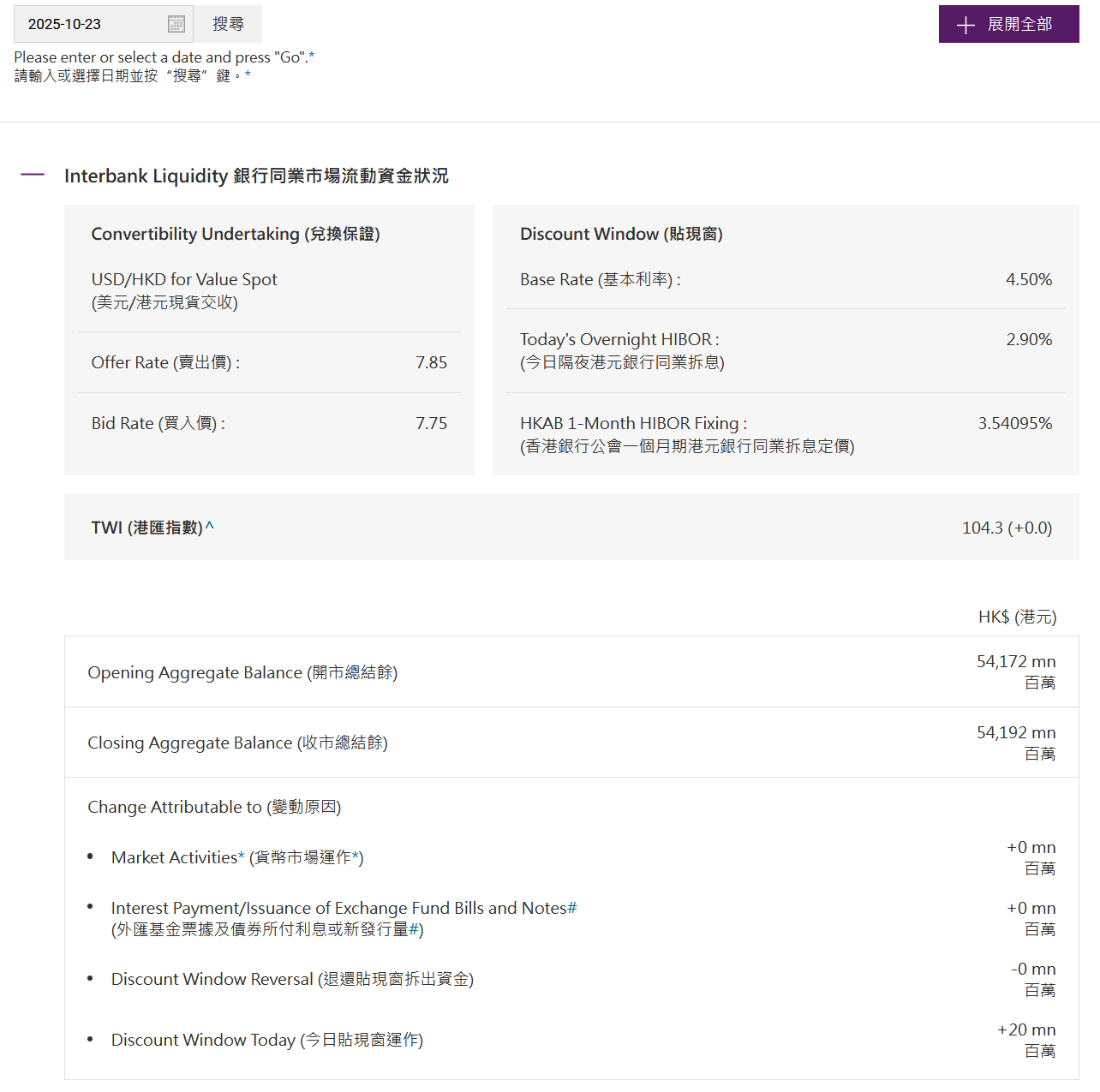
香港金管局通过贴现窗口向银行投放2000万港元流动性
智通财经网· 2025-10-23 12:48
Group 1 - The Hong Kong Monetary Authority (HKMA) provided a loan of HKD 20 million through the discount window to maintain market liquidity and stabilize the financial market [1] - The action taken by HKMA reflects its commitment to ensuring financial stability amid potential market fluctuations [1] Group 2 - The current overnight Hong Kong Interbank Offered Rate (HIBOR) is reported at 7.85 for the offer rate and 7.75 for the bid rate [2] - The aggregate balance at the opening and closing of the market is influenced by various factors, including market activities and interest payments [3] - The discount window reversal indicates the return of funds previously drawn from the discount window, which can affect liquidity levels in the banking system [3]

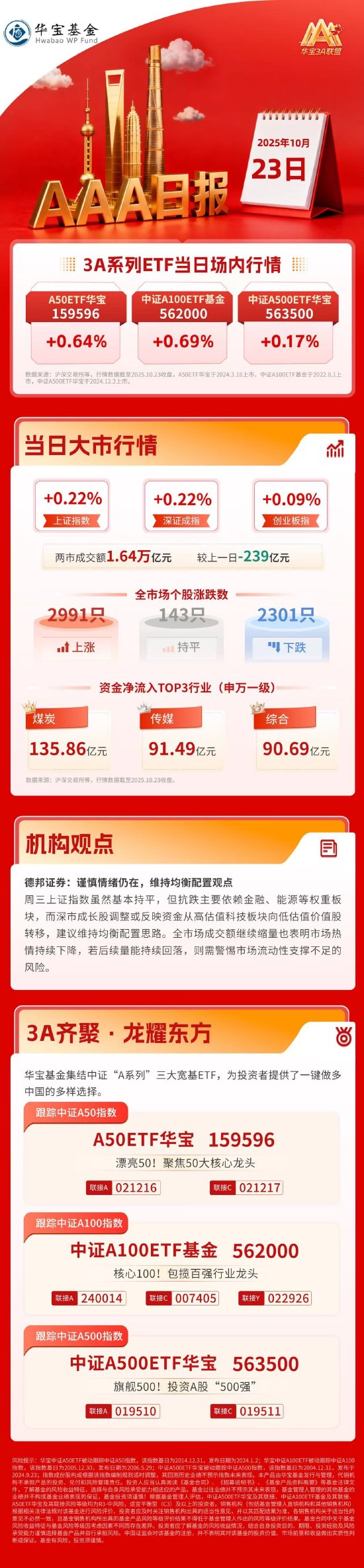
沪指尾盘发力极限翻红,煤炭、能源金属板块表现活跃,机构维持均衡配置观点| 华宝3A日报(2025.10.23)
Xin Lang Ji Jin· 2025-10-23 09:21
Group 1 - The market showed a slight increase with the Shanghai Composite Index remaining stable, primarily supported by financial and energy sectors, while growth stocks in the Shenzhen market adjusted, indicating a shift of funds from high-valuation tech stocks to undervalued value stocks [2] - The total trading volume in the market decreased to 1.64 trillion yuan, down by 239 billion yuan from the previous day, reflecting a continued decline in market enthusiasm [2] - The three major broad-based ETFs from Huabao Fund provide investors with diverse options to invest in China's market, tracking the CSI A50, CSI A100, and CSI A500 indices [2] Group 2 - The A50 ETF Huabao was launched on March 18, 2024, the China A100 ETF Fund on August 1, 2022, and the CSI A500 ETF Huabao on December 2, 2024 [1] - The market saw a net inflow of funds into specific sectors, indicating potential investment opportunities in those areas [1]
华泰期货流动性日报-20251022
Hua Tai Qi Huo· 2025-10-22 02:50
流动性日报 | 2025-10-22 市场流动性概况 2025-10-21,股指板块成交7535.01亿元,较上一交易日变动+6.44%;持仓金额12964.63亿元,较上一交易日变动 +3.00%;成交持仓比为58.11%。 国债板块成交3559.14亿元,较上一交易日变动-2.52%;持仓金额8228.00亿元,较上一交易日变动+1.34%;成交持 仓比为43.52%。 基本金属板块成交2850.28亿元,较上一交易日变动-16.99%;持仓金额5210.59亿元,较上一交易日变动-0.29%;成 交持仓比为60.62%。 贵金属板块成交11144.98亿元,较上一交易日变动-31.30%;持仓金额5259.23亿元,较上一交易日变动+2.15%;成 交持仓比为258.24%。 能源化工板块成交3854.59亿元,较上一交易日变动+5.74%;持仓金额4422.44亿元,较上一交易日变动-0.49%;成 交持仓比为70.19%。 农产品板块成交2977.98亿元,较上一交易日变动-7.71%;持仓金额5685.41亿元,较上一交易日变动+0.04%;成交 持仓比为45.48%。 黑色建材板块成交2160. ...
金银遭遇重挫 疯狂走势接近尾声?
Hua Er Jie Jian Wen· 2025-10-22 02:35
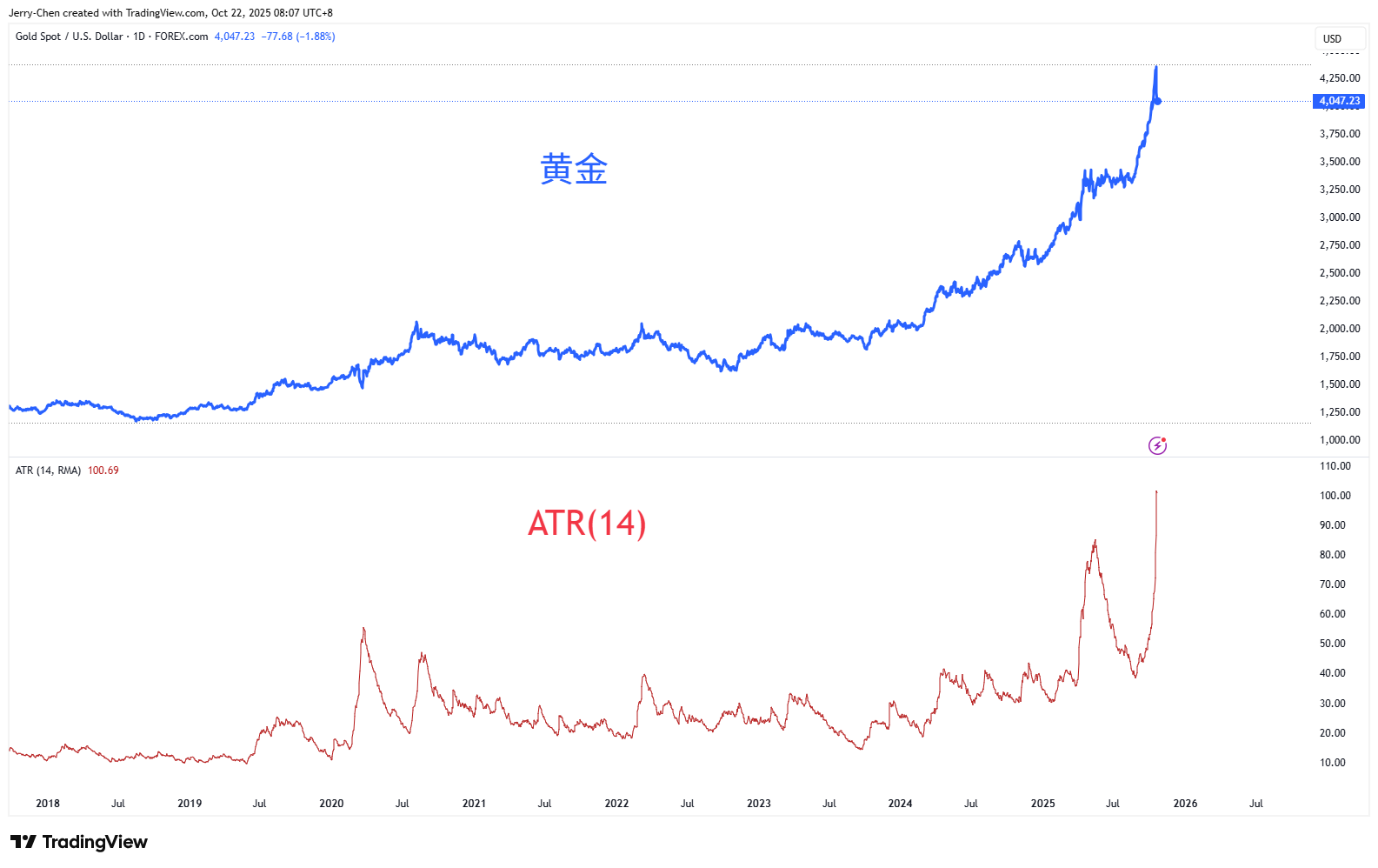
黄金白银周二经历史诗级暴跌,"高市交易"刺激美/日大幅上涨,美股涨跌不一。 现货黄金单日重挫5.3%,盘中一度跌破4100美元,最终收于4124美元,这是2020年8月11日以来的最大单日百分比跌幅。不过由于当前金价相较5年前已经 翻倍,因此周二近250美元的日内回撤幅度是当时的两倍还多。 除了黄金,近来顺风顺水的贵金属在周二集体遭遇滑铁卢。白银隔夜幅超7%,钯金和铂金的跌幅分别为5.8%和6.3%。 这是对近期疯狂行情的修正(获利了结),还是中期调整的信号? 黄金的衡量波动率的指标ATR(平均真实波幅)突破100美元。由于本周五有美国CPI数据公布,且目前多空双方势力更为均衡,因此黄金在本周剩余时间或 继续维持高波动。 但需要提醒的是,历史数据显示一旦ATR从峰值回落,黄金疯狂的涨势也将逐渐告一段落并转为震荡或下行走势。例如上次ATR在今年4月达到峰值,金价 在随后的5-8月进入横盘整理阶段。 另一个显示黄金可能遭遇阶段性调整的指标是金价和美国货币供应(M2)的比率。该数值达到自2011年以来的最高水平,这意味着相比于美国货币超发和 充裕的市场流动性,金价已经不再被低估。 与此同时,若把市值接近30万亿美元 ...
巴菲特嫌弃黄金,金价五年迭创新高,黄金到底值不值得买?
Sou Hu Cai Jing· 2025-10-21 11:07
Core Insights - The article discusses the enduring value of gold as a financial asset, contrasting it with other investments and highlighting its unique characteristics in the context of economic uncertainty and market dynamics [1][3][19] Group 1: Historical Context and Price Trends - Gold has seen significant price increases over the years, rising from 410 RMB per gram in 2020 to 1200 RMB per gram by October 2025, nearly tripling in value within five years [3] - Major events such as the 2008 financial crisis and the COVID-19 pandemic have led to spikes in gold prices, with gold reaching $1900 per ounce in 2011 and increasing by 36% in just seven months during the pandemic [5][9] - The price of gold is influenced by macroeconomic factors, including monetary policy and market liquidity, rather than solely by geopolitical events [9][17] Group 2: Supply and Demand Dynamics - The total amount of gold mined globally is approximately 205,000 tons, with an estimated 54,000 tons remaining to be mined, indicating a high barrier to entry for new supply [11] - Gold's supply is characterized by a low annual increase, never exceeding 2%, contrasting sharply with the rapid expansion of fiat currency [13] - Demand for gold is primarily driven by investment and jewelry, with central bank purchases accounting for only 20.4% of total gold sales, while jewelry demand constitutes 36.2% [17] Group 3: Investment Characteristics - Gold serves as a hedge against economic uncertainty, appealing primarily to high-net-worth individuals who prioritize capital preservation over short-term gains [15][19] - The volatility of gold prices, with an annualized volatility of 15.5%, makes it a risky investment for ordinary investors who may not be able to absorb significant price fluctuations [15] - Gold does not generate income like stocks or bonds, making it a unique asset that retains value without relying on credit or government backing [13][19]


华泰期货流动性日报-20251021
Hua Tai Qi Huo· 2025-10-21 02:39
Report Industry Investment Rating - Not provided in the given content Core Viewpoint - The report presents the market liquidity situation of various sectors on October 20, 2025, including trading volume, holding amount, trading - holding ratio, and their changes compared to the previous trading day [1][2] Summary by Directory 1. Plate Liquidity - Multiple figures are used to show the trading - holding ratio, transaction amount change rate, holding volume, holding amount, trading volume, and transaction amount of each sector, with data sources from Flush and Huatai Futures Research Institute [4][5][8] 2. Stock Index Plate - On October 20, 2025, the stock index plate had a trading volume of 707.913 billion yuan, a 26.46% decrease from the previous trading day; the holding amount was 1258.663 billion yuan, a 2.50% decrease; the trading - holding ratio was 55.88%. There are also detailed figures about the price change rate, trading - holding ratio, and other indicators of each variety in the stock index plate [1][5] 3. Treasury Bond Plate - On October 20, 2025, the treasury bond plate had a trading volume of 365.097 billion yuan, a 0.38% increase from the previous trading day; the holding amount was 811.886 billion yuan, a 1.87% decrease; the trading - holding ratio was 44.77%. There are also detailed figures about the price change rate, trading - holding ratio, and other indicators of each variety in the treasury bond plate [1][5] 4. Base Metals and Precious Metals (Metal Plate) - On October 20, 2025, the base metals plate had a trading volume of 343.366 billion yuan, a 7.22% decrease from the previous trading day; the holding amount was 522.558 billion yuan, a 0.10% decrease; the trading - holding ratio was 65.34%. The precious metals plate had a trading volume of 1622.201 billion yuan, a 3.11% increase; the holding amount was 514.839 billion yuan, a 5.58% decrease; the trading - holding ratio was 395.70%. There are also detailed figures about the price change rate, trading - holding ratio, and other indicators of each variety in the metal plate [1][5] 5. Energy and Chemical Plate - On October 20, 2025, the energy and chemical plate had a trading volume of 364.539 billion yuan, an 8.64% decrease from the previous trading day; the holding amount was 444.413 billion yuan, a 0.31% increase; the trading - holding ratio was 70.33%. There are also detailed figures about the price change rate, trading - holding ratio, and other indicators of each major variety in the energy and chemical plate [1][5] 6. Agricultural Products Plate - On October 20, 2025, the agricultural products plate had a trading volume of 322.678 billion yuan, a 4.22% increase from the previous trading day; the holding amount was 568.290 billion yuan, a 0.77% increase; the trading - holding ratio was 51.36%. There are also detailed figures about the price change rate, trading - holding ratio, and other indicators of each major variety in the agricultural products plate [1][5] 7. Black Building Materials Plate - On October 20, 2025, the black building materials plate had a trading volume of 274.430 billion yuan, a 16.23% increase from the previous trading day; the holding amount was 358.618 billion yuan, a 1.98% increase; the trading - holding ratio was 74.05%. There are also detailed figures about the price change rate, trading - holding ratio, and other indicators of each variety in the black building materials plate [2][5]
如何理解 10月份LPR“按兵不动”
Jin Rong Shi Bao· 2025-10-21 01:07
Group 1 - The Loan Prime Rate (LPR) for 1-year remains at 3.0% and for 5-year and above at 3.5%, unchanged for five consecutive months [1] - The average interest rate for new corporate loans in September was approximately 3.1%, down about 40 basis points year-on-year, while the average rate for new personal housing loans was also around 3.1%, down about 25 basis points year-on-year [1] - Experts believe that the current low levels of both corporate and personal loan rates indicate that guiding a decrease in LPR is not an urgent matter [1] Group 2 - Economic indicators such as consumption, investment, and industrial production have shown a downward trend due to multiple factors including extreme weather and adjustments in the real estate market [2] - The stability of the LPR is attributed to the overall monetary policy being in an observation phase since the third quarter, following earlier fiscal policy support and interest rate cuts [2] - Future monetary policy is expected to maintain a moderately accommodative stance, with continued adjustments to short- and medium-term market liquidity to support government bond issuance and increased credit supply [2]
聚焦关税进展与四季度方向
2025-10-20 14:49
Summary of Conference Call Records Industry or Company Involved - Focus on the impact of tariffs and market strategies for the fourth quarter of 2025 - Discussion on the strategic value of China's rare earth resources Core Points and Arguments Market Conditions and Strategies - Short-term market volatility is heavily influenced by sentiment, with technical support levels being more critical than fundamentals [1][2] - Investors who have reduced positions may consider selectively buying quality structural assets, while those who have not should avoid hasty adjustments based on emotional market fluctuations [1][2] - The U.S.-China tariff negotiations may see short-term progress, but long-term uncertainties are increasing, with high tariffs being detrimental to both sides [1][2][3] - The current market liquidity is abundant, leading to a pursuit of scarce returns, which has resulted in localized inflation [1][5] Asset Performance and Allocation - In Q4, the focus for asset allocation is on gold, dividends, and growth assets, which have all seen a rise this year, breaking traditional asset pricing logic [1][4] - The performance of these asset classes is influenced by various factors, including geopolitical tensions, global decoupling, and central bank gold purchases [1][4] - The U.S. market shows a disparity between strong growth in the tech sector and weakness in other areas, exacerbated by the acceleration of AI investments [1][6] Credit Cycle and Economic Outlook - The applicability of the Merrill Lynch clock framework in China is limited due to significant policy expectations and evident disparities in economic performance [2][7] - Future asset rotation can be analyzed through the intensity of credit expansion in both government and private sectors, with a focus on indirect financing [2][8] - The credit cycles in the U.S. and China may diverge, with the U.S. potentially moving towards recovery while China may experience stagnation or slight slowdown [2][9] Export Dynamics and Trade Relations - China's exports have exceeded expectations, with a year-to-date growth rate of 6.1% in dollar terms, despite a nearly 20% decline in exports to the U.S. [2][12][14] - The structure of China's exports is changing, with an increasing proportion of intermediate goods, which are essential for industrial production [2][12][13] - The strategic value of rare earth resources is highlighted, with China holding a dominant position in both reserves and the entire supply chain [2][21][22] Rare Earth Resources and Strategic Implications - China's rare earth resources account for 34% of global reserves, with a significant share in heavy rare earths [2][21] - Recent export control measures have enhanced China's control over rare earth resources, impacting global supply chains and U.S. companies [2][22] - The demand for high-performance permanent magnet materials is expected to grow, with a projected annual increase of over 10% in the coming years [2][22] Other Important but Possibly Overlooked Content - The current geopolitical landscape and the restructuring of the global dollar monetary system are influencing asset performance and investment strategies [1][4] - The potential for localized inflation due to abundant liquidity and the pursuit of scarce returns is a critical factor for investors to consider [1][5] - The implications of U.S.-China trade relations on agricultural commodities, particularly soybeans, are significant, with price pressures observed due to tariffs [2][17][19]
策略周报(20251013-20251017)-20251020
Mai Gao Zheng Quan· 2025-10-20 07:35
Market Liquidity Overview - R007 decreased from 1.4850% to 1.4685%, a reduction of 1.65 basis points; DR007 fell from 1.4229% to 1.4085%, down 1.44 basis points. The spread between R007 and DR007 narrowed by 0.21 basis points [9][13] - The net inflow of funds this week was 11.43 billion, a decrease of 28.91 billion from the previous week, with total fund supply at 80.86 billion and demand at 69.43 billion. Fund supply decreased by 4.56 billion, with net financing buy decreasing by 60.09 billion, while stock dividends increased by 39.30 billion [13][16] Industry Sector Liquidity Tracking - Most sectors in the CITIC first-level industry index declined, with the banking sector showing the strongest performance, up 4.99%, while the electronics and media sectors led the declines, down 7.10% and 6.28% respectively [18][20] - The net inflow of leveraged funds was highest in the non-ferrous metals sector, with a net inflow of 5.15 billion, while the electronics sector saw a significant net outflow of 6.23 billion [21][22] Style Sector Liquidity Tracking - Most style indices experienced declines, with the growth style suffering the largest drop of 5.82%, followed by the cyclical style at 3.78%. The growth style remains the most active sector, accounting for 55.99% of average daily trading volume [32][33] - The average turnover rate for the growth style was the highest at 2.98%, while financial and stable styles had relatively low turnover rates [33]