日本央行加息

Search documents
策略师:仅凭美日贸易协议,日本央行不会加息
news flash· 2025-07-23 00:32
金十数据7月23日讯,东京三井住友银行首席外汇策略师置评美日贸易协议:这对日本经济来说是个好 消息。然而,仅凭这一点并不会促使日本央行提高利率,而且对购买日元的推动力可能有限。如果说有 什么不同的话,那就是政治不稳定对市场的影响更大,日元贬值的压力可能会继续下去。 策略师:仅凭美日贸易协议,日本央行不会加息 ...
石破茂大选惨败严重冲击!日本央行还会加息吗?
Jin Shi Shu Ju· 2025-07-22 06:34
Core Viewpoint - The recent election results in Japan may create a dilemma for the central bank, as increased spending could keep inflation high, while political paralysis and global trade tensions provide reasons to delay interest rate hikes [2][3] Economic Impact - Rising living costs contributed to the ruling coalition's defeat in the recent Senate elections, with inflation exceeding the Bank of Japan's 2% target for over three years [2] - Analysts warn that ongoing political uncertainty could weaken the yen and increase import costs, exacerbating price pressures [2][3] Central Bank Strategy - New Bank of Japan member Junko Koeda emphasized the need to monitor the "second-round effects" of rising rice costs, while other members suggest that the central bank may need to resume rate hikes as inflation risks increase [2][3] - The Bank of Japan's current strategy involves a cautious approach, with a pause in rate hikes until the economic impact of U.S. tariffs is clearer [4] Political Dynamics - Prime Minister Kishida plans to collaborate with other parties to mitigate inflation's impact on households, potentially leading to a supplementary budget larger than last year's 14 trillion yen (approximately 95 billion USD) [3] - The ruling coalition's minority status in both houses of parliament may necessitate compromises with opposition parties advocating for tax cuts and increased spending [3] Currency and Market Reactions - Analysts express concerns that Japan's significant debt and political instability may weaken the yen, casting doubt on the central bank's view that cost-push inflation will ease later this year [3][4] - A potential decline in the yen could trigger further interest rate hikes by the Bank of Japan, as historical precedents show sensitivity to political dynamics [5]
财政政策或加码?日本参院选举,五大不确定性下的政策变局
Hua Er Jie Jian Wen· 2025-07-17 09:20
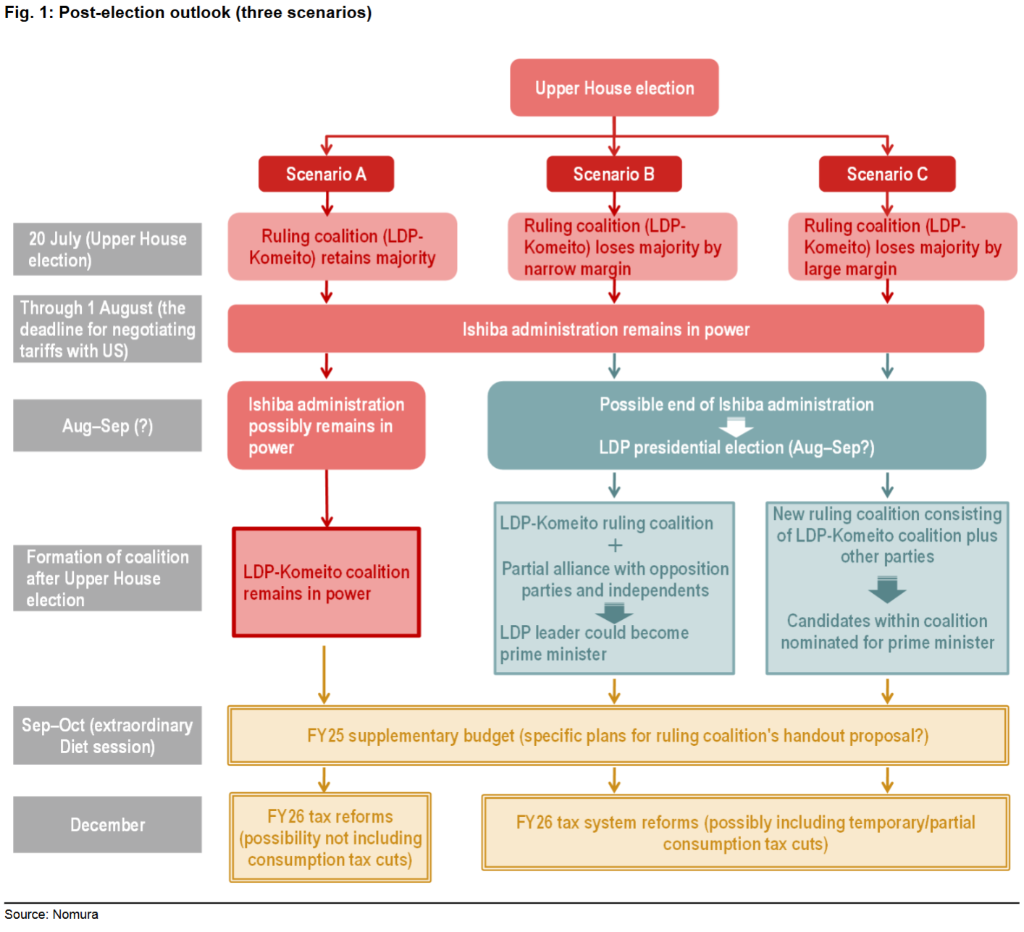
Core Viewpoint - The upcoming Japanese Senate election poses significant challenges for the ruling coalition, which must secure at least 50 additional seats to maintain a majority in the Senate [1][2]. Group 1: Election Context - The ruling coalition, consisting of the Liberal Democratic Party (LDP) and Komeito, currently holds 75 non-renewable seats in the Senate and needs to win 50 more to maintain a majority [1]. - The election outcome could lead to various fiscal policies, including cash handouts and potential consumption tax cuts, depending on the coalition's performance [2][3]. Group 2: Possible Scenarios - Scenario A: The ruling coalition retains a majority, increasing the likelihood of cash handouts being included in the 2025 supplementary budget, but no consumption tax cuts in the 2026 tax reform proposal [2]. - Scenario B: The ruling coalition slightly loses its majority, leading to potential alliances with opposition parties, which may result in both cash handouts and temporary consumption tax cuts [3]. - Scenario C: A significant loss of majority may force the ruling coalition to include opposition parties, facing pressure for both cash handouts and consumption tax cuts [4]. Group 3: Economic Impact - The cash handout policy, amounting to approximately ¥3.5 trillion (about 0.6% of GDP), is expected to have limited impact on economic growth, with only a projected 0.2% increase in private consumption and 0.1% in GDP [7][9]. - In contrast, a reduction in the food consumption tax from 8% to 0% could lead to a more substantial GDP growth of about 0.5% due to a decrease in the effective consumption tax rate [9]. - Analysts warn that temporary consumption tax cuts may lead to a significant GDP decline of 6% in Q2 2027 when these measures expire, potentially prompting political pressure to extend them [12]. Group 4: Monetary Policy Outlook - Despite uncertainties surrounding the election, expectations remain that the Bank of Japan will raise interest rates in January 2026, maintaining the policy rate unchanged for the remainder of the fiscal year [13].

日本参议院选举引发财政担忧 10Y日债利率创17年新高
智通财经网· 2025-07-15 06:58
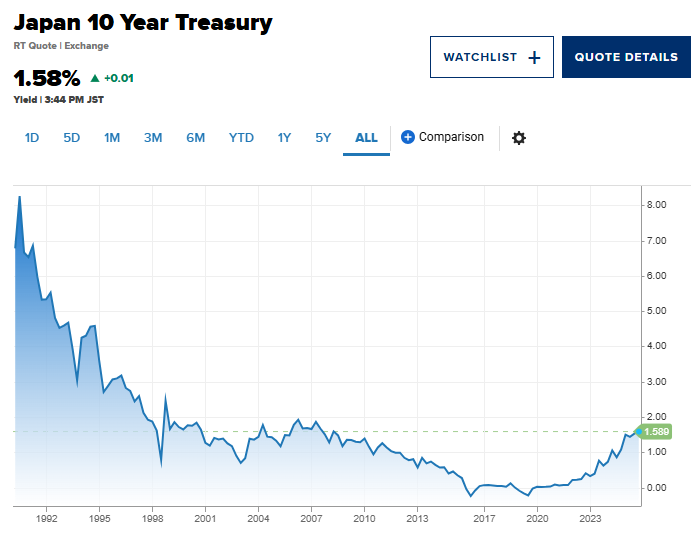
Group 1 - Japan's 10-year government bond yield has risen to 1.599%, the highest level since 2008, driven by concerns over fiscal spending ahead of the upcoming Senate elections [1] - The 30-year Japanese government bond yield reached a record 3.21%, while the 20-year yield hit its highest level since 1999 [1] - Market expectations of fiscal expansion policies due to the Senate elections are contributing to the rise in long-term and ultra-long-term bond yields [1][3] Group 2 - Discussions among Japanese politicians regarding lowering the consumption tax are intensifying ahead of the Senate elections, which may lead to increased economic volatility [3] - The current inflation rate in Tokyo decreased to 3.1% in June from 3.6% in May, but remains high, potentially prompting the Bank of Japan to adjust its inflation expectations and accelerate its next interest rate hike [3] - The supply-demand imbalance in the Japanese bond market may worsen, particularly as life insurance companies' capacity to absorb new supply has declined [3] Group 3 - The Bank of Japan announced plans to slow the pace of government bond purchase reductions starting April next year, maintaining the benchmark interest rate at 0.5% due to increasing economic risks [4] - The Bank of Japan reiterated its plan to reduce monthly purchases of Japanese government bonds by approximately 400 billion yen (about 2.76 billion USD) each quarter until March 2026, consistent with previous guidelines [4]
日本央行前首席经济学家预警:可能最早10月加息
智通财经网· 2025-07-15 02:51
Group 1 - The former chief economist of the Bank of Japan, Harukawa Hideo, indicated that if tariff uncertainties dissipate, Japan's inflation could prompt the Bank of Japan to consider raising interest rates as early as this fall [1] - Harukawa believes that the Bank of Japan will likely revise its inflation forecasts upward for both the current and next fiscal years, reflecting a trend where companies are increasingly passing costs onto consumers [1][3] - The Bank of Japan's latest outlook report predicts a 2.2% increase in the core consumer price index for the fiscal year ending in March, while the increase for the following 12 months is only expected to be 1.7% [1][3] Group 2 - Japan's inflation rate has exceeded the Bank of Japan's price target for three consecutive years, leading to discussions about whether the central bank should take action [2][3] - The upcoming July 20 Senate elections in Japan have made inflation a focal point, with differing views between the ruling and opposition parties on whether to provide cash subsidies or tax cuts [2] - A recent quarterly public opinion survey indicated that the Japanese public believes prices have risen by 20% over the past year, marking the highest recorded increase [2][3]

荷兰合作银行:日元短期内可能面临一定波动
news flash· 2025-07-14 14:18
Core Viewpoint - The Dutch Cooperative Bank indicates that the Japanese yen may experience short-term volatility due to tariff uncertainties, but is expected to gradually recover in the long term [1] Group 1: Economic Impact - The potential threat of high tariffs from the U.S. on the Japanese economy is negatively affecting Japan's growth outlook [1] - This situation has weakened market expectations regarding the Bank of Japan's ability to raise interest rates [1] Group 2: Currency Forecast - If there are signs that Japan will not face the proposed 25% tariffs from President Trump, the yen is likely to be boosted [1] - The Dutch Cooperative Bank forecasts that if the Bank of Japan raises interest rates, the USD/JPY exchange rate could fall to 140 within 12 months [1]
日本参议院选举可能改变政坛格局,进一步阻碍日本央行加息
news flash· 2025-07-14 03:29
Core Viewpoint - The upcoming Japanese Senate election on July 20 is expected to shift the political landscape, potentially hindering the Bank of Japan's ability to raise interest rates due to increased influence from opposition parties advocating for tax cuts and loose monetary policy [1] Political Landscape - Polls indicate that Prime Minister Shigeru Ishiba's coalition may lose its majority in the Senate, which could lead to a political deadlock as the ruling coalition is already a minority in the more powerful House of Representatives [1] - This deadlock may empower opposition parties, giving them greater influence in decision-making processes [1] Economic Implications - Analysts suggest that if opposition groups pressure the Bank of Japan to avoid interest rate hikes and call for a reduction in consumption tax, this could lead to an increase in government bond yields [1] - The efforts of the Bank of Japan to normalize monetary policy may become more challenging as a result of these political dynamics [1] Expert Opinion - Daiju Aoki, Chief Japan Economist at UBS SuMi Trust Wealth Management, estimates a 50% chance that the ruling coalition will lose its Senate majority, which could intensify discussions about lowering Japan's consumption tax rate and raise concerns about the country's fiscal situation, potentially driving up long-term interest rates [1]
日本最大寿险公司预计超长期日债收益率将下降
news flash· 2025-07-08 07:28
Core Viewpoint - Japan's largest life insurance company, Nippon Life Insurance, anticipates a gradual decline in long-term Japanese government bond yields due to improving demand and progress in US-Japan tariff negotiations [1] Group 1: Economic Outlook - The company expects the Japanese economy to slow down due to tariff impacts but does not foresee a recession [1] - Concerns about fiscal expansion are heightened due to increased US defense spending requests and the upcoming Japanese Senate elections [1] Group 2: Interest Rate and Bond Market - There is a risk of rising interest rates, but the Ministry of Finance is reducing the issuance of long-term bonds, which will narrow the supply-demand gap [1] - The Bank of Japan is likely to slow down the pace of government bond purchase reductions starting from April 2026, considering market stability and participant feedback [1] - An interest rate hike by the Bank of Japan may occur once in the second half of the fiscal year 2025 [1] Group 3: Potential Risks - If US-Japan negotiations falter and have significant economic impacts, there is a possibility that no interest rate hike will occur within the current fiscal year [1]
凯投宏观:关税不确定性可能将日本央行的加息推迟至2026年
news flash· 2025-07-08 04:10
Core Viewpoint - The uncertainty surrounding tariffs may delay the Bank of Japan's interest rate hike until 2026 [1] Group 1: Tariff Impact on Monetary Policy - Ongoing tariff issues lack clarity, potentially postponing the Bank of Japan's tightening of monetary policy [1] - The basic forecast remains that Tokyo will reach an agreement with Washington to avoid a 25% tariff threat [1] - If an agreement is reached soon without significant tariff increases, the rationale for a rate hike in October remains intact [1] Group 2: Economic Indicators - Current inflation rates are significantly higher than the Bank of Japan's May forecast [1] - The Japanese economy has performed relatively well so far [1] Group 3: Future Projections - Economist Marcel Thieliant indicates that any delays in negotiations or substantial tariff increases could lead the central bank to postpone rate hikes until next year [1]
日本实际薪资意外创2023年9月以来最大降幅 但央行加息预期未受扰动
智通财经网· 2025-07-07 01:53
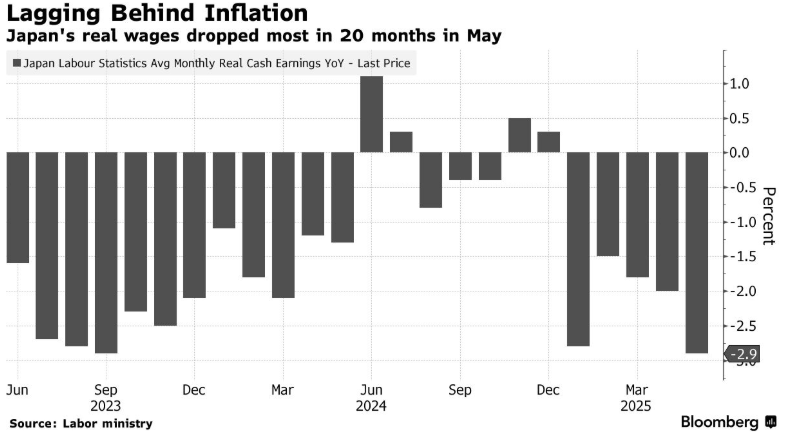
Group 1 - Japan's real wages fell by 2.9% year-on-year in May, marking the largest decline since September 2023, which poses a significant challenge for Prime Minister Kishida ahead of the upcoming elections [1][4] - The nominal wage growth was only 1%, significantly below economists' expectations, primarily due to reduced bonuses [1][4] - The largest labor union, Rengo, reported a 5.25% increase in agreed wages this year, the highest in 34 years, driven by inflation and labor shortages [1][6] Group 2 - Japan's core inflation rate reached 3.7% in May, well above the Bank of Japan's target of 2%, with essential goods and services driving the increase [4] - The ruling Liberal Democratic Party has proposed cash handouts and measures to stimulate wage growth, but recent polls indicate low public support for these initiatives [4][5] - Despite the decline in real wages, the Bank of Japan may still consider further interest rate hikes due to the ongoing nominal wage increases and inflation pressures [4][7] Group 3 - Basic wages increased by 2.1% in May, with stable indicators showing full-time employee wages rising by 2.4%, maintaining growth above 2% for nearly two years [5][6] - Structural labor shortages are pushing companies to raise wages to attract and retain talent, particularly in sectors like information technology [6] - Economic uncertainties, particularly related to U.S. tariff policies, pose risks to wage growth momentum, especially for large manufacturers [6][7]