线上线下融合

Search documents
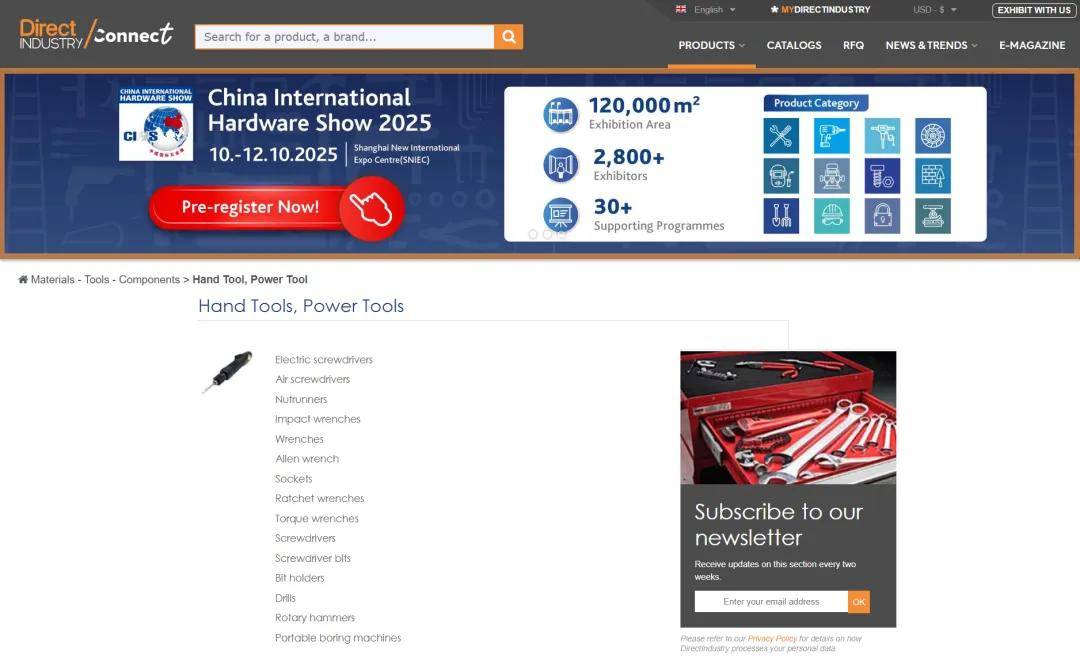
全球顶级展会都选TA!中国五金展CIHS与法国维易集团达成战略合作
Sou Hu Cai Jing· 2025-08-18 10:22
Group 1 - VirtualExpo's flagship platform, DirectIndustry, has formed a strategic partnership with the leading hardware exhibition in Asia, the China International Hardware Show (CIHS) [1][4] - The collaboration aims to achieve mutual benefits through resource sharing, integrating online and offline resources, and empowering the global industrial ecosystem [4] - VirtualExpo has already gained recognition from top global exhibitions, including being selected as the official media partner for the Hannover Messe, the largest international industrial fair [4] Group 2 - The 136th Canton Fair will feature over 28,000 exhibitors and showcase more than one million new products, with half of them being green products characterized by low carbon emissions [32][33] - The Canton Fair has optimized its online capabilities to enhance supplier-buyer matchmaking and improve connections between suppliers and buyers [33] - The Health & Medicine sector of the Canton Fair will take place from October 31 to November 4, featuring over 1,000 exhibitors and thousands of new products [35]

聚龙湾太古里一期计划年底开业;华润全国首座“万象里”亮相济南;蓝瓶咖啡将开北京首店
Sou Hu Cai Jing· 2025-08-18 06:46
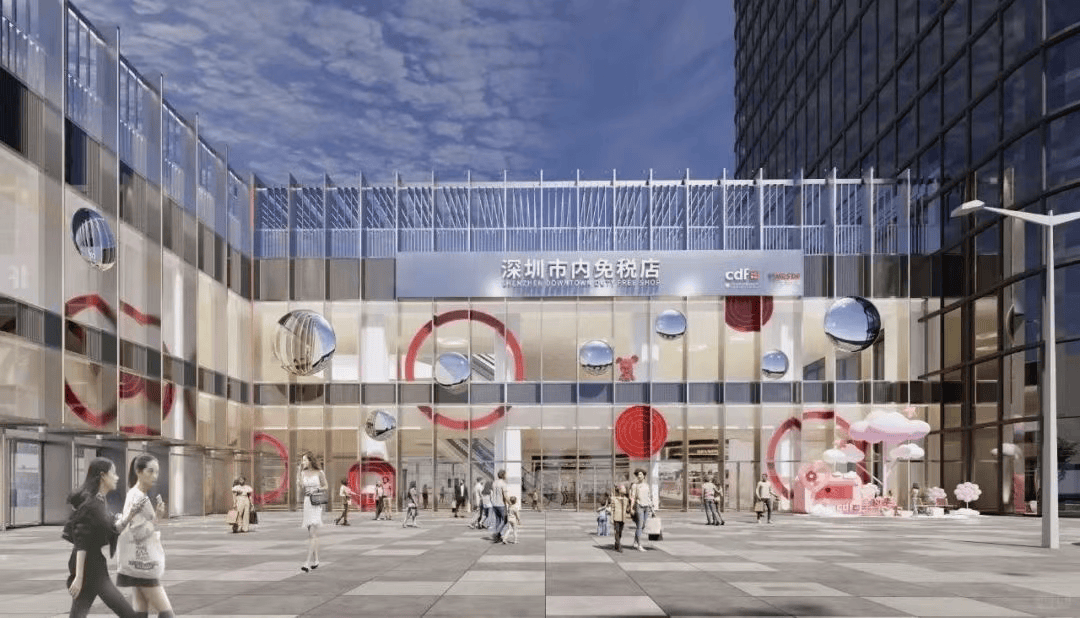
Group 1: Commercial Real Estate Trends - The commercial real estate sector is experiencing a divergence, with leading companies like China Resources Land reporting a rental income of 18.56 billion yuan, a 12.2% increase, while weaker firms like China Evergrande face liquidation [2] - The average rental rate for retail properties under CapitaLand China Trust has decreased by 2.7%, yet occupancy remains high at 96.9%, indicating a scarcity of quality properties [2] - The industry is entering a new phase of competition focused on asset quality and operational capabilities, highlighting a "Matthew Effect" where the strong continue to thrive [2] Group 2: Outlet Market Developments - There is a surge in outlet development, with projects like the 3 billion yuan Panda-themed outlet in Chengdu and a 4 billion yuan "Outlet + Amusement Park" complex in Dongguan [3] - Vipshop's outlet same-store sales have seen double-digit growth, and the company is initiating a 3.48 billion yuan REIT fundraising, reflecting strong market confidence in this sector [3] - The trend indicates a rising concentration in the industry, with large-scale, themed, and experiential projects becoming the norm, putting pressure on smaller, homogeneous traditional outlets [3] Group 3: Retail Sector Transformation - Traditional retail is undergoing significant changes, with companies like Bubugao reporting a net profit of over 200 million yuan, largely due to adopting the "Fat Donglai model" which involves closing inefficient stores and revamping potential ones [4] - The first "Fat Donglai self-reform" store by Metro in Beijing has opened, confirming the replicability of this model [4] - In contrast, brands lacking differentiation and user experience, such as GU and Tsutaya Bookstore, are facing closures, indicating a shift towards user experience-centric retail [4] Group 4: Duty-Free Market Growth - The opening of the first city duty-free stores in Shenzhen and Guangzhou marks a significant development in the duty-free economy, following the implementation of new policies [5] - South Korea's announcement of visa-free entry for Chinese group tourists is expected to boost duty-free shopping, with Lotte Duty-Free strengthening partnerships with Chinese travel agencies [5] - City duty-free stores are anticipated to become a new engine for high-end consumption, creating new shopping experiences through a combination of "duty-free + consumption + experience" [5] Group 5: Consumer Spending Trends - In July, the total retail sales of consumer goods grew by 3.7%, with online retail sales increasing by 9.2% from January to July, accounting for 24.9% of total retail sales [6][7] - Companies like 361 Degrees reported a 45% growth in e-commerce business, while Moutai's net profit increased by 8.89%, indicating resilience in high-end brands [6][7] - The restaurant sector saw only a 1.1% increase in revenue, suggesting consumers are becoming more cautious with service-related spending [6][7]



从小米到腾讯:互联网大厂为何都在造“员工社区”
Mei Ri Jing Ji Xin Wen· 2025-08-16 11:00
Group 1: Tencent's Headquarters Development - Tencent's headquarters park has been completed by 30% and will enter trial operation in October [1] - The park, located in Shenzhen, covers an area of 809,000 square meters and is designed to accommodate over 80,000 employees [1] - The construction of employee apartments aims to address housing difficulties for young employees and enhance their sense of belonging [1][2] Group 2: BYD's New Racing Facility - BYD's all-terrain racetrack in Zhengzhou has officially opened, featuring various unique track types [2] - The racetrack includes a 1,758-meter course with nine bends and a straight acceleration section of 550 meters, allowing speeds over 220 km/h [2] - This facility serves as a platform to showcase BYD's technical capabilities and supports performance validation for electric vehicles [2] Group 3: Lenovo's Financial Performance - Lenovo reported a record revenue of 136.2 billion yuan for Q1 of the 2025/2026 fiscal year, a 22% year-on-year increase [3] - Net profit also grew by 22% to 2.816 billion yuan, driven by the implementation of a hybrid AI strategy [3] - The infrastructure solutions segment saw a revenue increase of 35.8%, with AI infrastructure revenue doubling [3] Group 4: China Unicom's Revenue Growth - China Unicom's revenue surpassed 200 billion yuan in the first half of the year, marking a 1.5% increase [4] - The company's profit totaled 17.7 billion yuan, reflecting a 5.2% year-on-year growth [4] - The growth is attributed to the stability of traditional communication services and advancements in smart network services [4][5] Group 5: GAC Group's New Automotive Initiative - GAC Group has launched the Huawang Automotive city recruitment plan, focusing on a "less business, more stores" strategy [5] - The plan aims to create a diversified and professional store matrix to enhance brand penetration [5] - This initiative is expected to reduce channel costs and boost sales for GAC's new energy vehicles [5] Group 6: Xiaomi's User Engagement Strategy - Xiaomi's CEO Lei Jun initiated a poll regarding the renaming of the Xiaomi YU7 model, with over 70% of voters supporting no name change [6] - This reflects Xiaomi's commitment to user participation in brand decisions, reinforcing its user-oriented approach [6] - The strong user support for the current product positioning is crucial for Xiaomi's market share in the competitive smart electric vehicle sector [6] Group 7: JD Group's Strategic Partnership - JD Group has signed a strategic cooperation agreement with Dongfeng Motor Group to enhance collaboration in various sectors [7] - The partnership will focus on full-channel marketing for passenger vehicles and green intelligent logistics for commercial vehicles [7] - This collaboration aligns with the trend of integrating online and offline operations in the automotive industry [7]






京东集团-SW(09618)二季度取得收入3567亿元 同比增加22.4% 持续布局新增长领域
智通财经网· 2025-08-14 10:09
Core Insights - JD Group reported a revenue of 356.7 billion RMB for Q2 2025, a year-on-year increase of 22.4%, with a net profit of 6.2 billion RMB [1] - For the first half of 2025, the company achieved a revenue of 657.742 billion RMB, up 19.28% year-on-year, with a net profit of 17.068 billion RMB [1] Retail Business Performance - The retail segment saw a revenue growth of 20.6% year-on-year, with an operating profit margin reaching 4.5%, the highest for any promotional quarter in the company's history [2] - The core retail business has shown consistent potential, with gross profit margins increasing for 13 consecutive quarters [2][3] New Business Developments - JD's new business initiatives, including food delivery, are progressing well, with daily order volumes exceeding 25 million during the 618 shopping festival and over 1.5 million quality merchants onboarded [4] - The launch of "Seven Fresh Kitchen" aims to innovate the supply chain model in the food delivery market, enhancing quality development in the industry [4] Logistics and Technology Advancements - JD Logistics has implemented its self-developed "Smart Wolf" system across multiple cities, significantly improving warehouse operational efficiency and enabling high-density storage [3] - The integration of online and offline data and services in JD MALL provides consumers with an immersive and digital shopping experience [3]
有人建议,取消外卖,关闭电商,恢复人间烟火气和市面繁荣,你同意吗?
Sou Hu Cai Jing· 2025-08-13 09:05
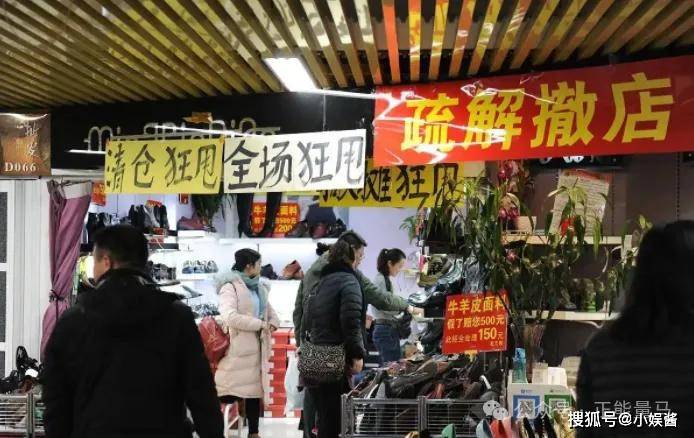
Group 1 - The core issue is the struggle of physical retail businesses in the post-pandemic era, with many restaurants and shops facing reduced customer traffic and some closing down [1][3] - A growing debate has emerged around the idea of stopping food delivery and e-commerce to revive physical stores, highlighting the complexity of the issue which affects millions of livelihoods and daily lives [3][10] - The existence of food delivery services has become a necessity for many, with 520 million users in China, predominantly young professionals who rely on it to balance work and life [4][6] Group 2 - E-commerce has transformed daily life, with over 100 million users aged 60 and above, and 72% of them finding online shopping significantly convenient [6][7] - The price advantage of e-commerce over physical stores is notable, with some products being 30% cheaper online, which is crucial for families facing rising living costs [7][14] - The delivery and e-commerce sectors employ over 150 million people, making them a vital part of the economy and a significant source of income for many families [8][9] Group 3 - Many physical stores view food delivery and e-commerce as lifelines rather than competitors, with 82% of surviving restaurants offering delivery services [13][14] - The real challenges for physical retail include shrinking consumer demand, intense competition, and rising operational costs, which are exacerbated by the presence of delivery and e-commerce [14][15] - Solutions for revitalizing physical retail include reducing operational costs, encouraging differentiated competition, and enhancing consumer experiences [16][17][18] Group 4 - The essence of a vibrant commercial atmosphere lies in the connections between people and the cultural fit of business models, rather than merely forcing consumers to shop in physical stores [16][18] - The evolution of commercial forms is inevitable, and the focus should be on creating new vitality in the market rather than longing for past shopping experiences [18]
淘宝闪购发布新数据,北大报告称外卖消费券拉动七千亿增量市场
Xin Lang Ke Ji· 2025-08-12 07:29
Core Insights - The article highlights the significant impact of digital platforms, particularly Taobao Flash Sale and Ele.me, on consumer spending and the growth of small and medium-sized businesses in the food and retail sectors [3][4][5]. Group 1: Consumer Spending and Market Growth - On August 7, over 300,000 small restaurants achieved peak sales on Taobao Flash Sale, with Ele.me's delivery personnel increasing to 3.5 times last year's numbers and average income rising to 1.4 times [3]. - A report from Peking University's Guanghua School of Management indicates that every 1 yuan of effective flash sale subsidies generates an additional 6.76 yuan in consumer spending, potentially unlocking nearly 700 billion yuan in consumption growth [4][5]. - The total investment by the three major food delivery platforms in Q2 reached 25 billion yuan, which could lead to a projected 676 billion yuan increase in overall consumption if the same subsidy levels are maintained throughout the year [5]. Group 2: Impact on Small and Medium-sized Businesses - The research shows that flash sale coupons significantly boost revenue for small and medium-sized food businesses, with a 44.5% increase in offline revenue for small merchants [5]. - The influx of traffic from the flash sale platform has allowed small businesses to gain visibility and improve their sales, regardless of their participation in the program [5][6]. Group 3: Online and Offline Integration - The integration of online and offline sales channels has proven beneficial for brands, with companies like Xiaomi seeing a fourfold increase in daily orders on Taobao Flash Sale compared to May [6]. - The synergy between online and offline operations has led to increased customer retention and diversification of spending categories, enhancing overall consumer experience [6][7]. - The competition among various platforms has provided merchants with more choices, allowing them to operate in a more balanced and favorable environment [7]. Group 4: Consumer Behavior and Market Dynamics - The relationship between takeaway and dine-in services is symbiotic, with online orders helping to promote in-store consumption rather than cannibalizing it [7][8]. - The rise of digital platforms has not only expanded the service consumption market but also facilitated regional consumption upgrades, tapping into local consumer potential [8][9].


2025年中国无纺布壁纸行业产业链、市场规模、竞争格局及发展趋势研判:作为高品质壁纸的理想基材,无纺布壁纸未来发展潜力巨大[图]
Chan Ye Xin Xi Wang· 2025-08-11 01:29
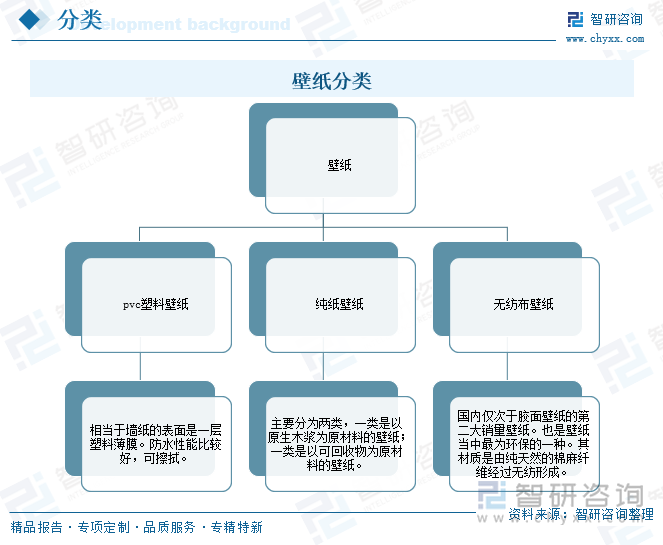
Core Viewpoint - The non-woven wallpaper industry in China is gradually gaining market share due to its superior qualities, despite currently being overshadowed by PVC plastic wallpaper. The demand for non-woven wallpaper is expected to rise significantly, driven by the renovation of old neighborhoods and the increasing quality of commercial spaces [1][13]. Industry Overview - Non-woven wallpaper is the second-largest type of wallpaper in terms of sales in China, following PVC wallpaper. It is made from natural plant fibers and is known for its environmental friendliness and durability [3][11]. - The market for non-woven wallpaper is projected to reach 116 million square meters in sales by 2024, representing a year-on-year increase of 16.0% [1][13]. Market Dynamics - The production of non-woven wallpaper has seen a recovery, with an expected output of 144 million square meters in 2024, marking a 35.8% increase from the previous year [11][13]. - The home decoration industry, a key application area for non-woven wallpaper, is facing challenges, with a projected market size of 3.56 trillion yuan in 2024, down 16.8% year-on-year. However, the integrated decoration market is expanding, with a compound annual growth rate of 12.6% [9][11]. Competitive Landscape - The non-woven wallpaper industry is becoming increasingly competitive, with numerous companies entering the market. Key players include Suzhou Huarlimite Decoration Materials Co., Ltd., Shanghai Xinwang You Neng Materials Co., Ltd., and Beijing Oriental Grammy Wallpaper Co., Ltd. [15][19]. Development Trends - Customization is becoming a mainstream trend in the non-woven wallpaper industry, with companies leveraging digital printing technology to offer personalized designs [21]. - Online sales channels are expected to play a more significant role, with e-commerce platforms providing a convenient shopping experience and innovative marketing strategies [22]. - The industry is likely to see consolidation, with larger companies acquiring smaller ones to optimize resources and enhance market presence [23].
红旗连锁(002697):Q2主业利润与投资收益双增,线上线下融合发展
Shenwan Hongyuan Securities· 2025-08-09 15:31
Investment Rating - The report maintains a "Buy" rating for the company [2][7]. Core Insights - The company reported a strong performance in Q2, with both main business profits and investment income increasing. The H1 2025 revenue was 4.808 billion yuan, down 7.3% year-on-year, while the net profit attributable to shareholders was 281 million yuan, up 5.3% year-on-year [7]. - The company is optimizing its store structure and enhancing efficiency, which has temporarily impacted revenue. The revenue from different regions showed a decline, with main urban areas down 8.21% [7]. - The profitability has improved, with a gross margin of 29.85% in H1 2025, up 0.87 percentage points year-on-year. Investment income from Xinwang Bank significantly contributed to this improvement [7]. - The company is deepening its online and offline integration strategy, planning to set up foreign trade quality product sections in over a thousand stores [7]. - The long-term strategy focuses on a differentiated approach combining products and services, leveraging a dense store network and advanced information management [7]. Financial Data and Profit Forecast - Total revenue for 2025 is estimated at 10.158 billion yuan, with a projected net profit of 532 million yuan, reflecting a 2.1% year-on-year growth [6][9]. - The company expects to maintain a net profit of 554 million yuan in 2026 and 585 million yuan in 2027, with corresponding PE ratios of 14 and 13 [7][9].

红旗连锁2025年中报:营收下滑但盈利能力增强
Zheng Quan Zhi Xing· 2025-08-08 22:25
Core Viewpoint - Red Flag Chain reported a decline in revenue for the first half of 2025, but demonstrated improved profitability and effective cost control measures [2][9]. Operational Overview - Total revenue for the company reached 4.808 billion yuan, a decrease of 7.3% year-on-year; net profit attributable to shareholders was 281 million yuan, an increase of 5.33% year-on-year; and net profit excluding non-recurring items was 262 million yuan, up 8.63% year-on-year [2]. - In Q2 alone, total revenue was 2.329 billion yuan, down 7.43% year-on-year, while net profit attributable to shareholders rose to 124 million yuan, an increase of 20.34% year-on-year [2]. Profitability - The company improved its profitability with a gross margin of 29.85%, an increase of 3.01% year-on-year; net profit margin was 5.84%, up 13.63% year-on-year, indicating effective cost control and operational efficiency [3]. Financial Condition - Cash and cash equivalents amounted to 2.424 billion yuan, a 30.55% increase year-on-year, reflecting improved liquidity; accounts receivable decreased by 8.28% to 96.975 million yuan, showing better management of receivables; interest-bearing debt was reduced by 15.45% to 436 million yuan, lowering financial risk [4]. Cost and Expenses - Total sales, management, and financial expenses were 1.175 billion yuan, accounting for 24.44% of revenue, a slight increase of 0.76% year-on-year; the company achieved cost savings through optimizing store structure and reducing expenses, effectively countering gross margin pressure [5]. Cash Flow - Net cash flow from operating activities was 414 million yuan, with operating cash flow per share at 0.3 yuan, a decrease of 4.85% year-on-year; despite the slight decline, overall operations remained stable [6]. Main Business Composition - Revenue from food products was 2.134 billion yuan, accounting for 44.38% of total revenue; revenue from tobacco and alcohol was 1.703 billion yuan, making up 35.42%; daily necessities contributed 592 million yuan, or 12.32%; and other income was 379 million yuan, representing 7.88% [7]. Development Strategy - The company continued to deepen its online and offline integration strategy, leveraging social e-commerce platforms to enhance visibility and conversion rates; regular operations of Douyin live streaming were implemented to drive traffic and accumulate private domain traffic; the company also adhered to ESG principles, with over 40% of delivery vehicles being new energy, and collaborated with suppliers to establish environmental packaging standards [8]. Summary - Overall, despite facing revenue decline in the first half of 2025, the company exhibited strong performance in profitability, cost control, and financial structure, achieving stable operational results through various strategic measures [9].
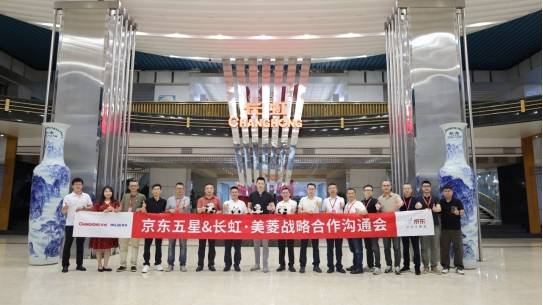
强强联手拓市场,京东电器与长虹·美菱战略升级
Sou Hu Cai Jing· 2025-08-08 08:26
Core Insights - JD Electronics and Changhong·Meiling are deepening their strategic partnership in response to the competitive landscape of the home appliance market in the second half of 2025 [1] - The collaboration aims to enhance user experience, expand market share, and adapt to new consumer trends [1] Group 1: Partnership Development - A high-level strategic communication meeting was held on August 6, where both parties reviewed the achievements of their collaboration in the first half of the year [3] - The partnership has seen significant breakthroughs in sales across all channels for Changhong·Meiling's full range of products, driven by government subsidy policies [3] - Joint marketing efforts during key promotional events like "May Day" and "618" have garnered widespread market recognition [3] Group 2: Strategic Focus Areas - JD Electronics is advancing a comprehensive online and offline integration strategy, with a focus on the 3C home appliance and high-end product sectors [4] - The partnership will leverage new store openings, store upgrades, and the "Ten Thousand Towns" initiative to enhance capabilities in ESG innovation, experiential marketing, and service delivery [4] - Both companies aim to accelerate the growth of Changhong's full product range within JD Electronics' channels, enhancing consumer choices and experiences [4] Group 3: Future Collaboration - Changhong's management emphasized the importance of JD Electronics as a long-term partner, highlighting the potential for sustainable development and supply chain resilience [5] - The strategic communication marks a comprehensive upgrade in their partnership, injecting strong momentum into core business development [5] - Both companies will focus on product development, brand promotion, and channel construction to set a benchmark for collaborative development in the industry [5] Group 4: User Experience Enhancement - A shared consensus exists on the importance of improving user experience, with both companies looking to capitalize on the consumption potential released by national subsidies in the second half of the year [7] - The collaboration will enhance synergies in channel integration, user engagement, and innovative marketing models, creating an ecosystem of "home appliances + retail + services" [7] - This initiative is expected to provide consumers with better and broader smart living options while opening new growth avenues for both companies in a competitive market [7]