
制造业回流

Search documents
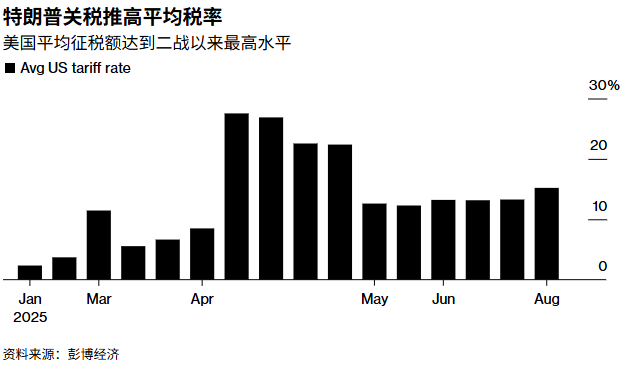
特朗普关税全面落地:美国平均税率跃升至15.2% 创二战后新高
Zhi Tong Cai Jing· 2025-08-07 06:28
Group 1 - The Trump administration's tariff policy officially took effect, marking a significant shift in global trade dynamics, with nearly all trade partners facing increased tariffs [1][3] - The average tariff rate in the U.S. is projected to rise from 2.3% to 15.2%, the highest level since World War II, impacting key products from the EU, Japan, and South Korea [1][3] - Ongoing negotiations with Mexico, Canada, and China are still in separate tracks, with potential additional tariffs on strategic industries like pharmaceuticals and semiconductors anticipated [3][4] Group 2 - Economic data indicates potential risks, with July employment figures showing the largest decline since the pandemic began, and economic growth slowing due to reduced consumer spending [3][4] - Wall Street institutions have warned of market risks, predicting a possible short-term pullback in the S&P 500 index due to rising inflation and weak consumer spending [4] - Legal challenges are emerging regarding the legality of the tariff implementation, with experts highlighting significant flaws in the legal basis for the tariffs [6][8] Group 3 - The administration claims that the tariff policy will lead to an "economic golden age," with record tariff revenues of $113 billion reported, but experts caution that increasing tariff revenue and expanding domestic manufacturing jobs may be contradictory [8]

特朗普宣布对芯片征收关税后,苹果将在美国额外投资 1000 亿美元
Sou Hu Cai Jing· 2025-08-07 06:14
Core Points - President Donald Trump announced that Apple will invest an additional $100 billion in the U.S., bringing its total investment over the next four years to $600 billion [1][2] - Trump attributed this investment to his "America First" policy, emphasizing the return of manufacturing jobs to the U.S. [1] - Apple CEO Tim Cook confirmed the investment and highlighted the company's commitment to domestic manufacturing, including a new AI server factory in Houston [2][3] Investment Details - The initial investment plan announced by Apple earlier this year was $500 billion, which included creating approximately 20,000 R&D jobs across the U.S. [3] - Previous commitments included $350 billion in 2018 and $430 billion in 2021, indicating a history of investment promises from Apple [3] - Trump's warning of a 25% tariff on companies that do not relocate manufacturing to the U.S. has been a significant factor in Apple's decision-making [3] Market Reaction - Following the announcement of the investment, Apple's stock (AAPL) surged by 3.8% during trading hours [6] - The White House described the agreement with Apple as a victory for manufacturing, aimed at enhancing national security and economic stability [6] International Considerations - Apple plans to shift a significant portion of its phone assembly business to India by the end of 2025, which is seen as a strategy to reduce reliance on China amid escalating trade tensions [4] - Trump's recent imposition of a 50% tariff on Russian oil imports to India raises questions about the potential impact on Apple's plans in India [5]
深夜,巨头暴跌!
Zheng Quan Shi Bao· 2025-08-06 15:06
Group 1 - Supermicro's stock price plummeted over 17% after reporting Q4 revenue of $5.76 billion, a 7.5% year-over-year increase, but below analyst expectations of $6.01 billion [2] - Adjusted earnings per share were $0.41, also below the expected $0.44, and the company revised its FY2026 revenue forecast down from $40 billion to $33 billion [2] - The company anticipates Q1 FY2026 revenue between $6 billion and $7 billion, which is lower than the analyst average expectation of $6.59 billion [2] Group 2 - Apple shares rose by 4% after announcing an additional $100 billion investment in U.S. manufacturing to increase domestic production capacity and avoid punitive tariffs on iPhones [2] - A new manufacturing plan aims to bring more of Apple's supply chain to the U.S. and produce more critical components domestically [3] - Apple's total investment commitment in the U.S. has now reached $600 billion, including plans for a new server manufacturing facility in Houston and a supplier academy in Michigan [3] Group 3 - Snap's stock opened significantly lower, dropping over 20% [4] - iQIYI's shares increased by over 4% as it seeks to raise approximately $300 million through a secondary listing in Hong Kong to enhance liquidity [4] - Li Auto's stock fell over 4% after reporting a 40% year-over-year decline in vehicle deliveries for July 2025, with a total cumulative delivery of 1.3685 million vehicles as of July 31, 2025 [4] Group 4 - Brent crude oil futures rose by 2% to $68.991 per barrel, while WTI crude oil futures also increased by 2% to $66.678 per barrel [4]
苹果(AAPL.US)涨近3% 将再投资1000亿美元用于美国制造业
Zhi Tong Cai Jing· 2025-08-06 13:52
据悉,今年早些时候,特朗普在白宫会见苹果首席执行官库克后的第二天警告称,若苹果不将iPhone生 产线转移至美国,将对其征收至少25%的关税。苹果此前已宣布,计划未来四年在美国投资5000亿美 元,其中包括在休斯顿建设新的服务器制造工厂、在密歇根州设立供应商学院,以及增加对美国现有供 应商的投入。白宫表示,周三的声明将使苹果的累计承诺投资达到6000亿美元。 周三,苹果(AAPL.US)涨近3%,报208.81美元。消息面上,当地时间周三,美国总统特朗普将宣布,苹 果承诺再投资1000亿美元用于美国国内制造业。这将是这家科技巨头为增加美国本土产品产能而做出的 最新承诺,其目的是避免旗舰产品iPhone遭受惩罚性关税打击。 ...

供应增长有限叠加宏观利好托底 锌价下方空间有限
Qi Huo Ri Bao· 2025-08-05 23:31
Group 1: Zinc Market Overview - Zinc prices have entered a downward trend due to a relaxed supply side and disappointing demand expectations in the U.S. macroeconomic environment [1] - The U.S. tariff policy adjustments under the Trump administration are expected to lead to a long-term decline in the dollar, which will positively impact zinc prices [2] - Domestic zinc concentrate production has slightly decreased year-on-year due to declining ore grades, with future increases expected to be limited [3] Group 2: Supply Dynamics - Overseas mining production is anticipated to recover in the medium to long term, despite recent reductions due to weather and maintenance issues [2] - Domestic zinc smelting output is expected to increase year-on-year, but the growth potential remains limited due to reduced imports from overseas smelters [3] - The overall supply of zinc ore is expected to continue growing, but the year-on-year increase will be relatively modest [2][3] Group 3: Demand Factors - Weak demand is observed in the construction sector, with significant declines in operating rates for cement and asphalt facilities [4] - The real estate sector is experiencing a downturn, with new construction and completion areas showing a year-on-year decline [4] - The automotive sector is seeing growth driven by trade-in policies and promotions, which may support zinc demand in the medium to long term [4] Group 4: Price Outlook - The combination of a declining dollar and resilient macro data is expected to provide some support for zinc prices [5] - However, the ongoing increase in supply coupled with weak demand will lead to a more relaxed supply-demand structure, potentially putting downward pressure on prices [5] - The expected price range for zinc may shift downward, but the space for decline is expected to be narrower than before due to limited supply growth and macroeconomic support [5]
36万亿美债还不起,特朗普屡次为难大债主,为此不惜自曝家丑
Sou Hu Cai Jing· 2025-08-05 09:59
特朗普属实是没招儿了,眼睁睁看着美债飙升,每年的利息都高达上万亿美元,美联储还不降息。 鉴于美联储的独立性,他虽贵为总统却不能指挥美联储主席鲍威尔,只能打打嘴炮给鲍威尔来个激将 法,但无奈鲍威尔并不上钩。 甚至连威胁要"弄死"他,也不为所动,没办法,特朗普只好出狠招——自爆家丑了。 他到底爆了什么家丑?意图是什么? 36万亿美债还不起 很多人对于美国的印象都还是那个超级大国,GDP抵得上好几个国家的总和,生活水平也高其他国家一 大截,是很多人学习、生活的圣地。 尤其是本世纪初我国还是一穷二白的时候,对于美国等西方国家的崇拜之情最盛,现在一些老一辈的人 都还认为能去美国生活就是最好的。 但随着网络的发展和中国经济快速发展,其实差距已经没有太大了,甚至在一些方面我们还比他们更 好。 拜登即将下台之前各种针对中国,强迫TikTok卖给美国企业时,TikTok不得不暂停服务,引发美国人成 了"抖音难民",疯狂下载小某书,还来了一场"中美对账"。 中国人民才知道,原来美国人上学费用高达上万美元,毕业后还要还很多年学费贷,每个月的工资也就 两三千美元而已,租房也比我们贵得多,要打好几份工才能维持生活。 1.3万亿美元看起 ...
海亮股份20250731
2025-08-05 03:20
Summary of Hailiang Co., Ltd. Conference Call Company Overview - **Company**: Hailiang Co., Ltd. - **Industry**: Copper products manufacturing Key Points and Arguments Impact of U.S. Tariff Policy - The U.S. has imposed a 50% tariff on semi-finished copper products to encourage domestic manufacturing, benefiting companies like Hailiang that have local production capabilities, but increasing import cost pressures [2][3][4] - Hailiang is evaluating the impact of the tariff policy and considering processing raw materials in Mexico before shipping them back to the U.S. or expanding domestic production to reduce costs [2][4] Cost Increases - Hailiang has experienced significant increases in processing costs over the past few months, with industrial pipe processing fees rising by approximately $1,000 per ton, and water pipes increasing to $4,500-$5,500 [2][6] - The company anticipates that processing fees will continue to rise following the implementation of the new tariff policy, which could further enhance revenues [6][21] Expansion Plans - Hailiang plans to expand its Houston factory to leverage local resources, enhance self-sufficiency, and reduce import costs, thereby increasing market competitiveness [2][7] - The Houston facility covers over 1,200 acres, providing ample space for future growth [7][28] Market Demand - The U.S. market demand for copper products is primarily focused on industrial pipes and water pipes, with total demand estimated at 250,000 to 290,000 tons [9][10] - The return of manufacturing to the U.S. and the growth of the AI economy are driving increased demand for copper products [10][18] Price Acceptance - The U.S. market has shown a high tolerance for price increases, historically accepting price hikes of 30%-40% due to various factors, indicating that future high prices may also be accepted [15] Competitive Landscape - Hailiang faces competition from domestic U.S. companies, which have limited competitiveness due to higher costs. The market is expected to see a short-term import gap that local companies may struggle to fill [17] - The tariff policy is expected to enhance Hailiang's competitive advantage in the U.S. market by making local production more favorable [13][14] Production Capabilities - Hailiang currently has a production capacity of 30,000 tons for industrial pipes in Texas and is planning to increase production of copper foil to meet market demand [16][28] - The company has also begun mass production of PCB copper foil, creating new profit growth points through differentiated products [37] Globalization Strategy - Hailiang's global layout has effectively mitigated regional volatility, allowing the company to adapt to market changes and enhance profitability through new product offerings [38] Financial Performance - Hailiang's U.S. operations reported a loss of over 30 million yuan last year, primarily due to underutilized capacity. However, the company expects to achieve profitability as production ramps up [33] Labor and Operational Challenges - Hailiang is addressing labor issues by managing visa challenges and optimizing equipment to reduce labor needs, aiming to increase efficiency and production capacity [22][23] Additional Important Insights - The 232 tariff legislation has significantly impacted the copper industry, with a sudden 50% tariff leading to increased domestic processing levels and strategic importance for military-related materials [11][13] - Hailiang's strategic adjustments in response to tariffs and market conditions position it favorably for future growth in the U.S. market [26][29]

铜价暴跌后仍被看好,美国铜关税“反转”,或对铜材加工企业影响较大但范围有限
Hua Xia Shi Bao· 2025-08-04 06:16
Group 1 - The U.S. government announced a 50% import tariff on semi-finished copper products, while exempting refined copper and copper raw materials, leading to a significant market reaction with New York copper prices dropping over 20% [2][3][4] - Analysts noted that the tariff policy deviated from market expectations, which anticipated a blanket 50% tariff on all forms of copper, causing a sell-off among bullish positions [4][5] - Despite the short-term price drop, the long-term outlook for copper remains positive due to ongoing demand from the renewable energy transition, which is expected to support copper prices [5][6] Group 2 - Companies like Luoyang Molybdenum Co. reported minimal impact from the tariff changes, as their copper products fall within the exempt category and are sold globally [6][8] - The majority of copper companies derive significant revenue from domestic markets, with Jiangxi Copper and Tongling Nonferrous Metals having 87.39% and 74.60% of their revenues from China, respectively [6][7] - Companies with substantial overseas operations, such as Hailiang Co., have proactively adjusted their strategies to mitigate risks from changing international trade environments, maintaining a balanced supply chain [6][8]


招商宏观:特朗普新对等关税有哪些变化?
智通财经网· 2025-08-02 07:27
智通财经APP获悉,招商证券发布研报称,当地时间7月31日,特朗普签署"进一步修改对等关税税 率"行政令,确定了对多个国家和地区征收的10%~41%不等的新对等关税税率,并于8月7日正式生效。 新对等关税新税率生效后,初步估算美国对全球实际关税税率或由11%升至约16%,与此前特朗普威胁 的关税税率相比更具实施性和可持续性,现阶段的关税收入或基本达到特朗普政府的合意水平,该合意 水平与贸易平衡有关,但更多是为了弥补财政收入。 当地时间7月31日,特朗普签署"进一步修改对等关税税率"行政令,确定了对多个国家和地区征收的 10%~41%不等的新对等关税税率,并于8月7日正式生效。 核心内容 特朗普新对等关税的主要内容:1)10%~41%不等的新对等关税税率适用于70个国家和地区,未提及的 国家依旧征收10%的基础关税税率。2)8月7日正式生效,但货物在8月7日前货物已在装货港装船或在 进入美国之前以最终运输方式转运的商品除外,对10 月 5 日前进入消费或从保税仓库提取用于消费的 货物按此前行政令征收额外从价关税。3)任何试图通过第三国转运来规避该关税的做法将被征40%的 惩罚性税率,不允许减轻或减免对被发现为逃 ...
欧美贸易协议给欧洲留下巨大隐患
Jing Ji Ri Bao· 2025-08-01 21:59
Core Viewpoint - The trade agreement between the U.S. and the EU, reached on July 27, aims to address tariffs, energy procurement, and investment, temporarily avoiding a potential high-intensity tariff conflict, but raises concerns about its sustainability and impact on European competitiveness [1][2][3]. Tariff and Investment Summary - The U.S. will impose a 15% tariff on EU products, replacing a previously threatened 30% punitive tariff, while the EU commits to investing $600 billion in the U.S. and purchasing $750 billion worth of U.S. energy products over three years [2]. - The agreement includes zero tariffs on strategic materials like aircraft parts and key chemicals, but maintains existing tariffs on steel and aluminum, with unresolved issues regarding spirits [2]. European Internal Reactions - There is significant dissent within Europe regarding the agreement, with various leaders expressing concerns about its fairness and long-term implications for European economic strength [3]. - French Prime Minister Béru criticized the deal as a capitulation to the U.S., while German Chancellor Merz acknowledged the negative impact on Germany's economy [3]. Economic Implications - The 15% tariff is expected to weaken the competitiveness of EU exports in the U.S., particularly affecting key industries such as automotive and cosmetics, with potential long-term economic costs for Europe [4]. - A report from the Kiel Institute for the World Economy predicts a 0.13 percentage point loss in Germany's economic growth due to the agreement [4]. Uncertainties and Risks - The agreement contains ambiguities, particularly regarding the steel and aluminum tariffs, and lacks clarity on specific product exemptions, which could lead to future disputes [5]. - The investment commitments from the EU to the U.S. lack detailed terms, raising concerns about potential imbalances and the risk of the U.S. prioritizing its own interests [5]. Internal Discrepancies - The differing interests among EU member states and the lack of supportive policies for the agreement's implementation may create significant obstacles to its approval and execution within the EU [6]. Conclusion - The trade agreement reflects a compromise by Europe under pressure, aiming to stabilize market expectations in the short term, but it risks undermining European autonomy in trade, energy, and investment in the long run [7].