港股投资

Search documents
QDII基金规模再创新高 机构加码布局港股市场
Shang Hai Zheng Quan Bao· 2025-07-29 17:53
Core Insights - The number of QDII funds in China reached 319 with a total scale of 683.77 billion yuan, marking an 11.85% increase from the end of last year, a historical high [1][2] - Significant growth in QDII fund shares investing in the Hong Kong stock market, with eight out of the top ten funds by share increase being QDII funds focused on Hong Kong stocks [2] - The Hong Kong technology-themed QDII funds saw remarkable share increases, particularly index funds, with the largest being the Huaxia Hang Seng Technology ETF, which increased by 9.51 billion shares [2] QDII Fund Growth - As of the end of June, QDII funds' total scale reached 683.77 billion yuan, a historical high [1][2] - The share of QDII funds investing in Hong Kong stocks significantly increased, with eight funds in the top ten for share growth [2] - The Huaxia Hang Seng Technology ETF had a share increase of 9.51 billion, leading the market [2] Global Fund Allocation - There is a growing trend in domestic funds for global allocation, with several funds like the Bosera S&P 500 ETF and Huaxia Nasdaq 100 ETF showing notable share increases [3] Domestic Fund Holdings in Hong Kong - As of July 28, net inflows from southbound funds reached 772.19 billion yuan, surpassing the total for the entire year of 2024 [4] - The number of domestic public funds investing in Hong Kong stocks increased to 4,048, with total assets reaching 2.62 trillion yuan [4] - The stock market value held by public funds in Hong Kong reached 734.3 billion yuan, a 12.8% increase [4] Outlook on Hong Kong Market - The Hong Kong market has rebounded significantly, with the Hang Seng Index and Hang Seng Technology Index rising by 27.43% and 26.77% respectively [5] - Fund managers maintain an optimistic outlook on the Hong Kong market, citing signs of economic recovery and the presence of globally competitive Chinese companies [6]
54只权益基金近一年业绩翻倍 广发基金上榜数量居首
Zhong Zheng Wang· 2025-07-29 10:52
Core Viewpoint - The performance of equity funds has rebounded significantly, with 54 funds achieving over 100% returns in the past year, highlighting the strong capabilities of fund managers in the current market environment [1]. Group 1: Fund Performance - As of July 25, 2023, 54 funds have recorded returns exceeding 100%, with 34 of these being actively managed funds [1]. - Among the top-performing funds, GF Fund has six products that doubled their returns, leading the industry [1]. - Specific funds from GF Fund include GF Growth Navigation One-Year Holding A, GF Beijing Stock Exchange Selected Two-Year Open A, and GF Growth Start One-Year A, with returns of 131.81%, 118.13%, and 100.65% respectively [1]. Group 2: Investment Strategies - GF Growth Navigation One-Year Holding A, managed by Wu Yuanyi, has benefited from a strategic increase in its Hong Kong stock allocation from approximately 5% to 32% over recent quarters, effectively capturing the Hong Kong market's upward trend [2]. - The fund has focused on new consumption and internet technology sectors, which have shown significant elasticity during the recent market rally [2]. - GF Growth Start One-Year Holding A, managed by Chen Yunzhong, has also increased its allocation to nearly full capacity, focusing on technology growth stocks and high-end manufacturing assets [2]. Group 3: Index Funds - GF CSI Hong Kong Innovative Medicine ETF, GF North Exchange 50 Component A, and GF CSI Hong Kong Innovative Medicine Link A have achieved returns of 126.53%, 121.72%, and 111.20% respectively, serving as low-cost investment tools for capturing the Hong Kong innovative medicine and North Exchange market trends [2]. Group 4: Overall Fund Performance - In addition to the six funds that doubled their returns, GF Fund has 37 other funds with returns exceeding 50% in the past year, with 25 of these funds reaching historical net asset value highs this year [3]. - The comprehensive product layout and diversified investment capabilities of GF Fund have contributed to strong returns for investors [3].
7月28日【港股Podcast】恆指、友邦、平安、小米、金沙、舜宇
Ge Long Hui· 2025-07-29 10:26
Group 1: Market Overview - The Hang Seng Index (HSI) shows bullish sentiment with investors expecting an increase to 26,000, while some anticipate a pullback to 25,000 [1] - Current resistance is at 25,928 points, with a potential challenge to 26,700 points if breached [1] - Support is noted at 24,864 points, indicating cautious positioning for both bullish and bearish investors [1] Group 2: AIA Group (01299.HK) - AIA's stock price reached a high of 74.75 HKD, signaling a strong buy recommendation [3] - There is potential for the stock to challenge 77.6 HKD in the near term [3] Group 3: Ping An Insurance (02318.HK) - Ping An's stock hit a new high of 57.65 HKD, closing above the upper Bollinger Band, indicating strong bullish momentum [6] - Resistance levels are identified at 59.2 HKD and 61.1 HKD, with support at 52.8 HKD [6] Group 4: Xiaomi Corporation (01810.HK) - Xiaomi is experiencing significant selling pressure, with investors looking for support levels [9] - A buyback strategy is being considered with a recovery price set at 55.5 HKD [9] Group 5: Sands China (01928.HK) - Sands China is currently in a sideways trading pattern, with a recent rebound noted [12] - Technical analysis suggests a buy signal, with resistance at 19.6 HKD and 20.1 HKD [12] Group 6: Sunny Optical Technology (02382.HK) - Sunny Optical opened high but closed lower, with a potential resistance at 78.2 HKD [14] - Investors are considering waiting for a drop to 70 HKD before re-evaluating their positions [14]

港股持有比例,创新高
Zhong Guo Ji Jin Bao· 2025-07-27 13:36
Group 1 - The core viewpoint of the articles highlights that the proportion of actively managed equity funds holding Hong Kong stocks has reached a historical high, driven by a significant increase in global interest in Chinese assets [1][3]. - As of the end of Q2, the total market value of Hong Kong stocks held by public funds reached 734.3 billion yuan, a 12.8% increase from the previous quarter, with the proportion of public fund holdings in Hong Kong stocks rising from 36.9% to 39.8% [2]. - The actively managed equity funds specifically increased their holdings in the healthcare and financial sectors while reducing exposure in information technology and discretionary consumer sectors [2]. Group 2 - The Hang Seng Index has seen a year-to-date increase of nearly 27%, making it the best-performing major index globally, with fund managers expressing optimism about the market's future [4]. - Fund managers are particularly optimistic about structural opportunities in various sectors, including new consumption, innovative pharmaceuticals, and traditional industries like "AI+", overseas expansion, and smart manufacturing [4]. - The increasing allocation of public funds to Hong Kong stocks reflects a growing attractiveness of the market, with over 50% of public funds now having the ability to invest in Hong Kong stocks as of Q2 2025 [3].





港股持有比例,创新高!
中国基金报· 2025-07-27 13:29
Core Viewpoint - The proportion of actively managed equity funds holding Hong Kong stocks has reached a historical high, reflecting a strong positive outlook for the Hong Kong market as it experiences a wave of value re-evaluation driven by global capital inflows [1][4]. Group 1: Fund Holdings and Market Performance - As of the end of Q2, actively managed equity funds held a total market value of 4,379 billion yuan in Hong Kong stocks, an increase of 6.5% from the previous quarter, with the stock allocation rising from 30.8% to 32.5% [3]. - The total market value of public funds invested in Hong Kong stocks reached 7,343 billion yuan, marking a 12.8% increase from the end of Q1 [3]. - The number of public funds eligible to invest in Hong Kong stocks has increased significantly, with 50.97% of public funds now having this capability as of Q2 2025 [4]. Group 2: Sector and Stock Preferences - In Q2, actively managed equity funds increased their holdings in the healthcare and financial sectors while reducing exposure to information technology and discretionary consumer sectors [3]. - Tencent has been the largest holding for two consecutive quarters, with four Hong Kong stocks appearing in the top ten holdings of public funds [3]. Group 3: Market Outlook - Fund managers express optimism about the future performance of the Hong Kong market, citing a clear rebound in China's macroeconomic indicators and the global competitiveness of Chinese companies listed in Hong Kong [6][7]. - The anticipated global interest rate cuts in the second half of the year are expected to benefit emerging markets like Hong Kong, enhancing their attractiveness to global capital [7].
买入!
中国基金报· 2025-07-25 05:42
Core Viewpoint - On July 24, the A-share market experienced slight fluctuations, with the Shanghai Composite Index closing above 3600 points and a total trading volume of 1.9 trillion yuan. The stock ETF saw a net inflow of 1.7 billion yuan, indicating continued interest from investors in the market [2][3][4]. Fund Inflows - On July 24, stock ETFs had a net inflow of 1.7 billion yuan, with 31 ETFs receiving over 100 million yuan each. The top three ETFs by net inflow were Huatai-PB CSI 300 ETF, Southern CSI 1000 ETF, and Fortune Hong Kong Internet ETF, each exceeding 700 million yuan in inflow [6][7]. - The sectors attracting the most inflow included the CSI 1000 Index (net inflow of 1.67 billion yuan), Hong Kong Financial Index (1.64 billion yuan), and CSI 300 Index (1.31 billion yuan) [6][7]. Fund Outflows - On the same day, 29 ETFs experienced net outflows exceeding 100 million yuan, with the CSI A500 ETF, ChiNext ETF, and STAR 50 ETF among those with the highest outflows [10]. - The total outflow from stock ETFs in July has reached over 2 billion yuan, with significant outflows from the CSI A500 ETF, CSI 300 ETF, and ChiNext ETF [10]. Market Trends - The Hong Kong market has shown strong performance, with net inflows into related ETFs reaching 20 billion yuan in July alone. The inflows were particularly strong in sectors such as securities, non-bank financials, and technology [3][7]. - Despite the overall market fluctuations, there are structural investment opportunities, especially in growth sectors, as indicated by fund managers [10][11]. ETF Performance - As of July 24, there were 1,151 stock ETFs in the market, with a total scale of 3.82 trillion yuan. The top-performing ETFs included the CSI 300 ETF with a scale of 391.7 billion yuan and the CSI 1000 ETF with 69.6 billion yuan [5][8]. - The performance of various ETFs showed that the Hong Kong-related ETFs had significant inflows, while some broad-based and thematic ETFs faced notable outflows [9][10].

洪灏:下半年经济增长放缓已成定局,唯港股很牛穿越28000点!
2025-07-25 00:52
Summary of Conference Call Records Industry or Company Involved - The discussion primarily revolves around the economic conditions and market dynamics in China, with a focus on tariffs, capacity reduction, and stock market performance. Core Points and Arguments 1. **Tariff Impact and Market Sentiment** The anticipated impact of tariffs is less severe than expected, with a potential increase of 10% for all countries and 30% for China. Market reactions suggest that the negative effects of tariffs are being mitigated by pricing strategies, leading to a perception that the situation is manageable [1] 2. **Economic Slowdown Expectations** A slowdown in economic growth is likely in the second half of the year due to reduced export demand after inventory accumulation in the first half. This could lead to a deceleration in export growth rates [1][2] 3. **Stock Market and Economic Fundamentals** There is a belief that short-term stock market performance is not strongly correlated with economic fundamentals. Even if the fundamentals weaken, as long as liquidity remains available, the stock market can still perform well [2] 4. **Capacity Reduction Challenges** The discussion highlights the complexities of capacity reduction in the economy. There are concerns about the balance between reducing capacity and maintaining economic growth, especially when upstream investment is lacking and downstream consumption is low [3] 5. **Investment in New Energy** The investment in new energy sectors, such as solar panels and electric vehicle batteries, raises questions about whether these investments are becoming obsolete. The need for a clear definition of what constitutes outdated capacity is emphasized [3] 6. **Market Valuation and Trading Strategies** The speaker expresses skepticism about market predictions regarding stock price floors and ceilings. The argument is made that market movements should be based on liquidity conditions rather than arbitrary price points [4] 7. **Potential for Market Recovery** There is optimism about the potential for the market to recover, with a possibility of reaching levels above 28,000 points. The speaker notes that a 10% increase from current levels is feasible, given historical performance and market conditions [5] 8. **Valuation Misconceptions** The discussion critiques the notion that stocks should be bought solely based on low valuations. It argues that missing out on high-performing stocks due to valuation concerns can lead to significant losses, as seen in the case of companies like NVIDIA [6] Other Important but Overlooked Content - The conversation reflects a broader concern about the sustainability of economic growth in the face of external pressures and internal capacity issues. The need for a strategic approach to balancing economic goals with capacity management is highlighted [3] - The speaker's trading philosophy emphasizes the importance of market trends over static valuation metrics, suggesting a more dynamic approach to investment decisions [4][6]
7月23日【港股Podcast】恆指、中信、騰訊、快手、港交所、友邦
Ge Long Hui· 2025-07-24 10:24
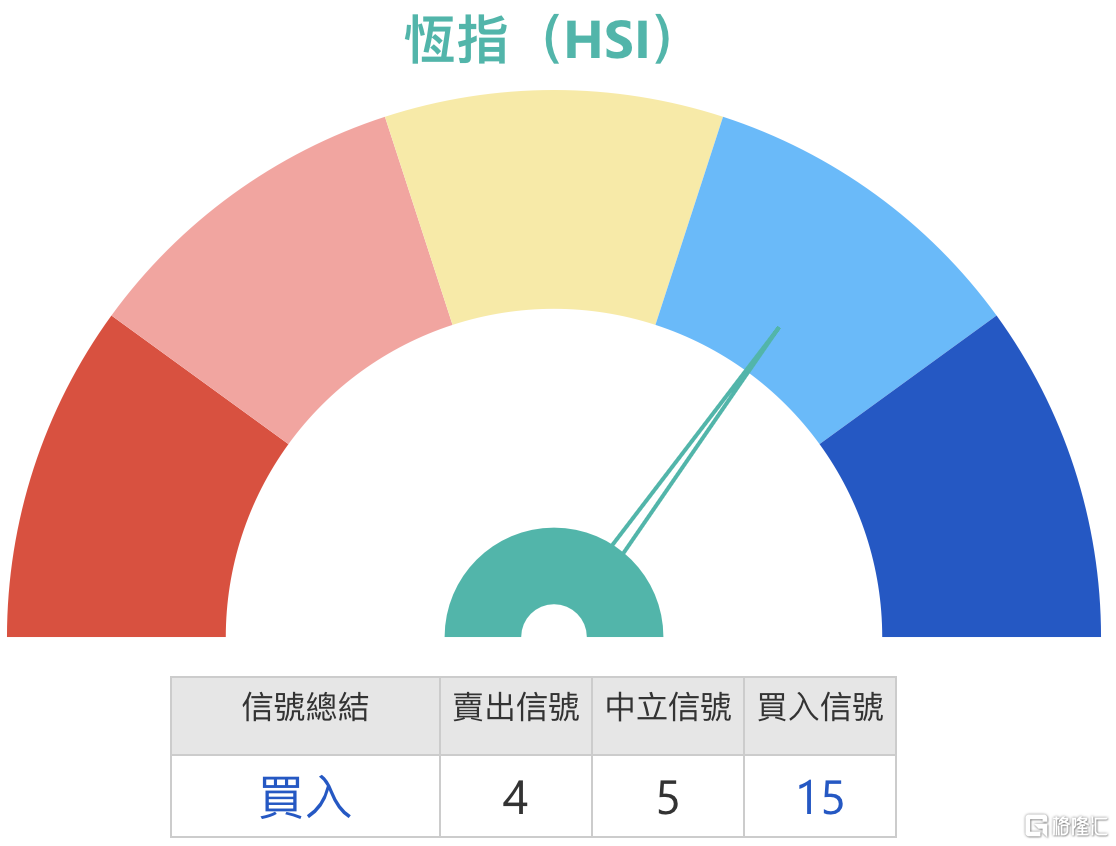
Simon:前期高位在30.23元,目前技術信號總結為"買入"15個買入和4個賣出。能否挑戰高位呢?數據系統分析的阻力位在30.1元和32.2元,有機會升穿之前 高位。 1、恆指:看多投資者認為繼續大成交,資金未有減退,已突破阻力,下一個目標26600,過夜牛證。看空投資者則同時部署Put和熊證 Simon:全日收在最高位25538.7點,從周線圖看,恆指升穿周線圖的保力加通道頂部。如果反手部署,投資者都會問選擇認沽證好還是熊證?兩者之間最大 的區別就是牛熊證有收回風險,如果市場繼續升,而買入貼價熊證,會出現即刻被收回的風險。如果看淡走勢,考慮買下跌工具搏一搏的話,選擇認沽證, 不會有收回風險。如果升勢情況下,熊證則有機會被收回,認沽證則還等待一段時間。回到指數分析,目前買賣信號總結為"買入",整體偏向樂觀向好。阻 力位25795點和26580點。 2、中信証券 (06030.HK): 這周能破前高嗎?窩輪市場上有投資者尾盤入Call Simon:走勢引人矚目。升穿保力加通道頂部,盤中最高見552元。近期有一定的升幅,窩輪牛熊證選擇獲利離場是合理的。信號總結為"強力買入",上方阻 力位在572元和586元。 ...

最猛赛道,狂买!
中国基金报· 2025-07-24 06:51
Core Viewpoint - The article highlights the significant inflow of funds into stock ETFs, particularly those linked to the Hong Kong stock market, with a total inflow exceeding 250 billion yuan in July, indicating strong investor interest and market confidence [2][11]. Group 1: Market Performance - The A-share market has been fluctuating around the 3600-point mark, with the Shanghai Composite Index reaching a new high for the year at 3582.30 points on July 23, 2023, showing a slight increase of 0.01% [4]. - The overall market valuation has been gradually increasing due to the influx of new capital, with stock ETFs being a preferred investment vehicle for market participants [4][11]. Group 2: ETF Inflows - On July 23, 2023, the total net inflow into stock ETFs (including cross-border ETFs) was 13.89 billion yuan, marking the third consecutive day of inflows, totaling nearly 60 billion yuan over this period [3][4]. - The Hong Kong stock ETFs have been the main contributors to this inflow, with over 64 billion yuan attracted in the last three trading days and more than 254 billion yuan in July [2][11]. Group 3: Specific ETF Performance - The top-performing ETFs in terms of net inflow on July 23 included the 30-Year Treasury Bond ETF with an inflow of 10.16 billion yuan and the CSI 500 ETF with an inflow of 8.72 billion yuan [10]. - The Hong Kong stock ETFs, particularly those tracking the non-bank and internet sectors, have seen significant interest, with inflows of 6.15 billion yuan and 5.96 billion yuan, respectively [10][11]. Group 4: Future Outlook - Analysts express optimism regarding the future performance of the Hong Kong internet sector, driven by factors such as the easing of restrictions and improved investor sentiment towards core Chinese assets [11]. - The insurance sector within the Hong Kong non-bank segment is also viewed positively, with expectations of improved profitability due to a favorable investment environment and recovering premium income [12].
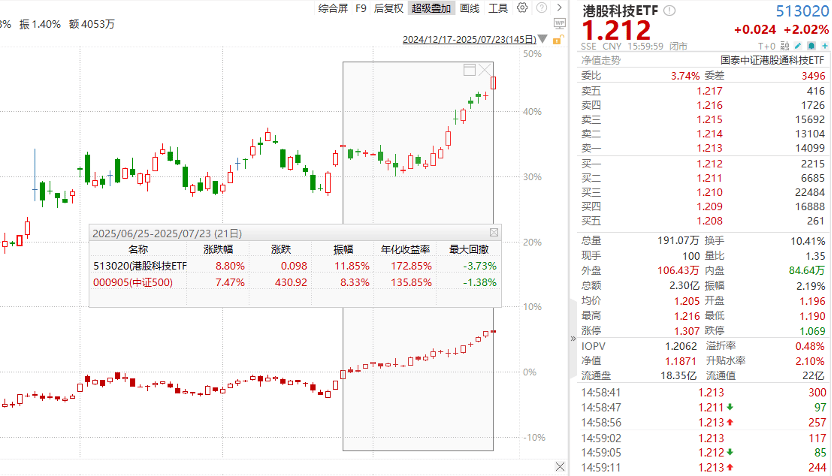
流动性驱动港股走势强劲,港股科技ETF(513020)、港股通50ETF(159712)涨幅居前
Sou Hu Cai Jing· 2025-07-24 01:20
Core Viewpoint - The recent strong performance of Hong Kong stocks is driven by a rebound in the internet sector and structural factors leading to a bull market in the region [3][5]. Group 1: Market Performance - On July 23, the Hong Kong Technology ETF (513020) rose by 2.02% in a single day, with a 20-day increase of 7.73, outperforming major A-share indices [1]. - The Hong Kong Stock Connect 50 ETF (159712) saw a daily increase of 1.45% and a 20-day rise of 3.37% [1]. Group 2: Factors Influencing the Market - The rebound in the internet sector has significantly contributed to the stronger performance of Hong Kong technology indices compared to broader indices [3]. - The "anti-involution" and water-electricity market trends have catalyzed growth in construction and building materials sectors in both A-shares and H-shares [3]. Group 3: Liquidity and Investment Trends - The strong performance of Hong Kong stocks is closely linked to the current liquidity conditions, characterized by a low domestic interest rate environment and a scarcity of high-return assets [5]. - As of June, China's M2 reached 330 trillion yuan, which is 2.4 times the GDP, indicating a significant demand for asset allocation [5]. - The ongoing liquidity easing is expected to continue, providing certain allocation value in Hong Kong stocks [7]. Group 4: Future Outlook - Despite potential short-term disturbances, the long-term outlook remains positive due to the resonance between fundamentals and liquidity [7]. - Investors are advised to focus on Hong Kong Technology ETF (513020) and Hong Kong Stock Connect 50 ETF (159712) for low-position layouts [7].