
碳达峰

Search documents
“共同追求更可持续的未来”(外媒看中国)——国际舆论积极评价中国引领全球气候治理
Ren Min Ri Bao· 2025-11-21 21:54
Core Viewpoint - The international community is closely watching the COP30 conference, with expectations that its outcomes will guide global climate governance for the next decade. China has made significant progress in implementing its 2030 Nationally Determined Contributions (NDCs) and has announced its 2035 NDCs, which include absolute reduction targets for all greenhouse gases [1][4]. Group 1: China's Role in Global Climate Governance - China is recognized as a key leader in global climate governance, with foreign media highlighting its achievements in green industry development and international cooperation on climate change [1]. - The country has established the world's largest and fastest-growing renewable energy system, becoming the largest market for new energy vehicles [2][4]. - China's new round of NDCs aims for a 7%-10% reduction in greenhouse gas emissions by 2035, with non-fossil energy consumption reaching over 30% of total energy consumption [4][6]. Group 2: Renewable Energy Development - China is developing a vast clean energy industry network in the Tibetan Plateau, leveraging its unique environmental conditions to create a low-cost renewable energy system [3]. - The country has formed the largest and most complete new energy industrial chain globally, providing a significant portion of the world's photovoltaic components and wind power equipment [2][4]. - Chinese enterprises are expanding their presence in the global clean energy sector, influencing the energy transition worldwide [4][5]. Group 3: International Cooperation and Investment - China is actively collaborating with African nations on renewable energy projects, supporting their energy transitions through investments in solar, wind, hydro, and biomass energy [2][5]. - The establishment of the South-South Cooperation Fund for climate change reflects China's commitment to enhancing international climate cooperation [7]. - China's actions in trade, finance, and security have generated positive environmental and social benefits, enhancing the capacity of other countries to achieve sustainable development goals [7][8].
合肥泰禾智能科技集团股份有限公司第五届董事会第十五次会议决议公告
Shang Hai Zheng Quan Bao· 2025-11-21 18:40
Group 1 - The company held its 15th meeting of the 5th Board of Directors on November 21, 2025, where several key resolutions were passed [1][5][8] - The company plans to permanently supplement its working capital with surplus funds of 2.0384 million yuan from completed fundraising projects [1][5] - A proposal to change the investment direction of 219.0937 million yuan from the "Intelligent Coal Dry Selection Machine Industrialization Project (Phase I)" to a "120MW/240MWh User-side Energy Storage Project" was approved [5][57] Group 2 - The company approved an increase in the guarantee limit for its subsidiary, Anhui Sunshine Energy Storage Co., Ltd., to 100 million yuan to enhance overall financing efficiency [8][26] - The company plans to repurchase and cancel 430,000 shares from the first employee stock ownership plan, which accounts for 0.23% of the total share capital [12][34] - The company will hold its second extraordinary general meeting of 2025 on December 8, 2025, to discuss the approved proposals [17][38] Group 3 - The company reported that the total amount of external guarantees after the increase will be 120 million yuan, accounting for 9.31% of the latest audited net assets [32][33] - The company has no overdue guarantees and does not provide guarantees for controlling shareholders or related parties [32][33] - The company’s registered capital will decrease from 1.83375358 billion yuan to 1.82945358 billion yuan following the share repurchase [34][35] Group 4 - The company’s decision to terminate the "Intelligent Coal Dry Selection Machine Industrialization Project (Phase I)" is due to unfavorable market conditions and a decline in demand for coal intelligent sorting machines [57][68] - The new "120MW/240MWh User-side Energy Storage Project" is expected to have a total investment of 252.09 million yuan, with 219.0937 million yuan sourced from the repurposed funds [57][73] - The project aims to be operational by December 31, 2026, and is aligned with national strategies for carbon neutrality [57][73]

通领科技IPO:专注汽车内饰创新,向智能化进军
Cai Jing Wang· 2025-11-21 11:03
Core Viewpoint - Tongling Technology is set to be reviewed by the Beijing Stock Exchange on November 21, 2025, with a profit of 128 million yuan in 2024, making it the best performer among the four companies [1] Company Overview - Tongling Technology, established in 2007, specializes in the R&D, production, and sales of automotive interior components, including door trim strips and dashboard panels, primarily for passenger vehicles [1] - The company has a significant market share in the automotive interior components sector, with a domestic market share of 15.44%, 10.95%, 9.02%, and 9.40% over the past four years [3] Industry Context - China's automotive market has seen rapid growth, maintaining the largest global sales for 15 consecutive years, although the per capita car ownership remains lower than in traditional automotive powerhouses like the US, Germany, and Japan [2] - The demand for automotive interior components is closely linked to the overall development of the automotive industry, with increasing importance placed on design and functionality [1][2] Market Growth Potential - The market for automotive interior components in China is projected to grow from 231.1 billion yuan in 2024 to 276.5 billion yuan by 2029, indicating substantial growth potential [3] - The shift towards electric vehicles (EVs) has created new demands for interior components, such as battery management systems and smart cockpit designs, further driving industry growth [3] Technological Innovation - Tongling Technology's core competitiveness lies in its technological innovation, having obtained 127 patents, including 44 invention patents [4] - The company has established a research and development center since 2009, focusing on mold design and new process development to meet the evolving needs of the automotive market [4] Financial Performance - The company reported revenues of 892 million yuan, 1.013 billion yuan, and 1.066 billion yuan for the years 2022 to 2024, with a compound annual growth rate of 9.29% [5] - The net profit after deducting non-recurring items was 62.15 million yuan, 107 million yuan, and 128 million yuan for the same period, showing a compound growth rate of 43.38% [5] IPO Plans - Tongling Technology plans to publicly issue up to 15.6 million shares, accounting for 25% of the total share capital post-issue, with funds allocated for various projects including production and R&D upgrades [6]
国家碳达峰试点(成都)实施方案印发
Zhong Guo Hua Gong Bao· 2025-11-21 04:45
Group 1 - The core viewpoint of the news is the implementation of the "National Carbon Peak Pilot (Chengdu) Implementation Plan," which outlines eight key tasks to effectively promote the city's carbon peak pilot construction [1] Group 2 - The plan emphasizes the development and utilization of clean energy, including support for photovoltaic, hydrogen, and biomass energy applications, with a target of exceeding 1.5 million kilowatts of renewable energy installed capacity by 2030 [1] - The plan aims to optimize and adjust the industrial structure by exploring the construction of low-carbon and zero-carbon parks, focusing on energy structure transformation and resource-saving measures [1] - The advanced energy industry scale is expected to reach 200 billion yuan by 2027, with a focus on lithium batteries, new energy vehicles, and green hydrogen [1] Group 3 - The city plans to improve the resource utilization rates of urban solid waste, aiming for an 87% resource utilization rate for municipal waste and over 96% for general industrial solid waste by 2030 [2] - The plan includes a focus on green low-carbon technology innovation in fields such as hydrogen energy and new power systems, utilizing competitive approaches to accelerate breakthroughs in advanced technologies [2]
能源早新闻丨长三角互济电量年度目标提前完成!
中国能源报· 2025-11-20 22:33
Industry News - The Ministry of Finance and the Ministry of Industry and Information Technology have released a draft for public consultation regarding the procurement standards for new energy vehicles, emphasizing non-discriminatory treatment of suppliers and strict adherence to contract specifications for vehicle parameters and configurations [2] - China's first green hydrogen coal chemical project has commenced full market operation, with an expected annual hydrogen production of 705,900 cubic meters, which will reduce carbon dioxide emissions by 13,880 tons [2] - Over 510 green mines have been established at the provincial level or above in China, including 1,054 national-level green mines, accounting for 40.8% of licensed operating mines, achieving significant results in resource conservation and ecological restoration [2] - The steel, cement, and aluminum smelting industries are set to complete their first carbon emission quota clearance by the end of this year, as per the newly released quota distribution plan for 2024 and 2025 [2] Regional Developments - The Yangtze River Delta has achieved 180.8 billion kilowatt-hours of inter-regional electricity exchange, surpassing its annual target ahead of schedule, with an 8.26% increase compared to the previous year [3] - The implementation plan for the national carbon peak pilot in the Qiannan High-tech Industrial Development Zone has been released, aiming for a low-carbon, efficient modern phosphate chemical industry by 2030 [3] Energy Projects - Shanxi Province has initiated a bidding process for new energy projects, with a total mechanism electricity scale of 55.06 billion kilowatt-hours, including 14.17 billion kilowatt-hours from wind power and 40.89 billion kilowatt-hours from solar power [4] International Developments - Japan is expected to approve the restart of its largest nuclear power plant, the Kashiwazaki-Kariwa Nuclear Power Plant, with only one of its seven reactors set to resume operation [5] - Egypt has signed a nuclear fuel procurement agreement with Russia for the Dabaa Nuclear Power Plant, ensuring fuel supply for the first reactor [5] Corporate News - China Nuclear Engineering Corporation has reported new contracts totaling 123.84 billion yuan and cumulative operating revenue of 81.33 billion yuan as of October 2025 [7]

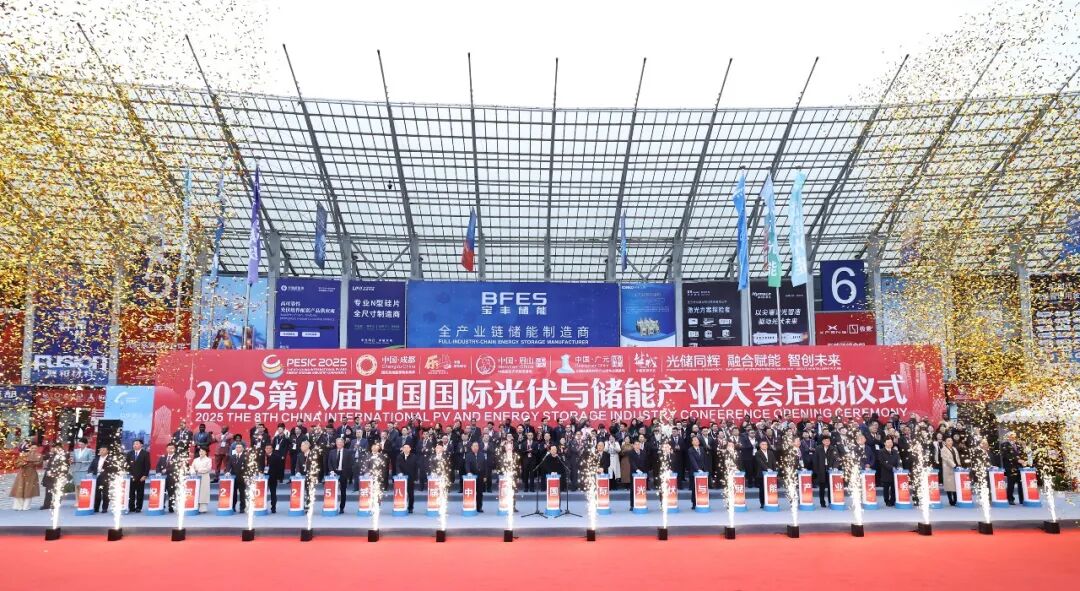
全球光储领袖聚蓉城 共破内卷筑就零碳新生态丨2025第八届中国国际光伏与储能产业大会
Jin Rong Jie· 2025-11-20 01:36
Core Insights - The 2025 8th China International Photovoltaic and Energy Storage Industry Conference was held on November 18 in Chengdu, emphasizing the importance of the photovoltaic and energy storage industry for global sustainable development [1][10]. Group 1: Conference Overview - The conference gathered key leaders, experts, and representatives from the global photovoltaic and energy storage sectors to discuss advancements and collaborations [1][3]. - The event was inaugurated by prominent figures including Chen Changzhi, Vice Chairman of the Standing Committee of the National People's Congress, and Wang Fengchao, Mayor of Chengdu, highlighting the significance of the conference in promoting green energy [1][10]. Group 2: Industry Challenges and Opportunities - Chen Changzhi emphasized the need for high-quality development in the photovoltaic and energy storage sectors, calling for collaboration among government, industry, and enterprises to enhance competitiveness and innovation [8][12]. - Su Bo, former Vice Minister of Industry and Information Technology, pointed out challenges such as over-competition and structural oversupply in the industry, urging companies to focus on innovation and collaboration to strengthen their market position [12][25]. Group 3: Future Development Goals - The conference highlighted China's ambitious goal to achieve a total installed capacity of 3.6 billion kilowatts for wind and solar power by 2035, necessitating an average annual increase of nearly 200 million kilowatts over the next decade [16]. - The importance of technological innovation and collaboration within the industry was reiterated, with a focus on building a modern industrial system and enhancing the resilience of supply chains [12][16]. Group 4: Brand Recognition and Industry Standards - The "2025 China Energy Storage Brand Top 100 List" was released, showcasing leading companies such as CATL, BYD, and LONGi, which are recognized for their contributions to the industry [30][32]. - The conference served as a platform for discussing the establishment of a healthy ecosystem within the industry, addressing issues like "involution" and promoting sustainable development practices [49][51]. Group 5: Global Collaboration and Knowledge Sharing - The event featured speeches from international leaders, including former New Zealand Prime Minister Jenny Shipley, who highlighted China's proactive approach to achieving climate goals ahead of schedule [33]. - Discussions on global energy transition and the role of Chinese companies in the international market were emphasized, with calls for deeper cooperation and knowledge exchange [24][41].

专访中国能源研究会首席专家黄少中:可通过技术手段和机制创新 让“负电价”红利惠及老百姓
Mei Ri Jing Ji Xin Wen· 2025-11-19 17:04
Core Viewpoint - The recent publication of the "Suggestions on Formulating the 15th Five-Year Plan for National Economic and Social Development" emphasizes the need for high-quality development of clean energy, including the peak consumption of coal and oil, and the promotion of new energy storage solutions [1] Group 1: Coal and Oil Peak Consumption - China's coal consumption has decreased from 68.5% in 2000 to 53.2% in 2024, while oil consumption has dropped from 22% to 18.2%, but both still account for 71.4% of total energy consumption [2] - Achieving peak consumption for coal and oil by 2030 is challenging but feasible, with ongoing policy efforts showing gradual effectiveness [2] - The coal power sector is expected to reach its peak consumption before the coal sector overall, due to the reduction in coal use in industries like steel and cement [4] Group 2: Energy Transmission and Pricing Mechanism - The external transmission of electricity is deemed crucial for large-scale renewable energy consumption, especially in regions like Northwest China [5] - The establishment of a scientific and reasonable pricing mechanism for electricity transmission is essential, as current pricing often leads to disputes and inefficiencies [7] - Government intervention is necessary to enhance transmission capacity and coordinate interests among different stakeholders [9] Group 3: Renewable Energy Investment and Market Dynamics - As of September 2023, China's renewable energy capacity reached nearly 22 billion kilowatts, with a target of 36 billion kilowatts by 2035, necessitating an annual increase of 1.9 to 2 billion kilowatts [10] - The current low on-grid electricity prices are affecting investment enthusiasm in the renewable sector, particularly in solar energy [10][11] - The relationship between promoting investment and achieving targets is manageable, with expectations that the 2035 goal will be met or exceeded [12] Group 4: New Energy Storage Development - The new energy storage sector is experiencing rapid growth but faces challenges such as low-price competition and economic viability [15] - Recent policy changes have ended mandatory energy storage requirements for new renewable projects, leading to an oversupply in the market [16] - The government is working on reforms to improve market mechanisms for energy storage, including integrating it into capacity pricing systems [17]

电力设备及新能源行业周报:宇树科技完成IPO辅导,两部委下发新能源消纳和调控指导意见-20251119
Shanxi Securities· 2025-11-19 05:09
Investment Rating - The report maintains an investment rating of "Synchronize with the market - A" for the electric equipment and new energy industry [1]. Core Viewpoints - Tesla plans to expand its Texas Gigafactory, aiming to establish a production base for the Optimus humanoid robot with an annual capacity of 10 million units by 2027 [1]. - The completion of IPO guidance for Yushu Technology has been reported, indicating progress in the company's public offering process [1]. - The National Energy Administration has issued guidelines to promote the integrated development of new energy, emphasizing the importance of reliable replacement levels and market competitiveness by 2030 [2]. - The National Development and Reform Commission and the National Energy Administration have released guidance on new energy consumption and regulation, aiming to establish a multi-level consumption regulation system by 2030 [3]. Summary by Relevant Sections Market Performance - The report highlights the recent market performance of the electric equipment and new energy industry, noting significant developments such as Tesla's expansion plans and Yushu Technology's IPO progress [1][2]. Price Tracking - The report provides price tracking data for polysilicon, silicon wafers, battery cells, and modules, indicating stable prices for polysilicon and slight declines in silicon wafer prices due to weak demand [5][7][8]. - The average price of polysilicon remains at 52.0 CNY/kg, while silicon wafer prices have decreased by 3.7% for N-type wafers [5][7]. Investment Recommendations - The report recommends several companies based on different strategic focuses, including: - BC new technology: Aishuo Co., Longi Green Energy - Supply-side focus: Daqian Energy, Fulete - Light storage direction: Sunshine Power, Deyi Co. - Market-oriented direction: Langxin Group - Domestic substitution: Quartz Co. - Overseas layout: Hengdian East Magnetic, Bowei Alloy [9].
究竟要反垄断,还是反内卷?刘汉元直接给出答案
Tai Mei Ti A P P· 2025-11-18 00:41
Core Viewpoint - The current state of the photovoltaic industry necessitates bold actions to address issues of "involution" and potential antitrust concerns, emphasizing the importance of energy transition and carbon neutrality for China's economic development [1][9]. Group 1: Industry Challenges and Opportunities - The photovoltaic industry faces a critical moment where the balance between preventing excessive competition ("involution") and addressing antitrust issues is essential for sustainable growth [1][9]. - China's reliance on foreign energy sources is a significant concern, with oil dependency exceeding 70% and substantial foreign exchange expenditures on energy imports, amounting to approximately $500 billion annually [2][3]. - The "14th Five-Year Plan" highlights the strategic importance of energy transition, emphasizing renewable energy sources like solar and wind power to enhance energy security and reduce foreign dependency [2][3]. Group 2: Growth of Renewable Energy - The renewable energy sector, particularly solar and wind, is positioned to lead global energy transition efforts, with China holding a dominant share in the global photovoltaic market, accounting for about 95% of polysilicon production [8][6]. - The new energy system and storage industry are experiencing exponential growth, with new storage installations increasing by approximately 3000% year-on-year, indicating a robust market potential [6][8]. - The integration of renewable energy sources with storage solutions is expected to create a comprehensive energy pricing system, potentially below 0.5 yuan per kilowatt-hour, enhancing the feasibility of renewable energy adoption [6][8]. Group 3: Investment Potential - The photovoltaic and storage sectors are viewed as prime investment opportunities, with the potential for significant returns as the industry matures and scales [8][9]. - The current market dynamics suggest that leading companies in the photovoltaic supply chain could see their market valuations increase significantly, potentially five to ten times their current levels [8][9]. - The industry's ability to self-regulate and achieve effective integration is seen as a pathway to stabilize supply and demand, ensuring long-term growth and sustainability [14][13].
如何让负电价红利传导到居民?专访中国能源研究会首席专家黄少中:在维持居民电价基本稳定的前提下 通过技术手段和机制创新实现负电价红利的间接传导
Mei Ri Jing Ji Xin Wen· 2025-11-17 15:33
Core Viewpoint - The recent guidelines from the Central Committee emphasize the need for coordinated local consumption and external delivery of clean energy, aiming for high-quality development in the energy sector, while addressing the challenges of achieving peak coal and oil consumption by 2030 [1][2]. Group 1: Coal and Oil Peak Consumption - China's coal consumption has decreased from 68.5% in 2000 to 53.2% in 2024, while oil consumption has dropped from 22% to 18.2%, yet both still account for 71.4% of total energy consumption, indicating a challenge in reaching peak consumption targets [2][5]. - The coal industry is expected to peak before coal power, as coal power's peak is delayed due to its role in ensuring energy security and the reduction in coal consumption from other sectors like steel and cement [6][5]. Group 2: Energy Delivery and Storage - The primary solution for large-scale renewable energy consumption in the northwest regions is external delivery, as local consumption capacity is limited due to economic constraints and insufficient grid flexibility [7][8]. - The construction of external delivery channels faces challenges such as high costs and complex approval processes, which can lead to underutilization of built channels [9][10]. Group 3: Renewable Energy Investment - As of September, China's renewable energy capacity reached nearly 220 million kilowatts, with wind and solar power exceeding 170 million kilowatts, necessitating an annual addition of 19 to 20 million kilowatts to meet the 2035 targets [13][15]. - The recent market price decline for renewable energy has led to a cautious investment stance among power generation companies, particularly in the solar sector, due to the adjustments in pricing mechanisms [16][17]. Group 4: Addressing Negative Pricing - The frequent occurrence of negative pricing in the electricity market is attributed to supply-demand imbalances, and simply adjusting long-term trading ratios will not resolve this issue [18][19]. - To ensure that the benefits of negative pricing reach consumers, innovative mechanisms are needed, such as developing virtual power plants that aggregate consumer loads to respond to market conditions [20][21]. Group 5: New Energy Storage Development - The new energy storage sector is experiencing rapid growth but faces challenges such as low price competition and economic viability, leading to widespread operational difficulties [22][23]. - The government is working on reforms to allow energy storage to participate as an independent market entity, which includes integrating storage into capacity pricing mechanisms to ensure stable revenue streams [24].
