
稀土出口管制

Search documents
稀有金属板块配置价值凸显,稀有金属ETF基金(561800)早盘冲高涨近2%,成分股盛新锂能10cm涨停
Sou Hu Cai Jing· 2025-10-17 01:59
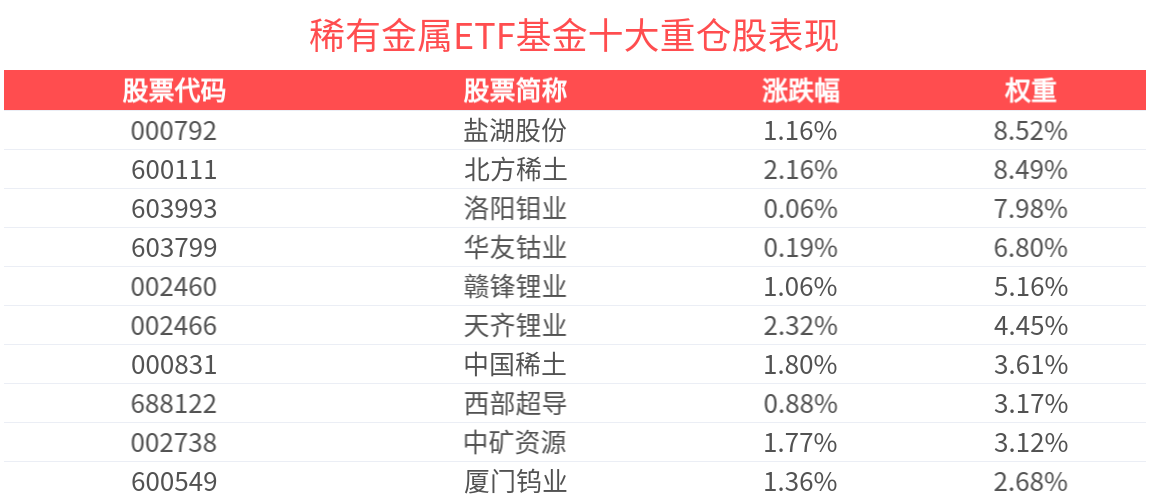
Group 1 - The core viewpoint of the articles highlights the strengthening of the rare metals sector due to recent developments such as detailed export controls on rare earths, renewed tariff trade frictions, and the Federal Reserve's interest rate cuts, which collectively enhance China's position in the global rare earth market [1][2][3] - The China Rare Metals Theme Index (930632) has shown a strong upward trend, with notable increases in component stocks such as Shengxin Lithium Energy (002240) reaching a 10% limit up, and other stocks like Rongjie Co. (002192) and Tibet Mining (000762) also experiencing significant gains [1][4] - The Rare Metals ETF (561800) has seen a net inflow of funds over three out of the last five trading days, totaling 19.6353 million yuan, indicating strong investor interest [1][3] Group 2 - The investment opportunities in rare metals are particularly noteworthy, as they are crucial in high-tech fields and exhibit greater price elasticity compared to traditional industrial metals, making them more responsive to market trends [2][3] - From a microeconomic perspective, rare metals like rare earths and tungsten have seen price increases due to export controls, while lithium carbonate prices remain stable amid a tightening supply-demand balance, driven by stricter mining regulations and rising demand from lithium battery and energy storage sectors [3][4] - The top ten weighted stocks in the China Rare Metals Theme Index account for 59.91% of the index, with companies like Northern Rare Earth (600111) and Luoyang Molybdenum (603993) being significant contributors [4][6]







稀土行业周刊:中国政府实施稀土出口管制,加快产业链技术攻关
Chan Ye Xin Xi Wang· 2025-10-17 01:24
Key Events - Brazil is advancing its rare earth reserve plan, with the São Paulo government announcing the launch of its first rare earth and critical mineral processing plant, which aims to utilize billions of dollars in business potential and reduce reliance on external suppliers [1] - Pensana has completed preliminary drilling at the Coola carbonatite, located approximately 30 kilometers north of its flagship Longonjo rare earth project, marking an important milestone in evaluating the area's potential [2][4] - WA1 Resources announced high-grade mineralization results from its Luni project in Western Australia, with significant niobium grades reported [13][14] - Lynas Rare Earths and Noveon Magnets signed a preliminary agreement to develop a permanent magnet supply chain in the U.S., with Lynas constructing a processing plant in Texas [22][25] - The U.S. government is reportedly interested in acquiring a stake in the Tanbreez rare earth project in Greenland, which is one of the largest rare earth deposits globally [28][30] - Momentum Technologies has launched commercial recycling of rare earth elements from magnetic scrap and tailings at its Texas facility, marking a significant step in enhancing U.S. rare earth supply [33] - Aldoro Resources has begun exploration for rare earth elements in Namibia, potentially confirming a new REE-Nb discovery [34][35] - The Chinese Ministry of Commerce announced export controls on certain rare earth-related items, including equipment and technologies [36][38] Company Highlights - Northern Rare Earth plans to adjust its rare earth concentrate trading price to 26,200 yuan per ton for Q4 2025, reflecting a 37% increase from the previous quarter [65] - Jilin Permanent Magnet's net profit for the first three quarters of 2025 is expected to increase by 157% to 179% year-on-year [66] - Northern Rare Earth anticipates a net profit increase of 272.54% to 287.34% for the first three quarters of 2025 [67] Industry Developments - The establishment of the Rare Earth Industry Collaborative Innovation Network in Baotou aims to enhance resource integration and technological innovation in the rare earth sector [74] - Jiangxi University of Science and Technology has launched three innovation centers focused on rare earth and critical minerals, aiming to strengthen research and development capabilities [75]

关注黄金及稀土磁材龙头企业
Sou Hu Cai Jing· 2025-10-16 23:08
Group 1: Industry Performance - The non-ferrous metal industry has shown significant performance, with the Shenwan Non-ferrous Metal Index rising 74% year-to-date as of October 14, compared to an 18% increase in the CSI 300 Index, making it the top-performing sector among Shenwan's primary industries [1] - Key sectors driving this growth include gold, rare earths, and minor metals [1] Group 2: Gold Market Insights - The Federal Reserve has initiated a rate-cutting cycle, with the federal funds target rate decreasing from 5.25%-5.5% to below 4.5%, and further cuts are expected, which will support gold prices [2] - Recent gold prices have surpassed $4,100 per ounce, with historical data indicating that during the last rate-cutting cycle (2019), gold prices increased by over 40% [2] - The current rate-cutting space is larger than the previous cycle, suggesting a high probability of sustained high gold prices [2] Group 3: Economic Indicators - The U.S. economy is showing signs of pressure, with a decrease of 32,000 in ADP employment numbers for September, marking the largest decline since March 2023 [3] - The Consumer Price Index (CPI) data aligns with market expectations, indicating stable inflation rates, which may influence the Fed's decision to continue rate cuts [3] - The ongoing rate cuts are expected to provide strong support for gold prices amid economic pressures [3] Group 4: Central Bank Gold Purchases - Global central banks have continued to increase gold reserves, with a net addition of 22 tons in June 2025, marking the third consecutive month of slight increases [3] - China's central bank has also increased its gold reserves to 7.406 million ounces as of September 2025, continuing a trend of monthly increases for 11 months [3] Group 5: Rare Earth Export Controls - China has intensified export controls on rare earth materials, with new regulations requiring export licenses for certain items containing Chinese components, particularly for military and advanced technology applications [5] - The new regulations will take effect immediately for items originating from China and from December 1 for other items, highlighting the strategic importance of rare earths [5] Group 6: Rare Earth Supply and Demand - China holds over 50% of global rare earth reserves and produces over 70% of the total, with supply largely regulated by government-issued separation and smelting quotas [6] - Demand for rare earths is expected to grow significantly in the next three years, particularly in the electric vehicle sector, with projected growth rates of approximately 25% [6] - The humanoid robot sector is anticipated to be a new growth point for rare earth demand, with a projected compound annual growth rate exceeding 150% [6] Group 7: Investment Summary - The rare earth industry is characterized by tight supply and promising demand prospects, with current prices at historical averages and potential for upward movement [7] - It is recommended to focus on leading companies in the rare earth magnet sector [7]
美国挑动盟友集体应对中国稀土出口管制?中方回应
Huan Qiu Wang· 2025-10-16 22:41
Group 1 - The G7 finance ministers are considering joint measures in response to China's planned export controls on rare earths, with discussions expected to take place during their meeting in Washington [1] - The U.S. Treasury Secretary emphasized the need for broader support beyond the G7, indicating a collective response involving allies such as Europe, Australia, Canada, India, and other democratic nations in Asia [1] - The G7 has reached a consensus to take action to protect their national and economic security interests against potential supply chain weaponization by China [1] Group 2 - China's Ministry of Commerce reiterated that the new export control measures are a normal action to improve its export control system and are not aimed at specific countries or regions [2] - Experts suggest that China's dominant position in the global rare earth supply chain makes it unlikely that the G7's collective actions will successfully challenge the existing market dynamics [2] - Analysts argue that the recent trade conflicts between the U.S. and China stem from unilateral actions by the U.S., and G7 countries should engage in equal negotiations with China to address their concerns without being misled by U.S. provocations [2]

中国商务部再回应稀土出口管制措施
Zhong Guo Xin Wen Wang· 2025-10-16 18:13
Core Viewpoint - The recent export control measures on rare earths by China are a legitimate action based on legal regulations aimed at preventing illegal flows of rare earths to inappropriate uses, thereby safeguarding national and global security [1][2] Group 1: Export Control Measures - The controlled rare earth products include those already listed in China's export control list, such as rare earth magnetic materials and related components, as well as rare earth target materials [1] - The measures are not aimed at specific countries or regions; compliant export applications for civilian use will be approved [2] - China is committed to optimizing the licensing process and considering general licenses and exemptions to facilitate compliant trade [2] Group 2: International Relations and Reactions - The U.S. claims that China's measures will broadly impact various industries, including semiconductors and artificial intelligence, but China argues that this interpretation is exaggerated and misleading [1] - The U.S. has a long history of extraterritorial jurisdiction measures, having implemented multiple semiconductor export controls against China since 2022 [1] - China maintains an open attitude towards equal consultations based on mutual respect in recent trade talks with the U.S. [2]
美财长称若中国停止实施 或将延长对华加征关税三个月豁免期限 中方回应
Guo Ji Jin Rong Bao· 2025-10-16 17:13
Core Viewpoint - The Chinese government has reiterated its stance on rare earth export controls, emphasizing that these measures are in line with international obligations and aimed at maintaining global peace and regional stability [1] Group 1: U.S. Response - The U.S. Treasury Secretary indicated that if China halts its strict rare earth export control plan, the U.S. may extend the three-month exemption on tariffs imposed on China [1] - President Trump is reportedly prepared to meet with Chinese leaders in the near future [1] Group 2: Japan's Concerns - Japan's Finance Minister expressed deep concern regarding China's recent announcement of broad export controls on rare earths, suggesting that the G7 should unite to address this issue [1] - The Chinese Foreign Ministry responded by stating that it has clarified its position on rare earth export controls multiple times, asserting that these measures are lawful and aimed at ensuring global supply chain security [1]
美财长称若中国停止实施,或将延长对华加征关税三个月豁免期限,中方回应
Sou Hu Cai Jing· 2025-10-16 16:43
Core Points - The U.S. Treasury Secretary indicated that if China halts its strict rare earth export control measures, the U.S. may extend the three-month exemption on tariffs imposed on China [1] - The Chinese Foreign Ministry reiterated its stance on rare earth export controls, emphasizing that these measures are in line with international obligations and aim to maintain global supply chain stability [3] Group 1 - The U.S. Secretary of the Treasury's comments suggest a potential diplomatic engagement between the U.S. and China, with President Trump preparing to meet with Chinese leaders soon [1] - Japan expressed significant concern over China's recent announcement of broad export control measures on rare earths, calling for a collective response from the G7 [3] - The Chinese government stated that its export control policies are legally justified and intended to uphold international peace and regional stability, while also being consistent with international practices [3]
商务部召开例行新闻发布会(2025年10月16日)
Shang Wu Bu Wang Zhan· 2025-10-16 13:53
Core Points - The Ministry of Commerce is actively promoting service consumption through various initiatives and policies, resulting in a notable increase in service consumption during the recent National Day holiday, with a 7.6% year-on-year growth in daily sales revenue across related industries [2][3] - The Ministry plans to focus on three main areas to further expand service consumption: cultivating new growth points, innovating diverse consumption scenarios, and optimizing service supply [3] Group 1: Service Consumption - The Ministry of Commerce has implemented a series of policies and activities to stimulate service consumption, including the "Service Consumption Season" and "Chinese Cuisine Fair" [2] - During the National Day holiday, service consumption showed strong performance, particularly in rural tourism and sports events [2] - Future efforts will include removing restrictive measures, enhancing service scenarios, and improving the quality of service supply, especially for the elderly and children [3] Group 2: Foreign Trade - China's foreign trade has maintained a stable growth trend, with a 4% increase in goods trade in the first nine months of the year, and an 8% growth in September alone [6] - The Ministry of Commerce will focus on releasing policy effectiveness, promoting trade, and deepening trade cooperation to stabilize foreign trade growth [6][7] - The proportion of imports from countries involved in the Belt and Road Initiative has increased to 51.7%, with a 9.7% growth in imports from the least developed countries [6] Group 3: Semiconductor Industry - The Ministry of Commerce expressed strong opposition to the Dutch authorities' interference in Nexperia's operations, emphasizing the need for a fair business environment [4] - The Ministry highlighted the negative impact of U.S. export control measures on international trade and the global supply chain, particularly regarding semiconductor companies [10][12] - China is committed to protecting its enterprises' legitimate rights and interests in response to U.S. actions that disrupt trade relations [10][12] Group 4: Rare Earth Export Controls - China's recent rare earth export control measures aim to enhance national security and prevent illegal use of these materials [14][15] - The Ministry clarified that these measures are not a ban on exports but are designed to ensure compliance with international obligations [15][16] - Efforts will be made to streamline the approval process for compliant exports to minimize the impact on businesses [16]
美方无端指责中国稀土出口管制影响全球多个行业,商务部回应
Nan Fang Du Shi Bao· 2025-10-16 13:22
Core Viewpoint - The recent export control measures on rare earths by China are aimed at enhancing national security and preventing illegal use of these materials, contrary to claims made by the U.S. that these measures will broadly impact various global industries [1][2]. Group 1: China's Export Control Measures - China's recent export control measures on rare earths are based on legal regulations and aim to prevent illegal flows of rare earths to inappropriate uses, such as weapons [1]. - The controlled products include rare earth magnetic materials and related components, as well as rare earth targets already listed in China's export control list [1]. - Prior to the implementation of these measures, China communicated with multiple countries and regions, including the U.S., EU, and Japan, regarding the export controls [1]. Group 2: U.S. Response and Misinterpretation - The U.S. interpretation of China's measures is seen as a distortion that exaggerates the impact, creating unnecessary misunderstandings and panic [2]. - The U.S. has a long history of extraterritorial jurisdiction measures, having implemented multiple semiconductor export controls against China since 2022 [2]. - The U.S. approach is viewed as an attempt to coerce other countries into joining efforts to suppress China, reflecting a broadening of its own national security concerns [2]. Group 3: Industry Concerns and Compliance - European companies have expressed concerns about production halts while waiting for rare earth export application approvals [2]. - China plans to optimize the licensing process during the implementation of these measures, aiming to shorten review times and consider general licenses and exemptions to facilitate compliant trade [2].