绿色金融

Search documents
刘宁与中央驻豫财政金融审计统计等单位负责同志座谈交流 紧密务实合作 共同团结奋斗 推动河南财政金融事业高质量发展 王凯出席
He Nan Ri Bao· 2026-02-03 12:59
2月3日上午,省委书记刘宁与中央驻豫财政金融审计统计等单位负责同志座谈交流,听取大家对河南经 济社会发展的意见建议,共同研究做好财政金融支持河南推动高质量发展、高效能治理工作。省长王凯 出席。 刘宁认真听取发言,不时与大家交流工作体会,要求有关部门积极研究吸纳意见建议。他说,刚刚过去 的2025年,是河南发展历程中很不平凡的一年。全省上下牢记嘱托、感恩奋进,深入学习贯彻习近平总 书记在河南考察时重要讲话精神和关于河南工作的重要论述,紧紧围绕"两高四着力"重大要求,推动各 项事业发展取得新成效、开创新局面。这些成绩的取得,根本在于习近平总书记领航掌舵和党中央坚强 领导,在于习近平新时代中国特色社会主义思想科学指引,也饱含着中央驻豫财政金融审计统计等各家 单位的智慧和心血,向大家致以诚挚敬意和衷心感谢。 刘宁强调,"十五五"时期是基本实现社会主义现代化夯实基础、全面发力的关键时期,也是河南发展扬 长补短、全面崛起的关键阶段。希望大家进一步关注河南、深耕河南,聚焦"1+2+4+N"目标任务体系, 紧密务实合作,共同团结奋斗,加大对河南重大战略、重点领域的支持力度,助力河南奋力谱写中原大 地推进中国式现代化新篇章,在 ...
我国绿色金融支持体系进入“全链条覆盖”新阶段
中国能源报· 2026-02-03 12:21
新增之后,碳减排支持工具支持领域将达到6个,分别是清洁能源、节能环保、碳减排技术、节能改造、绿色升级、能源绿色低碳转 型。 ▲图片由AI制作 近日,中国人民银行决定将节能改造、绿色升级、能源绿色低碳转型等具有直接碳减排效应的项目纳入碳减排支持工具支持领域,旨在 推动经济社会发展全面绿色转型。碳减排支持工具按季操作,每次操作提供1年期再贷款资金,全年操作量不超过8000亿元。同时,根 据货币政策调控需要确定季度操作量,依据金融机构向支持领域发放的贷款情况以及再贷款需求,按照政策规定提供再贷款资金支持。 作为结构性货币政策的重要组成部分,碳减排支持工具始终扮演着"精准滴灌"的角色,引导金融资源向清洁能源、节能环保等领域聚 集。新增之后,碳减排支持工具支持领域将达到6个,分别是清洁能源、节能环保、碳减排技术、节能改造、绿色升级、能源绿色低碳 转型。受访专家普遍表示,这并非简单扩容,而是对绿色转型需求的深度响应,标志着我国绿色金融支持体系进入"全链条覆盖、多层 次赋能"的新阶段。 撬动更多社会资金促进碳减排 2021年11月,中国人民银行创设推出碳减排支持工具,引导金融机构在自主决策、自担风险的前提下,向碳减排重点领 ...


中国人民银行拓展碳减排支持工具支持领域,推动经济社会发展全面绿色转型 | 投研报告
Zhong Guo Neng Yuan Wang· 2026-02-03 09:50
信达证券近日发布ESG周报:我国已发行ESG债券达3911只,排除未披露发行总额的债券,存量规模达 5.76万亿元人民币。其中绿色债券余额规模占比最大,达62.28%。本月发行ESG债券共58只,发行金额 达340亿元。近一年共发行ESG债券1267只,发行总金额达13,720亿元。 以下为研究报告摘要: 本期内容提要: 热点聚焦: 国内:中国人民银行拓展碳减排支持工具支持领域,推动经济社会发展全面绿色转型。为推动经济社会 发展全面绿色转型,进一步做好绿色金融大文章,中国人民银行决定将节能改造、绿色升级、能源绿色 低碳转型等具有直接碳减排效应的项目纳入碳减排支持工具支持领域。碳减排支持工具按季操作,每次 操作提供1年期再贷款资金,全年操作量不超过8000亿元。中国人民银行根据货币政策调控需要确定季 度操作量,依据金融机构向支持领域发放的贷款情况以及再贷款需求,按照政策规定提供再贷款资金支 持。 国际:合规指南:2026年起出口欧盟要交"碳关税"。随着2026年1月1日CBAM正式进入征收期,为期两 年多的过渡阶段(2023–2025年)宣告结束,进口商开始为高碳产品"真金白银"支付碳关税。面对这一 重大变化, ...
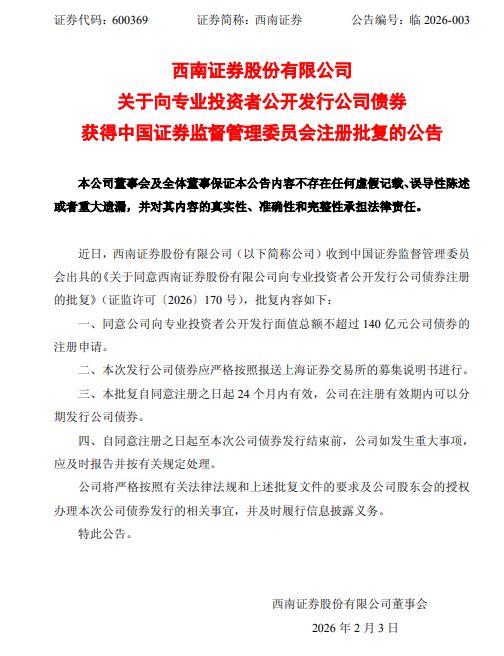
西南证券140亿元公司债获批 以核心实力续写高质量发展新篇章
Quan Jing Wang· 2026-02-03 09:41
Group 1 - The core viewpoint of the article is that Southwest Securities has received approval from the China Securities Regulatory Commission to publicly issue company bonds not exceeding 14 billion yuan, which reflects regulatory recognition of the company's comprehensive strength and risk management capabilities [1][4]. - The bond approval is valid for 24 months and can be issued in tranches, providing strong momentum for the company to deepen its core advantages and empower the real economy [1][4]. - As a leading brokerage rooted in Southwest China, the company continues to demonstrate its core competitiveness by focusing on regional markets and achieving significant results in areas such as technology finance and green finance [4]. Group 2 - For the first three quarters of 2025, the company's proprietary business achieved revenue of 1.07 billion yuan, representing a year-on-year growth of over 37% [4]. - The company aims to adhere to its financial roots and continue to deepen its involvement in the Chengdu-Chongqing economic circle, enhancing its service model to support the real economy and cultivate new productive forces [4]. - The investment banking business is strategically focused, contributing to the overall growth of the company's operating performance [4].

破解林业“四难”融资困境:重庆市深化集体林权制度改革背景下的绿色金融创新路径研究|政策与监管
清华金融评论· 2026-02-03 08:43
Core Viewpoint - The article discusses the systemic challenges faced by the forestry sector in China, particularly in financing, and highlights the innovative practices and policy recommendations from Chongqing to address these issues, aiming to provide a reference for national-level forestry financial reform and the smooth transition of ecological benefits [2][3][27]. Group 1: Financing Challenges in Forestry - The inherent difficulties in forestry financing include "difficulties in rights confirmation, valuation, mortgage, and financing," which have long restricted the effective transmission of financial capital to the forestry sector [2][3]. - The traditional credit system is not compatible with the unique characteristics of forestry assets, leading to structural financing difficulties [5]. - The challenges of rights confirmation stem from unclear asset boundaries and difficulties in accurately identifying ownership, particularly in collective forest rights [6]. - Valuation issues arise from the lack of standardized metrics to quantify ecological benefits, leading to significant underestimation of forestry asset values [7]. - Mortgage difficulties are primarily due to inadequate channels for asset disposal and a lack of risk mitigation mechanisms, causing financial institutions to hesitate in lending against forestry assets [8]. - The culmination of these challenges results in a mismatch between the supply and demand for funds, making it difficult for forestry operators, especially smallholders, to access sufficient and low-cost financing [9]. Group 2: Chongqing's Innovative Practices - Chongqing has adopted a systematic approach to address these financing challenges by integrating collective forest rights reform with financial innovation, creating a comprehensive solution that includes institutional design, digital infrastructure, financial product matrices, and value transformation systems [11]. - The city has implemented a multi-layered, collaborative policy framework to support the reform, including various policy documents aimed at addressing financing difficulties [12][13]. - A digital platform, "Smart Forest Rights," has been developed to enhance the clarity and reliability of forest rights, facilitating better access to financing [14][15]. - Chongqing has established a value transformation system that includes unified valuation standards and integrates ecological product value into credit approval processes, thereby enhancing the financial viability of forestry assets [17][18]. Group 3: Financial Product Innovations - Financial institutions in Chongqing have created a range of innovative financial products tailored to the characteristics of forestry assets, including carbon credit pledge loans and unique financing models based on specific asset rights [19][20]. - A "stock-loan-bond-insurance" linkage mechanism has been developed to provide comprehensive financial support throughout the project lifecycle, effectively sharing risks and benefits among stakeholders [20]. Group 4: Future Focus Areas - Chongqing aims to deepen the application and promotion of value assessment standards, ensuring that ecological product value assessments are integrated into financial decision-making processes [22]. - The "Smart Forest Rights" platform will be enhanced to improve efficiency and functionality, incorporating advanced data analytics and risk monitoring capabilities [23]. - The city will continue to expand financial applications in forestry, focusing on customized financial solutions that align with specific project needs and regional characteristics [24][25].
绿色信托多元服务低碳转型
Jing Ji Ri Bao· 2026-02-03 04:00
Core Viewpoint - The release of the top ten green trust cases by the China Trust Industry Association highlights the role of trust mechanisms in supporting green transition projects, showcasing their characteristics of asset independence, risk isolation, and long-term sustainability [1][3] Group 1: Green Trust Development - Green trust is becoming a core tool for revitalizing green assets and empowering low-carbon transitions due to its unique advantages of flexible systems and diverse services [1][3] - The development of green trust is seen as a necessary choice for the trust industry to return to its roots, reshape business logic, and find growth points [1][3] Group 2: Case Examples - The ten cases include four asset service trusts, such as Kunlun Trust's carbon capture project and Huaxin Trust's clean energy hydroelectric project, and four asset management trusts, including Wukuang Trust's zero-emission wastewater project [2] - Two charity trust cases focus on biodiversity and endangered species protection, demonstrating the diverse applications of green trust [2] Group 3: Policy and Market Support - The rapid development of green trust is supported by an improving policy framework and increasing market demand, with new guidelines clarifying classification and disclosure standards [3] - The guidelines introduce a quantitative standard for recognizing green projects, addressing previous ambiguities in business definitions and operational standards [3] Group 4: Opportunities for Trust Companies - Trust companies have significant opportunities to enhance their competitiveness by leveraging their unique functions in financing services, carbon finance, and family trusts [4] - They can explore green trust loans, green asset securitization, and green equity investments to support green industry development [4] - In the carbon finance sector, trust companies can focus on carbon asset management services to enhance market liquidity and financial attributes [4]
国泰君安期货商品研究晨报:绿色金融与新能源-20260203
Guo Tai Jun An Qi Huo· 2026-02-03 01:33
2026年02月03日 国泰君安期货商品研究晨报-绿色金融与新能源 | 观点与策略 | | --- | | 镍:宏观情绪主导边际,基本面与投机盘博弈 | 2 | | --- | --- | | 不锈钢:二月检修减产频出,镍铁预期托底下方 | 2 | | 碳酸锂:下游陆续采购,盘面下方空间较有限 | 4 | | 工业硅:硅厂减产落地,下方空间不深 | 6 | | 多晶硅:关注现货成交情况 | 6 | 国 泰 君 安 期 货 研 究 所 请务必阅读正文之后的免责条款部分 1 期货研究 商 品 研 究 2026 年 2 月 3 日 2)新华社 12 月 12 日从商务部获悉,商务部、海关总署日前印发公告,决定对部分钢铁产品实施出口 许可证管理。公告自 2026 年 1 月 1 日起执行。 3)根据钢联,印尼镍矿商协会 (APNI) 透露,能源和矿产资源部(ESDM)将于 2026 年初修订镍矿商 品的基准价格公式,修订要点之一是政府将开始将镍的伴生矿钴视为独立商品并征收特许权使用费。 镍:宏观情绪主导边际,基本面与投机盘博弈 不锈钢:二月检修减产频出,镍铁预期托底下方 张再宇 投资咨询从业资格号:Z0021479 ...
2025年地方土地出让收入41518亿元;上海启动收购二手住房用于保障性租赁住房工作 | 房产早参
Mei Ri Jing Ji Xin Wen· 2026-02-02 23:09
|2026年2月3日星期二| 点评:此举标志着住房保障体系与房地产市场发展进入新的历史阶段,这不仅为解决新市民、青年人住 房问题提供了新路径,更为房地产市场去库存、稳预期提供了新解法,为全国其他城市提供了可复制、 可推广的经验。 财政部日前公布的数据显示,2025年地方政府性基金预算本级收入中的国有土地使用权出让收入41518 亿元,比上年下降14.7%。这是自2022年以来,连续第四年这一收入出现两位数降幅。与2021年收入峰 值8.7万亿元相比,2025年地方土地使用权出让收入减少了约4.6万亿元,降幅达到52.3%。 点评:这是中国房地产市场深度调整与地方财政转型的必然结果,也是经济发展方式转变的重要标志。 尽管短期面临财政压力与转型阵痛,但这一变化将推动地方政府摆脱土地依赖,培育可持续发展能力。 NO.2 越秀地产拟发行17.35亿元绿色票据 2月2日,越秀地产发布公告,拟发行于2029年到期的17.35亿元人民币3.4厘有担保绿色票据,所得款项 净额将按照公司可持续融资框架,用于置换一年内到期的中长期境外债务,同时分配用于合资格绿色项 目的融资及再融资。 点评:在行业深度调整期,优质房企正通过绿色金 ...
上海国投公司副董事长郑杨:加强资本支持与创新金融工具 打造科技金融“上海样本”
Shang Hai Zheng Quan Bao· 2026-02-02 18:44
0 18 所示 18 a f 在这方面,上海国投公司做了很多工作,包括联动社会资本,引进耐心资本、长期资本,招投联动,形 成上海独有的特色,助力科创企业来上海落户发展,走出一条健康发展的路子。 二是做好风险防控。建议进一步强化投后/贷后管理,建立完善的"四早"预警机制和风险监测系统;建 立适应科技企业发展特点的评价体系,更注重考量技术、数据资源等核心轻资产价值,并将团队、技 术、成果、模式等作为关键因素。 在绿色金融方面,郑杨建议,推动绿色金融产品创新,完善标准和监管体系:一是做好绿色金融领域整 体规划。布局加大绿色债券的发行规模,把上海建成长三角绿色债券发行中心;先行建立长三角统一的 ESG评价体系,加强对金融机构环境信息披露、碳核算碳审计的引导。二是加快绿色金融创新发展。持 续推动绿色信贷、绿色债券、绿色保险等产品创新;扎实加快转型金融机制的持续落地;将发展绿色金 融和海洋经济结合起来。 在普惠金融方面,郑杨建议,优化普惠金融服务,提升风险管理能力:一是深化普惠金融领域的深层次 改革。完善"政府+银行+保险"合作模式,构建合理的风险共担与利益分配机制;大力推进上海及长三 角地区普惠金融平台建设。二是提升普 ...

独家专访上海国投公司副董事长郑杨:以投引贷、以贷助投,打造科技金融“上海样本”
Sou Hu Cai Jing· 2026-02-02 15:08
Core Viewpoint - The integration of Shanghai's international financial center construction and the science and technology innovation center is focused on technology finance, aiming to create a new model for Shanghai [1][4]. Financial Development Strategy - During the 14th Five-Year Plan, Shanghai's financial initiatives have shown significant progress, ranking among the best in the country. The 15th Five-Year Plan aims to further enhance financial services for the real economy [1][4]. - Key challenges include insufficient patient capital, lack of a sound standard system, information opacity, and risks associated with innovation. A comprehensive approach involving overall planning, collaborative advancement, resource integration, and risk control is recommended [1][4]. Technology Finance Initiatives - Strengthening capital support and innovative financial tools is essential for technology finance. Specific measures include accelerating financial reform and resource integration, establishing a full lifecycle service mechanism for tech enterprises, and enhancing capital market development [5]. - A white list mechanism is proposed to improve fund circulation efficiency, alongside the development of diversified capital products such as index funds [5]. Risk Management - Emphasis on post-investment and post-loan management is crucial, with the establishment of a comprehensive early warning mechanism and risk monitoring system tailored to the characteristics of technology enterprises [5]. Green Finance Recommendations - Promoting innovation in green financial products and improving standards and regulatory systems is vital. This includes increasing the issuance of green bonds and establishing a unified ESG evaluation system in the Yangtze River Delta [6]. - Continuous development of green credit, bonds, and insurance products is encouraged, along with integrating green finance with marine economy [6]. Inclusive Finance Enhancements - Optimizing inclusive finance services and improving risk management capabilities are recommended. This involves deepening reforms in the inclusive finance sector and enhancing the cooperation model among government, banks, and insurance [7]. - Establishing a diversified resolution mechanism for financial disputes and improving credit assessment systems are also suggested [7]. Pension Finance Development - A diversified pension finance system should be constructed, with a focus on planning and reforming the pension finance mechanism to allow for broader investment opportunities [7]. Digital Finance Strategy - Integrating data resources and strengthening digital risk control systems are essential. This includes breaking down data barriers and establishing a comprehensive data service platform [7]. - The development of digital infrastructure and expanding the application scenarios for digital currency are also highlighted [7]. International Financial Center Goals - The 15th Five-Year Plan suggests enhancing the competitiveness and influence of the international financial center and accelerating the establishment of a global RMB asset allocation center [8]. - Recommendations include improving the international asset trading framework based on RMB asset transactions and advancing the construction of both onshore and offshore financial centers [8].