
L3级自动驾驶

Search documents
16只L3自动驾驶产业链概念股曝光(名单)
2 1 Shi Ji Jing Ji Bao Dao· 2025-12-16 23:20
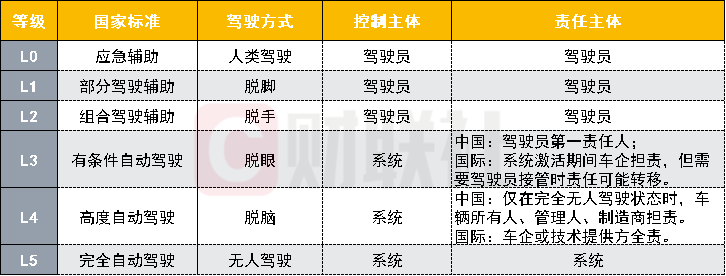
市场热度背后是中国L3级自动驾驶商业化进程的实质性突破。 12月16日,无人驾驶概念集体活跃,截至午盘,汉鑫科技(920092.BJ)30CM涨停,万集科技 (300552.SZ)、浙江世宝(002703.SZ)、翠微股份(603123.SH)、北汽蓝谷(600733.SH)等涨停, 舜宇精工(920906.BJ)、三友科技( 920475.BJ)等涨超10%。 昨日晚间,工业和信息化部正式公布首批L3级有条件自动驾驶车型准入许可,两款适配城市拥堵与高 速场景的车型将在北京、重庆指定区域开展上路试点,意味着我国L3级自动驾驶从测试阶段向商业化 应用迈出了关键一步。 根据《汽车驾驶自动化分级》国家标准,L3级自动驾驶属于"有条件自动驾驶",即在特定设计运行条件 下,车辆系统可以完全接管动态驾驶任务,允许驾驶员脱手,但驾驶员仍需保持警觉并随时准备接管。 附部分智能驾驶概念股清单(16只): | | | 部分智能驾驶概念股一览 | | | | --- | --- | --- | --- | --- | | 关联类别 | 证券名称 | 总市值 ( 亿元 ) | 年内涨跌幅(%) | 市盈率PE ( TTM ) | | ...


L3级自动驾驶车型产品获准入许可 智能网联汽车迈入量产应用
Shang Hai Zheng Quan Bao· 2025-12-16 18:45
L3级自动驾驶正式"持证上路" 记者了解到,这次公布的两款车型,来自重庆长安汽车股份有限公司和北汽蓝谷麦格纳汽车有限公司。 一款长安牌纯电动轿车,可以实现在交通拥堵环境下高速公路和城市快速路单车道内最高时速50公里的 自动驾驶功能,目前该功能仅限在重庆市有关路段开启。一款北汽集团旗下极狐牌纯电动轿车,可以实 现高速公路和城市快速路单车道内最高时速80公里的自动驾驶功能,目前该功能仅限在北京市有关路段 开启。 据工业和信息化部信息,下一步,两款车型将由重庆长安车联科技有限公司、北京出行汽车服务有限公 司两家使用主体在上述区域内开展上路通行试点。相关部门将加强车辆运行监测和安全保障,不断健全 智能网联汽车准入管理和标准法规体系,推动我国智能网联新能源汽车产业高质量发展。 12月15日,工业和信息化部公布我国首批L3级有条件自动驾驶车型准入许可,两款分别适配城市拥 堵、高速路段的车型将在北京、重庆两地指定区域开展试点。 "我国自动驾驶在发展进程中迈出了重要一步,L3级自动驾驶从测试阶段开始迈入商业化应用阶段。"同 济大学汽车学院汽车产业与技术战略研究中心主任王宁告诉上海证券报记者,这表明L3级自动驾驶技 术成熟度得 ...

我国首批L3级自动驾驶车型产品获得准入许可,商业化应用加速推进!
Zhi Tong Cai Jing· 2025-12-16 16:35
Group 1 - The first batch of L3 conditional autonomous driving vehicle permits in China has been officially announced, including Changan's SC7000AAARBEV and Arcfox's BJ7001A61NBEV, marking the transition from testing to commercial application [3] - In the first three quarters of this year, Pony.ai reported a total revenue of $60.876 million, representing a year-on-year increase of 54.1% [3] - Revenue from autonomous ride-hailing services (Robotaxi) reached $9.95 million, up 111.7% year-on-year, while technology licensing and application services surged by 216.8% to $23.443 million [3] - The revenue from autonomous truck services remained stable at $27.483 million, roughly unchanged from the same period last year [3] - Pony.ai's management anticipates achieving breakeven before 2030, driven by a vision of expanding its Robotaxi fleet to over 100,000 vehicles by that year [3]

腾讯研究院AI速递 20251217
腾讯研究院· 2025-12-16 16:32
Group 1: Apple AI Server Chip - Apple is developing its first AI server chip, codenamed "Baltra," in collaboration with Broadcom, utilizing TSMC's 3nm process, expected to be deployed in 2027 [1] - Apple has shifted from building its own large models to paying approximately $1 billion annually for Google's customized 1.2 trillion parameter Gemini model, with Baltra primarily aimed at meeting significant AI inference demands [1] - The chip architecture will focus on optimizing latency and throughput, employing low-precision operations like INT8, and may utilize a configuration of 64 interconnected chips with large-capacity LPDDR memory [1] Group 2: NVIDIA Nemotron 3 Series - NVIDIA has launched the Nemotron 3 series of open models, which includes Nano, Super, and Ultra scales, featuring a breakthrough heterogeneous mixture expert architecture [2] - The Nemotron 3 Nano has a throughput that is four times higher than its predecessor, achieving leading token generation rates per second in large-scale multi-agent systems, significantly enhancing inference efficiency [2] - The model achieves exceptional accuracy through advanced reinforcement learning techniques and large-scale parallel multi-environment post-training, providing a complete training dataset and reinforcement learning library [2] Group 3: ChatGPT Memory System - Developer Manthan Gupta has reverse-engineered ChatGPT's memory system, revealing a four-layer architecture: session metadata, user memory, recent conversation summaries, and a sliding window [3] - The system does not utilize vector databases or RAG retrieval but instead relies on pre-generated lightweight summaries and explicitly stored structured information to achieve the effect of "remembering users" [3] - GPT-4 has a maximum context window of 128k tokens, beyond which the earliest content is forgotten, and users can request the model to delete or modify memory content at any time [3] Group 4: Tencent Yuanbao Writing Mode - Tencent Yuanbao has launched a writing mode that supports automatic completion of plot character outlines and one-click generation of manuscripts, capable of producing tens of thousands of words in a single session [4] - The feature is adaptable to various genres, including historical, science fiction, and fan fiction, allowing users to set a single sentence to let AI complete the outline and chapter structure, with customizable story direction and endings [4] - Yuanbao can generate approximately 30,000 words in about 14 minutes and 50,000 words in half an hour, with support for one-click export to local documents or Tencent documents [4] Group 5: Tongyi Wanxiang 2.6 Release - Tongyi Wanxiang 2.6 has become the first video model in China to support role-playing functions, featuring audio-visual synchronization, multi-camera generation, and voice-driven capabilities, making it the most comprehensive video generation model globally [5] - The video generation supports 15-second long videos, multi-camera narratives, and natural audio-visual synchronization, allowing for single and multi-person collaborations based on input video character appearance and voice [5] Group 6: ByteDance Seedance 1.5 Pro Model - ByteDance has released the Seedance 1.5 Pro audio-video generation model, which supports precise audio-visual synchronization, multilingual dialects, cinematic-level camera movements, and 15-second long video generation [6] - The model employs the MMDiT architecture to achieve precise audiovisual collaboration, natively supporting multiple languages, including Chinese, English, Japanese, Korean, and dialects like Sichuanese and Cantonese, with audio instructions at industry-leading levels [6] - In comprehensive evaluations, SeedVideoBench 1.5 demonstrated rich dynamic performance, vivid character expressions, and significantly reduced audio-visual misalignment, applicable in film, advertising, and short drama scenarios [6] Group 7: L3 Autonomous Driving Models - The Ministry of Industry and Information Technology has conditionally approved Chang'an's Deep Blue SL03 and Arcfox Alpha S as the first L3 autonomous driving models in China [8] - The Deep Blue SL03 can achieve single-lane autonomous driving at a maximum speed of 50 km/h in congested environments, limited to designated routes like the Chongqing Inner Ring; the Arcfox Alpha S can reach 80 km/h, restricted to routes like the Beijing-Jingtai Expressway [8] - Both companies have completed product testing and safety evaluations, with plans to conduct on-road trials in designated areas through Chang'an Vehicle Networking Technology and Beijing Travel Automotive Services [8] Group 8: Eric Schmidt's Views on AI - Former Google CEO Eric Schmidt proposed the "San Francisco Consensus," suggesting that the combination of language agents and reasoning capabilities will approach human core abilities, leading to recursive self-improvement in AI as technology converges [9] - He predicts that AI mathematicians will emerge within the next year, driving the birth of new mathematical theories, with industry consensus on this transformation occurring within 2-4 years, while emphasizing the need to maintain human agency and decision-making authority [9] - The paths of US-China AI competition are diverging: the US focuses on superintelligence development but faces power shortages, while China is fully promoting AI commercial applications with ample power supply, both relying on the private sector for development [9] Group 9: AI "Finger Problem" - Multiple AI models failed to accurately count the number of fingers in images depicting six-fingered hands, even when prompts explicitly stated there were six fingers, with models insisting on five [10] - The root of the problem lies in the strong association in training data of "human hands = five fingers" and the lack of explicit structural constraints in the Transformer architecture, which cannot track state information in a single forward pass [10] - Diffusion models excel at capturing overall distributions and textures but struggle with precise control of local discrete structures, revealing current AI's Achilles' heel in visual reasoning and causal relationship understanding [10]





我国首批L3级自动驾驶车型获准上路 试点应用开启商业化探索新阶段
Zheng Quan Ri Bao Zhi Sheng· 2025-12-16 16:09
Core Viewpoint - The Ministry of Industry and Information Technology of China has officially granted conditional access permits for the first batch of L3-level conditional autonomous driving vehicles, marking a significant step towards real-world operation and commercialization of autonomous driving technology in China [1][2]. Group 1: Regulatory Framework - L3-level conditional autonomous driving is seen as a critical milestone in the development of autonomous driving, allowing vehicles to perform all dynamic driving tasks under specific conditions while requiring the driver to remain capable of taking control [2][3]. - The two models approved for conditional access are from Changan Automobile and BAIC Group's Arcfox brand, with specific operational limits: Changan's model can operate at speeds up to 50 km/h in congested traffic, while BAIC's model can reach 80 km/h in relatively smooth conditions [2][3]. Group 2: Testing and Safety Measures - The approval process involved collaboration among multiple government departments, ensuring comprehensive testing and safety evaluations of the vehicles, which included multiple safety redundancy designs in critical systems [3][4]. - The Arcfox Alpha S (L3 version) has undergone rigorous testing, completing over 800,000 kilometers of equivalent mileage tests, ensuring comprehensive coverage of its operational design domain [5][6]. Group 3: Industry Implications - The introduction of L3-level autonomous driving is not just a technological breakthrough but a systemic engineering challenge that involves collaboration across various sectors, including vehicle manufacturing, core components, software algorithms, and data governance [4][6]. - The approval of these vehicles provides real-world application scenarios for automakers and suppliers, fostering collaborative development across the industry chain [4][5]. Group 4: Future Outlook - Experts suggest that while the approval of L3 vehicles represents a milestone, the current operational scenarios are limited to simpler environments like highways and urban expressways, which aligns with safety requirements and technological maturity [6][7]. - The pilot program will involve designated operators, insurance requirements, and continuous monitoring of vehicle performance, with the potential for adjustments based on operational feedback [7].
今日新闻丨鸿蒙智行、小鹏、理想获得L3级道路测试牌照!激光雷达巨头Luminar申请破产!欧拉5、红旗HS6 PHEV上市!
电动车公社· 2025-12-16 15:50
Core Viewpoint - The article highlights the recent launches of electric vehicles, including the Hongqi HS6 PHEV and Ora 5, along with significant developments in the autonomous driving sector and challenges faced by the lidar industry [1][3][20]. Group 1: Hongqi HS6 PHEV Launch - The Hongqi HS6 PHEV was launched on December 16, with a price range of 178,800 to 228,800 yuan [1][3]. - The vehicle features a family design style with a closed vertical grille, dimensions of 4925/1970/1740mm, and a wheelbase of 2925mm, positioning it as a mid-to-large SUV [2]. - It is equipped with a 110kW 1.5T engine and two electric motor options (168kW and 369kW), with battery capacities of 23kWh and 40kWh, offering a pure electric range of 148/225/248km depending on the version [7]. - The vehicle's performance includes 0-100 km/h acceleration times of 7.9/8.3/4.8 seconds and WLTC fuel consumption rates of 5.1/5.4/5.9L/100km [7]. - The competitive landscape for large SUVs is intense, with rivals like Silver River M9 and Funyun T11 offering advantages in size and features [9]. Group 2: Ora 5 Launch - The Ora 5 was also launched on December 16, with a price range of 99,800 to 133,800 yuan, and an additional limited-time trade-in subsidy of 8,000 yuan [10][11]. - The vehicle maintains the design style of the Ora Good Cat, featuring retro mechanical lines and dimensions of 4471/1833(1844)/1641mm, with a wheelbase of 2720mm, classifying it as a compact SUV [13]. - It includes a 150kW electric motor and battery options of 45.3kWh and 58.3kWh, providing CLTC ranges of 480km and 580km respectively [17]. - The Ora 5 targets a younger demographic with its design and features, including the integration of lidar technology at a price point below 120,000 yuan [19]. Group 3: Autonomous Driving Developments - Companies including Hongmeng Zhixing, Xiaopeng, and Li Auto have received L3-level road testing licenses for autonomous driving, allowing for regular testing on specific roads [20][21]. - The L3 license is conditional and does not imply full autonomy, as it is primarily for testing purposes, with no company currently possessing a civilian L3 capability in China [23]. Group 4: Lidar Industry Challenges - Luminar, a leading lidar company, has filed for bankruptcy protection, with a peak valuation of $5 billion now reduced to an estimated $1-5 billion, while liabilities range from $5-10 billion [24]. - Volvo, Luminar's largest customer, ceased collaboration due to unmet contractual obligations, highlighting the importance of technology in the lidar market [26].





明日四大主题前瞻 | 中央财办强调!扩大内需是明年排在首位的重要任务,商务部对欧盟进口猪肉征收反倾销税
Jin Rong Jie· 2025-12-16 15:38
Group 1: L3 Autonomous Driving and Smart Driving Industry - The Ministry of Industry and Information Technology has officially announced the first batch of L3 conditional autonomous driving vehicle permits, marking a significant step towards commercial application in China [1] - Two models designed for urban congestion and highway conditions will conduct road trials in designated areas of Beijing and Chongqing, indicating a shift from testing to commercial use [1] - The implementation of this policy removes regulatory barriers for high-level autonomous driving technology, accelerating the maturation and cost reduction of the smart driving hardware and software industry [1] - As technology evolves and consumer acceptance increases, smart driving features are gradually penetrating mainstream vehicles, becoming a core driver of the automotive industry's intelligent upgrade [1] Group 2: Domestic Consumption and Economic Strategy - The central government has prioritized the expansion of domestic demand as a key task for 2025, focusing on unleashing consumer potential and implementing special actions to boost consumption [2] - The National Development and Reform Commission has emphasized stabilizing major consumption and promoting policies such as trade-in for consumer goods, enhancing brand leadership, standard upgrades, and new technology applications [2] - Sectors closely related to residents' daily lives, such as retail, e-commerce, cultural tourism, and service consumption, are expected to benefit from increased demand, along with investment growth in consumption infrastructure and supply chain enterprises [2] Group 3: Impact of AI on Power Demand and Grid Investment - The development of AI has led to a surge in electricity demand, with internet data service electricity consumption increasing by 43% year-on-year from January to October this year [3] - The consensus is that "the end of computing power is electricity," highlighting the critical role of electricity in supporting the digital economy [3] - The rapid construction of AI computing centers will significantly drive the demand for stable, efficient, and green electricity, indicating a new golden period for grid investment [3] - Urgent needs for upgrades in the power system will encompass ultra-high voltage transmission, smart distribution networks, energy storage, and virtual power plants [3]
长安汽车斩获首批L3级自动驾驶准入 2026年一季度启动上路试点
Zheng Quan Shi Bao Wang· 2025-12-16 14:30
Core Insights - The first batch of L3 conditional autonomous driving vehicles has been approved for entry, including Changan's SC7000AAARBEV and Arcfox's BJ7001A61NBEV electric cars [1] Group 1: Approval and Features - Changan Automobile's Deep Blue brand received approval for L3 autonomous driving capabilities, allowing for single-lane autonomous driving in congested traffic at speeds up to 50 km/h [1][2] - The speed range of 0-50 km/h was chosen based on user needs and safety considerations, focusing on urban congestion scenarios where drivers face frequent acceleration and deceleration [2] Group 2: Technology and Safety - Changan employs a seven-layer redundancy architecture for its L3 technology platform, integrating advanced perception systems including high-resolution 4D imaging radar and innovative micro-Doppler sensors [3] - The system is designed to handle various challenging scenarios, including adverse weather and sudden stops, ensuring optimal performance in critical situations [3] Group 3: Future Plans and Development - Changan plans to initiate road testing with its L3 technology in Q1 2026, targeting consumer market entry following the implementation of relevant national regulations [3][4] - The company has been developing L3 capabilities since 2017, with significant milestones achieved in 2020 and 2021, leading to its current status as a pioneer in L3 autonomous vehicle testing and evaluation [4]
L3级自动驾驶“准生证”落地!长安北汽抢先上车,概念股现上涨潮
Guo Ji Jin Rong Bao· 2025-12-16 13:45
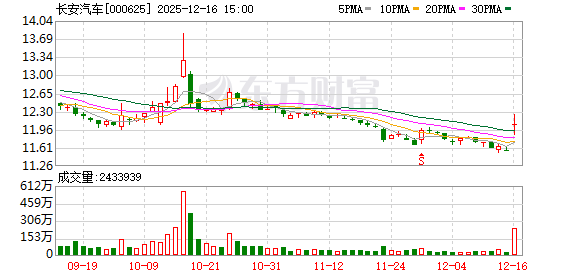
Core Viewpoint - The first batch of vehicles equipped with Level 3 (L3) conditional autonomous driving has been approved, marking a significant step from technology validation to mass production application in China's automotive industry [2][4]. Group 1: Approval of L3 Vehicles - The Ministry of Industry and Information Technology and three other departments have jointly released the list of the first batch of models approved for L3 conditional autonomous driving, with two models from Changan Automobile and BAIC Blue Valley Magna Auto [2][4]. - The approved Changan model, SC7000AAARBEV, focuses on autonomous driving in traffic congestion environments, with a maximum speed of 50 km/h, and is set to be tested in specific areas of Chongqing [4][6]. - The BAIC Blue Valley model, BJ7001A61NBEV, is designed for high-speed scenarios, capable of autonomous driving at speeds up to 80 km/h, with testing areas in Beijing [6]. Group 2: Market Impact - Following the approval, BAIC Blue Valley's stock surged to a closing price of 8.24 yuan per share, a 10.01% increase, while Changan Automobile's stock rose by 4.42% to 12.06 yuan per share [7]. - The positive market response extended to the supply chain, with companies like Hanxin Technology and Wanji Technology experiencing significant stock price increases [9]. Group 3: Industry Developments - Other automakers are also advancing in L3 autonomous driving, with XPeng Motors obtaining a testing license in Guangzhou and GAC Group securing a high-speed L3 testing license for its model [9]. - The transition from Level 2 to Level 3 autonomous driving introduces new commercial challenges, as the responsibility for accidents shifts from human drivers to a shared responsibility between humans and machines [11][12]. Group 4: Regulatory and Infrastructure Challenges - The current insurance framework needs reform to accommodate the shift in liability, as automakers will need to purchase substantial product liability insurance to cover potential accidents caused by system failures [12]. - There are concerns regarding the legal framework for liability distribution among manufacturers, software suppliers, and vehicle owners, which could hinder consumer adoption of L3 technology [12][13]. - Infrastructure and data interoperability issues remain significant barriers, as L3 technology relies heavily on high-definition maps and standardized road signage, necessitating government-led collaborative efforts for development [13].
长安汽车(000625) - 2025年12月16日投资者关系活动记录表
2025-12-16 12:24
Group 1: L3 Autonomous Driving Approval - Changan Automobile's Deep Blue product received L3 autonomous driving approval on December 15, 2025, enabling automatic driving in congested traffic at speeds up to 50 km/h [2][3] - The approval reflects Changan's 40 years of automotive manufacturing experience and its achievements in intelligent transformation [2][3] Group 2: Technical Features and Safety - The L3 system employs a seven-layer redundancy architecture, integrating braking, steering, power, communication, perception, control, and interaction [4][6] - The perception system utilizes high-resolution 4D imaging radar, vision, and ultrasonic sensors, enhancing performance in adverse weather and complex scenarios [4][6] - Over 5 million kilometers of testing have been conducted, with no accidents or violations reported during the activation period of over 150,000 kilometers [6][7] Group 3: User-Centric Design and Market Strategy - The speed limit of 0-50 km/h is based on user needs in congested driving scenarios, addressing the most significant pain points for drivers [3][5] - Changan plans to initiate road trials with its L3 technology in Q1 2026, targeting C-end users after regulatory approvals [7][8] - Future L3 models will be introduced gradually, with pricing potentially reaching the 150,000 RMB level as the technology scales [7][8] Group 4: Safety and Quality Assurance - Changan prioritizes safety and quality, establishing a comprehensive safety system that integrates functional safety, network security, and data security [8] - The company has developed a quality management system that ensures safety and reliability can be replicated and scaled [8]