
红利资产

Search documents
银河证券:海内外不确定因素增 预期港股宽幅震荡
智通财经网· 2025-10-27 00:13
Core Viewpoint - The overall valuation of the Hong Kong stock market is at a historically high level, with expectations of wide fluctuations in the future. The report suggests focusing on certain sectors due to rising market risk aversion and changing market styles [1]. Market Performance - During the week of October 20 to October 24, major global stock indices mostly rose, with the Hang Seng Index increasing by 3.62%, the Hang Seng Tech Index by 5.20%, and the Hang Seng China Enterprises Index by 3.91% [2]. - Among the primary industries, nine sectors rose while two fell. The energy, information technology, and consumer discretionary sectors saw the highest gains, increasing by 5.26%, 4.83%, and 4.15% respectively [2]. - In terms of liquidity, the average daily trading volume on the Hong Kong Stock Exchange was HKD 240.846 billion, a decrease of HKD 118.507 billion from the previous week [2]. Valuation and Risk Appetite - As of October 24, the PE and PB ratios for the Hang Seng Index were 12.04 and 1.23, reflecting increases of 3.84% and 3.80% respectively, placing them at the 86% and 89% percentile levels since 2019 [3]. - The risk premium for the Hang Seng Index was calculated at 4.29%, which is significantly below the historical average, indicating a low risk appetite among investors [3]. Investment Outlook - The U.S. CPI rose by 3% year-on-year in September, the highest since January, but below market expectations, leading to increased expectations for interest rate cuts by the Federal Reserve [4]. - China's GDP grew by 5.2% year-on-year in the first three quarters, with a slight decline in growth rate in the third quarter [4]. - The 20th Central Committee's Fourth Plenary Session highlighted key economic goals for the 14th Five-Year Plan, emphasizing high-quality development and technological self-reliance [4].
公用事业行业周报(2025.10.20-2025.10.24):煤价上涨接近尾声,火电Q3业绩如期兑现-20251026
Orient Securities· 2025-10-26 04:43
Investment Rating - The report maintains a "Positive" investment rating for the utility sector in China [5] Core Insights - The rise in coal prices is nearing its end, with expectations of a peak in coal price increases. The average price of Q5500 thermal coal at Qinhuangdao port reached 770 RMB/ton, which is at the upper limit of the long-term contract price range set by the National Development and Reform Commission [8][14] - The Q3 performance of thermal power companies met expectations, with a total net profit of 3.68 billion RMB for four major thermal power companies, reflecting a year-on-year increase of 61% [8] - The report highlights the defensive attributes of utility assets, suggesting that low-priced utility assets are worth attention amid increasing market volatility [8] Summary by Sections Coal Price Trends - The pace of coal price increases has slowed, with the average price of Q5500 thermal coal at Qinhuangdao port increasing by 2.9% week-on-week [14] - The report anticipates that the current round of coal price increases is close to its peak, with coal prices expected to stabilize [8] Electricity Price Dynamics - The average electricity price in Shanxi province reached 758 RMB/MWh, a year-on-year increase of 164% [11] - The report notes that the market's pessimistic expectations regarding long-term electricity prices for thermal power are likely to ease [8] Sector Performance - The utility sector index rose by 1.1%, underperforming the CSI 300 index by 2.2 percentage points [38] - Among sub-sectors, thermal power showed the highest increase, indicating a positive trend in profitability [40] Investment Recommendations - The report recommends focusing on utility stocks, particularly in thermal, hydro, and nuclear power sectors, due to their strong dividend potential and favorable market conditions [8] - Specific stocks mentioned include Guodian Power (600795), Huadian International (600027), and China General Nuclear Power (003816) [8]
策略研究框架的时代底色:极致的轮动与绝对的低波
Guohai Securities· 2025-10-25 14:39
Core Insights - The report highlights the acceleration of industry rotation in the A-share market, indicating a shift from sustained single-line trends to rapid sector changes, with the industry rotation index showing increased activity since 2023 [13][14] - It emphasizes the scarcity of fundamentally strong investment opportunities, suggesting that while growth investment remains relevant, the range of viable options has significantly narrowed compared to the past two decades [20][19] - The report identifies the importance of "crowding" and "calendar effects" as tools for navigating the current market dynamics, with a focus on how these metrics can guide investment strategies [37][38] Group 1: Industry Rotation Dynamics - The A-share market has experienced a notable increase in industry rotation speed, with the duration of dominant trends decreasing from 6-12 months in previous years to approximately 2 months in 2023 [13][14] - The report outlines that the current market environment is characterized by a blend of "extreme rotation" and "absolute low volatility," where thematic investments and stable fundamental assets coexist [4][5] - The report provides a comparative analysis of industry performance, indicating that sectors such as military, robotics, and software are expected to benefit from low crowding and catalysts in the near term [6] Group 2: Investment Strategies and Sector Focus - For active funds, the report suggests focusing on sectors with strong growth trends and catalysts, particularly in the context of the upcoming quarterly reports [6] - It recommends maintaining positions in sectors like computing power, innovative pharmaceuticals, and non-ferrous metals, while also noting the potential for increased allocations in dividend-paying sectors such as banks and home appliances as the year-end approaches [6] - The report highlights the significance of calendar effects, suggesting that both active and long-term investors may find opportunities for positioning in the market during specific periods [5][6]
红利资产“避风港”效应升温
Jing Ji Guan Cha Wang· 2025-10-24 10:01
Core Insights - The A-share market has experienced increased volatility since October, with previously strong technology sectors showing significant fluctuations, while defensive dividend sectors have started to strengthen [2][3] - Agricultural Bank's stock price has risen continuously for several trading days, achieving a cumulative increase of over 20%, significantly outperforming the broader market [2] - Investors are shifting towards low-volatility, high-dividend funds, with many funds in this category achieving positive returns, contrasting with the decline in technology-themed funds [3][4] Market Trends - Technology sectors such as batteries, semiconductors, and electronic chemicals have seen declines, impacting technology-themed funds, with over a hundred funds dropping more than 7% since October [3] - In contrast, most dividend funds have reported positive returns, with several funds exceeding 5% returns as of October 23 [3][4] - There has been a notable shift in market sentiment towards dividend funds, with recent inflows reversing previous outflows, indicating a growing preference for these assets [4] Investment Strategies - A balanced investment approach is being adopted, with a significant portion allocated to large-cap dividend funds, while also considering smaller-cap growth funds and Hong Kong dividend funds for diversification [5][6] - The appeal of Hong Kong dividend funds is increasing due to their higher dividend yields compared to A-share counterparts, with some indices showing yields above 6% [5] - Investors are advised to consider A-share dividend funds as core assets for stability, while using Hong Kong dividend funds as satellite assets to enhance overall portfolio returns [6] ETF Market Dynamics - In Hong Kong, dividend strategy ETFs have gained popularity among institutional investors, with significant inflows observed [7][8] - The rise in these ETFs is attributed to their ability to provide risk diversification and stable income, especially in a volatile market environment [8] - Investors are encouraged to focus on key features of dividend ETFs, such as dividend frequency, underlying asset quality, and operational convenience, to align with their investment goals [9]


一年多次分红蔚然成风 A股中期红包密集派发
Zhong Guo Zheng Quan Bao· 2025-10-23 20:12
Core Viewpoint - The A-share market is experiencing a significant increase in cash dividends, with over 600 listed companies distributing more than 300 billion yuan in cash dividends for the first half of the year, indicating a shift towards a return-focused capital market [1][2]. Group 1: Dividend Distribution - As of October 24, over 30 A-share companies, including China Ping An and China Unicom, have completed their cash dividend distributions for the first half of 2025 [2]. - The total cash dividend amount for A-share companies reached 649.7 billion yuan, with a payout ratio of 31.97%, slightly up from the previous year [2][3]. - Central enterprises are leading the way in dividend distribution, with companies like China Mobile and China Petroleum distributing over 100 billion yuan each [2]. Group 2: Future Dividend Plans - More than 3 billion yuan in cash dividends are still pending distribution, with major banks and coal companies expected to contribute significantly [3]. - The third-quarter dividend window has opened, with over 30 companies planning to distribute more than 4 billion yuan in dividends [3]. - Companies are increasingly adopting a multi-dividend strategy, with firms like WuXi AppTec and CRRC announcing their first interim dividends this year [3]. Group 3: Dividend Yield and Investor Sentiment - The average dividend yield for companies that have distributed dividends is 2.52%, with over 90 companies yielding more than 3% [4]. - The proactive approach of companies in returning capital to shareholders has been recognized, with total distributions over the past five years reaching 10.6 trillion yuan, significantly higher than previous periods [4]. - Companies are making long-term commitments to shareholder returns, with some planning to distribute at least 70% of their net profits as dividends from 2025 to 2027 [4]. Group 4: Investment Perspective - The stable dividend distribution in the A-share market is attracting more attention to dividend assets, which are viewed as long-term investments rather than short-term speculative plays [5]. - Investors are encouraged to focus on the sustainability of dividend payments rather than short-term stock price fluctuations, reinforcing the long-term logic behind dividend investments [5].



银行股涨势延续,农行登顶A股市值榜首,红利资产行情来了?
Sou Hu Cai Jing· 2025-10-23 12:45
Core Viewpoint - The banking sector in both Hong Kong and A-shares has shown strong performance, with several banks experiencing significant stock price increases, driven by a favorable market environment and investor sentiment towards dividend-paying stocks [1][3][4]. Group 1: Stock Performance - Postal Savings Bank (01658.HK) rose by 4.59%, while Minsheng Bank (01988.HK) increased by 2.39%, and Agricultural Bank of China (01288.HK) saw a rise of 1.88% in the Hong Kong market [1][2]. - In the A-share market, Postal Savings Bank (601658) gained 4.71%, Minsheng Bank (600016) increased by 2.72%, and several other banks also rose over 1%, although Agricultural Bank A-shares fell by 1.24% [2][4]. - The banking sector has experienced an 11-day consecutive rise in the A-share banking index and a similar trend in the Hong Kong banking stocks index [3]. Group 2: Market Capitalization - As of October 23, 2025, Agricultural Bank of China has solidified its position as the largest bank by market capitalization in A-shares, with a total market value of approximately 27,963.64 billion RMB, despite a recent decline of 1.24% [5][6]. - The overall market capitalization of the banking sector has been positively impacted, with Agricultural Bank's H-shares also showing a continuous upward trend [6]. Group 3: Dividend and Valuation - The banking sector's price-to-book ratio has improved, with Agricultural Bank's A-shares returning to a price-to-book ratio of 1 [6]. - The dividend yield for A-share banks has reached a range of 4%-5%, significantly higher than one-year deposit rates and ten-year government bond yields, enhancing the attractiveness of these stocks [6][7]. - Analysts suggest that the banking sector is supported by high dividend yield, valuation safety margins, and favorable capital allocation dynamics [7]. Group 4: Future Outlook - Morgan Stanley's recent report indicates that domestic bank stocks are expected to complete a natural cycle bottom without large-scale stimulus, supported by improvements in M1 growth and industrial profits [7]. - The upcoming dividend distributions and stable interest rates are anticipated to further support the revaluation of bank stocks in the fourth quarter [7].


139.6%累计收益+年度正收益全满贯!红利低波 ETF(512890)获资金持续加仓,机构:四季度是关键窗口
Xin Lang Ji Jin· 2025-10-23 08:24
Core Insights - The Reducing Volatility ETF (512890) has shown significant capital inflow, with net inflows of 10.6 billion over the last 5 trading days and a total circulation scale reaching 245.39 billion as of October 22, 2025 [1][2] - Several A-share listed companies have announced third-quarter dividend plans, enhancing market focus on dividend assets, with expectations for the fourth quarter to be a key time for bottom-fishing in dividend stocks [1] - The banking sector is projected to maintain positive revenue and profit growth, with a year-on-year increase of 0.4% in revenue and 1.1% in net profit for the first three quarters of 2025 [1] Fund Performance - The Huatai-PineBridge Reducing Volatility ETF (512890) has achieved a cumulative return of 139.60% as of October 22, 2025, ranking 70th among 502 similar products [2] - The fund has consistently delivered positive returns for six consecutive years from 2019 to 2024, marking it as one of the few A-share ETFs to achieve "annual positive return full marks" [2] - Investors are encouraged to consider the ETF as a core component for stable returns in their asset allocation, especially through systematic investment plans to mitigate short-term volatility [2] Market Activity - On October 23, A-share major indices experienced fluctuations, with the Reducing Volatility ETF (512890) closing up 0.58% at 1.206 yuan, leading in trading volume among similar ETFs with a turnover rate of 1.90% and a transaction amount of 4.68 billion [3]
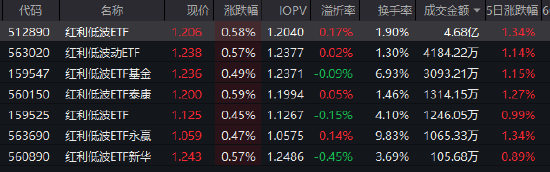
农行破净7年终翻身!银行ETF天弘(515290)强势四连阳,近5日“吸金”3.15亿元
Xin Lang Cai Jing· 2025-10-23 07:43
Core Viewpoint - The banking sector is experiencing significant growth, with the Tianhong Bank ETF (515290) showing a notable increase in both price and trading volume, indicating strong investor interest and capital inflow [2][3]. Group 1: Bank ETF Performance - The Tianhong Bank ETF (515290) rose by 0.54%, achieving four consecutive days of gains, with a trading volume of 1.05 billion yuan [2]. - Over the past two weeks, the Tianhong Bank ETF has seen an increase of 1.244 billion yuan in scale and a growth of 568 million shares [2]. - In the last five trading days, there were net inflows on four days, totaling 315 million yuan, indicating strong demand for the ETF [2]. Group 2: Individual Bank Stocks - Key constituent stocks of the Tianhong Bank ETF, such as Postal Savings Bank (601658), Minsheng Bank (600016), and Industrial Bank (601166), have shown significant price increases of 4.71%, 2.72%, and 1.76% respectively [2]. - Agricultural Bank of China has been a standout performer, with its stock price rising significantly, breaking a long-standing "net asset value" issue and achieving a market capitalization exceeding 2.8 trillion yuan [3][4]. Group 3: Dividend Trends - As of October 22, at least 18 A-share companies have announced dividend plans, with a total payout exceeding 3.4 billion yuan, highlighting a growing focus on dividend stocks [5]. - The current market environment, characterized by increased volatility and a shift towards safer investments, has made dividend-paying assets attractive to investors seeking stable cash flows [5][6]. Group 4: Institutional Insights - Analysts note that the banking sector's characteristics of high dividends and low valuations are becoming more pronounced, with the A-share banking sector trading at a price-to-book (PB) ratio of 0.71 and H-share banks at 0.5 [6]. - The average dividend yield for H-share banks is around 5%, enhancing their appeal to risk-averse investors amid ongoing economic uncertainties [6].

金点策略晨报:窄幅整理短线反弹势头放缓-20251023
British Securities· 2025-10-23 06:05
Core Views - The market is experiencing a narrow consolidation near its peak, with increased investor caution. Low-valuation blue-chip stocks are expected to gradually lift the market's focus, while high-valuation stocks face performance tests and shareholder reduction pressures, indicating a potential narrowing of high-valuation stock activity [1][7][8] - Attention should be paid to the effects of economic stabilization policies on the A-share market, which may provide positive impacts [1][7][8] - Continuous monitoring of precious metal price fluctuations is necessary due to their spillover risks to other financial markets [1][7][8] A-share Market Overview - On Wednesday, the market showed a narrow consolidation trend, with short-term rebound momentum weakening. Despite optimistic macro policy expectations, external funds remain cautious about future policy strength and fundamental improvements, leading to a lack of significant participation from outside investors [2] - The Shanghai Composite Index closed at 3913.76 points, down 0.07%, while the Shenzhen Component Index fell 0.62% to 12996.61 points. The total trading volume was 16903 billion [3] Sector Performance - The banking sector continued to rise, with a year-to-date increase of 8.13%, ranking 22nd among A-share industry sectors. The banking sector's performance has been relatively stable, attracting long-term funds during periods of market uncertainty [4] - The non-ferrous metals sector faced a pullback, declining by 1.36% on Wednesday, influenced by the drop in international precious metal prices. However, the sector has seen a year-to-date increase of 67.39%, the highest among industry sectors [5][6] Future Market Outlook - The market is expected to continue its narrow consolidation, with low-valuation blue-chip stocks playing a stabilizing role. Investors are advised to adjust their portfolio structures by increasing allocations to dividend assets [1][7][8]
煤炭股逆市走强,红利低波ETF泰康(560150)早盘探底回升冲击4连涨,红利板块关注度持续回暖
Xin Lang Cai Jing· 2025-10-23 05:17
Core Viewpoint - The performance of the Dividend Low Volatility ETF Taikang (560150) has shown positive trends, with a notable increase in net value over the past year, indicating potential investment opportunities in dividend-paying assets and sectors like coal and oil [1][2]. Group 1: ETF Performance - As of October 23, 2025, the Dividend Low Volatility ETF Taikang (560150) rose by 0.08%, marking its fourth consecutive increase, with a trading volume of 9.7734 million yuan [1]. - Over the past 10 trading days, the ETF has attracted a total of 10.5933 million yuan, and its net value has increased by 10.36% over the past year, ranking first among comparable funds [1]. Group 2: Sector Analysis - Shanxi Securities indicates that coal sector stocks are expected to perform better in Q4 compared to Q3, with coal prices experiencing unexpected increases during the peak summer demand period [1]. - The report suggests that while domestic coal supply growth is limited, coal prices are expected to have downward support, and demand is anticipated to recover in Q4, leading to a potential increase in average prices [1]. Group 3: Dividend Assets Outlook - Everbright Securities notes that dividend assets have returned to relatively low levels, and with the upcoming release of Q3 reports from A-share listed companies, there is potential for dividend assets to drive A-share market growth again [2]. - The "Big Three" oil companies (China National Petroleum, Sinopec, and CNOOC) are expected to enhance their production capacity, with planned oil and gas equivalent production growth rates of 1.6%, 1.5%, and 5.9% respectively for 2025 [2]. - The "Big Three" are anticipated to achieve long-term growth through continuous cost reduction and production increase efforts, highlighting their long-term investment value [2].


