
人民币国际化

Search documents
尺素金声|如何看待人民币升值对出口的影响?——澄清当前关于中国经济的一些模糊认识①
Xin Lang Cai Jing· 2026-01-29 10:30
Core Viewpoint - The recent appreciation of the Renminbi (RMB) against the US dollar has sparked diverse opinions in the market, with some believing it may enter a sustained appreciation phase, while others express concerns about its negative impact on export enterprises [1] Group 1: RMB Exchange Rate Trends - On January 23, the RMB to USD central parity rate was reported at 6.9929, marking a 90 basis point increase from the previous trading day and reaching the highest level since May 2023 [1] - The RMB has remained above the "7" mark since breaking it at the end of last year, with a projected 4.4% appreciation against the USD by 2025 [1] - Factors contributing to the recent RMB appreciation include a weakening USD, robust Chinese economic fundamentals, and released demand for foreign exchange [1] Group 2: Impact on Exports - Traditionally, RMB appreciation negatively affects export enterprises by reducing price competitiveness, decreasing RMB returns from exports, and compressing profit margins [3] - However, the impact of RMB appreciation on exports is gradually diminishing due to the diversification of foreign trade structures and the optimization of export product categories [3] - The increasing ability of enterprises to adapt to exchange rate fluctuations, with hedging ratios rising to around 30%, helps mitigate the impact of currency volatility on operations [3] Group 3: Import Perspective - RMB appreciation enhances its purchasing power in international markets, which can lower the import costs of bulk commodities and high-end equipment [3] Group 4: RMB Internationalization - The pace of RMB internationalization is accelerating, with cross-border RMB payments reaching 35 trillion yuan in the first half of 2025, a 14% year-on-year increase [4] - The acceptance of RMB in international trade settlements is improving, particularly among countries involved in the Belt and Road Initiative and regions like ASEAN and Africa [4] Group 5: Economic Resilience - The core support for maintaining RMB exchange rate stability comes from the strong resilience of the Chinese economy, characterized by a large market size, complete industrial chains, and ongoing technological and industrial innovation [4] - The continuous increase in foreign exchange trading volume and the diversification of market participants enhance the market's ability to absorb external changes [4] Group 6: Market Mechanism and Risk Management - In a market-driven exchange rate formation mechanism, RMB exchange rates are determined by market supply and demand, with fluctuations being a normal occurrence [5] - Companies are encouraged to focus on core competencies and enhance international competitiveness while adopting a "risk-neutral" approach to manage currency risks using various hedging tools [5]
如何看待人民币升值对出口的影响?——澄清当前关于中国经济的一些模糊认识①
Xin Lang Cai Jing· 2026-01-29 10:30
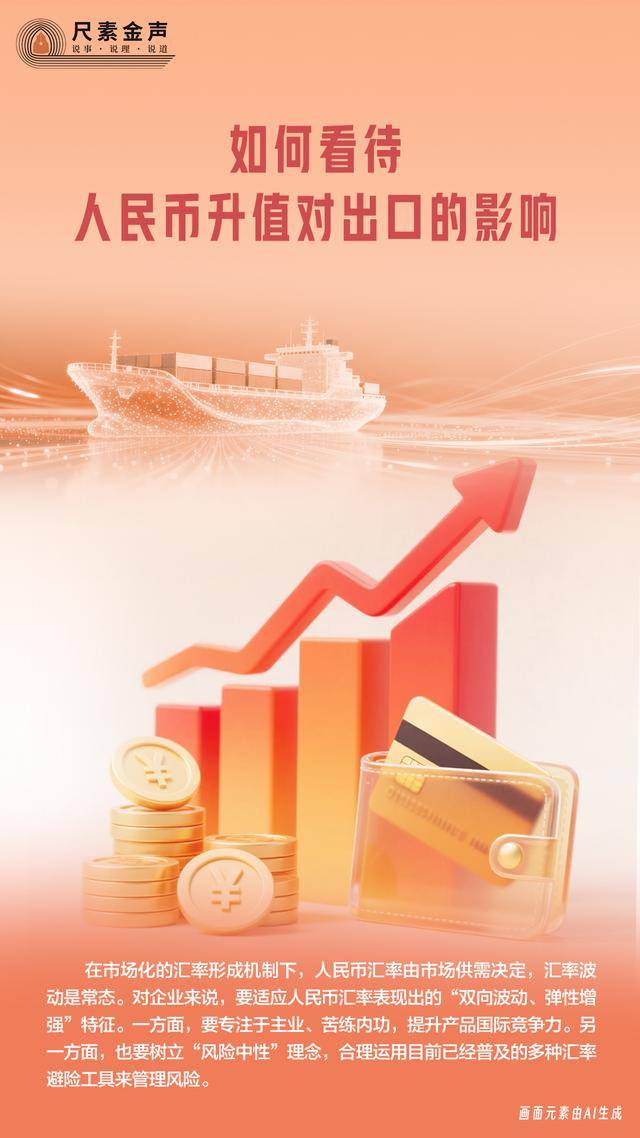
来源:人民日报客户端 同时也要看到,人民币国际化的步伐正逐渐加快。2025年上半年,人民币跨境收付金额合计为35万亿 元,同比增长14%,其中货物贸易跨境人民币收付金额合计为6.4万亿元,占同期本外币跨境收付的比 重为28%,收付金额和占比均处历史最好水平,这反映出人民币在国际贸易结算中的接受度不断提升, 尤其是共建"一带一路"国家和东盟、非洲地区的国家,对人民币结算的接受度更高。在此背景下,我国 货物出口对于汇率波动的敏感性也在逐步降低。 在复杂国际环境中,人民币汇率保持基本稳定的核心支撑,来自于中国经济表现出的强大韧性。中国具 有超大规模市场和完整产业链,科技创新和产业创新加速融合,新动能蓬勃发展,内需潜力不断释放, 国内国际双循环更加畅通,宏观经济基本面长期向好,这对人民币汇率基本稳定形成了坚实支撑。我国 外汇交易量持续创历史新高,市场参与主体涵盖国内主要金融机构以及境外机构,交易主体多元、市场 深度拓展,也能够有效吸纳外部环境变化的影响。 在市场化的汇率形成机制下,人民币汇率由市场供需决定,汇率波动是常态。对企业来说,要适应人民 币汇率表现出的"双向波动、弹性增强"特征。一方面,要专注于主业、苦练内功 ...
如何看待人民币升值对出口的影响?
Sou Hu Cai Jing· 2026-01-29 10:17
原标题:尺素金声|如何看待人民币升值对出口的影响? ——澄清当前关于中国经济的一些模糊认识① 再度破"7"!1月23日,人民币对美元汇率中间价报6.9929,较前一个交易日调升90个基点,创下2023年 5月以来的新高。去年末,离岸、在岸人民币对美元汇率相继破"7",目前维持在"7"的上方运行。 面对人民币汇率升值,市场上存在各种声音。部分人认为,人民币汇率或将就此进入升值通道。还有的 人认为,人民币汇率升值会对我国出口企业带来不利影响。当下,有必要结合我国实际,深入分析人民 币汇率变动将给经济社会带来的影响。 在市场化的汇率形成机制下,人民币汇率由市场供需决定,汇率波动是常态。对企业来说,要适应人民 币汇率表现出的"双向波动、弹性增强"特征。一方面,要专注于主业、苦练内功,提升产品国际竞争 力。另一方面,也要树立"风险中性"理念,合理运用目前已经普及的多种汇率避险工具来管理风险。 来源:人民日报客户端 一方面,2025年5月以来,美元指数有所走弱,人民币等非美货币普遍相对美元升值。另一方面,面对 复杂的外部环境,中国经济表现出的较强韧性,不断优化的贸易结构、持续深入的金融市场开放以及宏 观政策的精准发力,共 ...

俄罗斯对华黄金出口,暴增800%!中国连续囤金,美元或将被取代?
Sou Hu Cai Jing· 2026-01-29 05:50
在全球经济动荡变革的当下,金价波动早已超越单纯的投资者投机游戏,成为国家间战略博弈的重要筹码。一场围绕黄金主权的暗战正悄然蔓延,而历史悠 久的国际金融枢纽——香港,正成为这场博弈的核心焦点。故事的起点,始于俄罗斯黄金出口的爆发式增长,其对华出口量的激增背后,不仅是自身财政突 围的迫切需求,更折射出全球黄金格局的深刻重构。 据中国海关数据测算,2025年俄罗斯对华出口实物黄金总量达25.3吨,贸易金额攀升至32.9亿美元,较2024年分别实现8倍、13.6倍的大幅增长,两项指标均 创下双边贸易历史新高。这一爆发式增长直接推动俄罗斯跻身中国十大黄金供应国之列,排名跃升至第七位,为全球黄金市场注入强烈变数。受此影响,国 际金价持续走强,2026年1月21日,伦敦现货黄金、纽约商品交易所黄金期货价格盘中双双突破每盎司4800美元关口,延续了2025年以来的强劲涨势,全年 伦敦金价涨幅达64.56%,创下近四十年来罕见的持续上行态势。 俄罗斯黄金的"东向转身",本质是欧美制裁下的必然选择。G7对俄罗斯黄金实施出口禁令后,其传统欧美市场彻底关闭,被迫将黄金出口重心转向非西方 阵营。为突破制裁封锁,俄罗斯向东方国家出口黄金 ...

人民银行上海总部召开2026年第一季度新闻发布会
Xin Lang Cai Jing· 2026-01-29 05:40
Core Viewpoint - In 2025, the Shanghai headquarters of the People's Bank of China implemented a moderately loose monetary policy, resulting in a significant increase in social financing and direct financing, alongside a reasonable growth in credit and a steady decline in financing costs [2][19]. Financing and Credit Situation - The total social financing in Shanghai increased by 1.1632 trillion yuan, a year-on-year increase of 102.1 billion yuan, effectively meeting the financing needs of the real economy [3][20]. - The structure of financing improved, with RMB loans to the real economy increasing by 658.9 billion yuan, accounting for 56.6% of the financing increment. Direct financing rose by 341.9 billion yuan, making up 29.4% of the total, a year-on-year increase of 15 percentage points [3][20]. - By the end of December, the balance of loans in both domestic and foreign currencies reached 13.07 trillion yuan, a year-on-year growth of 6.5%, which is 0.3 percentage points higher than the national average [4][21]. - The weighted average interest rate for newly issued corporate loans in December was 2.64%, down 38 basis points from the previous year, marking a historical low [4][21]. Deposit Growth - By the end of December, the balance of deposits in both domestic and foreign currencies reached 24.5 trillion yuan, a year-on-year increase of 11.3%, which is 2.3 percentage points higher than the national average [5][22]. - Household deposits grew by 9.1% year-on-year, while non-financial enterprise deposits increased by 5.3% [5][22]. Foreign Exchange and Cross-Border Transactions - In 2025, Shanghai's foreign exchange receipts and payments reached a total of 5.66 trillion USD, accounting for over 36% of the national total, with a year-on-year growth of 14.3% [6][24]. - The total amount of cross-border RMB payments reached 32.4 trillion yuan, a year-on-year increase of 9%, maintaining a 46% share of the national total [8][26]. - The direct investment foreign exchange receipts and payments totaled a year-on-year increase of 5.8%, with securities investment receipts and payments growing by over 19% [7][25]. Policy Initiatives and Future Plans - The Shanghai headquarters will continue to implement a moderately loose monetary policy and promote financial reforms to support the "14th Five-Year Plan" and the construction of the Shanghai International Financial Center [12][30]. - The upgrade of the free trade account function aims to enhance cross-border trade and investment facilitation, with significant participation from banks and enterprises [14][31]. - The green foreign debt pilot program has been initiated to support enterprises in green and low-carbon transformation projects, with financing exceeding 64 million USD (approximately 450 million yuan) [16][34].
人民银行上海总部周鹏:将推动临港新片区离岸贸易金融服务综合改革试点扩围
Xin Lang Cai Jing· 2026-01-29 05:22
Core Viewpoint - The People's Bank of Shanghai Headquarters is committed to advancing the construction of Shanghai as an international financial center, focusing on cross-border trade and investment facilitation, financial market openness, and supporting the real economy in 2025 [1][4]. Group 1: Cross-Border Trade and Investment Facilitation - The bank aims to deepen cross-border trade and investment facilitation, implementing comprehensive reforms in offshore trade finance services in the Lingang New Area to enhance cross-border settlement efficiency [1][4]. - The pilot for "green foreign debt" policies has shown positive effects, and there is a steady advancement in foreign exchange business reforms and management of multinational corporate cross-border cash pools [1][4]. Group 2: Financial Market Openness - The bank is working to expand high-level financial market openness, successfully promoting the issuance of offshore bonds in the Shanghai Free Trade Zone [1][4]. - As of December 2025, 1,189 foreign institutions have entered the interbank bond market, holding bonds worth 3.46 trillion yuan, which accounts for approximately 2% of the total custody in the market [1][4]. Group 3: RMB Internationalization - Efforts are being made to broaden and deepen the internationalization of the RMB, with the total cross-border RMB settlement in Shanghai accounting for 46% of the national total in 2025 [2][5]. Group 4: Support for the Real Economy - The establishment of a working group for Shanghai's financial "five major articles" aims to enhance policy coordination and support for the real economy, particularly in the technology innovation sector [2][6]. - Initiatives include the issuance of technology innovation bonds in the interbank market and the promotion of carbon reduction support tools [2][6]. Group 5: Financial Environment Optimization - The bank is focused on improving the financial development environment by enhancing payment convenience and optimizing tax refund services for outbound travelers [2][6]. - The digital RMB international operation center has officially started operations, and the multi-central bank digital currency bridge pilot is progressing [2][6]. Group 6: Future Work Plans - In 2026, the bank plans to continue promoting offshore financial services reforms, advance RMB internationalization, and support the implementation of foreign exchange management reform pilot policies [3][7].
邢自强-美元对人民币汇率走势及全球货币体系分析
2026-01-29 02:43
Summary of Key Points from Conference Call Records Industry and Company Overview - The discussion primarily revolves around the **foreign exchange market**, specifically the **USD/CNY exchange rate** and its implications for the global monetary system and economic policies in the U.S. and China. Core Insights and Arguments - **RMB Exchange Rate Adjustment**: The adjustment of the RMB exchange rate relies on domestic policy reforms rather than significant appreciation to address local government incentive mechanisms and fiscal issues, avoiding a repeat of Japan's Plaza Accord [1][2] - **2026 Exchange Rate Predictions**: The USD/CNY exchange rate is expected to reach **6.8** in the short term, influenced by potential U.S. interest rate cuts. However, it may revert to around **7.0** by year-end due to seasonal factors and temporary influences [2][10] - **Decline of USD Dominance**: The share of the USD as a global reserve currency is projected to decrease from **58%** to **30%-40%** over the next decade, reflecting challenges to the dollar's hegemony [3][12] - **Foreign Investment in the U.S.**: The U.S. remains the largest recipient of foreign investment, which supports its economy and stabilizes interest rates and the treasury market [4][5] - **Link Between Exchange Rate and Trade Agreements**: There is speculation about a potential link between RMB appreciation and U.S. investment restrictions, but China is likely to avoid tying exchange rate adjustments to trade agreements to prevent economic stagnation [6] - **Reflation in China**: The likelihood of significant reflation in China by 2026 is low, with CPI increases driven mainly by gold and vegetable prices rather than real demand recovery [7] - **Recent USD Index Decline**: The recent decline in the USD index is attributed to slowing U.S. economic growth, interest rate cuts by the Federal Reserve, and concerns over rising government debt [8][9] - **Impact of U.S. Fiscal Policy**: Uncertainty in U.S. fiscal policy poses risks to the future of the dollar, with rising debt levels potentially undermining market confidence [11] - **Future Global Currency Landscape**: While the dollar's dominance may decline, it is unlikely to fall below **50%** of global reserves in the next decade due to U.S. military and technological strength [12] - **Long-term RMB Internationalization**: The RMB's internationalization has made progress, particularly through market connectivity, but challenges remain in achieving a greater global currency status [17] Other Important Insights - **Sector Focus for 2026**: High-tech industries, including AI, biopharmaceuticals, and humanoid robotics, are highlighted as key growth areas amidst broader economic challenges [22][23] - **Geopolitical Considerations**: The U.S. and China are in a delicate phase of their relationship, with interdependence in supply chains making a complete decoupling impractical [21]
资金“高速路”贯通,如何利好跨国公司?(环球热点)
Ren Min Ri Bao Hai Wai Ban· 2026-01-28 22:49
资金池是跨国公司集中运营和管理资金的重要工具。本外币一体化资金池业务带来哪些改变?该政策全 面推广如何利好跨国公司?又将产生哪些更深远影响?本报邀请来自金融机构、学术界和业界人士进行 综合解读。 跨国公司是链接全球市场与资源的关键引擎。然而,跨国公司的财务官们却常被这样的难题困扰:中国 市场的利润需要留存,东南亚工厂的采购款亟待支付,欧洲研发中心的拨款申请又到了……钱在全世 界,用起来却不方便:资金分散在全球各地,每一次跨境调度都像是一场漫长的跨国旅行,受审批成 本、汇率波动等多重因素影响。 近期,中国人民银行、国家外汇管理局发布《关于跨国公司本外币一体化资金池业务有关事宜的通知》 (以下简称《通知》),宣布此前已在部分地区试点的跨国公司本外币一体化资金池业务推广至全国。 "这一问题的根本症结在于人民币与外币资金池长期分属两套监管体系,形成了币种壁垒和账户冗 余。"国家开发银行高级专家曹红辉指出,这种资金管理模式,实质上制约了跨国公司资金的运营效 率,影响了其核心财务资源及管理职能的布局。 "如果把企业不同币种资金比作工具,那么集团在不同国家的子公司都管理着自己上锁的工具箱;在境 内的集团本部还会有本币和外币 ...
双轮驱动 构建高质量外贸协同生态
Sou Hu Cai Jing· 2026-01-28 16:47
[ 2025年,中国外贸进出口总额达到45万亿元,较上年增长3.8%。 ] 外贸作为中国经济的"稳定器"和"推进器",不仅在参与全球分工、塑造国际竞争优势中扮演核心角色, 更是保障宏观经济韧性的关键支柱。我国始终坚持高质量开展外贸活动的基本国策,着力构建稳定、连 续、可预期的政策环境。2025年,中国外贸进出口总额达到45万亿元,较上年增长3.8%,贸易顺差突 破8.5万亿元(约合1.2万亿美元),连续多年位居全球贸易前列,成为全球首个持续保持万亿美元级别 顺差的经济体。外贸企业不仅创造了巨大的贸易价值,更在推动产业升级、稳定就业市场、增强国际话 语权等方面发挥了不可替代的作用。 然而,与外贸高质量发展的强劲势头相比,我国金融服务在覆盖面、适配性和创新性上仍显滞后,已成 为制约外贸潜能释放的突出瓶颈。如何破解当前"金融与外贸"协同不足的局面,构建政策长效、法治健 全、服务匹配、生态联动的立体支撑体系,已成为推动中国经济高质量发展进程中的重要议题。 外贸企业:中国经济的稳定基石与增长引擎 中国外贸企业的成长轨迹始终与国家发展同频共振。面对全球格局的深刻演变与地缘风云的复杂变幻, 外贸企业凭借顽强韧性与持续创新, ...
双轮驱动,构建高质量外贸协同生态
Di Yi Cai Jing· 2026-01-28 13:10
Core Viewpoint - Financial services in China are lagging in coverage, adaptability, and innovation, which restricts the potential of foreign trade, a key pillar of the economy [1][6]. Group 1: Economic Impact of Foreign Trade - Foreign trade is a stabilizer and driver of China's economy, contributing significantly to GDP and employment, with a trade surplus projected to reach 8.5 trillion yuan (approximately 1.2 trillion USD) by 2025 [1][3]. - Foreign trade activities are expected to directly or indirectly support over 190 million jobs and maintain a GDP contribution rate of over 15% [3]. Group 2: Role of Foreign Trade Enterprises - Foreign trade enterprises are crucial for economic growth and industrial upgrading, demonstrating resilience and continuous innovation amid global changes [2]. - The export of new energy vehicles is projected to exceed 1 trillion yuan, becoming a significant driver in the global market [4]. Group 3: Financial Services Demand - The core foreign trade business, valued at 17.6 trillion yuan, generates substantial financial needs, including cross-border settlement and trade financing, with an estimated trade financing demand of about 4.4 trillion yuan [5]. - By 2025, cross-border RMB transactions are expected to reach 7.2 trillion yuan, accounting for 30% of total goods trade, marking a historical high [5]. Group 4: Challenges in Financial Services - There is a significant gap in financial service coverage, with domestic banks holding only 38%-42% of the core foreign trade settlement market, while foreign banks dominate [7][8]. - Financing support for large state-owned enterprises exceeds 80%, while small and medium-sized enterprises (SMEs) face a financing accessibility rate of less than 40% [9]. Group 5: Root Causes of Inefficiency - The imbalance between financial services and foreign trade development is influenced by policy environment, institutional capabilities, and market conditions [11]. - Domestic banks have limited international presence, particularly in key markets like Europe and the U.S., and lack innovative financial products tailored for foreign trade [12]. Group 6: Path Forward for Collaboration - A multi-faceted support system involving government, financial institutions, enterprises, and industry associations is essential to enhance the synergy between financial services and foreign trade [17]. - The government should promote long-term policies and improve legal frameworks to support foreign trade and financial innovation [18]. - Financial institutions need to optimize service networks and enhance product innovation to meet the diverse needs of foreign trade enterprises [19].