国补政策

Search documents
5月社零同比+6.4%,大促提前社零及电商增速环比提升
CMS· 2025-06-16 13:14
Investment Rating - The industry is rated as "Recommended" based on favorable fundamentals and expected outperformance of the industry index compared to the benchmark index [3]. Core Insights - In May 2025, the total retail sales of consumer goods reached 4,132.6 billion yuan, with a year-on-year growth of 6.4%. The online retail sales of physical goods grew by 8.2% year-on-year, benefiting from the early promotion of the 618 shopping festival [1][5]. - The growth in retail sales was driven by the early 618 promotion, with significant increases in categories such as home appliances and communication devices, which continued to lead the industry [1][5]. - The report emphasizes the importance of focusing on high-quality, well-performing, and low-valuation leading companies in the consumer internet sector as the 618 shopping festival concludes [1][5]. Summary by Sections Industry Scale - The industry comprises 132 listed companies with a total market capitalization of 1,163.4 billion yuan and a circulating market capitalization of 1,070.5 billion yuan [3]. Retail Performance - The total retail sales of consumer goods in May 2025 were 4,132.6 billion yuan, with a year-on-year increase of 6.4%, and a month-on-month increase of 1.3 percentage points [5]. - The retail sales of goods reached 3,674.8 billion yuan, growing by 6.5% year-on-year, while catering revenue was 457.8 billion yuan, with a year-on-year growth of 5.9% [5]. - Urban retail sales amounted to 3,605.7 billion yuan, up 6.5% year-on-year, while rural retail sales were 526.9 billion yuan, increasing by 5.4% year-on-year [5]. Online Retail Growth - The online retail sales of physical goods totaled 1,061.3 billion yuan in May, with a year-on-year growth of 8.2%, and a month-on-month increase of 2.1 percentage points [5]. - Categories such as food, clothing, and daily necessities saw online retail sales growth of 14.5%, 1.2%, and 6.1% respectively [5][21]. Category Performance - Essential categories like grain, oil, and food saw a year-on-year growth of 14.6%, while home appliances and audio-visual equipment led with a remarkable growth of 53% [5][35]. - Communication equipment grew by 33% year-on-year, and cultural and office supplies increased by 30.5% due to government subsidies [5][42]. Investment Recommendations - The report suggests focusing on leading consumer internet companies with strong fundamentals, good performance, high buybacks, and low valuations as the 618 shopping festival approaches its end [1][5].
国补暂停为阶段性管理措施,第二批资金正加速拨付中
Haitong Securities International· 2025-06-16 11:28
中国电子 China (Overseas) Technology 国补暂停为阶段性管理措施,第二批资金正加速拨付中 National Subsidy Suspension as a Temporary Measure, and the Second Batch of Funds Is Being Accelerated for wo[Table_Title] Research Report 16 Jun 2025 Allocation 姚书桥 Barney Yao 邓雅文 Linda Deng barney.sq.yao@htisec.com linda.yw.deng@htisec.com [Table_yemei1] Flash Analysis [Table_summary] 事件: 近期"618"购物节期间,中国部分省市的消费品以旧换新"国补"政策出现了不同程度的暂停或限制。不同地区的解 释各不相同,例如江苏省表示"部分资格平台正在进行整改或系统升级",重庆则表示"本轮绿色智能家电补贴资金 已使用完毕,暂停资格码申领"。面对这一情况,中国家用电器商业协会常务副秘书长吴咸建明确回应:"全国统一 截止时间 ...


商贸零售行业周报:年中大促临近尾声,多地国补转向限额管理-20250615
Shenwan Hongyuan Securities· 2025-06-15 09:39
Investment Rating - The report maintains a "Positive" outlook on the commerce and retail industry, highlighting the resilience of domestic demand and the ongoing consumption trends driven by promotional events like the "618" sales [1]. Core Insights - The "618" sales event has seen significant consumer engagement, with platforms extending promotional periods to over four weeks, effectively stimulating demand across various categories [4]. - National subsidies have shifted to a limited distribution model, impacting sales dynamics in categories like home appliances and electronics, with notable sales growth reported [11]. - Domestic brands are experiencing rapid growth, driven by increased consumer demand and a shift in preferences towards high-quality, cost-effective local products [12]. Summary by Sections Market Overview - During the week of June 9 to June 13, 2025, the social service index decreased by 0.01%, while the commerce retail index fell by 1.49%, ranking 15th and 25th respectively among the Shenwan first-level industries [18][19]. Sales Performance - Tmall's "618" event reported that 43 brands achieved over 100 million yuan in sales within the first hour, with overall sales growth exceeding 50% year-on-year [7]. - JD's "Heart-Pounding Shopping Season" saw over 5 billion consumers placing orders, with nearly 80,000 brands doubling their sales compared to the previous year [8]. Consumer Trends - The report indicates a strong preference for domestic brands among younger consumers, with significant sales recorded for local skincare brands during promotional events [14]. - The demand for brand-name products has notably increased, particularly in new-tier cities, driven by promotional discounts [14]. Investment Recommendations - The report suggests focusing on e-commerce platforms that are enhancing online consumption through national policies and strategic investments in AI and instant retail markets, including Alibaba, JD, Meituan, and Pinduoduo [1]. - It also highlights opportunities in premium jewelry brands and department stores that are adapting to consumer needs and enhancing their offerings [1].
华为Pura80系列首销:搭载12核处理器,不再严重缺货
Guan Cha Zhe Wang· 2025-06-14 14:29
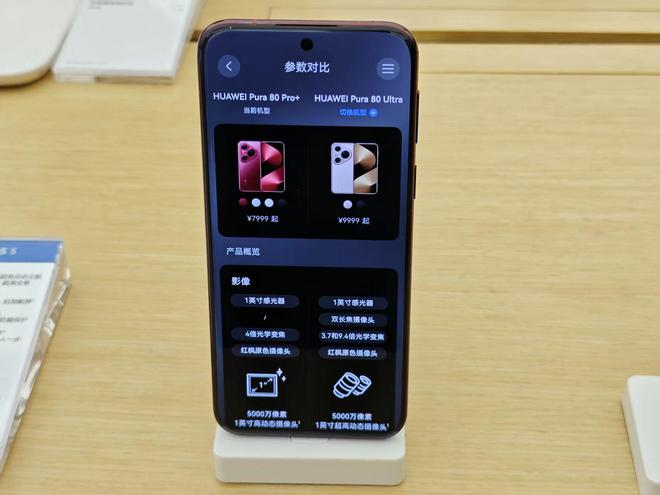
Core Viewpoint - Huawei's Pura 80 series, including the Pro and Pro+ models, has officially launched and is experiencing a strong initial sales performance, with improved availability compared to previous models [1][5]. Product Launch and Sales - The Pura 80 series was released on June 14, with the Pro and Pro+ models available for purchase, showing no significant stock shortages [1][3]. - The Pro model is priced at 6499 yuan and the Pro+ at 7999 yuan, maintaining the same price points as the previous generation [5]. - Initial sales reports indicate that stores are selling 50 to 60 units daily, reflecting strong consumer interest [3]. Product Specifications - The Pura 80 Pro features a 50MP one-inch main camera and a 12-core processor, while the Pro+ model includes a high-dynamic one-inch main camera [3]. - Both models run on HarmonyOS 5.1, which does not support downgrading [3]. Market Competition - Xiaomi's recent models, particularly the Xiaomi 15 series, are noted for their performance advantages due to the latest Qualcomm processors, although Huawei's Pura 80 series is praised for its superior build quality [5][6]. - Xiaomi has regained the top position in the Chinese smartphone market with an 18.6% share, benefiting significantly from government subsidy policies [8][9]. Market Trends and Predictions - The smartphone market is facing challenges, with IDC lowering global shipment growth forecasts due to tariff fluctuations and extended replacement cycles [11]. - In China, smartphone sales increased by 8.2% year-on-year during the promotional period from May 1 to June 7, driven by government subsidies and promotional activities [11]. - Huawei's ability to maintain growth and capture more high-end market share with the Pura 80 series is critical, especially as it competes against Apple and Xiaomi [11][12].

这个618,德施曼Q5FPro智能锁成国民爆款,引发现象级抢购
Zhong Guo Zhi Liang Xin Wen Wang· 2025-06-11 09:48
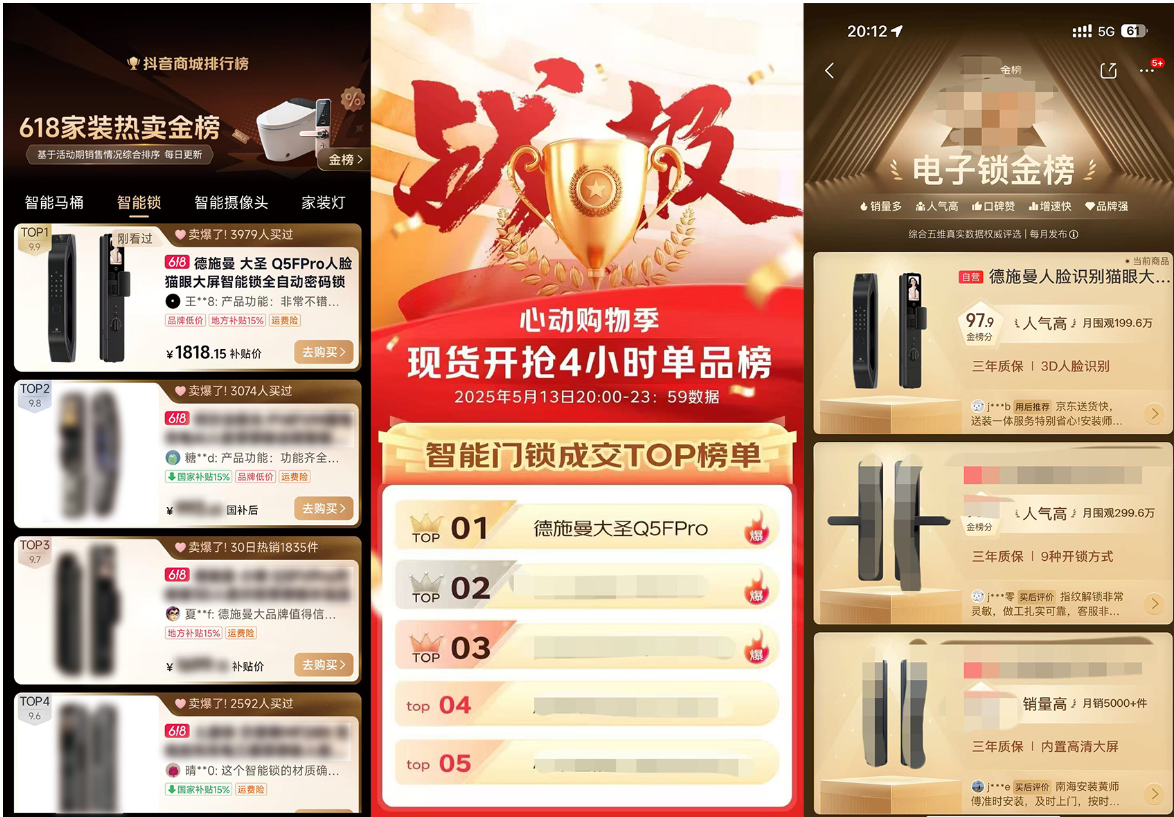
Core Insights - The company DeShiMan has secured the industry sales champion for the 618 e-commerce promotion, with its flagship product, the DaSheng Q5FPro, achieving multiple top rankings across various e-commerce platforms [1][3][4] Group 1: Sales Performance - DeShiMan's DaSheng Q5FPro ranked first in several official sales lists, including JD's electronic lock popularity list and Douyin's home decoration hot sales list during the 618 event [1][3] - On the first day of the 618 sales, DeShiMan achieved the dual championship in sales volume and sales amount across all platforms, as well as in the high-end smart lock category [3] - The DaSheng Q5FPro has consistently performed well in past promotions, including ranking first in sales during the 2024 Double 11 event on JD [3] Group 2: Product Features - The DaSheng Q5FPro is equipped with advanced technologies such as GPTfinger fingerprint recognition, a high-torque LongTing motor, and the D-Power smart endurance system [3] - It features an AI smart peephole, a 4-inch high-definition screen, and 3D facial recognition, offering nine unlocking methods and a super power-saving mode with a battery life of up to nine months [3] Group 3: Promotional Strategies - DeShiMan has implemented various promotional strategies, including significant discounts and subsidies during the 618 event, such as a 150 yuan discount for purchases over 1500 yuan on Tmall and additional reductions on JD [4] - The company is actively responding to national policies promoting consumption upgrades, providing substantial benefits to consumers [4] - A live-streaming event featuring the company's president is scheduled to offer additional promotions and incentives, enhancing consumer engagement [4]
骗政府补贴13万余元,判了
Jin Rong Shi Bao· 2025-06-11 03:35
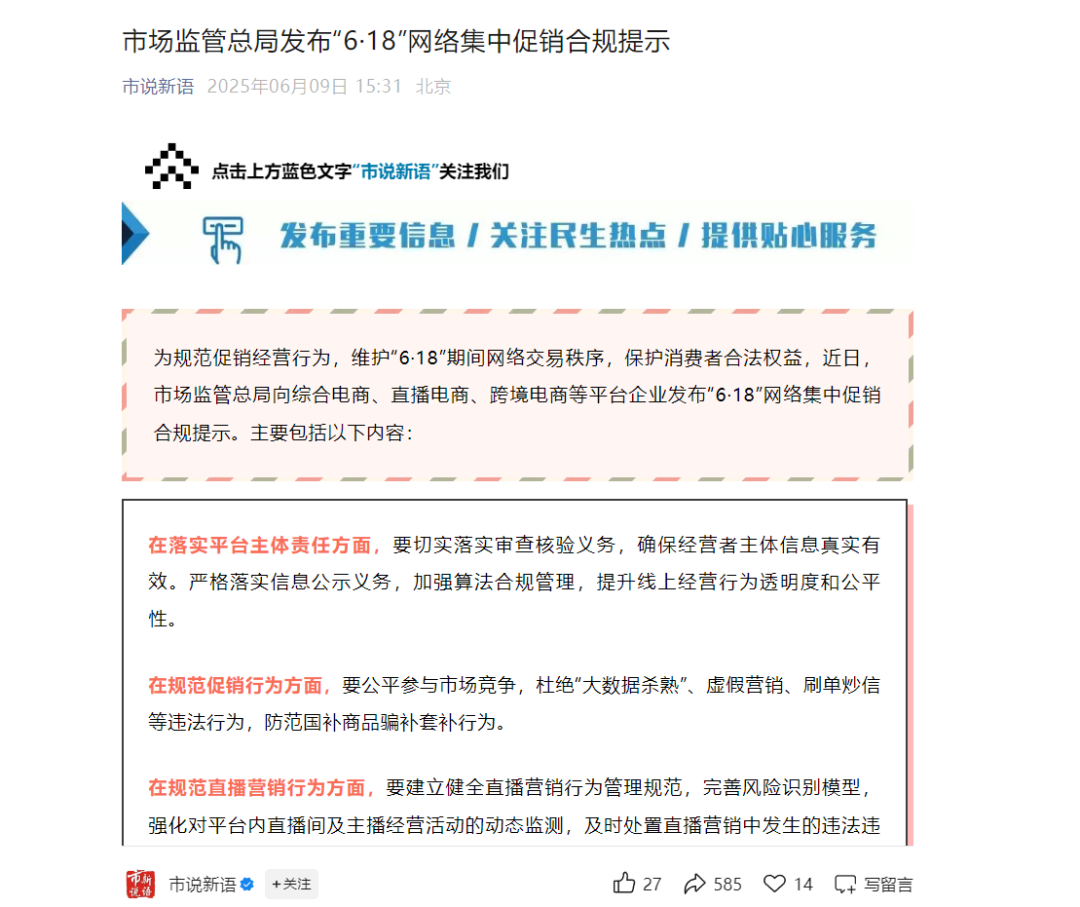
Core Viewpoint - The article highlights the ongoing "6.18" online shopping promotion and the regulatory measures taken by the National Market Supervision Administration to prevent fraudulent activities related to government subsidies for consumer vouchers [1][10]. Group 1: Regulatory Actions - The National Market Supervision Administration issued compliance guidelines specifically addressing the prevention of fraudulent claims related to government subsidies during the "6.18" promotion [1]. - The guidelines emphasize the need to regulate promotional activities and prevent behaviors that exploit government subsidies [1]. Group 2: Fraud Cases - A notable case involved a restaurant manager who was sentenced to three years in prison (with a three-year probation) for fraudulently cashing out 137,000 yuan (approximately 20,000 USD) using consumer vouchers [8][10]. - The manager exploited the "乐品上海" consumer voucher program by creating fictitious transactions to redeem multiple vouchers, ultimately defrauding the government [10]. - Similar fraudulent activities have been reported in other regions, such as a case in Zhuhai where a shop owner was sentenced for using consumer vouchers to illegally obtain government subsidies [11]. Group 3: Legal Risks - The article outlines the legal risks associated with fraudulent activities related to consumer vouchers, indicating that collusion between individuals and businesses to defraud government subsidies can lead to severe legal consequences [11]. - The Shanghai court noted that individuals involved in the resale of consumer vouchers may face restrictions from participating in future promotional activities due to violations of honesty and integrity principles [11]. Group 4: Broader Context - The article mentions that various regions are actively combating fraudulent claims related to government subsidies, with specific examples of companies being penalized for violating subsidy rules [12]. - The government aims to ensure that consumer vouchers serve their intended purpose of promoting consumption and supporting industry development, especially during peak shopping seasons like "6.18" [12].
618”大促进行中,国补政策助力,家电手机等销量迎“开门红
Zheng Quan Shi Bao Wang· 2025-06-06 13:16
Group 1 - The "618" shopping festival is experiencing significant sales growth, driven by national subsidy policies that stimulate consumer spending [1][2] - Major e-commerce platforms report impressive sales figures, with categories like smartphones, computers, and smart devices seeing over 100% year-on-year growth [1] - Brands such as Huawei, Xiaomi, and Midea have reported sales increases exceeding 200% during the initial phase of the "618" event [1][2] Group 2 - The participation in national subsidies has led to a 283% increase in total sales for home appliances and digital products compared to last year's "Double 11" event [2] - Live streaming sales, particularly in small appliances, have become a significant growth driver, with emerging domestic brands performing exceptionally well [2] - The demand for air conditioners and cleaning appliances is expected to surge in the second quarter, with intensified competition in these categories [2] Group 3 - The continuation of national subsidies is anticipated to positively impact domestic demand for home appliances, benefiting leading brands with strong financial capabilities and comprehensive distribution channels [3] - The implementation of "old for new" policies has significantly boosted consumer spending, with substantial sales figures reported in various regions [3][4] - As of early June, the "old for new" program has led to the sale of millions of home appliances and digital products, contributing to a notable increase in overall sales [3][4]
海信家电20250605
2025-06-06 02:37
Summary of Hisense Home Appliances Conference Call Industry Overview - The air conditioning market is highly competitive, with significant price pressure on flow models and cost-effective models. The national subsidy policy is being utilized quickly in coastal eastern regions, although some areas face funding shortages, which are expected to be resolved later. The policy has a significant positive effect on consumer demand [2][3][7] - The home appliance industry is experiencing single-digit growth in domestic sales, particularly after the 618 shopping festival began on May 13. Online sales growth has significantly improved in May, with a notable change in sales structure for refrigerators, air conditioners, and washing machines compared to the same period last year [3][21] Company Performance - Hisense's air conditioning installation card growth in May was in the high single digits, with new air conditioning installations exceeding 50% growth, accounting for over 20% of domestic sales. The company is actively expanding online channels for its flow models [4][5] - Hisense employs a K-shaped pricing strategy, improving the average price of high-end products while reducing prices for flow models due to intense competition [6] - The company anticipates that the effects of the national subsidy policy will become evident in the second quarter, with expectations for additional government funding to stimulate consumption [7][8] Market Dynamics - The central air conditioning market is expected to remain weak in the second quarter, with inventory levels around 90 days. The C-end and public construction sectors are expected to maintain single-digit growth, with profit margins stabilizing around 17% [9][10][11] - The overseas market, particularly in emerging regions like ASEAN, is expected to see strong growth, with overseas revenue growth and profit margin improvements being more certain than in the domestic market [12][13][14] Challenges and Strategies - Issues with the national subsidy policy include regional funding shortages and irregularities, which may lead to localized market disruptions. However, the overall impact is expected to be positive as more funds are anticipated to be allocated [7][19] - Hisense's strategy in response to the national subsidy policy involves requiring dealers to pre-finance, which may affect promotional activities during the 618 shopping festival [8][18] - The company plans to leverage the 618 shopping festival for marketing, with strategies tailored to optimize sales performance based on current trends [21][23] Future Outlook - Hisense aims to continue pushing for high-end product offerings, with plans to launch more products priced above 10,000 yuan. The company is also focusing on energy efficiency upgrades in the refrigerator sector [22] - The overseas marketing strategy includes sponsorship of major sports events like the World Cup and NBA, with a focus on expanding into new markets in the Middle East, Africa, ASEAN, and Latin America [25] Conclusion - Hisense Home Appliances is navigating a competitive landscape with strategic pricing and marketing initiatives while responding to government policies and market demands. The company is optimistic about growth in both domestic and international markets, particularly in emerging regions, despite facing challenges related to funding and competition.
国补的最大受益者,小米还能接着赢吗?
雷峰网· 2025-06-05 07:43
Core Viewpoint - The article emphasizes that Xiaomi has emerged as the biggest winner from the recent national subsidy policy, significantly boosting its market position and sales performance in the smartphone sector [4][11]. Group 1: National Subsidy Impact - The national subsidy policy, which provided consumers with a 15% subsidy on eligible digital products, led to a substantial increase in smartphone sales, with a 65% year-on-year growth in the week following its implementation [2][3]. - In the first quarter of 2025, the total shipment of smartphones in China reached 70.9 million units, a 5% increase year-on-year, with Xiaomi reclaiming the top position in market share for the first time in ten years [3][6]. - The subsidy policy has accelerated the competition among smartphone brands, with Xiaomi's performance being particularly strong, as it capitalized on the subsidy to enhance its market share and sales [3][4]. Group 2: Xiaomi's Financial Performance - Xiaomi's total revenue for the first quarter of 2025 reached 111.3 billion yuan, a 47.4% increase year-on-year, with adjusted profits rising by 64.5% to 10.7 billion yuan [6][9]. - The average selling price (ASP) of Xiaomi smartphones hit a record high of 1,211 yuan, reflecting a 5.8% year-on-year increase, while the market share of high-end models rose to 25% [6][7]. - Xiaomi's smartphone shipments in China reached 13.3 million units, a 39.9% increase compared to the same period last year, solidifying its market leadership [7][9]. Group 3: Competitive Advantages - Xiaomi's success is attributed to its strong product capabilities, brand strength, channel efficiency, and ecosystem integration, which have collectively enhanced its market competitiveness [11][12]. - The company has effectively utilized its extensive product line to increase consumer engagement and shopping experience, leading to higher brand exposure and sales [12][13]. - Xiaomi's automotive business, although not directly involved in the subsidy, has significantly boosted the brand's visibility and market presence, contributing to its overall growth [14][26]. Group 4: Future Outlook - The article suggests that while the national subsidy has provided a temporary boost, its long-term effects may diminish, leading to increased market competition and potential risks for manufacturers [24][25]. - Xiaomi is expected to continue leveraging its ecosystem strategy and technological advancements to maintain its competitive edge, with plans for significant R&D investments in the coming years [29][28]. - The company aims to expand its user base to over 200 million by 2026, indicating a strong growth trajectory despite potential market fluctuations [29].


多地停止申领!只因“国补”资金用完了,别急....
猿大侠· 2025-06-05 03:08
Core Viewpoint - The recent suspension of national subsidies for old-for-new appliance exchanges has sparked significant discussion, primarily due to the depletion of funds in various regions, leading to concerns about the future of these subsidy programs [1][10][12]. Summary by Sections Suspension of Subsidies - Several regions, including Chongqing, have announced the suspension of old-for-new appliance subsidies due to the exhaustion of available funds, with Chongqing being the first to completely deplete its budget as of June 4 [1][9]. - Other areas, such as Gansu and Jiangsu, have also halted their subsidy programs, indicating a broader trend of funding shortages across the country [9][10]. Reasons for Suspension - The suspension in Jiangsu was attributed not only to fund depletion but also to significant market imbalances and fraudulent activities by some merchants exploiting the subsidy system [6][7]. - Issues such as online platforms undercutting brick-and-mortar stores have led to customer loss for physical retailers, resulting in some businesses closing and contributing to local unemployment [7][8]. Future of Subsidies - Despite the current suspensions, local authorities in regions like Chongqing and Jiangsu have indicated that new rounds of subsidies are being planned, with expectations for re-launching the programs soon [12][13]. - The Chongqing Commerce Commission is drafting a second phase of the subsidy policy, expected to be released in early June, which will continue to support consumer upgrades to green and smart appliances [13][14]. Impact of Subsidies - The national subsidy policy has significantly stimulated consumer demand, as evidenced by a 21.5% year-on-year increase in the tablet market in Q1 2025, attributed to these subsidies [15]. - The core objectives of the subsidy program include promoting consumption upgrades, facilitating industrial transformation, and improving living standards, which require ongoing policy support for maximum effectiveness [15].