
谷子经济

Search documents
【大佬持仓跟踪】游戏+谷子经济,机构称重点新品有望今年上线,预计公司首年流水超数十亿或大幅带动细分业务板块业绩增长
财联社· 2025-07-08 05:15
Core Viewpoint - The article emphasizes the potential investment value of new products in the gaming and agricultural economy sectors, predicting significant revenue growth in the coming year due to the launch of key new products [1]. Group 1: Industry Insights - The gaming and agricultural economy sectors are expected to see the launch of important new products this year, with projected first-year revenues exceeding several billion [1]. - The integration of AI technology across multiple processes within the company is highlighted, indicating a forward-looking approach to innovation [1]. - The company is actively preparing for the overseas distribution of its products, suggesting a strategy for market expansion beyond domestic boundaries [1].


2025彩妆IP联名趋势洞察
Sou Hu Cai Jing· 2025-07-07 13:10
Group 1 - The core viewpoint of the report highlights that IP collaborations are becoming a key strategy for brands to stand out in the competitive cosmetics market, particularly appealing to young women, with lip gloss and perfume being the main collaborative product categories [1][6][19] - The report indicates that the domestic cosmetics market has surpassed 1 trillion yuan for two consecutive years, with domestic brands holding a 55.2% market share, outpacing international brands [1][6] - Despite having the highest number of brands in the top 50 cosmetics brands in China, domestic brands have an average retail scale of 4.116 billion yuan, which is significantly lower than the average of 5.619 billion yuan for American brands, indicating a gap in pricing power [1][6][19] Group 2 - The report identifies a growing trend in diverse collaborations, including technology crossovers, intangible cultural heritage, and food and beverage partnerships, which are becoming more prevalent in the cosmetics industry [1][6][25] - Consumer motivations for purchasing collaborative cosmetics are primarily driven by the attractiveness of the IP itself and the practicality of the products, with 67% of consumers liking the IP and 59% valuing the product's practicality [28][29] - The report notes that anime, cartoon, and gaming IPs are becoming the dominant types of collaborations in the beauty sector, reflecting consumer preferences [31][32] Group 3 - The report provides examples of successful collaborations, such as PinkBear's partnerships with popular IPs, which resulted in sold-out products within hours, showcasing the effectiveness of strategic collaborations [1][6][19] - The analysis of consumer demographics reveals that 93% of the interest in collaborative cosmetics comes from women, with a significant portion being young consumers aged 18-24 [12][10] - The report emphasizes the importance of innovative design and meaningful collaborations, as products lacking creativity often face consumer backlash [1][6][28]

《柯南》回春,这次小学生拯救的是中年危机
Xin Lang Cai Jing· 2025-07-07 10:50
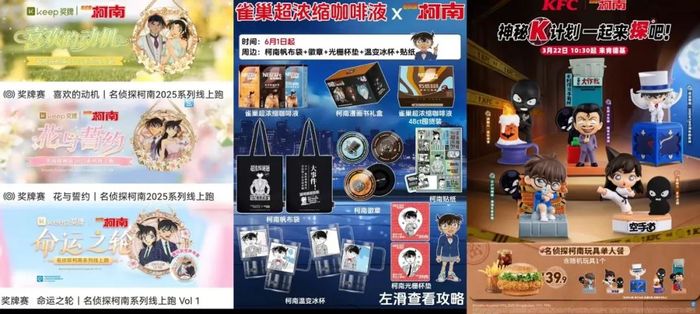
Core Viewpoint - The resurgence of the "Detective Conan" IP is attributed to a significant increase in brand collaborations and the success of the latest movie, "Detective Conan: One-eyed Flashback," which has generated substantial box office revenue in Japan and China [1][3][11]. Brand Collaborations - Over 30 brands have collaborated with "Detective Conan" this year, significantly surpassing previous years [1][3]. - The increase in collaborations is seen as a strategic move by various stakeholders in the industry, including Japanese copyright holders and Chinese distributors, to maximize the IP's potential [3][7]. Box Office Performance - The latest film, "Detective Conan: One-eyed Flashback," has grossed 143 billion yen in Japan, ranking it 17th in Japanese box office history [3]. - In China, the film earned 278 million yuan within ten days of release, with projections suggesting it could reach 400 million yuan [3][4]. Market Dynamics - The current landscape reflects a collective effort among Japanese and Chinese companies to revitalize the "Detective Conan" brand amid challenges faced by traditional IPs like Ultraman [11][17]. - The licensing and collaboration strategies are influenced by the complexities of Japanese copyright laws, which require careful navigation by Chinese companies [5][7]. Economic Context - The Japanese manga industry is experiencing financial difficulties, prompting companies like Shogakukan to aggressively license their IPs in China to recover losses [17][20]. - The trend of "谷子经济" (Guziko economy) is emerging, where merchandise and collaborations are seen as a way to boost revenue in a challenging market environment [20][23]. Future Outlook - The success of "Detective Conan" in the current market may set a precedent for other IPs, as companies look to leverage established brands to drive sales and engagement [20][22]. - However, the oversaturation of the market with similar products could lead to diminishing returns if not managed carefully [17][23].
养牙膏、超市“赶海”、“痛”式毕业,打卡“没用”兴趣展
Nan Fang Du Shi Bao· 2025-07-07 10:01
Core Insights - The article highlights the emergence of diverse and seemingly "useless" interests among users on Xiaohongshu, transitioning the platform from a "lifestyle guide" to a "lifestyle interest community" [1] Group 1: Interest Exhibition - Xiaohongshu hosted its first "Great! It's a Useless Interest Exhibition" in Shanghai, featuring six exhibition areas and over 30 community interests, with more than 50 user-created interest works [1] - By June 2025, the platform is expected to have over 2,500 interest tags [1] Group 2: Cultural Trends - The "pain bag" culture is gaining popularity, with a 30-fold increase in search volume for related terms on Xiaohongshu, and over 70 million exposures for topics related to "pain hats" and "pain graduation gowns" [2] - The term "goods" (谷子) refers to merchandise derived from various media, and the exhibition showcased unique creations like "using goods to make goods" [2] Group 3: Creative Expressions - Users are engaging in various creative activities, such as nurturing unconventional items and documenting their experiences, which reflect a unique emotional expression among contemporary youth [3] - The trend of "collecting small happiness" is evident, with users sharing poetry inspired by nature and engaging in activities like cloud observation and birdwatching, leading to a 19-fold increase in birdwatching searches [4] Group 4: Community and Connection - The act of collecting fruits and sharing them among users fosters community connections, with one user amassing 26,000 followers through her fruit collection journey [5] - Xiaohongshu is witnessing a rise in users creating their own unique writing systems and reviving ancient cultural practices, indicating a growing cultural confidence among young people [5]
华龙证券:谷子经济持续高景气 关注IP潮玩及AI应用落地
智通财经网· 2025-07-07 09:02
Group 1: Media Sector Insights - The media sector is experiencing strong growth driven by content cycles, technological empowerment, and new consumption trends [1] - AI is significantly enhancing the efficiency of content production from script creation to marketing, leading to cost reduction and innovation [1] - The media sector's performance from January 2 to June 16, 2025, showed high volatility, with a maximum increase of 27.47% and a maximum decrease of 20.68% during the observed period [1] Group 2: Valuation Metrics - As of June 16, 2025, the media sector's PE ratio (excluding negative values, TTM, overall method) is 27.65 times [1] - The gaming sub-sector has a PE ratio of 26.09 times, the publishing sub-sector 18.79 times, the film sub-sector 48.62 times, and the advertising marketing sub-sector 29.76 times [1] Group 3: Market Growth in Related Sectors - The Chinese millet economy market is projected to reach 168.9 billion yuan in 2024, a 40.63% increase from 2023 [2] - The market for the pan-anime and peripheral sectors in China is expected to grow to 597.7 billion yuan in 2024, driven by an increasing audience size [2] - The Chinese trendy toy market is anticipated to reach 76.4 billion yuan in 2024, reflecting a 22% year-on-year growth [3] Group 4: AI Applications in Entertainment - The global AI interactive toy market is projected to grow from $61.25 billion in 2024 to $120.9 billion by 2031 [4] - 64% of leading gaming companies in China are investing in AIGC [4] - The micro-short drama industry in China is expected to experience explosive growth, reaching 50.4 billion yuan in 2024 and exceeding 68 billion yuan in 2025 [4]
大突破仍需基本面和流动性共振,震荡行情下结构性机会为主
British Securities· 2025-07-07 02:45
Core Views - The A-share market is experiencing a mixed performance with a lack of broad profit-making effects, indicating a structural market environment rather than a comprehensive upward trend [2][17] - The market is expected to remain in a volatile upward trend, with structural opportunities arising in sectors supported by performance and policy [2][17] Market Overview - Last Friday, the A-share market saw the Shanghai Composite Index reach a peak of 3497.22 points before a sudden drop, reflecting a clear divergence among indices [2][19] - The banking, insurance, and brokerage sectors showed strong performance, while the Shenzhen Component and ChiNext indices lagged behind, indicating a lack of widespread market momentum [2][19] - The overall market sentiment is cautious due to uncertainties surrounding tariff negotiations and insufficient economic recovery, leading to a preference for selective investment strategies [2][17] Investment Opportunities - Focus on three main investment lines: 1. Stocks with expected strong mid-year performance as the reporting window opens in July [3][18] 2. Technology sectors including military, robotics, AI, semiconductors, and digital economy, with a caution against speculative investments [3][18] 3. Stocks that have experienced significant declines, particularly in new energy and brokerage sectors, are recommended for opportunistic buying [3][18] Sector Analysis - The banking sector has shown resilience with a rebound after adjustments, driven by low valuations and high dividends, although macroeconomic uncertainties pose challenges [8] - The gaming sector is benefiting from advancements in AI and the growing popularity of short dramas, indicating a positive outlook for the entertainment industry [9] - Cross-border payment and digital currency stocks are experiencing renewed interest following regulatory developments, suggesting potential for future growth [10][11] - The pharmaceutical sector is gaining traction due to supportive government measures for innovative drug development, presenting a favorable investment environment [13] - The renewable energy sector, particularly solar and wind, is expected to see technical rebounds as global demand for clean energy continues to rise [14] - The steel industry is showing signs of recovery with limited downside potential in prices, supported by recent positive PMI data [15] - The brokerage sector is active due to policy support and market reforms, indicating potential for growth in investment banking activities [16]
比Labubu还猛的“碎钞机”,杀出来了
3 6 Ke· 2025-07-03 07:27
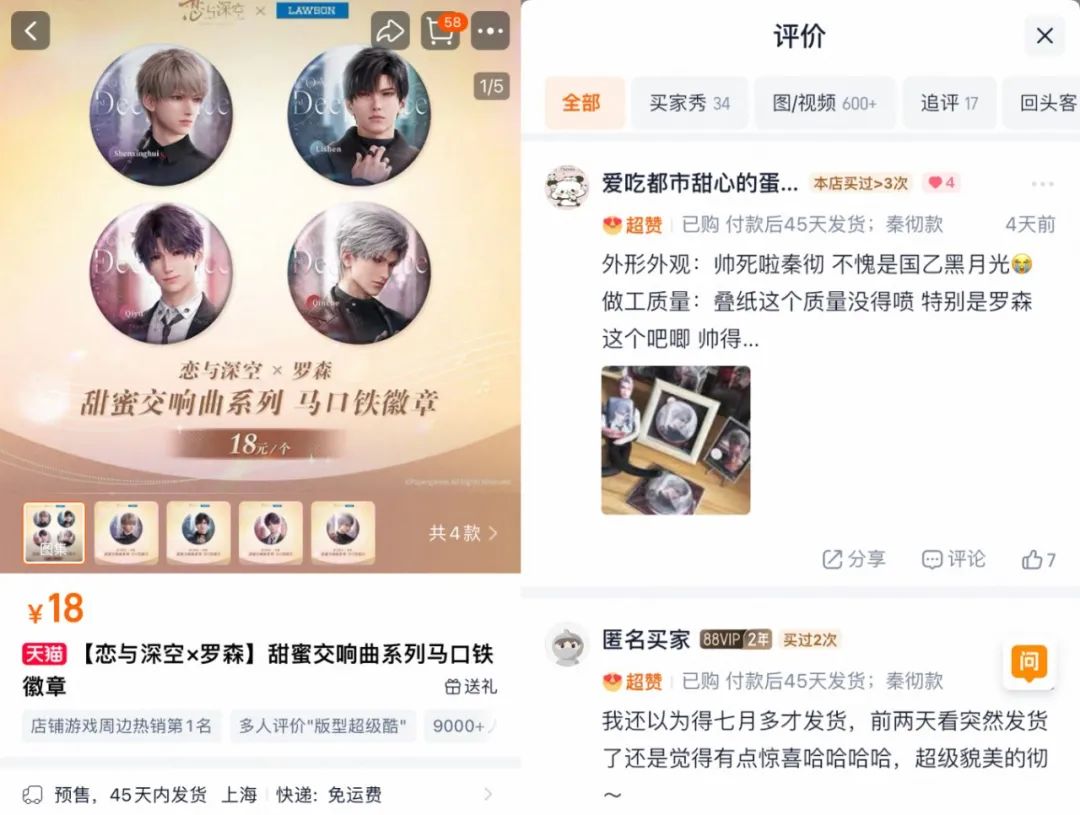
Core Insights - Tmall's潮玩 (trendy toys) sector has seen a surprising success story with the game company "叠纸" (Paper Games), whose flagship store "叠纸心意" became the top seller during the first phase of the 618 shopping festival, achieving over 100 million in sales [1][5] - The popularity of叠纸's merchandise is attributed to its strong gaming IPs, particularly the "恋与" (Love and Production) and "暖暖" (Warm Warm) series, which cater primarily to a female audience [2][11] - The surge in sales of叠纸's products reflects a broader trend in the gaming industry, where merchandise has become a significant revenue stream, especially for companies focusing on emotional connections with players [20][23] Company Overview -叠纸 was established in 2013 and has gained recognition in the gaming community, particularly for its female-oriented games [2][3] - The company has released several successful titles, including《恋与制作人》 (Producer of Love), which became a phenomenon in the mobile gaming market [3][11] Sales Performance -叠纸's merchandise sales have shown remarkable growth, moving from sixth place to second in Tmall's潮玩 sales rankings within two years [4] - During the 618 shopping festival,叠纸's store topped the sales charts, surpassing established competitors like泡泡玛特 (Pop Mart) and米哈游 (miHoYo) [5] Product Strategy -叠纸's merchandise primarily consists of affordable items, with over 70% priced under 60 yuan, and the highest-selling products being low-cost items like 18 yuan figurines and 12 yuan postcards [8][9][10] - The company employs various sales strategies, including pre-sales and limited-time offers, which create urgency among consumers [14][15] Consumer Demographics - The majority of叠纸's user base consists of women, with 87.2% of《恋与深空》 (Love in Space) players being female, and over half being born in the 1990s [11] - Players often exhibit strong emotional attachment to game characters, leading to high demand for related merchandise [12] Market Trends - The gaming merchandise market is experiencing explosive growth, with domestic orders for gaming-related products increasing significantly, indicating a cultural export of "国谷" (national trendy toys) [21] - The trend reflects a shift in consumer behavior from practical to emotional value in toy and merchandise purchases, with a growing interest in collectibles and character-based products [25]
谷子经济千亿级市场,供需两端发力打开远期成长空间
NORTHEAST SECURITIES· 2025-07-01 08:15
Investment Rating - The report maintains an "Outperform" rating for the industry [7] Core Insights - The report highlights the rapid growth of the "Guzi" economy, driven by multiple factors on both demand and supply sides, with a projected market size increase from 537 billion yuan in 2017 to 1689 billion yuan by 2024, reflecting a CAGR of 17.79% [3][21] - The demand for "Guzi" products is expected to benefit from the rise of emotional consumption and changing consumer attitudes, particularly among younger demographics [12][56] Summary by Sections 1. Emotional Consumption Rise and Market Outlook - The "Guzi" economy is positioned within the broader context of the expanding ACGN subculture, which includes animation, comics, games, and related merchandise [12] - The market for the broader "pan-second dimension" and related products is projected to grow from 221.2 billion yuan in 2017 to 597.7 billion yuan by 2024, with a CAGR of 15.26% [12][19] 2. Demand Side Analysis - The user base for "pan-second dimension" products in China is substantial, with an expected growth to 503 million users by 2024, indicating a strong willingness to purchase "Guzi" products [2][42] - Approximately 88.71% of anime/manga viewers express a willingness to buy "Guzi," with 81.78% having made purchases [45][50] - The average single purchase amount for "Guzi" products is 102 yuan, with consumers increasing their purchase frequency from 2.3 to 2.9 times per month [62][64] - The market penetration in lower-tier cities is still low, presenting opportunities for expansion due to the price advantages of "Guzi" products [68][72] 3. Supply Side Analysis - The "Guzi" economy's supply chain encompasses IP production, authorization, and product sales, with a notable rise in domestic IPs stimulating consumer interest [73][76] - The domestic IP authorization market is growing, with retail sales of authorized products expected to reach 1550.9 billion yuan by 2024, reflecting a CAGR of 11% [86][90] - The report notes that the sales of domestic IPs have surpassed those of Japanese IPs on platforms like Xianyu, indicating a shift in consumer preferences [80][81]
半年超155家谷店闭店,谷子经济的下一个“救命IP”何时出现?
3 6 Ke· 2025-07-01 03:32
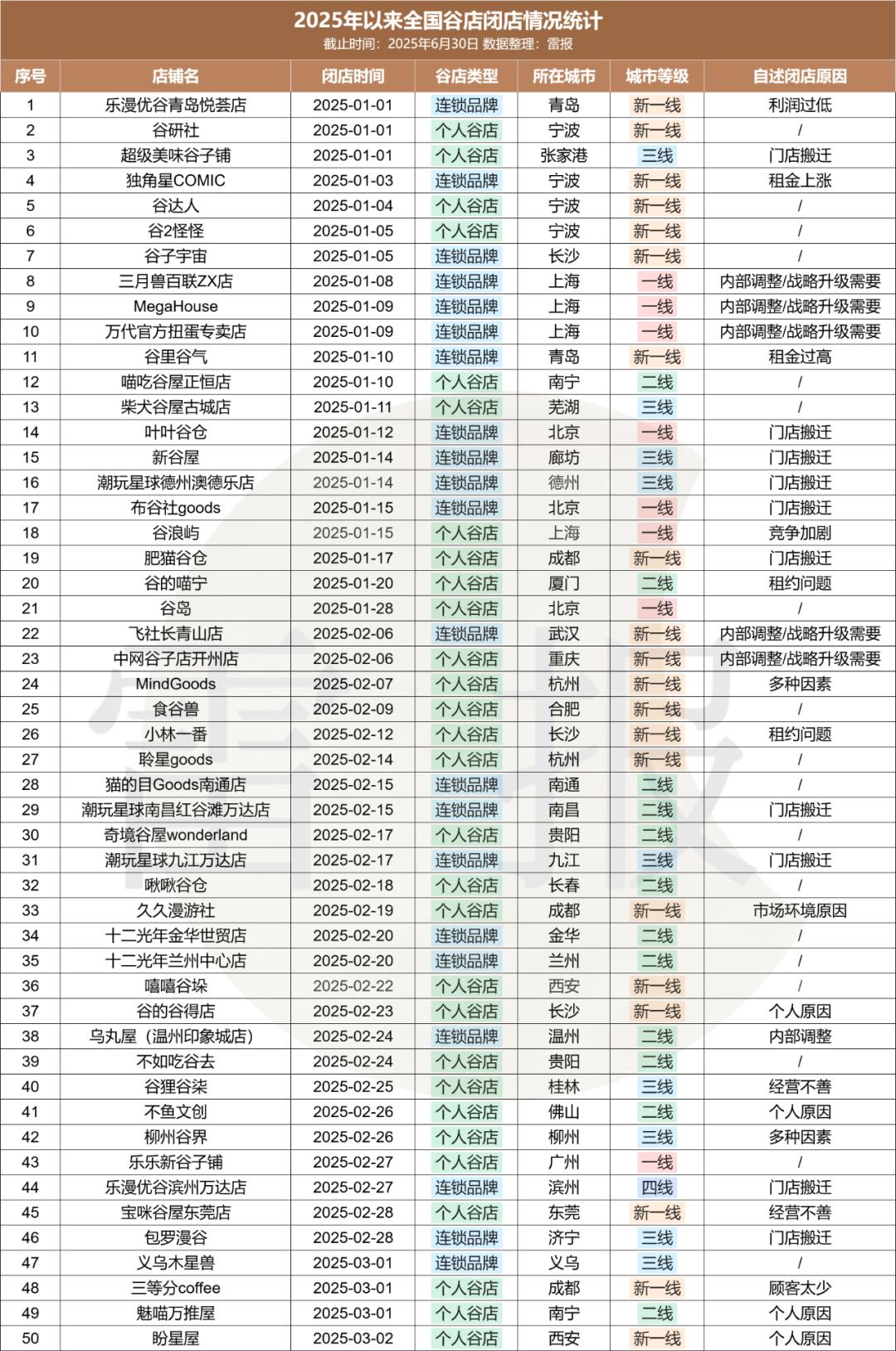
Core Viewpoint - The current state of the "谷子经济" (Guzi Economy) is characterized by a significant wave of store closures, particularly among "谷店" (Guzi stores), while the market continues to see new openings, leading to a paradoxical situation of both decline and expansion in the industry [1][3][8]. Group 1: Store Closures - Over the past six months, at least 155 Guzi stores have closed or planned to close, with 755 new stores opening during the same period, indicating a turbulent market environment [3][8]. - The closures are primarily attributed to low profits, high rents, and increased competition, particularly in first-tier and new first-tier cities, which account for 81% of the closures [7][10]. - The majority of the closed stores are personal Guzi stores, making up 55% of the total closures, while chain brands account for 45% [7]. Group 2: Market Dynamics - Despite the closures, the number of new store openings surged in the first half of 2025, with May alone seeing a record high of 241 new openings [8][10]. - The rapid expansion of stores has led to increased competition and consumer fatigue, resulting in inventory issues and price reductions among many brands [10][12]. - The decline in popularity of key IPs (Intellectual Properties) that support the Guzi economy has contributed to the current challenges, with significant drops in search interest for major IPs compared to the previous year [12][14]. Group 3: IP Dependency - The Guzi economy heavily relies on the popularity of specific IPs, and the current downturn is linked to a noticeable decline in the heat of these IPs, which were previously driving sales [11][22]. - The industry faces a systemic risk due to over-reliance on a few blockbuster IPs, leading to market volatility and a lack of sustainable growth [22]. - There is a growing need for a diverse ecosystem of IPs with long-term commercial value to stabilize the market and reduce dependency on singular hits [22].
潮玩系列4:全球IP生命周期复盘启示录
2025-06-30 01:02
Summary of Key Points from the Conference Call Industry Overview - The report focuses on the global IP (Intellectual Property) lifecycle and its implications for the collectible toy market, particularly in China and Southeast Asia, which are expected to lead global growth with compound annual growth rates (CAGR) of 17.2% and 20% respectively from 2024 to 2029 [1][5][6]. Market Size and Growth - The global IP derivative market is projected to reach 14 trillion yuan (approximately 2.1 trillion USD) by 2024, with the IP toy market specifically estimated at 525.1 billion yuan (approximately 79.5 billion USD) [1][5]. - China's IP toy market is expected to grow at a CAGR of 17.2%, reaching 167.5 billion yuan (approximately 25.5 billion USD) by 2029 [1][6]. Key Segments in the Market - Major segments in the Chinese market include building and assembly toys (26.8 billion yuan), static dolls (17 billion yuan), and plush toys (14.3 billion yuan) [6]. - There is significant potential for per capita spending on IP toys in China, which is currently 5-7 times lower than in Japan and the United States [6]. Competitive Landscape - Chinese companies are rapidly emerging in the IP toy market, with six out of the top ten companies being Chinese, including Pop Mart and Blokus [7]. - The industry typically employs a revenue-sharing model with a gross merchandise volume (GMV) share of 5%-8%, while licensing fees account for 10%-15% of listed companies' revenues [7]. Global IP Licensing Market - The global IP licensing market is highly concentrated, with the top five licensors holding approximately 40% market share and the top ten around 50% [8]. - Disney remains the leading player due to its extensive IP portfolio and consistent content output, followed by Warner Bros and Sea World [8]. IP Success Factors - The success of an IP is often attributed to its operational strategies, which can extend its lifecycle and enhance monetization opportunities [2]. - High-value IPs like Pokémon, Hello Kitty, Winnie the Pooh, and Mickey Mouse have generated over 50 billion USD in cumulative revenue, typically requiring over 30 years of history and a diversified commercial system [9]. Disney's IP Strategy - Disney has built a vast IP matrix through both organic growth and acquisitions, owning between 1,000 to 2,000 core IPs [10][17]. - The company has successfully maintained its IP relevance through continuous content updates and strategic partnerships [10][17]. Case Studies of IPs - **Hello Kitty**: Launched in 1974, it has a multi-layered monetization system and has successfully expanded its audience demographics over the years [24][25]. - **Mickey Mouse**: As a cultural icon since the 1930s, it has leveraged merchandise licensing and media adaptations to maintain its influence [26]. - **Pokémon**: Initially launched in 1996, it has seen rapid growth through innovative gaming and media strategies, achieving a GMV of nearly 120 billion USD in recent years [30][31]. Future Outlook - The report suggests that the Chinese IP toy market has a promising future, driven by increasing consumer spending and the emergence of local players [6][32]. - Companies like Pop Mart are expected to continue their growth trajectory, supported by a strong IP and product matrix [32][33].
