数字经济

Search documents
税友股份近20日股价回调超22%,受股东减持及高估值压力影响
Jing Ji Guan Cha Wang· 2026-02-14 04:22
Company Overview - Taxfriend Co., Ltd. (603171.SH) has experienced a significant decline of 22.77% over the past 20 days, with a closing price of 66.79 yuan as of February 13, 2026, primarily due to the controlling shareholder's reduction plan, technical adjustments, market sentiment, and high valuation pressure [1] - The controlling shareholder, Ningbo Sichi, plans to reduce its stake by up to 3% (approximately 12.19 million shares) from March 3 to June 2, 2026, raising liquidity concerns [2] - The stock price reached a peak of 90.60 yuan on January 16, 2026, with a cumulative increase of over 39% prior to the announcement of the reduction plan, leading to profit-taking [2] Financial and Technical Analysis - The stock has broken key moving averages, with the 20-day and 30-day moving averages at 73.58 yuan and 73.84 yuan, respectively, indicating a weak technical position [3] - The MACD has turned negative (-0.029), and the KDJ indicator has entered the oversold zone (K value of 19.11) [3] - There has been a net outflow of 32.987 million yuan from major funds over the past five days, with a single-day net outflow of 20% on February 13, 2026, and a turnover rate dropping to 0.86%, reflecting decreased market participation [3] Fundamental Analysis - The company's price-to-earnings ratio (TTM) stands at 253.45, placing it in the 97.6th percentile over the past five years, significantly higher than the industry median [4] - Despite a year-on-year increase of 42.33% in net profit attributable to shareholders for Q3 2025, there are concerns regarding the sustainability of AI product commercialization [4] - Sales expenses have increased by 20.05% year-on-year, and R&D expenses have risen to 337 million yuan, leading to a decline in gross margin to 59.19%, putting short-term profitability under pressure [4] Industry Context - The overall computer sector has seen a decline, with the Shenwan Computer Index dropping approximately 5% over the past 20 days, and the IT Services II sector down by 0.76%, indicating a downward shift in industry valuation [5] - Concept indices related to AI and digital economy have recently retreated, with Taxfriend's associated indices in smart governance and tax reform down by 0.21% and 0.90%, respectively, suggesting a cooling off in speculative trading [5]

张明研究团队“五篇大文章”成果回顾
Sou Hu Cai Jing· 2026-02-14 03:21
Core Viewpoint - The 2023 Central Financial Work Conference emphasizes the importance of five key areas in finance: technology finance, green finance, pension finance, inclusive finance, and digital finance, guiding research directions in these fields [1]. Technology Finance - Research highlights the characteristics, challenges, and strategies related to technology finance in China [33]. - The need for deepening financial reforms to enhance technology finance is emphasized [34]. - A theoretical framework and practical outlook for technology finance are discussed [35]. Green Finance - Studies focus on the development status, characteristics, and policy recommendations for green credit in China [21]. - The impact of climate policy adjustments on global current account imbalances is analyzed [20]. - Research on carbon emission trading markets provides insights into international experiences and Chinese characteristics [22]. Pension Finance - The development of pension finance in China faces significant challenges, with strategies proposed for improvement [30]. - The role of pension investment in economic and financial stability is reviewed [33]. - Research on the UK pension system offers insights and policy implications for China [30]. Inclusive Finance - The relationship between capital account openness and income inequality is examined [24]. - Studies investigate how global digital economy development can alleviate poverty [27]. - The impact of financial means on achieving common prosperity is discussed [29]. Digital Finance - The influence of digital currencies on the international monetary system is analyzed, focusing on stablecoins and their implications [4][5]. - Research on the challenges posed by cryptocurrencies to global financial governance is presented [7]. - The role of digital currencies in promoting the internationalization of the Renminbi is explored [12].


佳力图2025年预亏,股东减持与资金流出引关注
Jing Ji Guan Cha Wang· 2026-02-14 01:38
Financial Performance - The company expects a net profit loss of between 60 million to 74 million yuan for the year 2025, primarily due to intense market competition, rising raw material costs leading to a decline in gross margin, increased R&D expenses, and higher operational costs for the Kaide Youyun Data Center project [2] - The Q3 2025 report shows a significant decline in net profit attributable to shareholders, amounting to -43.73 million yuan, indicating a substantial year-on-year drop [2] Stock Price and Fund Movement - Shareholder Anle Engineering Group Co., Ltd. plans to reduce its holdings by up to 16.25 million shares (not exceeding 3% of total share capital) between January 30, 2026, and April 29, 2026, which may impact stock liquidity [3] - Recent fund movements indicate a net outflow of main funds, with a recorded outflow of 10.61 million yuan on February 4, 2026, and continuous net outflows observed throughout January 2026, reflecting cautious market sentiment that may increase short-term stock price volatility [3] Industry and Risk Analysis - The liquid cooling industry, to which the company belongs, is gaining attention due to expanding computing power demands and may benefit from the long-term development of the digital economy [4] - The company is currently under profit pressure, with a gross margin of only 14.09% reported in Q3 2025, down year-on-year, necessitating observation of whether the company can achieve a performance turnaround through cost control or improved orders [4] Company Fundamentals - The Q3 2025 report indicates a slight revenue increase to 483 million yuan, but a significant decline in net profit, with a debt ratio of 49.11% [5] - The high proportion of accounts receivable and the need to monitor cash flow conditions are fundamental factors that may affect the company's long-term performance [5]

主播化身家乡好物“推荐官”
Xin Lang Cai Jing· 2026-02-14 00:57
(来源:邯郸日报) 本报讯(记者佘志娟)近日,邯郸经开区精心打造的"经开LIVE"全民共享直播间,在情岛世集商业街 区正式投入运营。作为一处创新型开放式数字空间,该直播间集共享直播、本土优品展示、数字技能实 战演练于一体,以"零门槛、轻运营"模式,将数字经济实践融入市民日常生活,成为区域商业生态升 级、数字文化培育的全新地标。 走进"经开LIVE"全民共享直播间,专业灯光、音响及高清直播设备一应俱全,整体打造出沉浸式直播 体验环境。其最大亮点在于便捷高效,市民及访客只需通过简单的扫码预约,便可自主启用全套专业设 备,真正实现"路过即播、扫码即用",让创意表达、商业分享变得触手可及。直播间内还精心陈列着麒 赫饼干、康诺牛奶、奥维化妆品等邯郸经开区本土优质产品,主播可随手取用、即时体验、现场分享, 轻松化身推介家乡好物的"城市推荐官"。 据了解,该直播间不仅为个人及小微主体提供免费便捷的高标准硬件支持,大幅降低了直播创业与内容 创作的门槛,更着力打通线上流量与线下实体的联动通道,实现"线上内容传播"与"线下场景体验"双向 赋能,持续吸引市民游客到情岛世集街区实地消费打卡,有效提升街区人气与商业活力,为区域经济高 ...
我省举行2026年迎春团拜会
Shan Xi Ri Bao· 2026-02-14 00:35
Core Points - The meeting held in Xi'an on February 13, 2026, emphasized the importance of high-quality development and modernization in Shaanxi province [1][2] - The provincial leadership highlighted the achievements made during the "14th Five-Year Plan" period, noting significant progress in economic development and social stability [1] - The focus for the new year includes deepening reforms, enhancing education, technology, and cultural development, and promoting various economic sectors [2] Summary by Sections Leadership and Attendance - The meeting was attended by key provincial leaders, including the Secretary of the Provincial Party Committee, the Governor, and the Chairman of the Provincial Political Consultative Conference [1][2] - Representatives from various sectors, including military, media, and international guests, were also present [2] Achievements and Progress - The past five years have seen strong guidance from national leadership, resulting in significant advancements in various sectors [1] - The province has focused on implementing major national policies to promote stable growth, structural adjustments, and improved public welfare [1] Future Directions - The new year will see a commitment to uphold the "two establishments" and "two safeguards," with a focus on Xi Jinping's thoughts on socialism with Chinese characteristics [2] - Key initiatives will include enhancing county economies, private sectors, and digital economies, aiming to contribute to national rejuvenation and modernization efforts [2]
2025年山东服务业实现增加值55881亿元,同比增长6.1%
Feng Huang Wang Cai Jing· 2026-02-14 00:08
Core Insights - The service industry in Shandong Province has shown significant growth and stability in 2025, contributing to the overall economic development of the region [1] Group 1: Service Industry Performance - In 2025, the service industry achieved a value-added output of 55,881 billion yuan, with a year-on-year growth of 6.1%, marking a 0.5 percentage point increase from the previous year [1] - The contribution rate of the service industry's value-added output to the provincial economic growth reached 59.1%, driving a 3.2 percentage point increase in overall economic growth [1] - The proportion of the service industry's value-added output in the Gross Domestic Product (GDP) reached 54.1%, an increase of 0.8 percentage points from the previous year, indicating a more balanced and coordinated industrial structure [1] Group 2: Traditional Service Sector - Traditional service sectors such as wholesale and retail, transportation and storage, and accommodation and catering achieved value-added growth rates of 7.0%, 7.0%, and 6.0% respectively, collectively contributing 1.4 percentage points to economic growth [2] - Innovations in traditional services, such as the upgrade of smart terminal facilities at Qingdao Port, have significantly improved operational efficiency, showcasing the sector's quality enhancement [2] Group 3: Emerging Service Sectors - New economic sectors are accelerating transformation, with significant growth in information transmission, software and IT services, leasing and business services, and finance, which saw value-added growth rates of 8.1%, 9.9%, and 5.7% respectively, contributing 0.8 percentage points to economic growth [3] - The revenue of artificial intelligence companies in Shandong maintained over 30% growth, with core industry revenue exceeding 120 billion yuan, highlighting the deep integration of the digital economy with the service sector [3] Group 4: Business Environment and Outlook - The service industry’s business climate index remained in a "relatively prosperous" range throughout 2025, indicating stable operational conditions and growing confidence in market prospects [3] - By the end of 2025, the number of large-scale service enterprises in Shandong reached 17,000, reflecting a net increase of over 1,000 from the previous year, demonstrating strong market vitality and resilience [3]
《重庆市推进城市全域数字化转型行动计划》印发
Xin Lang Cai Jing· 2026-02-13 23:52
Core Viewpoint - The article discusses the official release of the "Chongqing City Digital Transformation Action Plan," which aims to accelerate the construction of a digital Chongqing empowered by AI, establishing new models for urban development, services, safety, and governance [1] Summary by Relevant Categories Goals and Objectives - By 2027, Chongqing aims to establish a comprehensive digital system with over 1,500 basic spatial layers published, a dispatchable intelligent computing scale reaching 100,000 PFLOPS, and a data supply-demand satisfaction rate maintained above 96% [1] - The plan includes the construction of 5,000 high-quality datasets and the development of 200 comprehensive scenarios [1] - The digital economy's core industry added value is expected to account for 11.1% of the regional GDP, with 1,000 new data enterprises to be cultivated [1] Core Capability Enhancement Actions - The action plan outlines five core capability enhancement actions covering areas such as digital infrastructure, intelligent central systems, six major systems, grassroots intelligent governance, and a suitable data ecosystem [1]
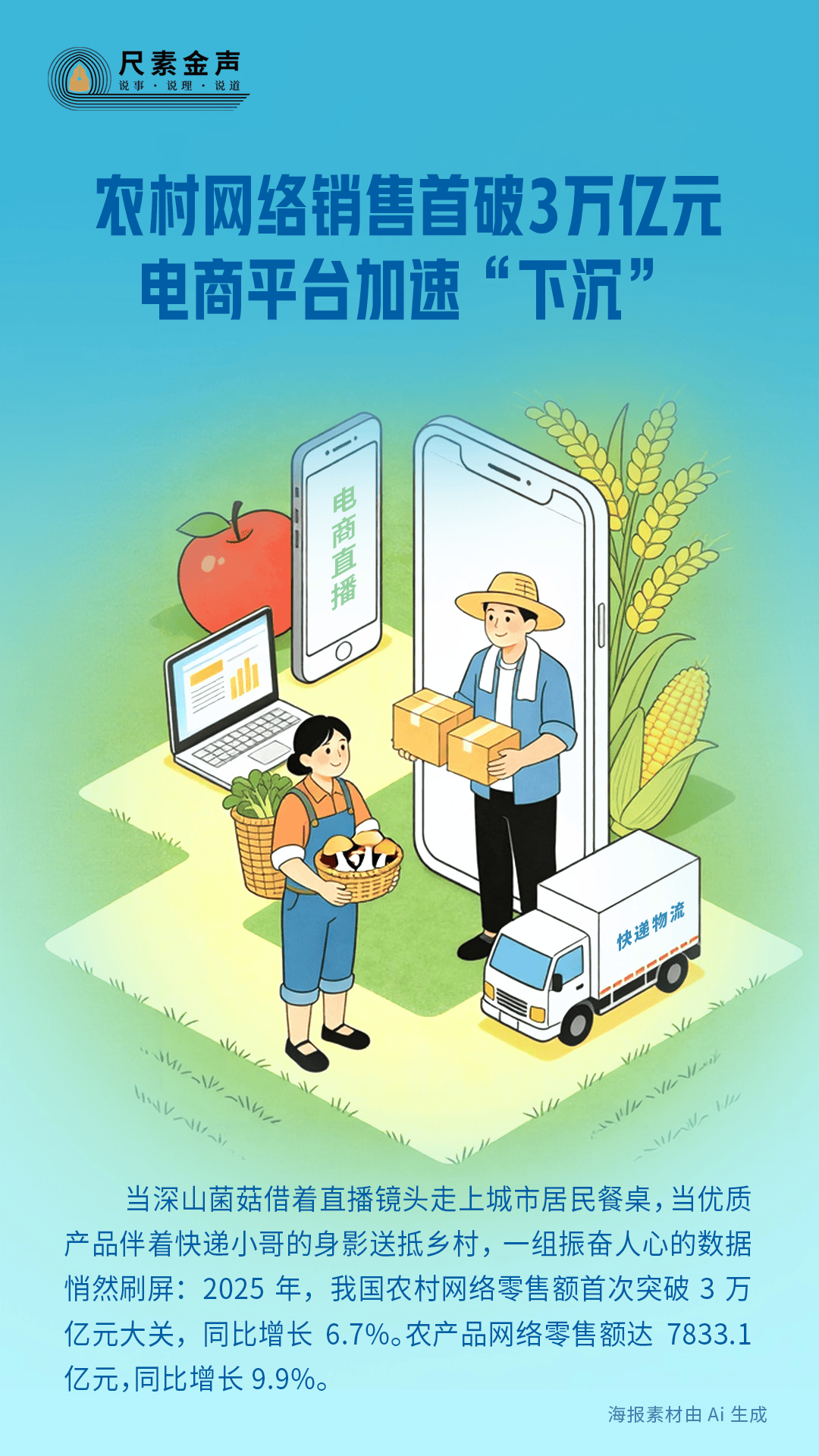
农村网络销售首破3万亿元,电商平台加速“下沉”
Xin Lang Cai Jing· 2026-02-13 14:17
Core Insights - The rural e-commerce sector in China is projected to surpass 3 trillion yuan in retail sales by 2025, marking a year-on-year growth of 6.7%, with agricultural product online sales reaching 783.31 billion yuan, a 9.9% increase [1][4] Group 1: Policy Support - The significant growth in rural e-commerce is attributed to precise policy support, including initiatives from 17 government departments aimed at enhancing county-level commercial systems and ensuring logistics accessibility [4][5] - Policies such as "Digital Commerce Promotes Agriculture" are being implemented to cultivate new rural business leaders and strengthen agricultural brand development, creating a conducive environment for rural online retail [4][5] Group 2: Infrastructure Development - Continuous improvement in rural infrastructure has been crucial for e-commerce growth, with logistics challenges being addressed through upgraded commercial service centers and widespread coverage of village-level express delivery points [5] - The application of digital technologies like 5G and big data in rural areas is facilitating skills training for farmers, enabling them to engage in live streaming sales and store operations, thus integrating digital economy tools into agriculture [5] Group 3: Market Dynamics - The vibrant activity of various market players, including e-commerce platforms and traditional stores, is enhancing the diversity and quality of rural online retail, with products from different regions reaching urban consumers [5][6] - The success of rural e-commerce is not only meeting urban demand for quality agricultural products but also providing employment opportunities and income growth for farmers [5][6] Group 4: Future Outlook - The achievement of surpassing 3 trillion yuan in rural online retail sales is seen as a new starting point, with ongoing challenges in e-commerce talent and brand influence in rural areas [6] - Continued policy guidance and market-driven approaches are expected to further enhance rural distribution networks and support the growth of market entities, unlocking new potential in rural e-commerce [6]
正元智慧:治理结构稳健,经营持续向好,坚定迈向高质量发展新阶段
Quan Jing Wang· 2026-02-13 11:25
Group 1 - The recent announcement by Zhengyuan Zhihui (300645.SZ) regarding judicial matters related to its actual controller does not affect the company's equity structure, governance mechanism, or daily operations [1] - The resolution of these matters clarifies long-standing uncertainties, improves the credit environment, alleviates pressure from major shareholder pledges, and creates favorable conditions for the gradual release of the company's operational and developmental potential [1] - The company has systematically completed board restructuring, legal representative changes, and the transition of the chairman's position since April 2025, ensuring compliance with the Company Law and internal regulations [1] Group 2 - Zhengyuan Zhihui's business structure has been continuously optimized, with significant advantages in digital technology integration and application innovation, providing a solid foundation for long-term development [2] - The Q3 2025 report shows operating cash inflow of 994 million yuan, a year-on-year increase of 15.58%, indicating the effectiveness of the company's "soft and hard integration" technology capabilities [2] - The company's net profit attributable to shareholders reached 25.56 million yuan in Q3 2025, a substantial increase of 37.2%, with a 69.0% growth in non-recurring net profit, reflecting improved profitability and operational quality [2]
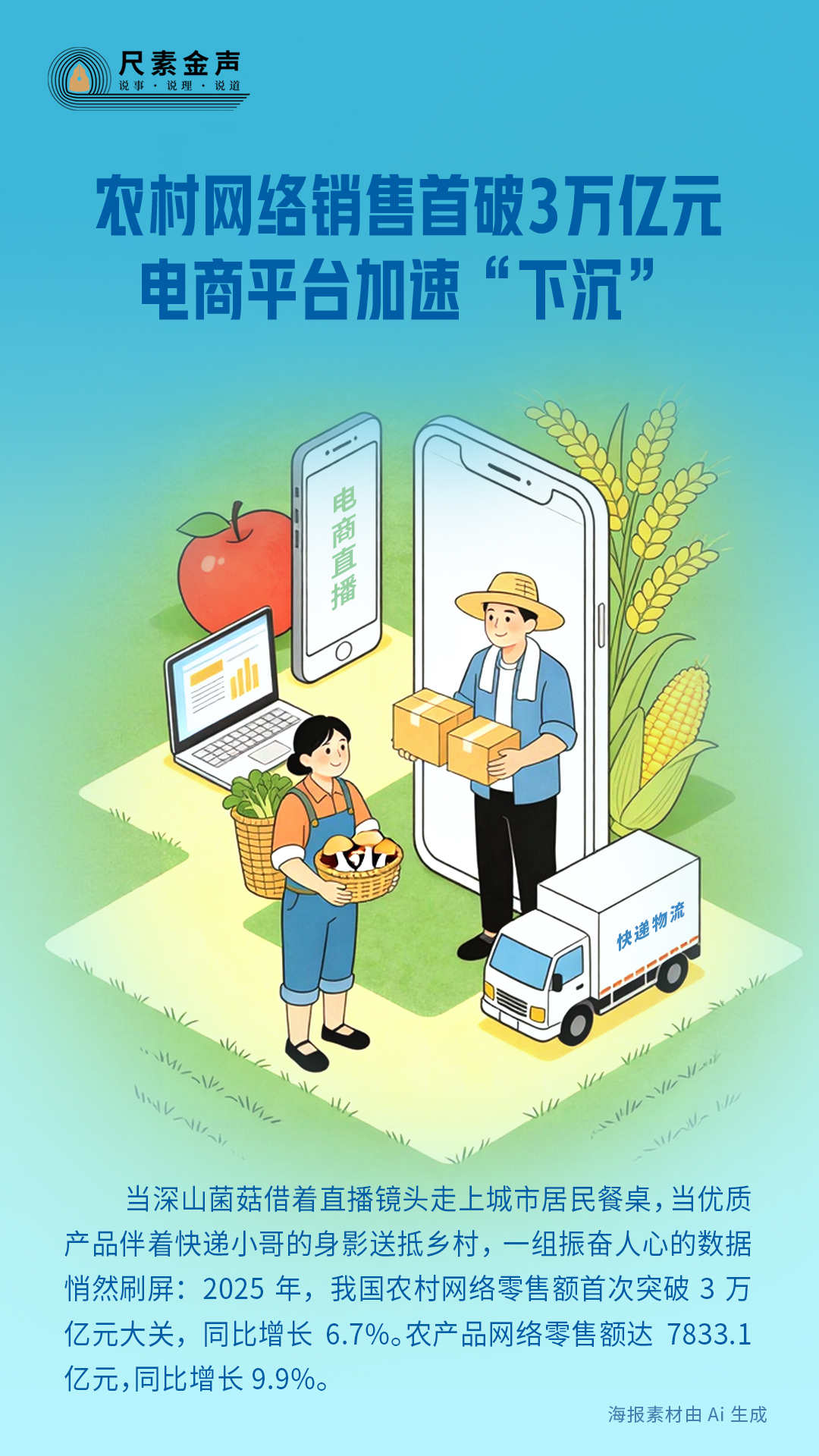
尺素金声|农村网络销售首破3万亿元,电商平台加速“下沉”
Sou Hu Cai Jing· 2026-02-13 05:50
Core Insights - The rural e-commerce sector in China is projected to surpass 3 trillion yuan in retail sales by 2025, marking a year-on-year growth of 6.7%, with agricultural product online sales reaching 783.31 billion yuan, a 9.9% increase [1][4]. Group 1: Policy Support - The significant growth in rural e-commerce is attributed to precise policy support, including initiatives from 17 government departments aimed at enhancing county-level commercial systems and ensuring logistics accessibility [4][5]. - Policies such as "Digital Commerce Promotes Agriculture" have been implemented to cultivate new rural business leaders and strengthen agricultural brand development, creating a conducive environment for rural online retail [4][5]. Group 2: Infrastructure Development - Continuous improvement in rural infrastructure has been crucial for e-commerce growth, with logistics challenges being addressed through upgraded commercial service centers and widespread coverage of village-level express delivery points [5]. - The application of digital technologies like 5G and big data in rural areas has facilitated skills training for farmers, enabling them to engage in live streaming sales and online store management [5]. Group 3: Market Dynamics - The vibrant activity of various market players, including e-commerce platforms and traditional stores, has enriched the rural online retail landscape, enhancing product quality and diversity [5][6]. - High-quality agricultural products from different regions are now reaching urban consumers through e-commerce, fulfilling the demand for premium goods while providing farmers with local employment opportunities and increased income [5][6]. Group 4: Future Outlook - The achievement of surpassing 3 trillion yuan in rural online retail sales is seen as a new starting point, with ongoing challenges in e-commerce talent and brand influence in rural areas [6]. - Continued policy guidance and market-driven approaches are expected to further enhance rural circulation networks and support the growth of market entities, unlocking new potential in rural online retail [6].