
科技自立自强

Search documents
系列财税“组合拳”持续支持科技自立自强
Ke Ji Ri Bao· 2026-01-21 00:04
Group 1 - The core viewpoint of the article emphasizes the effectiveness of the 2025 fiscal policy in supporting current economic growth while promoting long-term structural transformation for sustainable development [1] - The Ministry of Finance plans to utilize various policy tools, including funding support, tax incentives, and government procurement, to foster technological innovation and industrial integration [1][2] - Central government technology spending increased by 10%, significantly outpacing the growth of the general public budget, with total R&D investment expected to reach 3.63 trillion yuan in 2024, maintaining the world's second position [1][2] Group 2 - The Ministry of Finance is implementing tax incentives to reduce the tax burden on enterprises engaged in technological innovation, facilitating access to financing for small and medium-sized enterprises [2][3] - A collaborative innovation model in government procurement is being promoted, along with insurance compensation policies for first-time products, to enhance the commercialization of innovative results [2] - The Ministry of Finance will continue to adopt a more proactive fiscal policy in 2026, focusing on increasing total expenditure while ensuring the quality and effectiveness of spending [2]
刘少山:国际科技体系正出现三大变化
Huan Qiu Wang Zi Xun· 2026-01-20 23:14
Core Viewpoint - The article emphasizes the importance of technological development in the context of China's "14th Five-Year Plan," highlighting the goal of significantly improving the level of technological self-reliance and innovation as a core national strategy [1] Group 1: Changes in the International Technology System - The current international technology system, which has been dominated by a single country for a long time, is facing significant challenges due to profound changes in global technological power dynamics and international development trends [2] - The public nature of technology rules is weakening, with an increasing trend towards tool-based approaches, as some countries impose export controls and compliance reviews, raising the costs of international technological collaboration [3] - The focus of international technological discourse is shifting from technical capabilities to rule-making and platform dominance, with a few Western countries controlling key academic evaluation systems and standards, limiting the influence of emerging technological powers [3] Group 2: Needs of Developing Countries - There is a rising demand from global South countries for fair and sustainable technological cooperation, as many developing nations face high entry barriers and unstable cooperation mechanisms in the context of rapid digitalization and intelligence [4] - If the international technology system continues to operate with high barriers and a closed nature, it will not only fail to meet the development needs of these countries but also hinder the long-term healthy development of the technology system [4] Group 3: China's Role in the International Technology System - In this context, China's stronger leadership in the international technology system is both necessary and reasonable, aiming to provide more open, compatible, and sustainable rules and platforms for international technological cooperation [4] - China has made significant advancements in several key areas, achieving global influence in certain technologies, indicating that it is no longer just a follower but a competitor in core fields [4] - The core challenge lies not only in technical capabilities but also in effectively translating these advantages into rule-making influence, necessitating active participation in standard-setting and governance [5][6]
影响市场重大事件:嫦娥六号月球样品中首次发现天然单壁碳纳米管与石墨碳;财政部支持国家创业投资引导基金投早、投小、投长期、投硬科技
Mei Ri Jing Ji Xin Wen· 2026-01-20 22:30
Group 1 - The discovery of naturally occurring single-walled carbon nanotubes and graphite carbon in lunar soil samples by a research team from Jilin University provides key data for understanding the Moon's geological history and highlights the Moon's active geological processes [1] - The average profit growth rate of China's technology sector is expected to rise from -3% in previous years to +25%, which is seen as a critical factor supporting the sustained improvement of the A-share market [2] - The Shanghai International Energy Exchange has announced adjustments to the margin ratios and price fluctuation limits for international copper futures contracts, effective January 22, 2026 [3] Group 2 - Shanghai has released an action plan with 18 measures aimed at enhancing the resource allocation capabilities and global pricing influence of non-ferrous metal commodities [4] - The social media platform X has officially open-sourced its recommendation algorithm, which now relies heavily on AI to filter, score, and rank content based on user interaction history [5] - The first subject implanted with Neuralink's brain-machine interface has reported that the device can now receive over-the-air (OTA) updates, similar to Tesla vehicles [6] Group 3 - According to TrendForce, the shipment share of ASIC AI servers is projected to increase to 27.8% by 2026, marking the highest level since 2023, driven by the expansion of self-developed ASIC solutions by North American companies [7] - The Ministry of Finance has announced financial support for technology innovation loans, including interest subsidies and central bank refinancing, to promote the transformation of manufacturing and digitalization of small and medium-sized enterprises [8] - Morgan Stanley's report indicates that the high bandwidth memory (HBM) market has entered its fourth year of growth, with structural shortages expected to continue until 2028, driven by increasing demand from AI and high-performance computing [9] - The Ministry of Finance is committed to supporting the National Venture Capital Guidance Fund to invest early, small, long-term, and in hard technology sectors, focusing on original and disruptive technological advancements [10]

广州成第三个消费外贸“双万亿”城市 今年GDP预期目标为增长5%左右
Nan Fang Ri Bao Wang Luo Ban· 2026-01-20 10:00
1月19日,广州市第十六届人民代表大会第六次会议开幕。会上,广州市政府工作报告总结了过去一年 广州的发展成就,并对今年的各领域工作划出重点。报告提到,广州已成为全国第三个消费、外贸"双 万亿"城市。 面向"十五五",广州如何跑好关键一程?报告提出了"十五五"时期发展目标和重点任务。 根据《广州市国民经济和社会发展第十五个五年规划纲要(草案)》(下称《草案》),到2030年,创 新、宜居、美丽、韧性、文明、智慧的现代化人民城市建设取得重要进展,"6+4"城市性质和核心功能 进一步强化,老城市新活力、"四个出新出彩"取得显著成效,高质量发展领头羊和火车头作用充分彰 显,基础设施、产业发展、科教人才新优势全面提升,引领型国家中心城市、开放型大湾区核心引擎、 高能级省会城市功能持续强化,经济实力、科技实力、城市综合竞争力和国际影响力跃上新台阶,人均 地区生产总值达到世界中等发达国家水平,率先基本实现社会主义现代化。《草案》还提出,广州将努 力在七个方面增创新优势、实现新突破,包括建设"12218"现代化产业体系、推动高水平科技自立自 强、以大湾区建设牵引改革开放、推动城市内涵式发展、提升城市文化综合实力、推进民生社会 ...
财政部答21:科技创新类贷款给予贴息,结构性减税降费重点支持
2 1 Shi Ji Jing Ji Bao Dao· 2026-01-20 09:45
Core Viewpoint - The Chinese government is implementing a series of fiscal policies to support technological innovation and high-quality economic development, with a focus on achieving technological self-reliance and fostering new growth drivers by 2025 [1][2]. Group 1: Fiscal Policy Measures - The central government's technology expenditure increased by 10%, significantly higher than the general public budget expenditure growth, with a focus on basic research and national strategic technology tasks [1]. - In 2024, total R&D investment is projected to reach 3.63 trillion yuan, maintaining China's position as the second-largest R&D investor globally [1]. Group 2: Innovation Cost Reduction - The government is implementing tax incentives across multiple innovation stages to reduce the tax burden on enterprises, supporting 34,400 companies in obtaining over 140 billion yuan in bank loans, with comprehensive financing costs dropping below 5% [2][3]. Group 3: Innovation Results Transformation - The government is promoting a collaborative innovation model in procurement, enabling more innovative results to transition from laboratories to production lines, leading to a multiplier effect in value creation [2]. - China is recognized as one of the fastest-growing economies in terms of innovation, with a goal to enter the top 10 in the global innovation index by 2025 [2]. Group 4: Future Focus Areas - The government will leverage investment funds to support early-stage, small, long-term investments in hard technology, focusing on original and disruptive technological breakthroughs [3]. - There will be enhanced financial support for key industries, including interest subsidies for loans related to technological innovation, and continued promotion of digital transformation in manufacturing [3]. - Policies will be implemented to strengthen the role of enterprises in technological innovation, including structural tax reductions and support for specialized small and medium-sized enterprises [3]. - The government aims to accelerate the efficient transformation and application of major technological achievements, continuing to support the iteration and promotion of qualifying innovative products [3]. Group 5: Loan Subsidy Policy - A joint announcement from five government departments outlines a loan interest subsidy policy for small and micro enterprises, targeting 14 key industries, with a subsidy rate of 1.5% on total loan amounts for a maximum period of two years [4][5].
20cm速递|关注科创创业ETF(588360)投资机会,科创板块结构性机会显著,回调或可布局
Mei Ri Jing Ji Xin Wen· 2026-01-20 06:33
Core Viewpoint - The recent decline of over 2.5% in the Sci-Tech Innovation and Entrepreneurship ETF (588360) presents significant structural opportunities in the Sci-Tech sector, suggesting that this pullback may be a good time for investment [1]. Group 1: Market Conditions - According to Dongfang Securities, Sci-Tech enterprises are currently in a strong prosperity cycle amid a capital expenditure cycle [1]. - Overall domestic liquidity is ample, with funds concentrating on high-prosperity sectors, indicating a prevalence of structural opportunities [1]. Group 2: Strategic Focus - Bank of China International highlights that the year marks the beginning of the "14th Five-Year Plan," with technological self-reliance and advanced manufacturing expected to be core themes [1]. - The technology sector needs to shift towards systematic allocation, covering key core technologies and high-end manufacturing across multiple directions [1]. - Advanced manufacturing is set to upgrade to a multi-layered system, focusing on future industry layouts [1]. Group 3: ETF Overview - The Sci-Tech Innovation and Entrepreneurship ETF (588360) tracks the Sci-Tech Innovation 50 Index (931643), which has a daily price fluctuation limit of 20% [1]. - This index selects 50 listed companies with larger market capitalizations and better liquidity from the Sci-Tech Board and the Growth Enterprise Market, reflecting the overall performance of securities related to technological innovation [1]. - The index sample covers multiple industries, including information technology and healthcare, aiming to highlight the innovation capabilities and growth potential of enterprises [1].
俄罗斯没想到,美国更没想到,中国几乎所有“关键”技术遥遥领先
Sou Hu Cai Jing· 2026-01-20 05:08
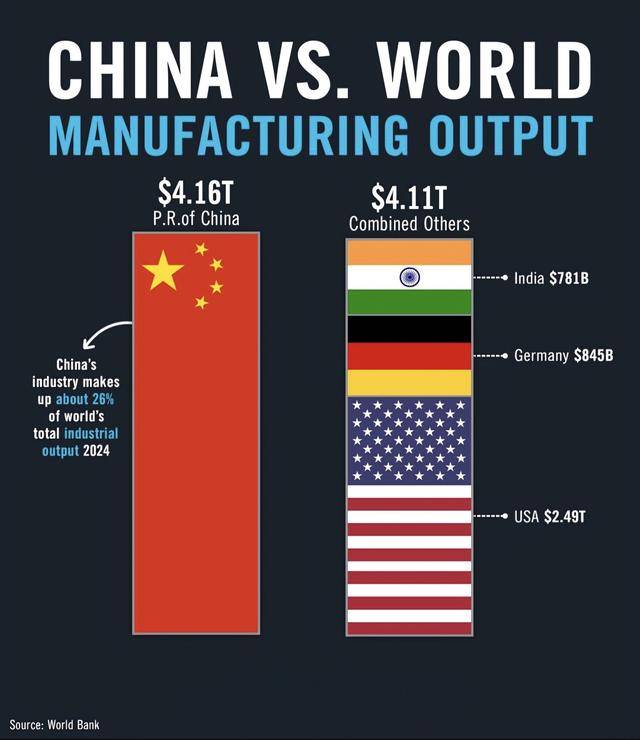
Core Insights - China's manufacturing sector is experiencing significant growth, with its value-added manufacturing output expected to account for 30% of the global total by 2025, marking 15 consecutive years at the top [1][3] - The U.S. manufacturing sector is facing challenges, with the Purchasing Managers' Index (PMI) indicating contraction for eight consecutive months, reflecting broader economic issues [11][13] Group 1: Manufacturing Strength - China's manufacturing value-added output during the 14th Five-Year Plan period is projected to increase by 8 trillion yuan, contributing over 30% to global manufacturing growth [3][5] - China leads in the production of most of the 504 major industrial products globally, showcasing its manufacturing scale advantage [3][5] - The high-tech manufacturing sector in China is expected to grow by 8.9% in 2024, with significant growth in aerospace and electronic equipment manufacturing [5] Group 2: Technological Advancements - The Jiangmen neutrino experiment is the world's first large-scale, high-precision neutrino facility, enhancing measurement precision by 1.5 to 1.8 times compared to previous international standards [7][22] - China is advancing in quantum computing with the "Zuchongzhi 3" superconducting quantum computing prototype, outperforming the fastest supercomputers in specific tasks [7] - The DeepSeek-R1 AI model has achieved performance comparable to leading global models with minimal computational resources, indicating a shift in AI research dynamics [7] Group 3: Global Positioning - China is the only country with all industrial categories recognized by the United Nations, demonstrating its comprehensive industrial capabilities [5][9] - The country has established 33 national-level manufacturing innovation centers, focusing on breakthroughs in key technologies [9][15] - China's innovation index has risen to the top ten globally, with the Shenzhen-Hong Kong-Guangzhou cluster ranking first [11][22] Group 4: Challenges in the U.S. and Europe - The U.S. manufacturing PMI fell to 48.7 in October 2025, indicating ongoing contraction due to trade uncertainties and high costs stemming from tariffs [11][13] - European manufacturing is stagnating, with declining export orders and structural issues hindering innovation and digital transformation [13][15] - The energy-intensive manufacturing sector in Europe faces rising costs exacerbated by geopolitical tensions, further limiting growth [13][15]

津电:深化体制机制改革 加速科技自立自强
Xin Lang Cai Jing· 2026-01-20 03:29
Core Viewpoint - The company, Tianjin Electric, has achieved significant operational improvements during the 14th Five-Year Plan period, with a focus on strategic governance, innovation mechanisms, and talent management to drive high-quality development [2][3][4]. Strategic Leadership and Mechanism Innovation - During the 14th Five-Year Plan, Tianjin Electric's operating performance has more than doubled compared to the beginning of the period, with core operating indicators surpassing expectations [2]. - The company has established a new strategic governance framework led by the party committee, with a complete management system for research, planning, implementation, and evaluation [2]. - An integrated product development (IPD) model has been introduced to enhance agile R&D capabilities, significantly improving R&D efficiency and success rates [2]. - A value creation-oriented distribution mechanism has been implemented, linking employee benefits closely with corporate value and individual contributions [2]. Comprehensive Breakthrough and Industrial Synergy - Over the past five years, Tianjin Electric has made historic strides in market expansion, achieving key system qualifications across all major models [3]. - The company has made breakthroughs in the defense market, contributing to significant projects such as the Long March rocket and naval fleet support [3]. - In the civil aviation sector, Tianjin Electric has transitioned from a follower to a competitor, with products for key national models like C919 and AG600 now in operation [3]. Technological Leadership and Innovation Drive - Tianjin Electric has achieved systematic breakthroughs in technology innovation, completing 176 innovation projects and overcoming 435 key technical challenges over five years [4]. - The company has established a technology and product asynchronous development model, enhancing decision-making efficiency and quality [4]. - Significant achievements in standardization include the formulation of 5 ISO international standards and 5 national military standards during the 14th Five-Year Plan [4]. Digital Integration and Manufacturing Upgrade - The company has advanced its digital transformation, establishing five digital assembly production lines and implementing various core information systems [6]. - Lean management practices have led to a more than 30% reduction in production cycles for major product lines, generating substantial economic benefits [6]. Quality Foundation and Supply Chain Enhancement - Tianjin Electric has deepened its supply chain system construction, significantly compressing supply chain cycles and enhancing responsiveness [7]. - The company has achieved various quality certifications, improving process control capabilities and ensuring compliance with industry standards [7]. - A comprehensive information system has been developed to support R&D, manufacturing, management, and decision-making processes [7].
平安证券(香港)港股晨报-20260120
Ping An Securities Hongkong· 2026-01-20 02:43
Market Overview - The Hong Kong stock market experienced a decline, with the Hang Seng Index closing at 23,831 points, down 145 points or 0.61% [1] - The market turnover decreased to 82.799 billion, with net inflows of 484 million from the Stock Connect [1] - The technology sector remains a key focus, with expectations for long-term growth opportunities in AI applications and self-reliance in technology [3] Company Performance - The report highlights the performance of leading companies in the sports apparel sector, specifically Li Ning, which saw a 2.9% increase in stock price [3] - Li Ning's revenue for the first half of 2025 reached 14.817 billion, a year-on-year increase of 3.3%, with a gross margin of 50% [9] - The report suggests that Li Ning's brand strength is recovering, particularly in the running category, where it holds a 15% market share in China [9] Investment Recommendations - The report recommends focusing on sectors supported by government policies, including AI, semiconductors, and industrial software [3] - It also suggests monitoring consumer sectors benefiting from domestic demand expansion, such as sports apparel and non-essential services [3] - The report emphasizes the value of state-owned enterprises with low valuations and high dividends, as well as upstream non-ferrous metals benefiting from anticipated interest rate cuts by the Federal Reserve in 2026 [3]
国有企业质量效益全面提升
Sou Hu Cai Jing· 2026-01-19 23:16
Core Viewpoint - The meeting held by the State-owned Assets Supervision and Administration Commission (SASAC) highlighted the significant improvements in the quality and efficiency of state-owned enterprises (SOEs) during the 14th Five-Year Plan period, with total assets of regulated enterprises increasing from 235 trillion yuan to 387 trillion yuan, reflecting an average annual growth of 10.5% [1] Group 1: Enhancements in Enterprise Competitiveness - By November 2025, local regulated enterprises achieved a value-added of 6.9 trillion yuan and completed fixed asset investments of 5.3 trillion yuan, contributing positively to economic growth and public welfare [2] - SASAC Director Zhang Yuzhuo emphasized the continuous strengthening of technological innovation within SOEs, with 16 local SASACs establishing evaluation systems for R&D input and output [2] - Traditional industries are undergoing quality upgrades while emerging industries are being nurtured, with provinces like Henan and Shandong implementing strategic plans for transformation and development [2] Group 2: Reform and Governance Improvements - The deepening of SOE reforms has led to optimized governance structures and improved market mechanisms, with local governments actively promoting reform initiatives [3] - The effectiveness of state asset supervision has been enhanced, with the establishment of a national property information database and comprehensive coverage of property registration systems [3] - Over the past five years, SOEs have seen increased vitality and competitiveness, contributing significantly to national strategies and infrastructure development [3] Group 3: Focus on Quality and Efficiency - The quality and efficiency of SOEs are crucial for the overall economic and social development of China, with a focus on creating value and improving operational metrics [4] - Key objectives for the 15th Five-Year Plan include enhancing value creation, technological innovation, and industrial upgrading capabilities [4][5] - Emphasis is placed on reform breakthroughs, strengthening party leadership, and ensuring effective governance to support high-quality development [5] Group 4: Future Development Directions - For 2026, SOEs are expected to focus on quality enhancement and steady growth, with initiatives to create new consumption scenarios and implement key projects to stimulate demand [6] - Strengthening the role of SOEs in technological innovation and optimizing the economic layout and structure are prioritized [6][7] - Local SASACs are urged to implement further reforms and improve market-oriented operational mechanisms while preventing systemic risks [7]