
汽车电动化

Search documents
奔驰价格崩了,最低只要12万,多地门店「人去楼空」
3 6 Ke· 2025-08-07 02:47
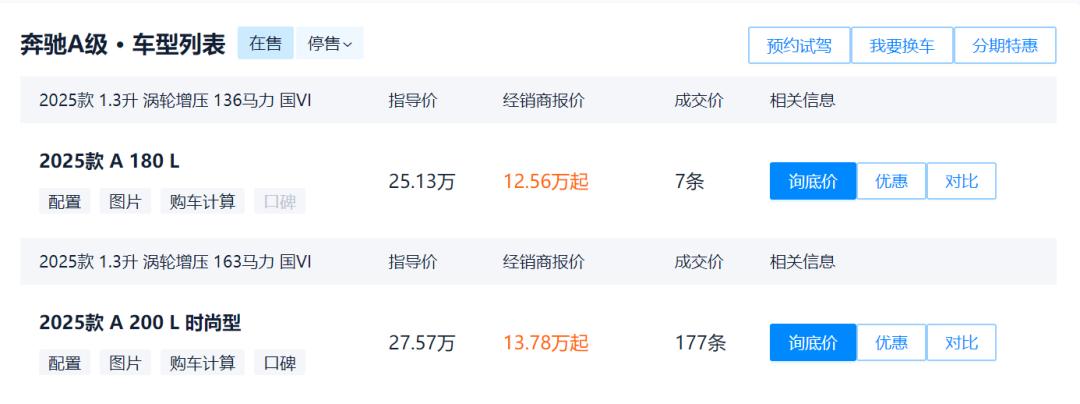
Core Viewpoint - Mercedes-Benz is facing significant challenges in the Chinese market, with drastic price reductions on multiple models and a notable decline in sales and profits, leading to the closure of several dealerships [1][13][14]. Pricing and Sales Performance - Recent price cuts for models such as the A-Class and C-Class have seen discounts of up to 50%, with the A-Class being offered at a low of 125,600 yuan compared to its original price of 251,300-275,700 yuan [2][3]. - The company's revenue for the first half of 2025 was reported at 66.377 billion euros, a year-on-year decline of 8.6%, with a staggering 55.8% drop in net profit [13][14]. - In the Chinese market, sales fell by 14% to 293,200 units in the first half of 2025, marking it as the largest decline globally for Mercedes-Benz [13][14]. Dealership Closures - Multiple dealerships in cities such as Tangshan, Dongying, and Luoyang have closed, attributed to business adjustments and authorization terminations [5][6][8]. - The closures have led to customer concerns regarding service continuity and rights, as many customers find themselves unable to access previously purchased services [6][9]. Customer Experience and Technology Issues - Customers have expressed dissatisfaction with the company's lag in smart technology and the introduction of fees for features that were previously included, such as remote control and navigation services [8][12]. - The company is reportedly expanding its R&D team in China to address the technological gap, particularly in software and smart cockpit development [8]. Market Position and Future Outlook - The decline in sales is partly due to the company's heavy reliance on traditional fuel vehicles, while the market is shifting towards electric vehicles, which have seen a significant increase in sales [14]. - The overall market environment shows that new energy vehicles accounted for over 44% of total vehicle sales in China, highlighting the urgency for Mercedes-Benz to adapt [14].

恒帅股份20250806
2025-08-06 14:45
Summary of the Conference Call for Hengshuai Co., Ltd. Industry and Company Overview - Hengshuai Co., Ltd. specializes in the automotive cleaning systems and micro-motor industry, covering four main modules: motors, electric modules, driving vision cleaning systems, and thermal management [2][4] - The company is controlled by Yu Guomei and Xu Ningning, who hold a combined 71.5% of the shares [6] Financial Performance - In 2024, Hengshuai achieved a revenue of 960 million yuan, representing a 4% year-on-year increase [2][7] - The net profit attributable to shareholders was 210 million yuan, up 6% year-on-year [2][7] - The micro-motor segment contributed the largest revenue share, accounting for 45% of total revenue [7] - Non-mainland China business revenue constituted 39% of total income [7] - Gross margin was 34.8%, down 1.5 percentage points year-on-year, while net profit margin improved by 0.3 percentage points to 22.2% [2][7] Market Trends and Growth Opportunities - The automotive micro-motor market is expected to grow from 16.6 billion USD in 2024 to 20.4 billion USD by 2031, with a compound annual growth rate (CAGR) exceeding 3% [2][8] - The demand for micro-motors in electric vehicles (EVs) is significantly higher than in traditional fuel vehicles, with an average of 115 micro-motors per high-end EV compared to 10-60 in fuel vehicles [8] Product Development and Future Directions - Hengshuai plans to enter the humanoid robot motor sector, leveraging its advanced harmonic magnetic field modulation technology, which is expected to see a CAGR of over 1,000% from 2025 to 2027 [4][12] - The company has filed multiple patents related to harmonic magnetic field modulation motors and is focusing on core materials like rare earth magnetic materials to enhance its technological depth and cost control [4][12] - Projected net profits for 2025, 2026, and 2027 are 240 million yuan, 290 million yuan, and 390 million yuan, respectively, with a three-year CAGR of 27.6% [3][4][12] Client Base and Collaborations - Hengshuai has a diverse client base, including major automotive companies such as BMW, Ford, and SAIC General, and has established partnerships for its ADAS active perception cleaning systems with companies like Weimar and Meituan [2][10][9] Additional Insights - The company has successfully developed an ADAS active perception cleaning system, which is increasingly in demand as the penetration rate of L2 and above vehicles in China is expected to reach 62% by 2025 [10] - The company has expanded its product offerings to include "motor + actuator" solutions in areas like invisible door handles and charging ports, indicating a strategy to explore new product opportunities [9]
观车 · 论势 || 汽车产量“第一省”选择向内发力
Zhong Guo Qi Che Bao Wang· 2025-08-06 01:30
Core Viewpoint - The establishment of the Anhui Province New Energy and Intelligent Connected Vehicle Industry Development Association marks a significant step towards high-quality development in the automotive industry, particularly in the context of the province's recent achievements in automotive production and sales [3][4]. Group 1: Industry Growth and Achievements - In the first half of 2023, Anhui Province's automotive and new energy vehicle production ranked first in the country, with the automotive industry chain's revenue surpassing 1 trillion yuan for the first time [3]. - The revenue is projected to exceed 1.5 trillion yuan in 2024, maintaining a growth rate of over 20% for two consecutive years [3]. - The number of new energy vehicles in Anhui has surged from 27,000 to 1.076 million over the past four years, with a penetration rate reaching 41% [3]. Group 2: Association's Role and Objectives - The association was founded by seven local companies, including Chery Automobile and NIO, and aims to engage in research, production, development, application, and service activities related to new energy and intelligent connected vehicles [3][4]. - The association is expected to act as a bridge between the government, industry, and enterprises, promoting collaboration and maintaining the industry ecosystem [3][4]. Group 3: Challenges and Industry Dynamics - Despite the growth, the automotive industry faces challenges such as overcapacity, with the national automotive manufacturing capacity utilization rate dropping to 71.3% in the second quarter of this year [4][5]. - The association's establishment is seen as a strategic move to enhance resource allocation efficiency and address the issue of fragmented competition among local automotive companies [5][6]. - The automotive industry's revenue now accounts for over 15% of Anhui's GDP, but the research and development intensity is only 60% of that in Guangdong, indicating a need for improvement in innovation and self-sufficiency in key components [6].

财经观察:日本汽车电动化,由中美车企引领?
Huan Qiu Shi Bao· 2025-08-05 22:38
Core Viewpoint - The article highlights that Chinese and American electric vehicle (EV) companies, represented by Tesla and BYD, are rapidly expanding their presence in Japan, while Japanese automakers are lagging in the electrification trend, which could lead to a loss of market share for them [1][4]. Group 1: Expansion of Chinese and American EV Companies - Tesla plans to increase its stores in Japan from 23 to 50 by the end of 2026 and is focusing on its Model 3 and Model Y in the Japanese market [1][3]. - BYD aims to grow its store count in Japan from 63 to 100 by 2025 and plans to introduce electric vehicles in the light vehicle sector by the second half of 2026 [3][10]. - As of June, imported electric vehicles, including those from Tesla and BYD, accounted for approximately 75% of total electric vehicle sales in Japan [3][4]. Group 2: Challenges Faced by Japanese Automakers - Japanese automakers are experiencing delays in their electrification efforts, which is affecting their competitiveness in both domestic and international markets [4][5]. - Factors contributing to the slow adoption of electric vehicles in Japan include high electricity costs due to reliance on thermal power, which diminishes the cost advantage of electric vehicles over traditional fuel vehicles [6][8]. - The traditional internal combustion engine industry in Japan, with over a century of development, poses a significant barrier to the transition to electric vehicles, risking job losses and economic disruption [7][8]. Group 3: Consumer Preferences and Market Dynamics - Consumer preferences in Japan show a reluctance to adopt electric vehicles, with only about 14% of consumers indicating a willingness to purchase them by 2024 [8][10]. - The lack of charging infrastructure, high purchase prices, and concerns over battery safety contribute to the slow uptake of electric vehicles in Japan [8][9]. - Japanese automakers are focusing on hybrid vehicles rather than fully electric models, as they have historically excelled in fuel-efficient internal combustion engine technology [9][10]. Group 4: Strategic Adjustments by Japanese Automakers - Companies like Honda are reducing their investment in electrification from 10 trillion yen to 7 trillion yen, emphasizing hybrid models instead [10][11]. - Nissan plans to start exporting electric vehicles from China to various global markets in 2026 to improve its performance [11].


业绩承压!宝马2025年上半年净利润同比暴跌29%
Xi Niu Cai Jing· 2025-08-05 14:07
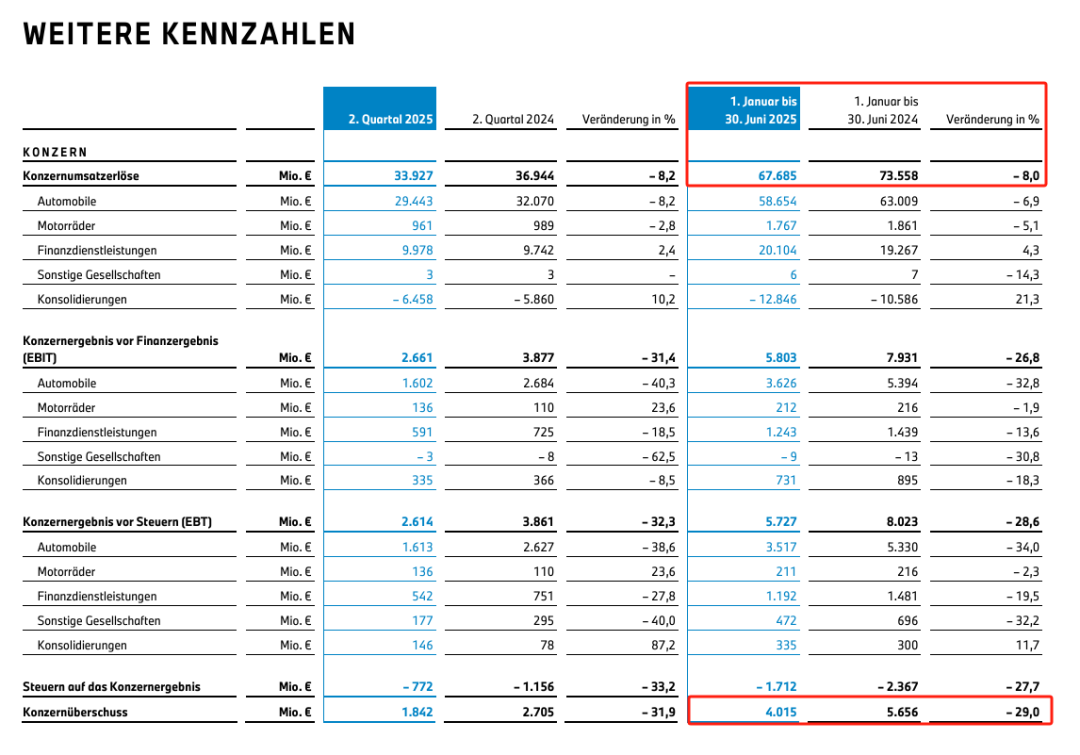
Core Insights - BMW Group reported a significant decline in financial performance for the first half of 2025, with sales revenue dropping by 8% to €67.7 billion and net profit falling by 29% to €4 billion, marking a recent low [1][2] - The second quarter of 2025 saw a sales revenue of €33.9 billion, down 8.2% year-on-year, and an EBIT of €2.66 billion, which represents a 31.4% decrease compared to the previous year [1][2] - Global deliveries in the second quarter increased slightly by 0.4% to 621,500 units, but profitability faced significant pressure [1] Financial Performance - Total sales revenue for the automotive segment in Q2 2025 was €29.4 billion, down 8.2% from €32.1 billion in Q2 2024 [2] - EBIT for the automotive segment fell by 40.3% to €1.6 billion in Q2 2025, compared to €2.7 billion in Q2 2024 [2] - The overall net profit for the group in Q2 2025 was €1.84 billion, a decrease of 31.9% from €2.7 billion in Q2 2024 [2] Market Performance - Europe remains BMW's largest market, with a cumulative sales volume of 497,800 units in the first half of 2025, reflecting an 8.2% year-on-year increase [2] - North American sales reached 237,200 units, up 3.4% year-on-year, while Asian market sales declined by 11.1% to 438,300 units, with China experiencing a 15.5% drop [2] - The decline in the Chinese market is attributed to the rise of local brands in the fields of new energy and smart technology, which are increasingly capturing BMW's market share [2] Electric Vehicle Performance - BMW delivered 318,900 electrified vehicles in the first half of 2025, marking an 18.5% increase and accounting for 26.4% of total deliveries [3] - The European market showed strong growth in electric and plug-in hybrid vehicles, with a 34.8% increase, driven by models like the i4, iX1, and iX [3] - However, BMW's electric vehicle offerings in China are lagging behind local competitors, impacting their market performance [3] Strategic Outlook - BMW's transformation is deemed urgent due to declining profits and sales, with plans to launch over 40 new and updated models by 2027, starting with the BMW iX3 [3] - The NEUE KLASSE platform's first model is set to debut at the IAA Mobility in September, representing a new beginning for the company [3]
上海汽配拟开展车载冰箱业务 预估2033年全球市场规模将达1400亿元
Zheng Quan Shi Bao Wang· 2025-08-05 13:46
Group 1 - Company plans to establish a joint venture focusing on car refrigerator business with Wuhan Reyi, with a registered capital of 20 million yuan, where Shanghai Auto Parts will contribute 12 million yuan (60%) and Wuhan Reyi will contribute 8 million yuan (40%) [1] - The establishment of the joint venture is part of the company's strategy to enhance product structure and diversify its product offerings, which is expected to significantly increase production scale and improve risk resistance and competitiveness [2] - The car refrigerator market is anticipated to experience substantial growth, with the global market size projected to reach 50 billion yuan in 2024 and expand to 140 billion yuan by 2033, reflecting a compound annual growth rate of 11.5% during the forecast period [2] Group 2 - Shanghai Auto Parts' main business includes the research, development, production, and sales of automotive thermal management system components and engine system components, with direct sales accounting for 93% of its main business revenue in 2024 [3] - In 2024, the company achieved a sales revenue of 2.101 billion yuan, a year-on-year increase of 13.72%, and a net profit of 188 million yuan, up 16.75% year-on-year [3] - The automotive thermal management system products generated sales revenue of 1.714 billion yuan, reflecting a year-on-year increase of 15.34%, while engine system products achieved sales revenue of 387 million yuan, up 7.08% year-on-year [3]

公司深度 | 沪光股份:国产线束之光 连接器助力成长【民生汽车 崔琰团队】
汽车琰究· 2025-08-05 04:00
Core Viewpoint - The company is positioned to benefit from the rapid growth of the electric vehicle (EV) market and the ongoing trend of domestic substitution in the automotive wiring harness industry, with projected revenue growth from 2.45 billion to 7.91 billion yuan from 2021 to 2024, reflecting a CAGR of 47.9% [2][24]. Group 1: Industry Growth and Trends - The automotive wiring harness industry is expanding due to the increasing demand for high-voltage and lightweight wiring harnesses driven by the electric vehicle market [4][51]. - The market for automotive wiring harnesses is expected to reach 150.3 billion yuan by 2026 and 216.5 billion yuan by 2030, indicating significant growth potential [4][15]. - The penetration rate of new energy vehicles is projected to reach 50% by 2025, further driving the demand for domestic wiring harness suppliers [64]. Group 2: Customer Structure and Global Strategy - The company has optimized its customer structure, with the revenue share of the top five customers decreasing from 98.7% in 2015 to 80.1% in 2024, indicating a diversification of its client base [3][40]. - The company has successfully entered the supply chains of new energy vehicle manufacturers such as Seres and Tesla, enhancing its revenue potential [13][43]. - The establishment of a subsidiary in Romania has contributed to a significant revenue increase, showcasing the company's successful global expansion strategy [3][24]. Group 3: Product Development and Competitive Advantage - The company is expanding into high-voltage connector products, which are expected to open a second growth curve, with the global automotive connector market projected to reach 23.09 billion dollars by 2025 [4][15]. - The company has a comprehensive product range covering various types of wiring harnesses, including high-voltage and low-voltage harnesses, catering to both traditional and new energy vehicles [19][48]. - Continuous investment in R&D, with expenses rising from 40 million yuan in 2016 to 260 million yuan in 2024, supports the company's technological advancements and product development [28][48]. Group 4: Financial Performance and Profitability - The company's revenue is expected to grow from 7.91 billion yuan in 2024 to 14.11 billion yuan in 2027, with a net profit of 670 million yuan in 2024, reflecting a year-on-year increase of 1,139.2% [7][25]. - The gross profit margin has improved significantly, with a projected gross margin of 17.5% in 2025, narrowing the gap with international competitors [32][33]. - The return on equity (ROE) is expected to reach 35.6% in 2024, indicating strong profitability and efficient asset management [33][48].


【周观点】7月第4周乘用车环比+13.2%,继续看好汽车板块
东吴汽车黄细里团队· 2025-08-04 09:11
Core Viewpoint - The automotive industry is entering a new crossroads phase, with the end of the electric vehicle (EV) dividend and the dawn of automotive intelligence, while robotics innovation is in the 0-1 stage. The recommendation is to increase the allocation weight of "dividend style" investments in the second half of the year [6][8][13]. Weekly Review Summary - In the fourth week of July, the compulsory insurance for vehicles reached 440,000 units, with a week-on-week increase of 13.2% but a month-on-month decrease of 22.8% [3][11]. - The performance of segmented automotive sectors this week ranked as follows: SW commercial cargo vehicles (-0.4%) > SW commercial passenger vehicles (-0.7%) > SW automotive parts (-2.1%) > SW automobiles (-2.4%) > SW motorcycles and others (-2.4%) > SW passenger vehicles (-3.4%) [3][11]. Industry Core Changes - Xiaopeng's new P7 will debut on August 6, with 36,717 new cars delivered in July. - Li Auto launched its first pure electric SUV, the i8, with deliveries starting on August 20. The Pro version is priced at 321,800 yuan, the Max version at 349,800 yuan, and the Ultra version at 369,800 yuan, with 30,731 new cars delivered in July [5][12]. - Zhiji released the "Star" super range extension system, targeting a pure electric CLTC range of over 400 km and a comprehensive CLTC range of 1,500 km. Audi A5L Sportback was officially launched with a starting price of 259,900 yuan [5][12]. - Yutong Bus signed a procurement agreement for 400 pure electric buses with its partner in Pakistan, marking the largest single order for new energy buses in Pakistan [5][12]. Sector Outlook - The automotive sector remains optimistic, focusing on three main lines: dividends, intelligence, and robotics [6][13]. - The market's core focus this week was on the automotive sector, which underperformed the broader market, with heavy trucks performing relatively better. The internal demand for passenger vehicles met expectations, but the performance of new energy vehicles fell short [6][13]. - Recommendations for sector allocation include: - **Dividend & Good Pattern Main Line**: Buses (Yutong Bus), heavy trucks (China National Heavy Duty Truck Group A-H / Weichai Power), two-wheelers (Chunfeng Power / Longxin General), and parts (Fuyao Glass + Xingyu Co., Ltd. + Xinquan Co., Ltd. + Jifeng Co., Ltd.) [8][13]. - **AI Intelligence Main Line**: Preferred passenger vehicles in Hong Kong stocks (Xiaopeng Motors-W / Li Auto-W / Xiaomi Group-W) > A-shares (Seres / SAIC Motor / BYD); preferred parts (Horizon Robotics-W / China Automotive Research / Desay SV / Bertel / Black Sesame Intelligence) [8][13]. - **AI Robotics Main Line**: Preferred parts (Top Group + Precision Forging Technology + Fuda Co., Ltd. + Xusheng Group + Aikodi) [8][13].

恒帅股份(300969):首次覆盖报告:汽车微电机核心企业,有望切入人形机器人电机领域
Western Securities· 2025-08-04 06:19
Investment Rating - The report assigns a "Buy" rating for the company [4]. Core Insights - Hengshuai Co., Ltd. is a leading enterprise in automotive micro-motors and cleaning systems, with steady global expansion. The company primarily focuses on automotive motor technology and fluid technology. In 2024, it is projected to achieve revenue of 960 million yuan, a year-on-year growth of 4.21%, with a CAGR of 29.6% from 2020 to 2024. The net profit attributable to shareholders is expected to reach 210 million yuan, a year-on-year increase of 5.75%, with a CAGR of 34.2% during the same period [1][4][31]. Summary by Sections Automotive Micro-Motor and Cleaning System Leadership - Hengshuai Co., Ltd. has been deeply engaged in the automotive cleaning system and micro-motor industry since its establishment in 2001, continuously enhancing its product matrix and expanding its global footprint [21][22]. - The company has established subsidiaries in various locations since 2019, actively expanding its domestic and international customer base [21][31]. Growth in Automotive Electrification - The trend of automotive electrification is evident, driving rapid growth in the demand for automotive micro-motors. The average usage of micro-motors in mid-to-high-end electric vehicles is significantly higher than in traditional fuel vehicles [50][53]. - The global automotive micro-motor market is expected to reach 20.4 billion USD by 2031, with a CAGR of 3.1% from 2025 to 2031 [60][61]. Advancements in Automotive Intelligence - The report highlights the increasing penetration of intelligent driving technologies, with the demand for ADAS (Advanced Driver Assistance Systems) cleaning systems expected to grow as the number of sensors in vehicles increases [2][71]. - The company has made significant progress in developing ADAS active perception cleaning systems, having secured batch business designations from various clients [79]. Strategic Expansion into Humanoid Robot Motors - Hengshuai Co., Ltd. is strategically positioning itself in the humanoid robot motor market, which is projected to have a market space of 58.3 billion yuan by 2027. The company’s harmonic magnetic field motors are entering the industrial expansion phase, indicating potential growth in this sector [2][80]. Financial Projections - The company is expected to achieve net profits of 239 million, 294 million, and 389 million yuan from 2025 to 2027, representing year-on-year growth rates of 11.8%, 23.0%, and 32.4%, respectively [2][15]. - The projected revenue for the same period is expected to be 1.08 billion, 1.32 billion, and 1.71 billion yuan, with corresponding growth rates of 12.4%, 22.1%, and 29.3% [2][15]. Valuation - The report notes that Hengshuai Co., Ltd. has a lower PE valuation compared to comparable companies in the automotive micro-motor sector, with projected PE ratios of 37.2, 30.2, and 22.8 for 2025 to 2027 [15].
7月第4周乘用车环比+13.2% | 投研报告
Zhong Guo Neng Yuan Wang· 2025-08-04 03:30
东吴证券近日发布汽车周观点:本周汽车A-H表现跑输大盘,板块内部重卡相对较佳。 本周核心变化:理想i8新车上市表现一般,7月前四周数据内需乘用车总量符合我们预期但 新能源表现不及我们预期。重卡7月板块最新观点据内需因淡季环比有一定下滑同比依然高 增长。 以下为研究报告摘要: 本周复盘总结:七月第四周交强险44万辆,环比上周/上月周度+13.2%/-22.8%。 本周细分板块涨跌幅排序:SW商用载货车(-0.4%)>SW商用载客车(-0.7%)>SW汽车零部件 (-2.1%)>SW汽车(-2.4%)>SW摩托车及其他(-2.4%)>SW乘用车(-3.4%)。本周已覆盖标的沪 光股份,北汽蓝谷,爱柯迪,明阳科技,江淮汽车涨幅前五。 板块观点重申:继续坚定看好汽车!红利/智能化/机器人三条主线! 本周市场对汽车核心关注? 本周汽车A-H表现跑输大盘,板块内部重卡相对较佳。本周核心变化:理想i8新车上市 表现一般,7月前四周数据内需乘用车总量符合我们预期但新能源表现不及我们预期。重卡7 月数 (板块最新观点据内需因淡季环比有一定下滑同比依然高增长。 当前时点汽车板块如何配置? 我们认为汽车行业或又进入了新的十字路口阶 ...