
货币宽松

Search documents
债市 短线整理蓄势
Qi Huo Ri Bao· 2025-09-17 23:09
Group 1: Industrial Production - In August, the industrial added value of large-scale enterprises grew by 5.2% year-on-year, a decrease of 0.5 percentage points from July's 5.7% [1] - Month-on-month growth in August was 0.37%, slightly lower than July's 0.38% [1] - The decline in industrial added value is primarily attributed to a decrease in external demand and cautious expansion attitudes among enterprises due to high tariffs [1] Group 2: Consumer Retail and Services - From January to August, the total retail sales of consumer goods reached 323,906 billion yuan, with a year-on-year growth of 4.6% [1] - In August alone, retail sales totaled 39,668 billion yuan, growing by 3.4% year-on-year and 0.17% month-on-month [1] - The growth in retail sales was supported by strong demand in service consumption, particularly in tourism and transportation, while the reliance on subsidies decreased [1] Group 3: Fixed Asset Investment - From January to August, fixed asset investment (excluding rural households) was 326,111 billion yuan, with a year-on-year growth of 0.5%, showing a slowdown in growth [2] - In August, manufacturing investment fell by 1.3% year-on-year, with the decline accelerating compared to the previous month [2] - Real estate development investment dropped by 19.9% year-on-year in August, with a significant increase in the rate of decline compared to July [2] Group 4: Economic Indicators and Monetary Policy - In August, the Consumer Price Index (CPI) showed weak performance while the Producer Price Index (PPI) improved [2] - There is a strong market expectation for a 25 basis point rate cut by the Federal Reserve, which may ease external constraints and open up more room for domestic monetary policy to be "moderately loose" [2] - The potential for a rate cut in the fourth quarter is increasing due to the current economic conditions [2] Group 5: Bond Market Outlook - The impact of data on the bond market has become relatively muted, with the main influencing factors being the stock-bond "see-saw" effect, policy expectations, and institutional behavior [3] - The bond market is expected to experience short-term fluctuations, but the long-term outlook remains positive due to unchanged economic fundamentals and a loose monetary environment [3]
刚刚!降息25基点
Zhong Guo Ji Jin Bao· 2025-09-17 14:35
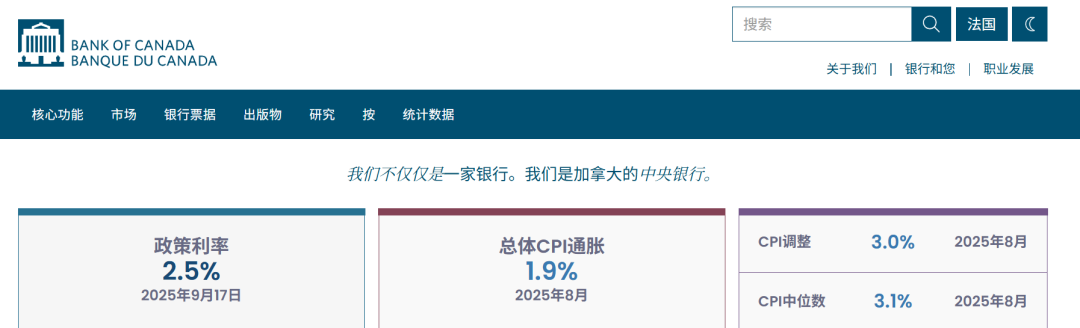
Core Viewpoint - The Bank of Canada has lowered its policy interest rate by 25 basis points to 2.5% in response to economic pressures from U.S. tariffs and a weakening labor market, marking the first rate cut since March [1][4][8] Economic Conditions - The Canadian economy contracted by an annualized rate of 1.6% in the second quarter, primarily due to declines in export activity and business investment [6][8] - Employment has decreased by over 106,000 jobs in July and August, mainly in trade-sensitive sectors, with the unemployment rate rising to 7.1% [6][9] - Consumer and housing activities are growing at a healthy pace, but slowing population growth and a weakening labor market may suppress household spending [6][8] Inflation and Monetary Policy - The core inflation rate is currently around 3%, but the Bank of Canada believes broader underlying inflation pressures are closer to 2.5% [6][9] - The decision to cut rates was made with a consensus among committee members, aiming to better balance risks in a weakening economy with reduced inflationary pressures [4][9] - The central bank has removed previous forward guidance suggesting further rate cuts may be necessary, indicating a cautious approach moving forward [4][5] Trade and Tariff Impact - U.S. tariffs have had a profound impact on key industries such as automotive, steel, and aluminum, contributing to economic strain [6][8] - The recent decision by the Canadian government to eliminate most retaliatory tariffs on U.S. imports is expected to alleviate some upward price pressures on related goods [9]

刚刚!降息25基点
中国基金报· 2025-09-17 14:27
Core Viewpoint - The Bank of Canada has lowered its policy interest rate by 25 basis points to 2.5% due to economic pressures and the impact of U.S. tariffs on the economy and labor market, marking the first rate cut since March [2][5][13]. Economic Conditions - The Canadian economy contracted by an annualized rate of 1.6% in the second quarter, primarily due to declines in export activity and business investment, which aligns with the central bank's expectations [9][14]. - Employment has decreased by over 106,000 jobs in July and August, mainly in trade-sensitive sectors, with the unemployment rate rising to 7.1% [9][14]. - Despite a healthy growth pace in consumption and housing, the central bank warns that slowing population growth and a weakening labor market may suppress household spending [10][14]. Inflation and Monetary Policy - The overall CPI inflation rate is at 1.9%, with core inflation indicators around 3%, but the upward momentum for broader inflation pressures is considered to have weakened [4][11][14]. - The central bank has removed previous forward guidance regarding the need for further rate cuts, indicating a cautious approach moving forward [8][15]. - The decision to cut rates is seen as a means to better balance risks in a weakening economy with reduced inflationary pressures [5][15]. Trade and Tariff Impacts - The U.S. tariffs have had a profound impact on key industries such as automotive, steel, and aluminum, contributing to economic strain [11][12]. - The recent decision by the Canadian government to eliminate some retaliatory tariffs on U.S. imports is expected to alleviate upward price pressures on related goods [14].
美国降息成定局!“放水”时代,定存、股票、黄金,哪些资产能涨?
Sou Hu Cai Jing· 2025-09-17 04:16
Group 1 - The Federal Reserve's upcoming meeting on September 16-17 is highly anticipated due to the confirmation of three new officials and the potential initiation of a rate-cutting cycle [1][3] - Market expectations for a rate cut have reached 100%, indicating that a reduction is almost certain [1][3] - The new officials may favor a more aggressive 50 basis points cut, while the remaining members might support a 25 basis points cut, but the key takeaway is the start of a new monetary easing cycle [3] Group 2 - The anticipated rate cuts in the U.S. could lead to a decrease in deposit rates in China, affecting trillions of yuan in savings interest [5] - Financial products, primarily backed by deposits and bonds, may see mixed effects; while deposit yields may decline, the bond market could benefit from increased liquidity [7] - Historical trends show that rate-cutting cycles often lead to bull markets in equities, with significant inflows of capital into stock markets expected [9] Group 3 - The gold market is likely to benefit from increased liquidity, with potential for gold prices to exceed $4,000 per ounce as investors seek safe-haven assets [11] - A weaker dollar resulting from rate cuts may lead to appreciation of other currencies, such as the Chinese yuan, prompting investors to consider currency exchanges [13] - The trend of appointing like-minded officials to the Federal Reserve suggests that rate cuts may continue over the next one to two years, impacting various financial assets [15]
美联储降息在即,专家称可能成为市场转折点
Sou Hu Cai Jing· 2025-09-17 00:56
Core Viewpoint - The Federal Reserve is expected to initiate a new rate-cutting cycle during its upcoming meeting, with a high probability of a 25 basis point cut and a lower probability for a 50 basis point cut [1] Group 1: Federal Reserve Expectations - The probability of a 25 basis point rate cut by the Federal Reserve is 95.9%, while the probability of a 50 basis point cut is only 4.1% [1] - By October, the cumulative probability of a 50 basis point cut is projected to reach 73.8%, indicating strong market expectations for continued monetary easing [1] Group 2: Global Impact and Market Reactions - The anticipated rate cuts by the Federal Reserve may trigger a wave of rate cuts from global central banks [1] - Although China's benchmark interest rate is already low, there remains some room for easing, such as lowering the Loan Prime Rate (LPR) and Medium-term Lending Facility (MLF) rates, or through reserve requirement ratio cuts to release liquidity [1] - Continued monetary easing and maintaining low interest rates could boost the A-share market and potentially lead to a second wave of upward momentum in the market [1] - The Federal Reserve's rate cut may serve as a turning point for the market, supporting the expected "golden September and silver October" trend in the A-share market [1]
日本股市新高后突然转跌
Zheng Quan Shi Bao· 2025-09-16 03:28
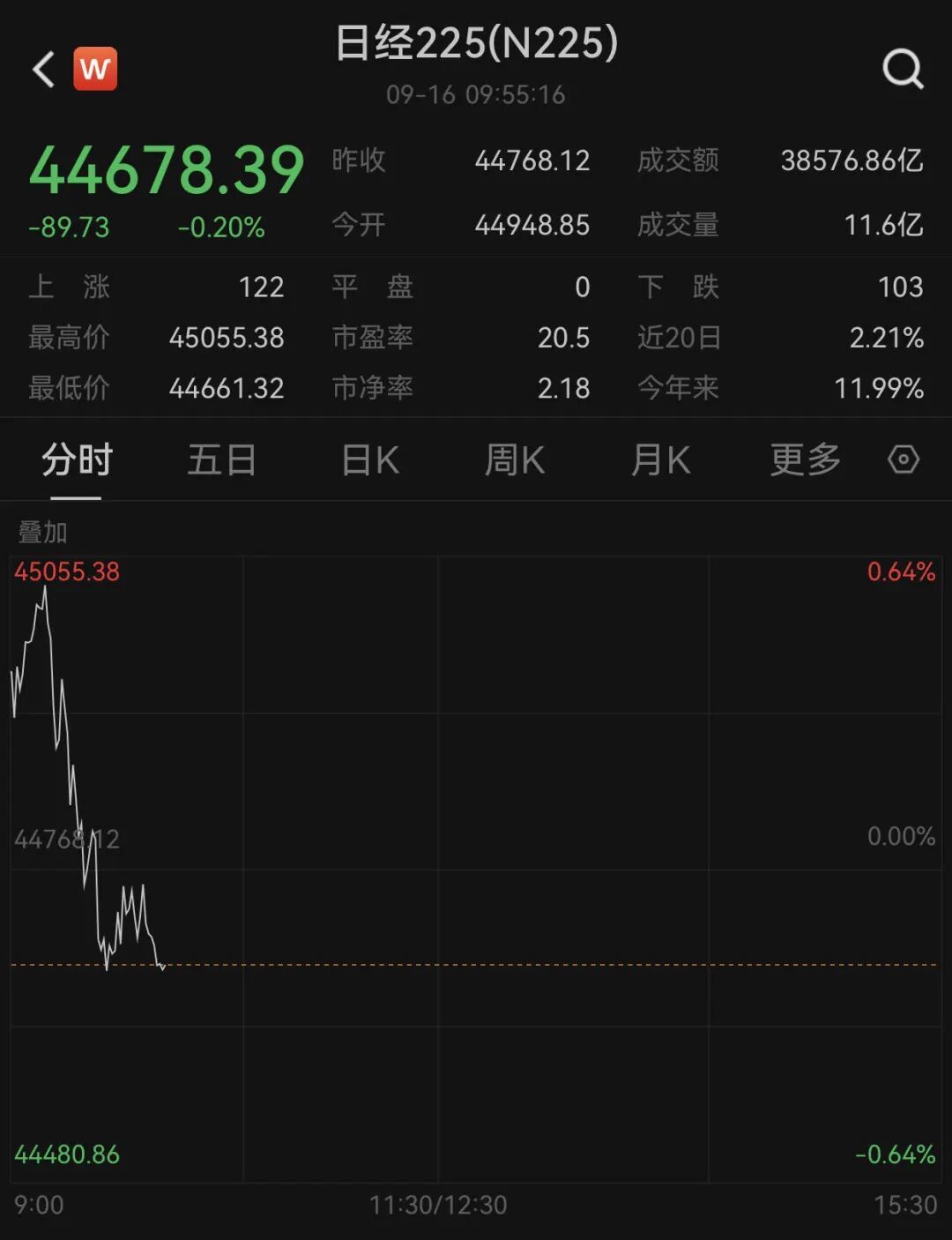
Group 1 - The Nikkei 225 index initially rose to a historical high of over 45,000 points but then turned down, closing at 44,678.39 points, a decrease of 0.20% [2][1] - The U.S. government announced a reduction in tariffs on Japanese cars to 15%, down from the previous 25%, effective from September 16 [4][5] - This tariff reduction aligns with President Trump's executive order to implement a U.S.-Japan trade agreement, which sets a baseline tariff of 15% on most Japanese imports [5] Group 2 - The Bank of Japan is expected to maintain its current interest rate of 0.5% during its upcoming meeting, with predictions suggesting that any rate hike may not occur until January 2026 [6][6] - Economic reports indicate that Japan's exports and production are showing signs of weakness, particularly in the automotive sector, which may influence the Bank of Japan's decision [6] - The market is optimistic about the potential election of a new Prime Minister, with candidates like Sanae Takaichi advocating for increased fiscal stimulus and monetary easing, which could positively impact Japanese stocks [7]
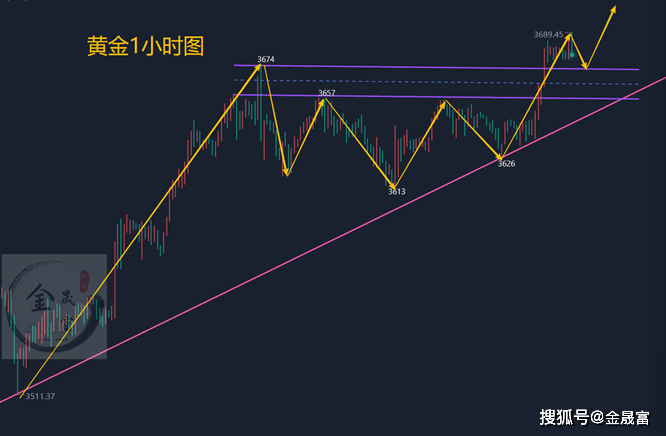
金晟富:9.16黄金买预期再创历史新高!日内黄金行情分析参考
Sou Hu Cai Jing· 2025-09-16 02:26
Core Viewpoint - The current gold market is experiencing a significant upward trend driven by multiple factors, including a weakening US dollar, declining US Treasury yields, and expectations of a Federal Reserve interest rate cut, which collectively create a favorable environment for gold investment [1][2][4]. Group 1: Market Dynamics - As of September 16, the spot gold price is trading at $3677.81 per ounce, with a notable increase of approximately 1% to close at $3678.73 [1]. - The US dollar index fell by 0.3%, reaching a near one-week low of 97.26, making gold more attractive to investors holding other currencies [1]. - Market expectations indicate a 96% probability of a 25 basis point rate cut by the Federal Reserve, with potential for additional cuts by the end of the year, providing strong support for gold prices [2]. Group 2: Technical Analysis - The gold price has broken previous highs, indicating a strong bullish trend, with key support levels identified at $3674-3675 and resistance at $3697-3700 [2][4]. - The current upward movement is characterized by a series of higher highs and higher lows, suggesting a continuation of the bullish trend [4]. - Short-term trading strategies recommend buying on dips around $3670-3675 and selling on rebounds near $3697-3700, with strict stop-loss measures advised [4]. Group 3: Investment Strategies - Investors are encouraged to view any price pullbacks as opportunities to enter long positions, as the overall market sentiment remains bullish [4]. - The upcoming Federal Reserve meeting is critical, as any dovish signals could lead to a further increase in gold prices, while hawkish comments may trigger a temporary pullback [2]. - The market is advised to monitor key economic indicators, such as the US retail sales data, which could impact gold price movements [2].
港股科技30ETF(513160)涨超1.2%,近五个交易日累计“吸金”近1.6亿元,机构:港股短期有望延续结构性上涨
2 1 Shi Ji Jing Ji Bao Dao· 2025-09-16 02:04
Group 1 - The Hong Kong stock market showed a collective strength on September 16, with the Hong Kong Technology 30 ETF (513160) rising by 1.21% and attracting nearly 160 million yuan in net inflows over the past five trading days [1] - The Hong Kong Technology 30 ETF closely tracks the Hang Seng Hong Kong Stock Connect China Technology Index, which includes mainland companies engaged in technology business and listed in Hong Kong, with major holdings including SMIC, Kuaishou, Tencent, Alibaba, and Xiaomi [1] - The market anticipates a new round of interest rate cuts by the Federal Reserve, which is expected to positively impact the Hong Kong stock market, particularly in the technology and consumer sectors [2] Group 2 - Analysts from Zhongtai Securities suggest that the Hong Kong market is likely to continue structural growth supported by expectations of interest rate cuts from the Federal Reserve and a recovery in A-share sentiment, with technology and consumption sectors being the most promising [2] - According to Everbright Securities, the Hong Kong market is more sensitive to U.S. Federal Reserve rate cuts compared to A-shares, which may lead to increased valuation and profit growth potential, especially for leading companies in technology, finance, and consumption sectors [2]
铝价:亚盘涨0.6%至2705美元,或创逾一年最长连涨
Sou Hu Cai Jing· 2025-09-15 06:17
Core Viewpoint - Aluminum prices have risen for seven consecutive days, potentially setting a record for the longest streak in over a year, driven by expectations of a Federal Reserve interest rate cut [1] Group 1: Market Dynamics - The benchmark aluminum price on the London Metal Exchange increased by 0.6% to $2,705 per ton during the Asian trading session, reaching the highest level since March [1] - The anticipation of the Federal Reserve's policy decision has led to increased expectations for monetary easing, which has put pressure on the US dollar and boosted industrial metal prices [1] Group 2: Supply Concerns - A surge in aluminum inventory withdrawal requests has raised supply concerns, which continues to support aluminum prices [1]
铝价:议息会前七连涨,或创一年最长连涨纪录
Sou Hu Cai Jing· 2025-09-15 06:17
Core Viewpoint - Aluminum prices have risen for seven consecutive days ahead of the Federal Reserve's meeting, potentially marking the longest streak in over a year, driven by expectations of interest rate cuts and increased supply concerns [1] Group 1: Market Trends - The London Metal Exchange's benchmark aluminum price increased by 0.6% during Asian trading hours, reaching $2,705 per ton, the highest level since March [1] - The rise in aluminum prices is supported by a surge in withdrawal requests from aluminum inventories, raising supply concerns [1] Group 2: Economic Factors - Investor sentiment is influenced by expectations of monetary easing from the Federal Reserve, which has put pressure on the US dollar and subsequently boosted industrial metal prices [1]