
降准降息

Search documents
央行开年即送货币金融政策大礼包支持实体经济 其中4项具体举措昨晚落地 今年降准降息还有空间
Shang Hai Zheng Quan Bao· 2026-01-15 18:01
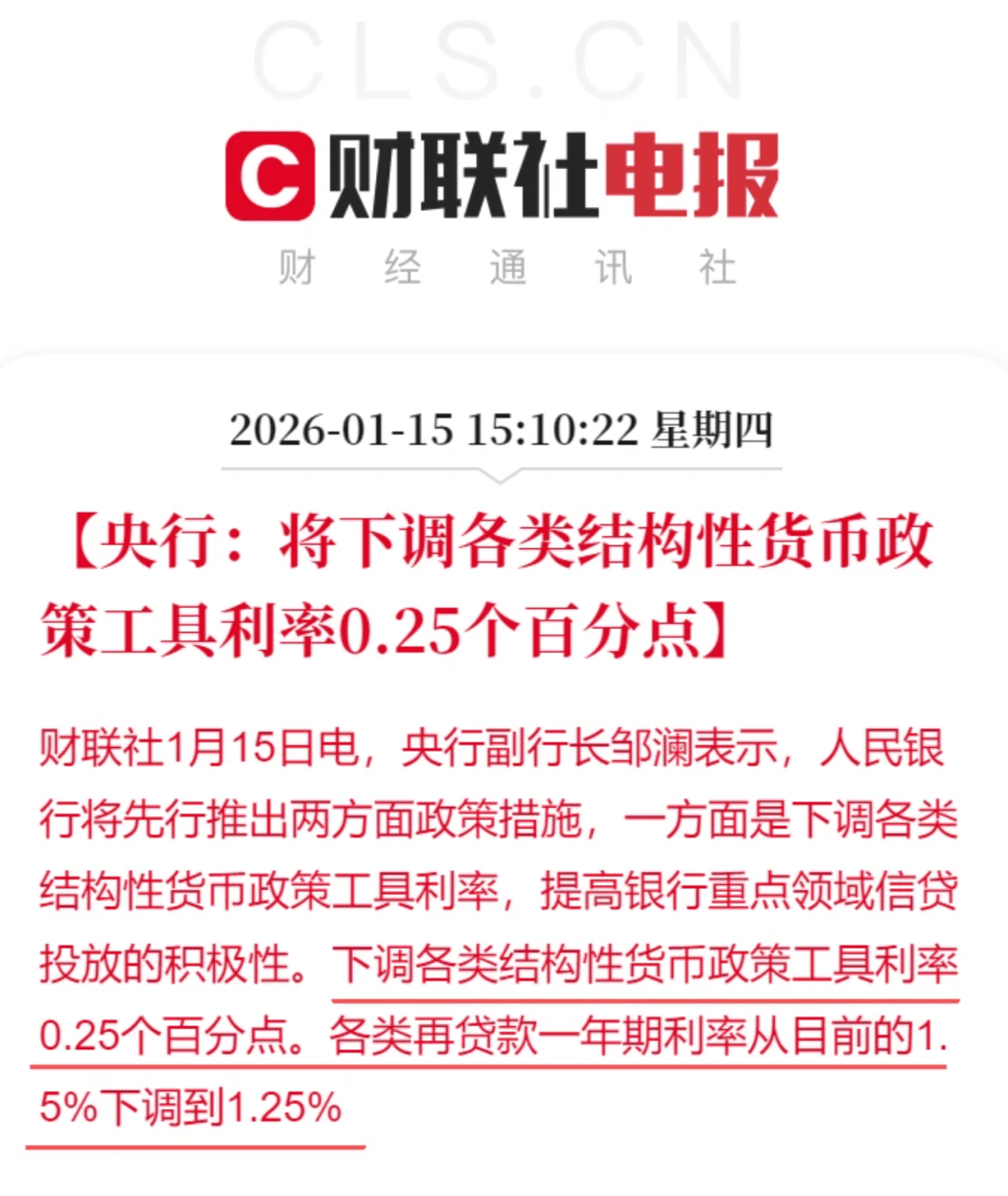
Group 1: Monetary Policy Measures - The People's Bank of China (PBOC) announced eight specific measures to support the real economy, including a 0.25 percentage point reduction in various structural monetary policy tool rates [1][2] - The re-lending and rediscount rates were lowered, and the quota for re-lending to support agriculture and small enterprises was increased by 500 billion yuan, with a separate quota for private enterprises set at 1 trillion yuan [2][3] - The quota for re-lending for technological innovation and technological transformation was increased from 800 billion yuan to 1.2 trillion yuan [1][2] Group 2: Support for Specific Sectors - The PBOC merged the existing private enterprise bond financing support tool and the technological innovation bond risk-sharing tool, providing a total re-lending quota of 200 billion yuan [3] - The carbon reduction support tool's scope was expanded to include energy-saving renovations and green upgrades [3] - The support areas for service consumption and elderly care re-lending were also broadened, incorporating health industry standards [3] Group 3: Real Estate and Financial Services - The minimum down payment ratio for commercial property loans was reduced to 30% to support the commercial real estate market [3] - Financial institutions are encouraged to enhance their foreign exchange risk hedging services, providing flexible and cost-effective tools for managing exchange rate risks [3] Group 4: Future Monetary Policy Outlook - There is still room for further reductions in reserve requirement ratios and interest rates, with the current average reserve requirement ratio at 6.3% [4] - The PBOC plans to maintain liquidity and guide overnight rates near policy rate levels, with a focus on reducing overall financing costs for enterprises [4][5] - The PBOC will flexibly conduct government bond trading operations to create a suitable monetary environment for government bond issuance [5]
央行送出“开年大礼包” 降准降息今年仍有空间
Xin Lang Cai Jing· 2026-01-15 17:24
Core Viewpoint - The central bank has introduced eight significant policy measures to support the transformation and optimization of the economic structure, including lowering interest rates on various structural monetary policy tools and increasing credit support for key sectors [1]. Group 1: Policy Measures - The central bank will lower the interest rates on various structural monetary policy tools by 0.25 percentage points and establish a special relending quota of 1 trillion yuan for private enterprises [1]. - Specific measures include reducing the minimum down payment ratio for commercial housing to 30% and enhancing the support for structural tools [1]. - The central bank aims to coordinate these measures with fiscal policies to amplify their effectiveness and promote effective domestic demand [1]. Group 2: Structural Tools - The structural monetary policy tools will see an increase in quotas and a reduction in rates, with the relending and rediscount rates lowered by 0.25 percentage points [3]. - The quotas for relending to support technological innovation and small enterprises will increase from 800 billion yuan to 1.2 trillion yuan, with additional support for high R&D investment private SMEs [3]. - The central bank will merge existing financing support tools for private enterprises and technological innovation, providing a total relending quota of 200 billion yuan [3]. Group 3: Support for Private Enterprises - A special relending quota of 1 trillion yuan will be established to enhance financial support for small and medium-sized private enterprises [8]. - The relending for private enterprises will include support for medium-sized enterprises, addressing the financing challenges faced by this segment [9]. - The central bank will continue to improve financial services for private enterprises and enhance the internal policy arrangements of financial institutions [10].
2025年社融规模新增35.6万亿元
Bei Jing Shang Bao· 2026-01-15 16:32
Core Viewpoint - The People's Bank of China reported strong financial statistics for 2025, with significant increases in social financing and new loans, indicating effective financial reforms, although there are notable weaknesses in household credit demand [1][6]. Group 1: Financial Performance - In 2025, new social financing reached 35.6 trillion yuan, and new loans totaled 16.27 trillion yuan, reflecting a robust financial environment [1][6]. - By the end of December 2025, the balance of RMB loans was 271.91 trillion yuan, showing a year-on-year growth of 6.4% [3][6]. - The total social financing stock at the end of 2025 was 442.12 trillion yuan, with an annual growth of 8.3% [6][7]. Group 2: Loan Structure - Corporate loans were the main driver of loan growth, with a significant increase of 15.47 trillion yuan in 2025, while household loans only increased by 441.7 billion yuan [3][7]. - The structure of loans improved, with manufacturing and infrastructure sectors seeing notable growth in medium to long-term loans, at 6.6% and 6.9% respectively [7][8]. - The financing costs decreased, with new loan rates in November 2025 being 0.42 percentage points lower than the previous year [7][8]. Group 3: Economic Outlook - Analysts expect that in 2026, there will be room for both interest rate cuts and reserve requirement ratio reductions, with new RMB loans projected to increase by approximately 1.2 trillion yuan compared to 2025 [11][12]. - The anticipated new social financing for 2026 is expected to reach 38.6 trillion yuan, driven by continued government bond financing and an acceleration in fixed asset investment [11][12]. - The overall economic environment is expected to remain supportive, with policies aimed at enhancing credit availability and reducing financing costs [9][10].


结构性货币政策工具扩容 降准降息可期
Bei Jing Shang Bao· 2026-01-15 16:25
Core Viewpoint - The People's Bank of China (PBOC) announced eight policies aimed at supporting high-quality economic development through monetary policy, establishing a foundation for the implementation of monetary policy in 2026, with a focus on maintaining moderate liquidity and promoting stable economic growth and reasonable price recovery [1][10]. Group 1: Policy Adjustments - The PBOC will lower the interest rates of various structural monetary policy tools by 0.25 percentage points, with the one-year re-lending rate decreasing from 1.5% to 1.25% [3]. - The PBOC will merge and increase the quotas for agricultural and small enterprise re-lending, adding 500 billion yuan to the agricultural and small enterprise re-lending quota and establishing a separate re-lending quota of 1 trillion yuan for private enterprises [4]. - The quota for re-lending for technological innovation and technological transformation will be increased from 800 billion yuan to 1.2 trillion yuan, expanding the support to include high R&D investment private small and medium-sized enterprises [4]. Group 2: Future Monetary Policy Directions - The PBOC indicated that there is still room for further reductions in reserve requirement ratios and interest rates in 2026, with the current average reserve requirement ratio at 6.3% [5]. - Analysts predict that potential rate cuts may occur in the second quarter of 2026 if economic indicators show weak recovery, with an expected initial reduction of 0.25 to 0.5 percentage points, releasing approximately 1 trillion to 2 trillion yuan in liquidity [6]. - The PBOC aims to maintain low comprehensive financing costs for society by promoting transparency in loan costs and optimizing the financing environment [7]. Group 3: Coordination of Monetary and Fiscal Policies - The PBOC plans to resume open market operations for government bonds, which had been suspended, to enhance liquidity management and prevent market volatility [8][9]. - The PBOC will consider various factors, including the need for base currency supply and bond market conditions, to flexibly conduct government bond transactions, ensuring a conducive monetary environment for smooth government bond issuance [9]. Group 4: Price Trends and Economic Outlook - The PBOC noted positive changes in price levels, with the CPI rising by 0.8% year-on-year in December 2025, the highest level since March 2023 [10]. - The PBOC will continue to implement a moderately loose monetary policy to promote stable economic growth and reasonable price recovery, as price levels are a key consideration for monetary policy [11].

央行开年首场发布会放大招,楼市、汇市将迎哪些变化?
第一财经· 2026-01-15 15:31
Core Viewpoint - The People's Bank of China (PBOC) signals that there is room for further interest rate cuts and reserve requirement ratio (RRR) reductions in 2026, aiming to support economic stability and reasonable price recovery [5][6]. Monetary Policy Adjustments - The average RRR for financial institutions is currently 6.3%, indicating potential for RRR cuts [5]. - The PBOC plans to lower the interest rates of various structural monetary policy tools to enhance support for key sectors and weak links [14][17]. - A reduction of 0.25 percentage points in the re-lending and re-discount rates will take effect on January 19, 2026, with new rates set for different loan terms [14]. Government Bond Operations - The PBOC will flexibly conduct government bond trading operations to maintain liquidity and support the smooth issuance of government bonds [8]. - In 2025, the total issuance of government bonds reached 16 trillion yuan, with a net increase of 6.6 trillion yuan, indicating a robust bond market [8]. Support for Commercial Real Estate - The minimum down payment ratio for commercial property loans has been reduced from 50% to 30%, aimed at stimulating the commercial real estate market [10]. Exchange Rate Policy - The PBOC maintains a clear and consistent exchange rate policy, emphasizing stability in the RMB exchange rate and rejecting competitive devaluation [12]. Support for Private Enterprises - The PBOC has increased the re-lending quota for supporting agriculture and small enterprises by 500 billion yuan, now including medium-sized private enterprises [16]. - The total quota for re-lending to private enterprises is set at 1 trillion yuan, with terms aligned with existing policies [16]. Price Stability Considerations - The CPI rose by 0.8% year-on-year in December 2025, marking the highest level since March 2023, prompting the PBOC to focus on promoting reasonable price recovery as part of its monetary policy [20].

贴息没等来,但真正大利好杀到,降息降首付了!
Sou Hu Cai Jing· 2026-01-15 15:01
大杀招开启,购房降息了!商业购房降首付了! 没有等到"广州贴息",但今天总算厉害天降,铺天盖地都是降息和降首付的新闻。 但是要讲清楚一点: 利好确实是利好; 但此降息收非彼降息,此首付也非彼首付! 简单讲,1. 就是不是房贷直接相关的LPR,只是央行借给商业银行的钱降息。 当然,银行成本低了,后面LPR也很可能再降,只是需要时间。 2. 这个降首付,是降商业用房,比如公寓商铺类的首付,不是住宅的首付。 保利天曜板房实拍 来源:业主群 下面再解读下文件: 全程唠嗑感,不拽专业词,保证街坊邻居一看就懂: 01 央行给银行"发便宜钱",非直接降房贷 1月19号开始,央行给银行的"定向借钱"(比如支持三农、小微的专项款)利率降了0.25个点,一年期的从1.5%降到1.25%,其他期限也跟着降。 大白话:央行给银行的"专项贷款"打折了(就这部分钱便宜,不是所有贷款都降哈)。 保利天曜板房实拍 来源:业主群 02 公寓、商铺首付大减!从5成降到3成 全国统一规矩: 不管是公寓、商铺还是写字楼,以前买得付5成首付,现在最低3成就行,广州也按这个来。 举个例子: 银行拿这钱成本低了,就更愿意把钱借给农民、小老板、搞科创的这些 ...
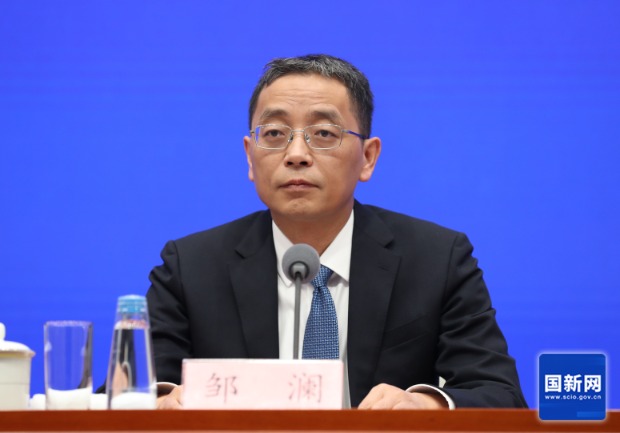
中国人民银行副行长邹澜:2026年降准降息还有一定空间
Xin Hua Cai Jing· 2026-01-15 14:48
Core Viewpoint - The People's Bank of China (PBOC) indicates that there is still room for further reductions in reserve requirements and interest rates to support high-quality economic development in 2026 [1][3]. Group 1: Monetary Policy Insights - The average statutory deposit reserve ratio for financial institutions is currently 6.3%, suggesting potential for a reduction in reserve requirements [3]. - The PBOC has noted that external constraints are relatively stable, with the RMB exchange rate being stable and the USD in a rate-cutting cycle, which does not impose strong constraints on monetary policy [3]. - Internally, the net interest margin for banks has stabilized at 1.42% over the past two quarters, indicating a favorable environment for potential interest rate cuts [3]. Group 2: Financing Cost Management - The PBOC plans to continue comprehensive measures to maintain low overall financing costs in society, including promoting transparency in loan costs through "loan clarity papers" for enterprises [3]. - Efforts will be made to reduce assessment, guarantee, and other intermediary financing costs to alleviate the financial burden on businesses and optimize the financing environment [3]. - The PBOC emphasizes the importance of effective execution and supervision of interest rate policies to ensure smooth transmission of these policies [3]. Group 3: Future Monetary Policy Direction - Looking ahead to 2026, the PBOC will implement moderately accommodative monetary policies in line with the central economic work conference's decisions, focusing on both stock and incremental policy effects [3]. - There will be an increased emphasis on counter-cyclical and cross-cyclical adjustments to create a conducive monetary and financial environment for stable economic growth and high-quality development [3].
央行大礼包来袭,长债利率为何上演“过山车”?
第一财经· 2026-01-15 14:42
Core Viewpoint - The central theme of the article revolves around the People's Bank of China's (PBOC) recent monetary policy adjustments, including a structural interest rate cut of 0.25 percentage points, signaling potential room for further reductions in reserve requirements and interest rates throughout the year [3][6]. Group 1: Market Reactions - Following the PBOC's announcement, long-term bond yields initially dropped but then rebounded, indicating a lack of strong bullish sentiment in the market [4][5]. - The 10-year government bond yield fell from approximately 1.85% to 1.835% before rising again to 1.8555%, reflecting a slight decrease of 0.2 basis points from the previous trading day [4]. - The 30-year government bond yield experienced similar fluctuations, initially dropping to 2.2915% before climbing to 2.3075%, closing at 2.3040%, which is an increase of 0.15 basis points [5]. Group 2: Policy Implications - The PBOC's announcement included a reduction in various structural monetary policy tool rates by 0.25 percentage points and indicated that there is still room for further cuts in reserve requirements and interest rates [6][7]. - The average statutory deposit reserve ratio for financial institutions is currently at 6.3%, suggesting that there is still potential for reserve requirement reductions [6]. - The PBOC aims to lower banks' interest costs and stabilize net interest margins, which could create further space for interest rate cuts in 2026 [6]. Group 3: Bond Market Dynamics - The bond market has shown signs of recovery since mid-January, with yields on key bonds declining by 3.1 basis points and 1.2 basis points, respectively, since January 8 [6]. - The PBOC's operations in the bond market, including the buying and selling of government bonds, are intended to maintain liquidity and support the smooth issuance of government bonds [10][11]. - In 2025, the total issuance of government bonds reached 16 trillion yuan, with a net increase of 6.6 trillion yuan, indicating a robust supply in the bond market [10].

央行开年首场发布会放大招 楼市、汇市将迎哪些变化?
Di Yi Cai Jing· 2026-01-15 14:33
Core Viewpoint - The People's Bank of China (PBOC) has signaled that there is room for further interest rate cuts and reserve requirement ratio (RRR) reductions in 2026, alongside measures to enhance structural monetary policy tools and support [1][2] Group 1: Monetary Policy Adjustments - The average statutory deposit reserve ratio for financial institutions is currently 6.3%, indicating potential for RRR cuts [2] - The PBOC plans to lower the interest rates on various structural monetary policy tools, effective January 19, 2026, with specific rates for agricultural and small business loans set at 0.95%, 1.15%, and 1.25% for different terms [7] - A new re-lending program for private enterprises will be established, with a total quota of 1 trillion yuan, aimed at supporting small and medium-sized enterprises [8] Group 2: Government Bond Operations - The PBOC will flexibly conduct government bond buying and selling operations to maintain liquidity and support the smooth issuance of government bonds [3] - In 2025, the issuance of government bonds reached 16 trillion yuan, with a net increase of 6.6 trillion yuan, indicating a robust bond market [3] Group 3: Real Estate Support - The minimum down payment ratio for commercial property loans has been reduced from 50% to 30%, aimed at stimulating the commercial real estate market [4] - This reduction is part of a broader strategy to address inventory issues in the commercial property sector [4] Group 4: Exchange Rate Policy - The PBOC maintains a clear and consistent exchange rate policy, emphasizing the stability of the RMB at a reasonable equilibrium level [5][6] - The external environment is expected to support the stability of the foreign exchange market, with major developed economies likely to continue their easing policies [5] Group 5: Price Stability Considerations - The PBOC aims to promote reasonable price recovery as a key consideration in monetary policy, with the CPI showing a year-on-year increase of 0.8% as of December 2025 [10] - The central bank will continue to implement a moderately accommodative monetary policy to foster an environment conducive to price recovery [10]
央行开年首场发布会放大招,楼市、汇市将迎哪些变化?
Di Yi Cai Jing· 2026-01-15 14:26
Core Viewpoint - The People's Bank of China (PBOC) is implementing a series of monetary policy measures, including lowering the minimum down payment ratio for commercial property loans to 30%, indicating a proactive approach to stimulate the economy and support the real estate market [4]. Group 1: Monetary Policy Adjustments - The PBOC signals that there is still room for interest rate cuts and reserve requirement ratio (RRR) reductions in 2026, with the current average RRR at 6.3% [2]. - The PBOC will lower the interest rates on structural monetary policy tools by 0.25 percentage points starting January 19, 2026, with new rates for various loan types [7]. - The PBOC plans to increase the quota for agricultural and small business loans by 500 billion yuan, integrating it with the rediscount quota [8]. Group 2: Support for Real Estate Market - The minimum down payment for commercial property loans has been reduced from 50% to 30%, aimed at boosting the commercial real estate market and reducing inventory [4]. - The PBOC's actions reflect a heightened focus on supporting the commercial real estate sector, indicating a shift in regulatory priorities [4]. Group 3: Government Bond Operations - The PBOC will flexibly conduct government bond buy-sell operations to maintain liquidity and support the issuance of government bonds, with a total of 16 trillion yuan in government bonds issued in 2025 [3]. - The PBOC's bond operations are intended to enhance the coordination between monetary and fiscal policies, ensuring a stable environment for government bond issuance [3]. Group 4: Currency and Exchange Rate Policy - The PBOC maintains a clear and consistent exchange rate policy, emphasizing the stability of the RMB against external economic conditions [5][6]. - The PBOC will continue to monitor cross-border capital flows and enhance the resilience of the foreign exchange market [5]. Group 5: Economic Growth and Price Stability - The PBOC aims to promote stable economic growth and reasonable price recovery as key considerations in its monetary policy, with CPI rising to 0.8% year-on-year as of December 2025 [10]. - The PBOC will implement a moderately loose monetary policy to create a conducive environment for price recovery [10].