马太效应

Search documents
2025年中国外卖市场现状报告-MCR嘉世咨询
Sou Hu Cai Jing· 2025-05-23 01:35
Market Size and Structure Characteristics - The online food delivery market in China is projected to reach CNY 16,357 billion in 2024, with a year-on-year growth of 7.2%, and a user base of 553 million, accounting for 50.3% of internet users [1][18] - The market exhibits a significant "Matthew effect," with the restaurant chain rate increasing from 35% in 2020 to 50% in 2025, indicating that chain brands dominate due to supply chain and standardization advantages [1][18] - Lower-tier cities are becoming the main growth driver, with over 60% of users in these markets ordering takeout more than three times a week [1][30] Platform Competition Landscape - The market is characterized by a "dual oligopoly" structure, with Meituan and Ele.me holding a combined market share of 92%, where Meituan accounts for 70% and Ele.me for 30% [1][21] - JD.com is entering the market in 2025 with a "zero commission" policy to attract merchants, prompting Meituan and Ele.me to adjust their commission strategies [1][23] - Vertical platforms like "Run Fast" are focusing on local services in townships, shifting competition from price wars to differentiated services [1][22] Category Expansion and Consumer Upgrade - The delivery category is expanding from traditional food to include fresh produce, pharmaceuticals, and electronics, reflecting a trend towards "instant delivery of everything" [1][26] - Healthy meal orders are expected to rise from 12% in 2020 to 25% in 2025, with pre-made dishes like Hema's "30-minute banquet package" achieving sales of over 800,000 during the Spring Festival [1][26] - Low-frequency high-value scenarios, such as late-night orders, are growing at a rate of 15%, with Meituan testing "home service + delivery" combo packages [1][26] Technology-Driven Efficiency Improvement - AI and big data are core drivers, with Ele.me's "Ark" algorithm reducing delivery times by 43%, and Meituan's drone delivery costs decreasing by 37% [2][4] - The application of blockchain technology in food safety traceability has led to a 62% reduction in complaint rates for JD Fresh's "one code traceability" system [2][4] - The penetration rate of green packaging has increased from 30% to 65%, with costs of eco-friendly materials dropping by 40%, promoting industry transformation towards sustainability [2][4] Business Model and Regulatory Changes - The commission model is facing challenges, with JD's zero-commission strategy prompting a reevaluation of profitability models across the industry [3][34] - Rider rights protection has become a focal point, with JD and Meituan beginning to pay social insurance for riders, benefiting an estimated one million riders at an annual cost of approximately CNY 13 billion [3][40] - Regulatory measures are tightening, with the Supreme Court clarifying labor relationship standards and the market regulator enhancing food safety and anti-monopoly measures [3][40] Future Trend Outlook - The market is expected to exhibit four major trends: community and personalized services, omnichannel integration, deep technological empowerment, and sustainable development [4][4] - By 2027, the market size is projected to reach CNY 19,567 billion, with growth driven by lower-tier markets, technological innovation, and diversified services [4][4]



信达澳亚朱永强:未来基金业马太效应会日益明显
news flash· 2025-05-22 03:39
信达澳亚总经理朱永强日前在晨星中国2025峰会上表示,《推动公募基金高质量发展行动方案》发布 后,预料未来基金业"马太效应"会更加明显,前20名的公司会逐步的"头部化",中等规模的基金公司, 未来应专注差异化策略。(资事堂) ...
透视中外车企2024年财报:从狂飙突进到盈利为王
Zhong Guo Qing Nian Bao· 2025-05-21 23:28
在人工智能和新能源技术的双重推动下,全球汽车产业在2024年继续保持向上发展的总态势。 全国乘用车市场信息联席分会统计的数据显示,2024年全年,全球汽车销量达9060万台(新能源汽车 1603万台)。其中纯电动车的占比达11.4%、插电混动车占比达6.3%、混合动力车占比达5.9%。 迈入5月,车企们陆续披露2024年财报。一份份沉甸甸的"成绩单",将全球汽车的"业绩版图"勾勒得愈 发清晰——在新技术和新趋势的风口下,市场竞争格局正被加速重构。机遇与压力并存的"冰与火之 歌",让头部企业与尾部阵营的业绩差距持续扩大。有的企业放弃了过去狂飙突进的增速,为了盈利而 主动进行战略收缩;有的企业则咬牙度过了生存危机,正试图借助AI等技术创新实现新的突破……在 几家欢喜几家愁的财报数据背后,各大车企正依托自身不同的资源和整体情况进行"全力突围"。 财报背后的"百花齐放" "一方面,比亚迪依靠'技术鱼池'中的新技术建造更高的护城河,引领新能源汽车的发展;另一方面则 通过打造'智驾平权''充电像加油一样快'等多个技术标签扩大品牌竞争力优势,激活终端市场需求。"张 翔分析说。 积极向新能源汽车领域转型的重庆长安汽车股份有限 ...
上海、深圳又在出现3大怪现象,开始逐步蔓延,值得每个人深思
Sou Hu Cai Jing· 2025-05-21 08:47
Group 1 - Major cities like Shanghai and Shenzhen are experiencing a stark contrast between luxury real estate and impoverished areas, with a housing price-to-income ratio reaching 100:1 in core urban areas [3][5] - The phenomenon of luxury homes coexisting with slums is a result of distorted real estate development, where high land prices are passed on to urban villages, creating a cycle of wealth extraction from affluent areas and poverty creation in others [3][5] Group 2 - Despite lowering household registration barriers to attract talent, major cities are witnessing accelerated population outflows, with Shanghai losing 72,000 residents in 2024, while the number of incoming residents decreased by 238,000 [5][6] - Contributing factors to this trend include stagnant income growth, high living costs, and a decline in blue-collar job opportunities due to manufacturing relocation and layoffs in the financial sector [6][8] Group 3 - Retail dynamics have shifted dramatically, with luxury stores seeing a significant drop in foot traffic, while discount stores thrive, exemplified by a 35% drop in average transaction value for LVMH in China, despite a 20% increase in purchase frequency [8][12] - The increase in foreclosed properties by 35% in 2024 indicates a collapse of wealth effects, pushing the middle class to cut spending and downgrade their consumption habits [9][12] Group 4 - The widening wealth gap is attributed to certain interest groups capturing most of the urban development benefits, while the relocation of manufacturing has deprived ordinary workers of upward mobility [12] - High operational costs are driving businesses away from urban centers, with vacancy rates in office buildings in Shenzhen exceeding 30% [12][14]
一边大规模清退、一边“戴维斯双击”,宠物食品赛道怎么了?
3 6 Ke· 2025-05-20 03:36
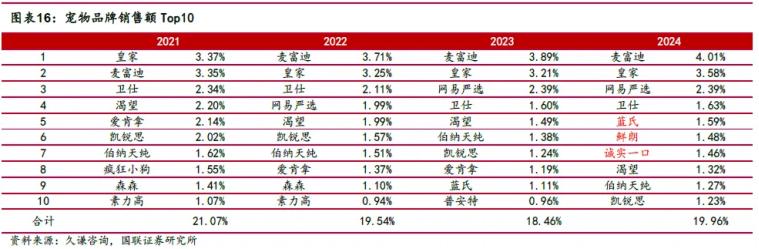
Industry Overview - The pet economy has become a hot topic, with significant growth in the pet sector, particularly in pet food, which is expected to continue expanding [1][2] - The pet consumption market is projected to exceed 404.2 billion yuan by 2027, with a compound annual growth rate (CAGR) of 12.6% from 2015 to 2027 [1] - The number of pet dogs and cats in China is expected to reach 124 million by 2024, with a 2.1% increase from 2023 [2] Company Performance - Leading companies like Guai Bao Pet and Zhong Chong Co. have shown remarkable revenue growth, with Guai Bao's revenue increasing from 1.4 billion yuan in 2019 to 3.4 billion yuan in 2022, a CAGR of 34.3% [3] - Zhong Chong Co. reported revenues of 3.248 billion yuan in 2022, with a projected increase to 4.465 billion yuan by 2024, reflecting growth rates of 12.72% and 19.16% respectively [5][6] Market Dynamics - The pet food sector accounts for over 60% of the urban pet consumption market, which is expected to reach 3.012 billion yuan in 2024 [2] - The market is experiencing a "Matthew Effect," where larger companies are gaining market share while smaller firms are struggling, with over 100,000 pet companies disappearing recently [1][10] Competitive Landscape - The top pet food brands are seeing shifts in market share, with Mai Fu Di surpassing Royal Canin in 2022 [4][6] - The CR10 (concentration ratio of the top 10 brands) for the pet food market is 19.96%, indicating a slight increase from the previous year [6] Challenges for Small Enterprises - Many small pet companies are facing significant challenges, with at least 35 companies expected to go bankrupt in 2024 due to financial difficulties [9][10] - The industry is witnessing a trend where brands that fail to innovate or adapt to market changes are being eliminated [10] Future Trends - The aging population is driving pet ownership, with consumers over 50 years old showing a 27% annual increase in spending [3] - New brands are emerging with unique selling propositions, focusing on fresh ingredients and innovative product offerings [11]
企业发展失衡,韩媒担心“马太效应”
Huan Qiu Shi Bao· 2025-05-19 22:48
Group 1 - South Korea's economic growth forecast has been significantly downgraded to 0.8% by the Korea Development Institute, reflecting issues such as capital flow imbalance and a downturn in the manufacturing sector [1] - Foreign investment in South Korea decreased by 33.8% year-on-year to $37.184 billion, while domestic investment abroad increased, indicating a structural trend that may weaken domestic economic vitality [1] - Major corporations in South Korea reported double-digit growth in operating profits in Q1, while medium-sized enterprises faced declining profits, highlighting a "Matthew effect" where larger firms thrive at the expense of smaller ones [2] Group 2 - The sales revenue of the top 500 medium-sized listed companies in South Korea increased by 4% year-on-year to 60.092 trillion KRW, but operating profits fell by 2.7% [2] - The construction and building materials sectors saw a dramatic decline in operating profits by 65.6%, while the IT and electronics sectors also experienced a 22.6% decrease [2] - South Korea's manufacturing output decreased by 0.8% in Q1, particularly in the chemicals and machinery sectors, contributing to a 0.2% decline in actual GDP [2] Group 3 - The proportion of employment in the manufacturing sector has been declining, reaching a low of 15.5% of total employment, the lowest since the implementation of the 10th version of the Korean Standard Industry Classification in 2013 [2] - The manufacturing employment share is projected to further decline to 15.7% in 2023 and 15.6% in 2024, with a significant drop in employment numbers observed in April [3] - The recovery in the manufacturing sector, particularly in semiconductors, is not translating into job growth due to the capital-intensive nature of these industries, leading to a slow recovery in the job market [3]
财险公司一季度经营透视:头部承包八成净利润,近7成企业成本率改善
2 1 Shi Ji Jing Ji Bao Dao· 2025-05-19 10:47
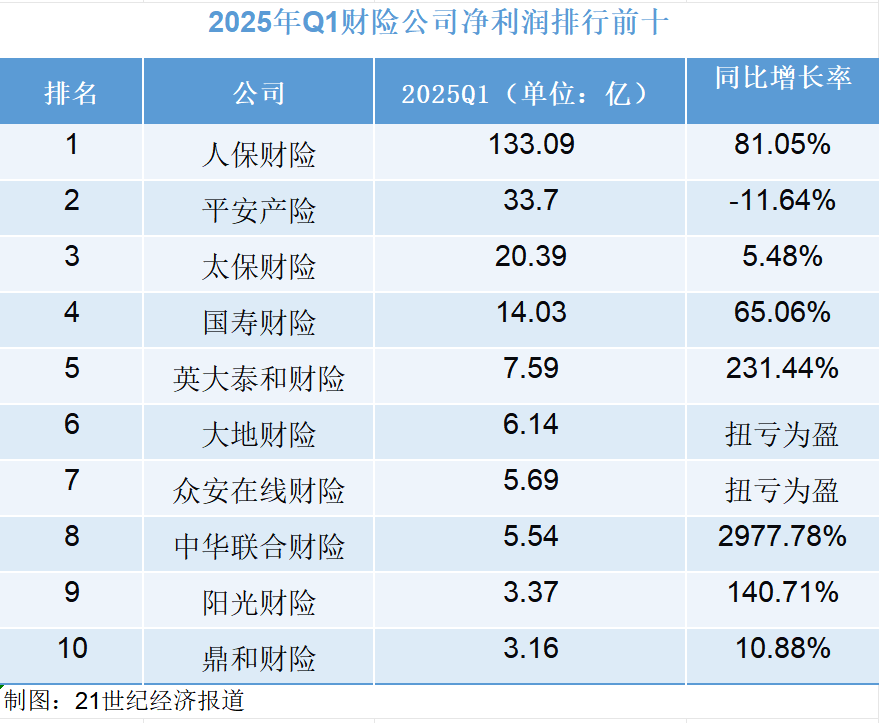
南方财经全媒体记者 孙诗卉 实习生 关晶月、德吉卓玛 当前,各家保险公司陆续披露2025年一季度偿付能力报告摘要。据统计,一季度,已披露相关数据的85家财险公司共实现保 费收入5161.44亿元,比去年同期增长5.4%;85家公司合计实现净利润256.06亿元,比去年同期大增66.91%。综合来看,今年 一季度财险公司业绩表现优于市场同期,净利润增速超65%。 东吴证券研报认为,2025年一季度大灾较少利好财险公司降低赔付。据应急管理部数据,2025年一季度国内重大自然灾害损 失同比明显减少,利好财险公司赔付支出的下降。 不过,值得注意的是,在保费增速与盈利水平双升的背后,行业马太效应仍持续凸显,头部公司强者恒强,中小险企则在成 本控制与业务转型中艰难突围。 头部五家财险公司占据八成净利润 从已披露偿付能力报告摘要的险企来看,一季度净利润排名前五的人保财险、平安产险、太保产险、国寿财险和英大财险合 计盈利超200亿元,占所有财险公司净利润的八成以上。其中,人保财险一季度盈利破百亿,达到133.09亿元,同比增长 81.05%;平安财险实现净利润33.7亿元,同比减少11.64%;太保财险实现净利润20.39亿 ...


华致酒行(300755) - 2025年5月16日投资者关系活动记录表
2025-05-16 13:21
Group 1: Industry Outlook - The domestic liquor consumption market has entered a phase of deep adjustment due to macroeconomic fluctuations and structural changes in the industry, with a focus on the white liquor sector [2][3] - The company remains optimistic about the liquor distribution sector, indicating a broad development space despite current challenges [2] Group 2: Strategic Adjustments - The company has initiated operational strategy adjustments under the board's strategic guidance, focusing on internal management reforms and organizational structure optimization [3] - Key action guidelines include "reducing inventory, promoting sales, stabilizing prices, strengthening teams, adjusting structures, and optimizing models" to achieve operational management goals [3] Group 3: Competitive Positioning - The company aims to stand out in the increasingly competitive white liquor market by focusing on "genuine brand channels and supply chain service platforms" [3] - Future store development will rely on three business models: "Hua Zhi Jiu Hang," "Hua Zhi Jiu Ku," and "Hua Zhi You Xuan," enhancing market adaptability and competitiveness [3] Group 4: Product Strategy - The company plans to continuously enrich its product matrix through deep cooperation with renowned liquor enterprises, promoting customized products to build a diversified premium liquor system [3] - Efforts will be made to enhance profitability and achieve sustainable, high-quality development through various initiatives [3]
毛利率改善板块业绩回暖 企业业绩分化马太效应愈发显著 | 2024原料药行业年报
Xin Lang Zheng Quan· 2025-05-16 06:17
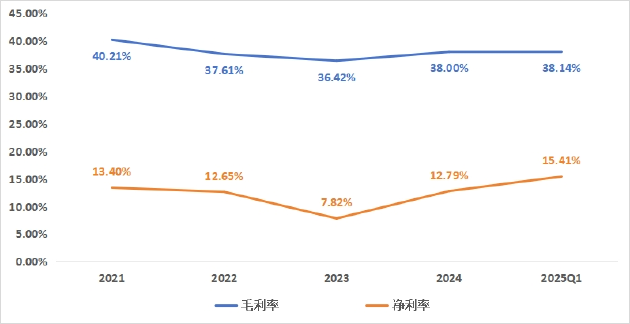
2024年,原料药板块盈利能力迎来全面改善,毛利率同比提升1.58个百分点至38%,净利率大幅攀升 4.97个百分点至12.79%,创下近三年新高。分季度看,Q4成为全年亮点,毛利率同比跳涨5.47个百分点 至40.29%,净利率同比提升13.89个百分点。 炒股就看金麒麟分析师研报,权威,专业,及时,全面,助您挖掘潜力主题机会! 2024年,32家原料药上市公司交出了一份稳健的成绩单,全年实现营业收入1176.77亿元,同比增长 6.74%,成功扭转了2023年因价格下行和去库存导致的低迷态势。分季度来看,行业呈现出显著的"前 低后高"特征。Q1营收同比微降0.56%,但从Q2开始,随着全球下游厂商去库存周期接近尾声,叠加部 分新产品进入放量期,Q2-Q4营收同比分别增长9.04%、12.64%、8.76%。 值得注意的是,尽管2025年Q1营收同比小幅下滑0.48%至295.46亿元,但环比仍增长5.77%,显示出行 业在经历阶段性调整后逐步企稳的态势。这一表现与全球医药供应链的修复节奏基本同步,尤其是欧美 市场对原料药需求的温和回升,为行业提供了支撑。 利润端的表现则更具爆发力,2024年原料药板块归母 ...
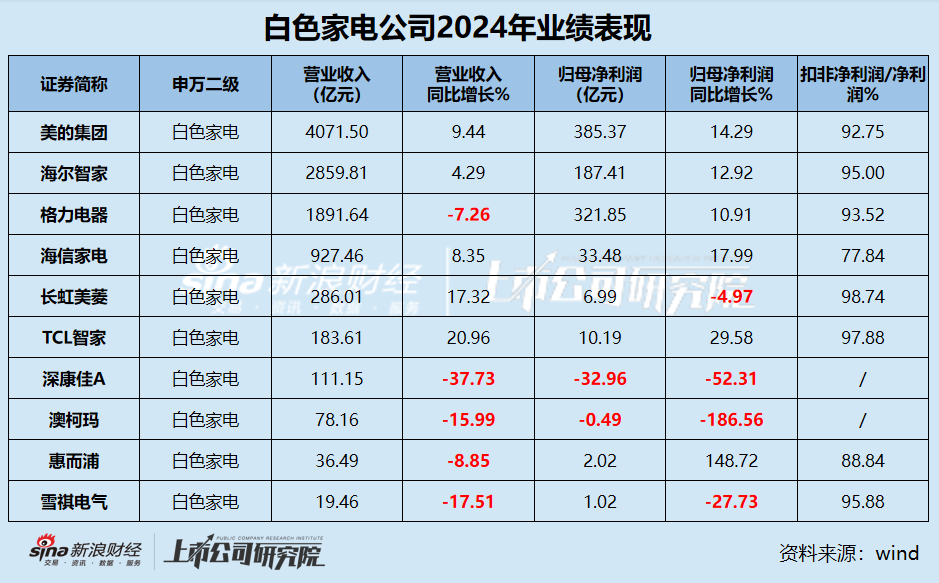
白电年报|行业“马太效应”显著 包括格力在内半数公司营收缩水 康佳、惠而浦、雪祺电气业绩持续下滑
Xin Lang Zheng Quan· 2025-05-15 09:46
Core Viewpoint - The white goods industry in A-share market has shown significant performance divergence, with leading companies benefiting from scale and innovation while smaller firms face increasing pressure and declining performance [1][2]. Industry Performance - In 2024, the white goods industry achieved a total revenue of 10,465.29 billion yuan and a net profit of 914.88 billion yuan [1]. - The industry experienced a "Matthew effect," where leading companies strengthened their market positions, while smaller firms struggled [1]. Company Performance - Midea Group led the industry with a revenue of 4,071.50 billion yuan and a net profit of 385.37 billion yuan, showing year-on-year growth rates of 9.44% and 14.29% respectively [2][3]. - Haier Smart Home reported a revenue of 2,859.81 billion yuan and a net profit of 187.41 billion yuan, with a high quality of earnings reflected in a 95% proportion of non-recurring net profit [2][3]. - Gree Electric Appliances saw a revenue decline of 7.26%, with a net profit growth of only 10.91%, indicating a lag behind its competitors [2][3]. Performance Disparity - Half of the listed companies in the white goods sector experienced revenue declines in 2024, including Gree, Konka, Aucma, Whirlpool, and Snowman Electric [4]. - Konka reported a significant loss of 32.96 billion yuan, with a year-on-year loss increase of 52.31% due to declining traditional appliance business [4]. - Aucma transitioned from profit to loss, with a year-on-year decline of 186.56% [4]. Profitability Metrics - The industry exhibits a "high gross margin, low net margin" characteristic, with significant disparities among companies [5]. - Gree Electric Appliances leads with a gross margin of 29.43% and a net margin of 17.11% [7]. - Konka has the lowest gross margin at 4.40% and a net margin of -34.95%, indicating severe profitability issues [7]. Expense Management - The top three companies (Haier, Midea, Gree) have significantly higher sales and R&D expenses compared to others, with Haier's sales expenses being 3.13 times its R&D expenses [8][9]. - Four companies, including Aucma and Konka, reduced their R&D expenses year-on-year, which may negatively impact their long-term competitiveness [9]. Operational Efficiency - Midea, Gree, and Haier maintain superior cash generation and operational efficiency, with Midea achieving over 600 billion yuan in operating cash flow [13]. - Konka's inventory turnover days exceed 100 days, indicating potential inventory accumulation and sales risks [13]. - Whirlpool is the only company in the industry with negative operating cash flow, highlighting its weak sales collection ability [13].