保护主义

Search documents
印尼工商会副主席答21:跟中国保持合作有助抵御不确定性
2 1 Shi Ji Jing Ji Bao Dao· 2025-09-19 11:36
Core Insights - The 22nd China-ASEAN Expo and Business and Investment Summit was held in Nanning, Guangxi from September 17 to 21, highlighting the commitment of Chinese and ASEAN enterprises to deepen cooperation amidst global challenges like unilateralism and protectionism [2][3] - In the first eight months of this year, China's trade with ASEAN reached 4.93 trillion yuan, a year-on-year increase of 9.7%, marking a historical high and accounting for 16.7% of China's total trade [2] - The trade volume between China and ASEAN has grown from over 870 billion yuan in 2004 to nearly 7 trillion yuan in 2024, representing a sevenfold increase and consistent growth for nine consecutive years [2] Trade Relations - ASEAN trade representatives expressed optimism about future cooperation with China, emphasizing the strong complementary nature of their industries [3] - ASEAN countries supply China with bulk commodities such as electronic components, energy, and agricultural products, while China provides machinery, technology, and consumer goods to ASEAN nations [3] - China has become a significant source of foreign direct investment for ASEAN, particularly in infrastructure, energy, and manufacturing sectors, with many projects linked to the Belt and Road Initiative [3] Impact of U.S. Trade Policies - Indonesian business leaders indicated that collaboration with China is essential for navigating uncertainties arising from U.S. tariff policies [3] - The balanced trade relationship between China and Indonesia is seen as a foundation for seeking more cooperative opportunities, which is a key reason for participation in the Expo and Summit [3]
【快讯】每日快讯(2025年9月19日)
乘联分会· 2025-09-19 08:34
Domestic News - The Ministry of Commerce of China hopes that the EU will not weaponize tariffs, emphasizing the importance of fair competition and collaboration in the electric vehicle (EV) sector [2] - As of August 2025, the total number of electric vehicle charging facilities in China reached 17.348 million, a year-on-year increase of 53.5%, with public charging facilities accounting for 4.316 million [3] - The Ministry of Science and Technology is promoting the accelerated application of humanoid robots in automotive manufacturing and other sectors, laying a solid foundation for future industry development [4] - Cumulative sales of new energy vehicles in China have surpassed 40 million, maintaining the world's leading position for ten consecutive years [5] - Li Auto has signed a comprehensive strategic cooperation agreement with CATL to enhance battery technology and expand domestic and international business [6] - Lantu Motors has opened test drives for its models in 143 cities across China, featuring advanced driving systems [7] - A new company, Chongqing Blue Electric Vehicle Technology Co., Ltd., has been established with a registered capital of 500 million RMB, focusing on various aspects of the automotive industry [8] - Geely's STARRAY EM-i has made its debut in Australia, marking a significant step in the company's international expansion [9] International News - Rivian is advancing its factory plans in Georgia, with an expected production capacity of 400,000 vehicles annually by 2028 [10] - Hyundai plans to invest 39.6 billion RMB over the next five years to address challenges in the automotive industry, focusing on electric vehicle development and production capacity [11][12] - BMW has announced a new product development strategy that will streamline its global vehicle platforms to adapt to the electric transition [13] - Panasonic aims to develop a breakthrough electric vehicle battery within two years, significantly enhancing battery capacity and energy density [14] Commercial Vehicles - The new Chery light truck, the Red Hoof version, is set to launch on September 21, targeting various urban logistics scenarios [15] - The Chery Rely Wuling R08 pickup truck is expected to launch on September 20, featuring a lifetime warranty and tailored versions for different environments [16] - A new national standard for RVs will be implemented on March 1, 2026, enhancing safety measures for users [17] - The 2025 World Energy Storage Conference will initiate the compilation of technical specifications for converting gas stations to methanol refueling stations, providing a cost-effective transition path [18]


多家欧盟车企加码新能源汽车 商务部回应
Zhong Guo Xin Wen Wang· 2025-09-18 09:56
Core Viewpoint - The article discusses the competitive landscape of the electric vehicle (EV) market, highlighting the introduction of affordable EVs by European automakers and the ongoing collaboration between Chinese and European companies to enhance innovation and market presence [1][2]. Group 1: European Automakers' Strategies - Several EU automakers, including BMW, Mercedes-Benz, and Renault, are set to unveil their new energy strategies and concept cars at the 2025 Munich Auto Show [1]. - Volkswagen Group announced the launch of a €20,000 ID.1 small electric vehicle, aiming to meet consumer demand for more diverse, advanced, and affordable products [1]. Group 2: China's Position and Response - China's Ministry of Commerce expressed support for the EU's move towards affordable EVs, emphasizing the need for a competitive market environment [1]. - The Chinese government criticized the EU for labeling Chinese EVs as "subsidized" and using anti-subsidy measures as a means to create market barriers, which they argue undermines free competition [1]. Group 3: Collaboration and Innovation - The article highlights the importance of technological innovation and full industry chain cooperation as key drivers of the EV sector's growth, particularly in the context of climate change [2]. - Partnerships between companies like Volkswagen and XPeng, as well as Stellantis and Leap Motor, are fostering innovation in the EU market, showcasing the deep integration of the Chinese and European EV supply chains [2]. Group 4: Future Cooperation - The Chinese side advocates for the removal of tariff barriers and the promotion of fair competition, aiming to create a predictable market environment conducive to industry development and climate change initiatives [3].

商务部再回应欧盟对中国电车征收反补贴税:不将关税武器化 消除市场壁垒
Zheng Quan Shi Bao Wang· 2025-09-18 08:18
Core Viewpoint - The Chinese government expresses hope that the EU will not weaponize tariffs and will eliminate market barriers to encourage fair competition in the electric vehicle (EV) sector, emphasizing the need for a cooperative approach to address global climate change and achieve green transformation [1] Group 1: Trade Relations - The Chinese side criticizes the EU for imposing anti-subsidy taxes on Chinese electric vehicles, arguing that this is an unfounded label based on the high cost-performance ratio of Chinese EVs [1] - The Chinese government asserts that the EU's actions are a form of protectionism that disrupts free competition and creates market barriers [1] Group 2: Market Environment - The Chinese government calls for the establishment of a fair, non-discriminatory, and predictable market environment to foster industrial development [1] - It emphasizes that cooperation is the correct path forward and expresses willingness to promote collaboration in the electric vehicle sector [1]
中国将携手各国在高水平开放中共享机遇、共谋发展
Ren Min Ri Bao· 2025-09-17 20:46
Core Viewpoint - China is committed to promoting an open world economy and resisting all forms of protectionism, emphasizing the importance of shared opportunities and development through high-level openness [1] Trade Performance - In the first eight months of this year, China's total goods trade value increased by 3.5% year-on-year [1] - ASEAN and the EU have become China's top two trading partners [1] - Trade with countries involved in the Belt and Road Initiative saw a growth of 5.4% [1] Global Trade Dynamics - The article highlights that trade wars and tariff battles have not significantly impacted China's trade performance, as evidenced by the increasing diversity of trade partners and the stability of China's position in global supply chains [1] - The spokesperson argues that building trade barriers will ultimately harm the countries that impose them, while open trade routes lead to mutual benefits [1]
中国—保加利亚经济联委会第18次会议召开
Zheng Quan Shi Bao Wang· 2025-09-17 09:17
Core Viewpoint - The 18th meeting of the China-Bulgaria Economic Joint Committee was held, highlighting the steady development of economic and trade cooperation between China and Bulgaria, with a focus on enhancing bilateral trade and investment cooperation in various sectors [1] Group 1: Economic Cooperation - The Chinese side expressed willingness to expand imports from Bulgaria and enhance investment cooperation in agriculture, infrastructure, new energy, and high technology [1] - The Bulgarian side acknowledged China as one of its most important economic partners and expressed a desire to strengthen mutually beneficial cooperation [1] Group 2: Trade Environment - The Chinese side urged Bulgaria to create a fair, just, and non-discriminatory business environment for Chinese enterprises [1] - Both parties emphasized the importance of maintaining a multilateral trade system centered around the World Trade Organization (WTO) and opposing unilateralism and protectionism [1] Group 3: Sectoral Focus - Bulgaria aims to increase agricultural exports to China and welcomes Chinese enterprises to leverage Bulgaria's geographical, industrial, and policy advantages for investment in agriculture, automotive manufacturing, new energy, infrastructure, and artificial intelligence [1]
美国怂恿盟友加关税后续:这次日本第一个站出来:做不到!
Sou Hu Cai Jing· 2025-09-17 03:26
Group 1 - Japan's Finance Minister Kato Katsunobu stated that imposing high tariffs on China and India for purchasing Russian oil is practically difficult [1][3] - Japan imported approximately 1% of its oil and 9% of its liquefied natural gas from Russia as of June, indicating a cautious approach to sanctions due to its own energy needs [3] - Japan's call for fair treatment of WTO members is influenced by concerns over potential retaliatory measures from China, which accounts for 23% of Japan's total exports [5] Group 2 - Kato's statement reflects Japan's first public rejection of the US-led economic sanctions since the Russia-Ukraine conflict, highlighting dissatisfaction with US unilateralism [6] - Japan's energy security and economic challenges compel it to maintain an independent stance on sanctions to avoid self-harm [8]
崔东树:1-8月汽车生产同比增11% 新能源汽车生产同比增31% 渗透率45%
Zhi Tong Cai Jing· 2025-09-15 12:46
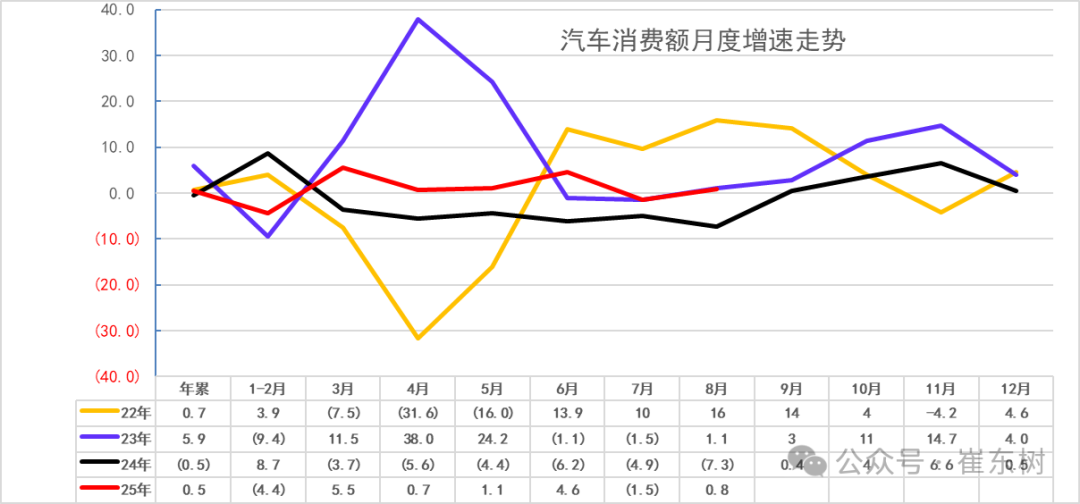
Core Insights - The automotive industry in China is experiencing significant growth, particularly in the production and sales of new energy vehicles (NEVs), driven by government policies and changing consumer preferences [1][2][20]. Group 1: Automotive Production and Sales - In August 2025, automotive production reached 2.75 million units, an 11% year-on-year increase, with NEVs accounting for 1.33 million units produced, up 23% [1][18]. - For the first eight months of 2025, total automotive production was 20.83 million units, also reflecting an 11% increase year-on-year, with NEVs at 938,000 units, a 31% increase [1][18]. - The penetration rate of NEVs in the automotive market reached 48% in August 2025, indicating a strong shift towards electric vehicles [1][18]. Group 2: Consumer Spending and Economic Impact - The total retail sales of consumer goods in August 2025 amounted to 39,668 billion yuan, with automotive consumption contributing 4,093 billion yuan, a 1% increase year-on-year [1][27]. - The overall retail sales for the first eight months of 2025 were 323,906 billion yuan, growing by 4.6%, with automotive consumption at 31,263 billion yuan, reflecting a modest 0.5% increase [1][27]. - The decline in the real estate market since 2021 has positively impacted automotive consumption, which rose from 3.94 trillion yuan in 2020 to an expected 5.03 trillion yuan in 2024 [4][22]. Group 3: Investment Trends - Fixed asset investment in the automotive sector grew by 20.2% in the first eight months of 2025, significantly outpacing overall manufacturing investment [20][21]. - The automotive investment growth is attributed to the rising demand for NEVs, indicating a recovery in the sector after previous downturns [20][21]. Group 4: Industry Challenges and Future Outlook - The automotive industry faces challenges from a complex external environment, including unilateralism and protectionism, which threaten supply chain stability [2]. - Despite a strong performance in the first half of 2025, the industry anticipates a slowdown in growth rates in the latter half of the year, necessitating supportive policies to sustain consumer demand [2][8].
外交部:坚决反对在他人胁迫下以各种名目对华设限
Zhong Guo Xin Wen Wang· 2025-09-15 08:56
Core Viewpoint - The Chinese Ministry of Foreign Affairs firmly opposes any restrictions imposed on China under coercion, regardless of the justification, and emphasizes the importance of mutual benefit in China-Mexico economic cooperation [1] Group 1: Economic Globalization - China advocates for inclusive and beneficial economic globalization and opposes unilateralism, protectionism, and discriminatory measures [1] - The Ministry stresses the need to protect China's legitimate rights and interests based on actual circumstances [1] Group 2: China-Mexico Relations - Both China and Mexico are significant global southern countries, and their economic cooperation is characterized by mutual benefit and win-win outcomes [1] - China places high importance on the development of China-Mexico relations and hopes for Mexico to work together to maintain a favorable international economic environment [1]
美方又炒作“中国产能过剩”,外交部:为保护主义提供借口
第一财经· 2025-09-15 08:32
Core Viewpoint - The Chinese government firmly opposes the notion of "overcapacity" in China, arguing that it misrepresents objective facts and economic laws, and serves as a pretext for protectionism aimed at hindering China's high-quality development [1] Group 1 - The U.S. Democratic Party has requested the Trump administration to pressure China regarding its overcapacity issues, suggesting that any bilateral trade agreement should include binding requirements [1] - The Chinese spokesperson, Lin Jian, emphasized that the narrative of "Chinese overcapacity" is misleading and contradicts economic realities [1] - The underlying intention of such claims is perceived as an attempt to restrict China's economic growth and development [1]