
债市

Search documents
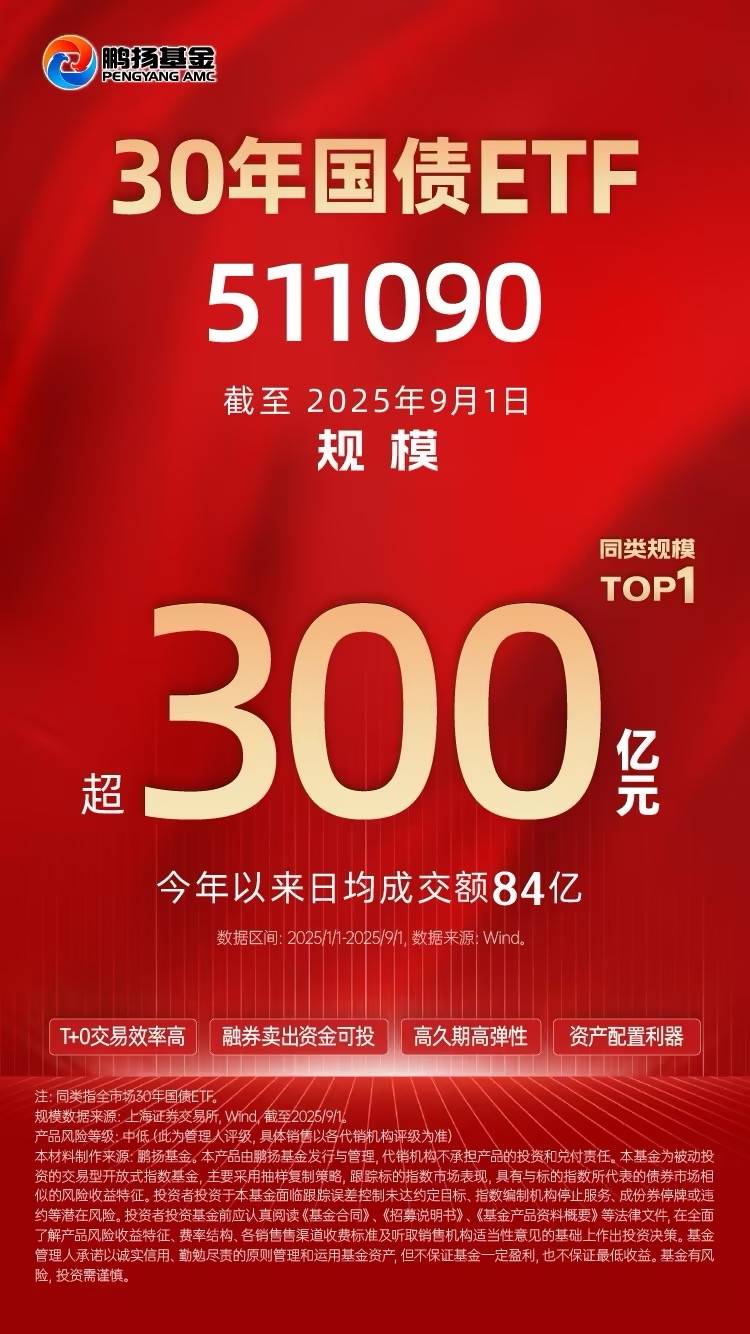
30年国债ETF(511090)红盘蓄势,规模首次突破300亿元创历史新高!
Sou Hu Cai Jing· 2025-09-02 02:40
Core Viewpoint - The 30-year Treasury ETF (511090) has reached a record high in both scale and shares, indicating strong investor interest and liquidity in the bond market despite potential challenges ahead [4][5]. Group 1: Market Performance - As of September 2, 2025, the 30-year Treasury ETF has increased by 0.10%, with the latest price at 120.74 yuan [4]. - The average daily trading volume for the ETF has been 10.593 billion yuan over the past week, with a total trading volume of 5.62 billion yuan on September 2 [4]. - The ETF's latest scale has reached 30.182 billion yuan, marking a new high since its inception [4]. Group 2: Fund Inflows and Investor Sentiment - The 30-year Treasury ETF has seen a net inflow of 252 million yuan recently, with a total of 1.352 billion yuan net inflow over the last five trading days [4]. - Analysts suggest that while the bond market may face headwinds, there are still investment opportunities available [5]. Group 3: Economic Outlook - The macroeconomic policy is shifting towards a "fiscal-led, monetary-supported" framework, which may lead to increased volatility in the bond market [5]. - The bond market is expected to enter a phase of central oscillation with increasing volatility, influenced by future fiscal measures and inflation fluctuations [5]. Group 4: Index Tracking - The 30-year Treasury ETF closely tracks the China Bond 30-Year Treasury Index, which consists of publicly issued 30-year treasury bonds [5].

2025年8月PMI点评:边际回升但压力仍存
Hua Yuan Zheng Quan· 2025-09-01 08:05
Report Industry Investment Rating - The report does not explicitly provide an investment rating for the industry. Core Viewpoints - In August, the three major PMI indices showed marginal improvements, but the manufacturing PMI remained below the boom-bust line. The overall expansion of enterprise production and business activities accelerated slightly, and the endogenous economic momentum continued to improve. However, the manufacturing PMI still needed continuous repair, and there was a risk of increased economic downward pressure in the second half of the year. Short-term bond markets might be suppressed by sentiment, but the bond market was expected to rise in September [2]. Summary by Related Content Manufacturing PMI - In August, the manufacturing PMI rose 0.1 pct month-on-month to 49.4%, staying below the boom-bust line for five consecutive months. The production and demand-related indices improved, and the price indices continued to rise, though the marginal increase weakened. The PMI of consumer goods industries decreased by 0.3 pct to 49.2%. The new export orders index and the import index were 47.2% and 48.0% respectively, up 0.1 pct and 0.2 pct month-on-month, indicating a possible improvement in foreign trade [2]. - The business climate of different types of enterprises continued to diverge. The PMIs of large and small enterprises increased by 0.5 pct and 0.2 pct respectively, reaching 50.8% and 46.6%. The small enterprises had been in the contraction range for 16 consecutive months. The PMI of medium-sized enterprises dropped 0.6 pct to 48.9% [2]. Non - manufacturing PMI - In August, the non-manufacturing business activity index was 50.3%, up 0.2 pct month-on-month. The non-manufacturing business climate had been at or above the critical point since January 2023, remaining relatively stable. The construction business activity index was 49.1%, down 1.5 pct month-on-month, possibly due to natural factors such as high temperatures and heavy rains. The service business activity index was 50.5%, up 0.5 pct month-on-month, reaching the highest value this year. The business activity expectation index remained at a relatively high level of 57.0%, up 0.4 pct month-on-month, indicating that enterprises were optimistic about the market outlook in September [2]. Economic Outlook and Bond Market - The economic negative cycle of "plummeting housing prices, plummeting stock markets - shrinking wealth - consumption downgrade" in the past two years might come to an end. However, there was still pressure on profit improvement, and the manufacturing PMI below the boom-bust line in August reflected growth pressure. Consumption and exports might face certain pressures in the second half of the year [2]. - The short-term bond market might be suppressed by sentiment, but the bond market was expected to rise in September. The economic downward pressure in the second half of the year might increase, and the central bank's continuous easing and banks' self - operated allocation needs provided support. After September, the net issuance of government bonds was expected to be no more than 25% of the annual plan, and the interest rate bonds might have a repair window. The report continued to be bullish on the 10Y treasury bond yield in the second half of the year, which was expected to be between 1.6% - 1.8%, and the 10Y treasury bond was considered to have high cost - effectiveness at around 1.8%. It was expected that the 10Y treasury bond yield would return to around 1.65% in the next six months, and the 5Y secondary capital bonds of state - owned and joint - stock banks would fall below 1.9% [2].
债市日报:9月1日
Xin Hua Cai Jing· 2025-09-01 07:52
Market Overview - The bond market showed a strong consolidation on September 1, with overall minor fluctuations in the morning and a recovery in the afternoon, leading to a slight decline in interbank bond yields [1] - The central bank conducted a net withdrawal of 105.7 billion yuan in the open market, with significant drops in funding rates at the beginning of the month [1] Bond Futures - All major bond futures closed higher, with the 30-year main contract rising by 0.30% to 116.910, the 10-year main contract up by 0.17% to 108.000, and the 5-year main contract increasing by 0.08% to 105.595 [2] - The yield on the 30-year government bond rose by 0.25 basis points to 2.02%, while the yields on the 10-year government bonds showed a slight decline [2] International Bond Market - In North America, U.S. Treasury yields were mixed, with the 10-year yield increasing by 2.31 basis points to 4.224% [3] - In Asia, Japanese bond yields generally rose, with the 10-year yield up by 1.9 basis points to 1.627% [3] - In the Eurozone, yields on 10-year bonds also increased, with French bonds rising by 3.4 basis points to 3.512% [3] Primary Market - The Agricultural Development Bank of China issued financial bonds with yields of 1.3785% for 91-day, 1.6741% for 3-year, and 1.7824% for 5-year bonds, with strong bid-to-cover ratios [4] Funding Conditions - The central bank conducted a 1,827 billion yuan reverse repo operation at a fixed rate of 1.40%, resulting in a net withdrawal of 105.7 billion yuan for the day [5] - Short-term Shibor rates fell across the board, with the overnight rate down by 1.6 basis points to 1.315%, marking a new low since September 2022 [5] Institutional Insights - There has been limited capital flow from the bond market to the stock market, with some redemption in pure bond funds but a general trend towards "fixed income plus" strategies [6] - The capital market's gradual improvement is expected to shift wealth allocation from deposits and fixed income towards equity assets, indicating a potential new cycle in wealth distribution [7]
利率周报:9月持续看多债市-20250831
Hua Yuan Zheng Quan· 2025-08-31 10:33
1. Report Industry Investment Rating - The report is bullish on the bond market in September [1][2][4][10][80] 2. Core Viewpoints of the Report - In July 2025, the profits of industrial enterprises in China showed marginal improvement, possibly related to the low base, but overall pressure remained. Manufacturing profits were the core driving force, with raw material manufacturing profits turning from decline to growth, and industries like steel and petroleum processing turning profitable, reflecting the stabilization of commodity prices and the effectiveness of supply - side reform [2][10][11][80] - The bond market may be suppressed by sentiment in the short term, but the report is consistently bullish on the bond market in September. The increasing economic downward pressure in the second half of the year, continuous central bank easing, and bank self - operated allocation demand will support the bond market. The peak of net government bond issuance this year has passed, and after September, the net issuance of government bonds may not exceed 25% of the annual plan, presenting a repair window for interest - rate bonds [2][4][10][80] 3. Summary According to the Table of Contents 3.1 Macro News - In July 2025, the operating income of large - scale industrial enterprises increased by 0.9% year - on - year, and 2.3% from January to July. The profits of large - scale industrial enterprises decreased by 1.5% year - on - year in July, with the decline narrowing by 2.8 pct compared to June. From January to July, profits decreased by 1.7% year - on - year, with the decline narrowing by 0.1 pct compared to the first half of the year. Manufacturing profits increased by 6.8% year - on - year in July, accelerating by 5.4 pct compared to June [11] - On August 28, the "Opinions of the Central Committee of the Communist Party of China and the State Council on Promoting High - quality Urban Development" was released, proposing to systematically promote the construction of "good houses" and complete communities [13] - On August 25 (Eastern Time), US President Trump announced the dismissal of Federal Reserve Governor Lisa Cook. Market bets on the Fed's policy easing continued to heat up, with traders expecting an over 80% probability of a rate cut in September [14] 3.2 Medium - term High - frequency Data 3.2.1 Consumption: Moderate Growth - As of August 24, the daily average retail volume of passenger car manufacturers was 60,000 vehicles, a year - on - year increase of 5.9%, and the daily average wholesale volume was 71,000 vehicles, a year - on - year increase of 2.0%. As of August 28, the total national movie box office revenue in the past 7 days was 976.06 million yuan, a year - on - year increase of 16.3% [15] 3.2.2 Transportation: Continued Activity - As of August 24, the container throughput of ports was 6.775 million twenty - foot equivalent units, a year - on - year increase of 14.8%. The postal express pick - up volume was 3.7 billion pieces, a year - on - year increase of 12.0%. The railway freight volume was 8.0868 million tons, a year - on - year increase of 5.5%, and the highway truck traffic volume was 5.5185 million vehicles, a year - on - year increase of 3.3% [22][23][29] 3.2.3 Operating Rates: Slight Monthly Decline but Year - on - Year Growth in the Infrastructure Chain - As of August 27, the blast furnace operating rate of major steel enterprises was 77.3%, a year - on - year increase of 2.8 pct. As of August 28, the average asphalt operating rate was 24.0%, a year - on - year increase of 1.0 pct [32] 3.2.4 Real Estate: Persistent Downturn - As of August 29, the total commercial housing transaction area in 30 large and medium - sized cities in the past 7 days was 1.889 million square meters, a year - on - year increase of 3.7% [40] 3.2.5 Prices: Differentiated - As of August 29, the average pork wholesale price was 20.0 yuan/kg, a year - on - year decrease of 27.4% and a 2.7% decrease compared to four weeks ago. The average vegetable wholesale price was 4.9 yuan/kg, a year - on - year decrease of 19.2% and an 11.1% increase compared to four weeks ago. The average spot price of iron ore was 791.5 yuan/ton, a year - on - year increase of 4.3% and a 0.2% increase compared to four weeks ago [45][51] 3.3 Bond and Foreign Exchange Markets: Loose Funds, Slight Differentiation in the Bond Market - On August 29, overnight Shibor was 1.33%, down 2.50 BP from August 25. The yields of 1 - year/5 - year/10 - year/30 - year government bonds were 1.37%/1.63%/1.84%/2.14% respectively, with changes of - 1.1BP/ - 0.3BP/+5.7BP/+6.0BP compared to August 22 [56][61] 3.4 Institutional Behavior: Continuous Decline in the Duration of Medium - and Long - Term Bond Funds for Interest - Rate Bonds - As of August 29, the estimated average duration of medium - and long - term interest - rate bond funds was about 5.1 years, a decrease of about 0.04 years compared to August 22. The estimated average duration of credit bond funds was about 2.8 years, a decrease of about 0.01 years compared to August 22 [76][77] 3.5 Investment Recommendations - The report is bullish on the bond market in September. The economic downward pressure in the second half of the year, central bank easing, and bank self - operated allocation demand will support the bond market. The report expects the 10Y government bond yield to be between 1.6% - 1.8% in the second half of the year, and believes that the current 10Y government bond is highly cost - effective. It is expected that the 10Y government bond yield will return to around 1.65% in the next six months, and the 5Y secondary capital bonds of national joint - stock banks will fall below 1.9%. Investors should cherish 5Y capital bonds with yields above 2% and 30Y government bonds [4][10][80]
社融增速或开始回落
Hua Yuan Zheng Quan· 2025-08-31 06:02
Group 1: Investment Ratings - No industry investment rating provided in the report Group 2: Core Views - Forecasts for August 2025 include 850 billion yuan in new loans, 2.6 trillion yuan in social financing, M2 reaching 331.4 trillion yuan with a YoY increase of 8.6%, new - caliber M1 YoY growth of 5.9%, and a social financing growth rate of 8.8% [2] - Predicts that new loans in August may be low due to weak credit demand, with expected individual loans of +18 billion, corporate loans of +70 billion, and non - bank inter - bank loans of - 5 billion. Also anticipates short - term individual loans of +10 billion, long - term individual loans of +8 billion, short - term corporate loans of - 20 billion, long - term corporate loans of +40 billion, and bill financing of +50 billion [3] - Expects the new - caliber M1 growth rate to rebound and the M2 growth rate to slightly decline in August. Forecasts the new - caliber M1 growth rate at 5.9% (up month - on - month) and the old - caliber M1 growth rate at 5.4% (up month - on - month), and the M2 growth rate at 8.6% (down slightly month - on - month) [3] - Suggests that the social financing growth rate may start to fall. Predicts a social financing increment of 2.6 trillion yuan in August (less than the 3.03 trillion yuan in August 2024), with the social financing growth rate at 8.8% at the end of August, down 0.2 percentage points month - on - month. Expects new loans (social financing caliber) to be slightly less year - on - year, government bond net financing to expand significantly year - on - year, and the social financing growth rate to rise first and then fall, reaching around 8.1% at the end of the year [3] - Recommends going long on the bond market in September, based on expectations of central bank easing, potential economic downturn in the second half of the year, and banks increasing bond allocation due to weak credit demand and falling liability costs. Suggests focusing on 10Y China Development Bank bonds, 30Y treasury bonds, and 5Y capital bonds [3] Group 3: Summary by Related Catalogs New Loans - Due to weak credit demand, new loans in the beginning of the quarter are usually low. The low 1 - month term transfer discount rate at the end of August reflects average credit issuance. Forecasts 850 billion yuan in new loans in August, close to the same period last year, with individual loans of +18 billion, corporate loans of +70 billion, and non - bank inter - bank loans of - 5 billion [3] M1 and M2 Growth Rates - Since January 2025, the central bank has used a new - caliber M1. Forecasts the new - caliber M1 growth rate at 5.9% and the old - caliber M1 growth rate at 5.4% at the end of August, both up month - on - month. Expects the M2 growth rate at 8.6% at the end of August, down slightly month - on - month [3] Social Financing - Predicts a social financing increment of 2.6 trillion yuan in August 2025, less than the 3.03 trillion yuan in August 2024. The decrease mainly comes from credit and government bond net financing. Expects 88 billion yuan in RMB loans to the real economy, +3 billion yuan in undiscounted bank acceptance bills, 15 billion yuan in corporate bond net financing, and 135 billion yuan in government bond net financing in August. Forecasts the social financing growth rate at 8.8% at the end of August, down 0.2 percentage points month - on - month, and anticipates it to reach around 8.1% at the end of the year [3] Bond Market - Recommends going long on the bond market in September, based on central bank easing, potential economic downturn in the second half of the year, and banks increasing bond allocation due to weak credit demand and falling liability costs. Suggests focusing on 10Y China Development Bank bonds, 30Y treasury bonds, and 5Y capital bonds [3]
30年国债ETF(511090)近5日“吸金”超20亿元,最新规模续创新高!
Sou Hu Cai Jing· 2025-08-29 06:11
Group 1 - The 30-year Treasury ETF (511090) has increased by 0.19%, with the latest price at 120.61 yuan, indicating active market trading [1] - The trading volume for the 30-year Treasury ETF reached 64.80 billion yuan, with a turnover rate of 21.69%, and an average daily trading volume of 117.88 billion yuan over the past week [1] - The latest scale of the 30-year Treasury ETF has reached 29.847 billion yuan, marking a new high since its inception, with the latest share count at 248 million shares [1] Group 2 - The net inflow of funds into the 30-year Treasury ETF is 3.81 billion yuan, with a total of 20.31 billion yuan net inflow over the last five trading days [1] - Institutions generally believe that the probability of a significant rise in interest rates is low, and the bond market is expected to show a "grinding top" trend in the short term [1] - The current 10-year Treasury yield has risen to over 1.78%, making it attractive for insurance and other institutional investors, which may limit the upward space for long-term interest rates [1] Group 3 - The People's Bank of China has shown intentions to support liquidity through reverse repos and large-scale MLF operations, which is expected to maintain a stable and loose liquidity environment [1]
债市日报:8月28日
Xin Hua Cai Jing· 2025-08-28 16:25
Market Overview - The bond market experienced fluctuations and a pullback on August 28, with government bond futures closing lower across the board, particularly in the long-end segment [1][2] - The interbank bond yield rose by approximately 2 basis points, indicating a shift in market sentiment [1][2] Bond Yield Movements - The 30-year government bond yield increased by 2.1 basis points to 2.015%, while the 10-year government bond yield rose by 2 basis points to 1.875% [2] - The 10-year government bond with interest saw a yield increase of 1.25 basis points to 1.7775% [2] Market Activity - The China Securities Convertible Bond Index rose by 0.19%, with a trading volume of 110.826 billion yuan [2] - Notable gainers in the convertible bond market included Chongda Convertible Bond and Weida Convertible Bond, with increases of 12.03% and 11.29% respectively [2] International Bond Market - In North America, U.S. Treasury yields fell across the board, with the 2-year yield dropping by 6.19 basis points to 3.611% [3] - In Asia, Japanese bond yields mostly declined, with the 10-year yield down by 0.9 basis points to 1.619% [3] - In the Eurozone, the 10-year French bond yield rose by 2 basis points to 3.516%, while the 10-year German bond yield fell by 2.3 basis points to 2.698% [3] Primary Market Results - The China Development Bank's 3-year and 7-year financial bonds had winning yields of 1.6355% and 1.8209%, respectively, with bid-to-cover ratios of 2.87 and 4.28 [4] - Inner Mongolia's local bonds showed strong demand, with bid-to-cover ratios exceeding 23 times for both 10-year and 15-year bonds [4] Liquidity and Funding - The People's Bank of China conducted a reverse repurchase operation of 416.1 billion yuan at a rate of 1.40%, resulting in a net injection of 163.1 billion yuan for the day [5] - Short-term Shibor rates increased, with the overnight rate rising by 0.1 basis points to 1.316% [5] Institutional Insights - CITIC Securities noted that the bond market is experiencing a bear steepening phase, driven by market sentiment rather than economic fundamentals [7] - Longjiang Fixed Income highlighted the diversification of funding sources in the convertible bond market, with banks and insurance funds playing a significant role [7] - Guosheng Fixed Income pointed out that recent market adjustments have made short-term brokerage subordinated bonds more attractive, suggesting a focus on investment value in this segment [7]
2025年7月工业企业利润点评:工业企业盈利水平持续好转,去库存加速
KAIYUAN SECURITIES· 2025-08-28 12:44
1. Report Industry Investment Rating No relevant content provided. 2. Core Viewpoints of the Report - In the second half of 2025, the economic growth rate is not expected to decline significantly, and structural issues such as prices are trending towards improvement [10]. - The allocation between stocks and bonds continues to shift, with bond yields and the stock market expected to rise continuously [10]. - Against the backdrop of revised economic expectations, bond yields are expected to rise trend - wise [9]. 3. Summary by Relevant Catalogs Profit - The cumulative and monthly year - on - year declines in industrial enterprise profits have both narrowed. From January to July, the profits of above - scale industrial enterprises decreased by 1.7% year - on - year, an increase of 0.1 percentage points compared to January - June. In July, the profits of above - scale industrial enterprises decreased by 1.5% year - on - year, an increase of 2.8 percentage points compared to June, indicating continuous improvement in corporate profitability [5]. - Analyzing industrial enterprise profits from the aspects of volume, price, and profit margin, from January to July, the added value of above - scale industries increased by 6.3% year - on - year, and the PPI of all industrial products decreased by 2.9% year - on - year, both decreasing by 0.1 percentage points compared to January - June. The profit margin of above - scale industrial revenue decreased by 4.63% year - on - year, an increase of 0.18 percentage points compared to January - June. The recovery of the profit margin drove the narrowing of the decline in industrial profits [5]. Structure By Industry Category - From January to July, the total profit of the mining industry decreased by 31.6% year - on - year, the profit of the manufacturing industry increased by 4.8% year - on - year, and the profit of the public utilities industry increased by 3.9% year - on - year. The expansion of the profit decline in the mining industry was due to anti - involution and frequent extreme summer weather, while the expansion of the profit increase in the public utilities industry was affected by the widespread high - temperature weather in July [6]. - In July, the profit of the manufacturing industry increased by 6.8% year - on - year, a 5.4 - percentage - point increase compared to June, driving the growth rate of the profits of above - scale industrial enterprises to accelerate by 3.6 percentage points compared to June. The profit of high - tech manufacturing changed from a 0.9% decline in June to an 18.9% increase, driving the growth rate of the profits of above - scale industrial enterprises to accelerate by 2.9 percentage points compared to June [6]. By Enterprise Nature - From January to July, the profits of state - owned enterprises decreased by 7.5% year - on - year, the profits of joint - stock enterprises decreased by 2.8% year - on - year, the profits of foreign - invested and Hong Kong, Macao, and Taiwan - invested enterprises increased by 1.8% year - on - year, and the profits of private enterprises increased by 1.8% year - on - year [7]. - In July, the profits of medium - sized enterprises above designated size increased by 1.8% year - on - year, and the profits of small enterprises increased by 0.5% year - on - year, showing significant improvement in efficiency. The monthly profit of private enterprises increased by 2.6% year - on - year, 4.1 percentage points higher than the average level of the profits of above - scale industrial enterprises [7]. By Industrial Chain Position - From January to July, the proportion of the cumulative profit of upstream raw material mining in the profits of above - scale industrial enterprises was 12.3%, the proportion of mid - stream material manufacturing was 15.4%, the proportion of downstream equipment manufacturing was 38.0%, the proportion of downstream consumer goods manufacturing was 21.1%, the proportion of other manufacturing was 0.6%, and the proportion of public utilities was 12.5% [7]. - Inventory destocking accelerated. At the end of July, the nominal and real inventory year - on - year were 2.4% and 6.0% respectively, both decreasing by 0.7 percentage points. The overall asset - liability ratio of industrial enterprises at the end of July was 57.9%, remaining flat month - on - month [7]. Market - The industrial enterprise profit data was released at 9:30. Although the cumulative and monthly year - on - year declines in industrial enterprise profits both narrowed, the bond market did not trade based on this data, and bond yields fluctuated within a narrow range. After the mid - day break, the A - share market rose first and then fell back, with heavy trading volume and a decline. Under the stock - bond seesaw effect, bond yields first rose and then fell. At the end of the session, due to redemption factors, funds changed from buying to selling, and coupled with tightening funds, bond yields rose again [8].
广发期货日评-20250827
Guang Fa Qi Huo· 2025-08-27 07:31
1. Report Industry Investment Ratings No specific industry investment ratings are provided in the report. 2. Core Viewpoints - The A-share market is expected to enter a high-level oscillation phase, waiting for a direction decision. It is recommended to buy put options to protect long positions or partially take profits on previous positions [2]. - The bond market sentiment is expected to continue to stabilize, and it is advisable to lightly test long positions on bond futures during pullbacks [2]. - Gold is oscillating strongly, and it is recommended to buy gold options and construct a bull spread strategy. Silver long positions should be held above $38 [2]. - The container shipping index is weakly oscillating, and short positions on the October contract should be continued [2]. - For steel products, it is possible to try long positions as the apparent demand has stopped falling and rebounded. For iron ore, coking coal, coke, etc., it is recommended to go long at low prices [2]. - For non-ferrous metals, copper is expected to see inventory depletion near the peak season, and it is recommended to refer to the price range. For other non-ferrous metals, different trading strategies are given according to their respective fundamentals [2]. - In the energy and chemical sector, different trading strategies are provided for each variety based on their supply and demand, cost, and other factors [2]. - In the agricultural products sector, different trading strategies are recommended for each variety according to their market conditions [2]. - For special commodities, trading strategies such as taking partial profits on previous short positions and going short at high prices are proposed [2]. - In the new energy sector, it is recommended to wait and see for polysilicon and lithium carbonate [2]. 3. Summary by Relevant Catalogs Financial Sector - **Stock Index Futures**: A-share market is expected to enter high-level oscillation. It is recommended to buy put options to protect long positions or partially take profits on previous positions [2]. - **Bond Futures**: Bond market sentiment is expected to continue to stabilize. It is advisable to lightly test long positions on bond futures during pullbacks [2]. - **Precious Metals**: Gold is oscillating strongly. It is recommended to buy gold options and construct a bull spread strategy. Silver long positions should be held above $38 [2]. Commodity Sector - **Shipping Index**: The container shipping index is weakly oscillating, and short positions on the October contract should be continued [2]. - **Steel and Iron Ore**: For steel products, it is possible to try long positions as the apparent demand has stopped falling and rebounded. For iron ore, it is recommended to go long at low prices in the range of 770 - 820 [2]. - **Coking Coal and Coke**: Due to a sudden mine accident and partial coal mine shutdowns, coking coal futures are expected to rebound. It is recommended to go long at low prices. Coke is also recommended to go long at low prices as the coking profit continues to repair [2]. - **Non-Ferrous Metals**: Copper is expected to see inventory depletion near the peak season. Different trading strategies are given for other non-ferrous metals according to their fundamentals [2]. - **Energy and Chemicals**: Different trading strategies are provided for each variety based on their supply and demand, cost, and other factors, such as going long, shorting, or waiting and seeing [2]. - **Agricultural Products**: Different trading strategies are recommended for each variety according to their market conditions, such as going long, shorting, or waiting and seeing [2]. - **Special Commodities**: Trading strategies such as taking partial profits on previous short positions and going short at high prices are proposed [2]. - **New Energy**: It is recommended to wait and see for polysilicon and lithium carbonate [2].
国债期货:股市回调期债继续回升 超长债涨幅居前
Jin Tou Wang· 2025-08-27 02:11
Market Performance - Government bond futures closed higher across the board, with the 30-year main contract rising by 0.47%, the 10-year main contract increasing by 0.06%, the 5-year main contract up by 0.04%, and the 2-year main contract gaining 0.01% [1] - The yields on major interbank bonds generally declined, with the 50-year government bond "25 Long Special Government Bond 03" yield down by 2.75 basis points to 2.10%, the 30-year government bond "25 Long Special Government Bond 02" yield down by 1.75 basis points to 1.98%, the 10-year policy bank bond "25 Policy Bank 10" yield down by 0.7 basis points to 1.84%, and the 10-year government bond "23 Coupon Government Bond 11" yield down by 0.85 basis points to 1.7560% [1] Funding Conditions - The central bank announced a 7-day reverse repurchase operation of 405.8 billion yuan at a fixed rate of 1.40% on August 26, with 580.3 billion yuan of reverse repos maturing on the same day, resulting in a net withdrawal of 174.5 billion yuan [2] - The interbank market remains liquid, with the overnight repo weighted average rate dropping over 3 basis points to around 1.31%, and non-bank institutions' pledged certificates and credit bonds borrowing overnight quoted around 1.4%, with seven-day rates at approximately 1.51-1.52%, slightly lower than the previous day [2] - The central bank's continued support has led to a return to a stable and loose liquidity environment, with expectations for a smooth transition across month-end [2] Operational Suggestions - The stock market experienced a pullback, while the bond market's response to stock market fluctuations has softened, coupled with a loosening funding environment, leading to a continued recovery in bond market sentiment [3] - The 10-year government bond yield is expected to face resistance around 1.78%-1.80%, with corresponding support for the T2512 contract in the range of 107.4-107.6, although short-term market expectations may still experience volatility [3] - A strategy of light long positions on bond futures during pullbacks is suggested [3]