
消费提振

Search documents
“魅力新郑 乐享生活”2025新郑暑期消费季活动盛大开幕
Sou Hu Cai Jing· 2025-07-12 11:44
Core Viewpoint - The "Charming Xinzheng · Enjoy Life" 2025 Xinzheng Summer Food Consumption Season aims to stimulate consumer activity and promote the integration of culture, tourism, and commerce through a series of events and activities [1][3]. Group 1: Event Overview - The event is organized by the Xinzheng Cultural, Radio, Television, Tourism, and Sports Bureau and will take place from July 11 to July 20, lasting for 10 days [1]. - The main theme of the event is "Food + Culture + Commerce," featuring the innovative "Xinzheng Beer" element and showcasing various cultural activities [3]. Group 2: Highlights of the Event - The event features three main highlights: 1. Full-area collaboration with the main venue and various sub-venues offering special promotions from numerous restaurants, allowing residents to enjoy local cuisine [7]. 2. Cultural empowerment through immersive experiences, combining intangible cultural heritage performances with traditional music and food [7]. 3. Integration of commerce and tourism to boost the economy, using food to drive tourism consumption and activate the nighttime economy [7].


中国迈向超大体量的“消费大国”
Zhong Guo Xin Wen Wang· 2025-07-11 16:59
Core Viewpoint - China is transitioning from a manufacturing powerhouse to a major consumer market, aiming to enhance domestic consumption as a key driver of economic growth [2][4][9]. Group 1: Current Economic Landscape - China has a consumption scale of nearly 50 trillion yuan, over 50 trillion yuan in investments, and more than 20 trillion yuan in imports, making it the second-largest consumer and import market globally [2]. - In 2024, the contribution of final consumption expenditure to economic growth is projected to be only 44.5%, significantly lower than the global average of 56.5% [3]. - The current economic environment faces challenges of insufficient effective demand, particularly in consumption, necessitating stronger consumer spending to drive growth [3]. Group 2: Strategic Importance of Becoming a Consumer Power - Transitioning to a consumer economy is a strategic move to mitigate external risks, especially given the volatility in global trade and tariffs imposed by the U.S. [4]. - A mature consumer market enhances China's influence in global trade, affecting international market dynamics and improving China's global economic standing [4]. - Boosting domestic consumption is essential for achieving high-quality economic development and creating diverse market demands, which will stimulate various sectors and generate employment [4]. Group 3: Policy Initiatives for Consumption Growth - The Chinese government is shifting macroeconomic policies to focus on improving livelihoods and promoting consumption, with a strong emphasis on expanding domestic demand [5]. - Key measures include increasing residents' income through various channels, enhancing social security systems, and optimizing the consumption environment to boost consumer confidence [6][7]. - The government is also working on supply-side upgrades to meet the growing demand for personalized and quality consumption [7]. Group 4: Structural Reforms - Long-term reforms, such as adjusting the consumption tax system and promoting a unified national market, are crucial for stimulating local consumption and balancing investment and consumption [8]. - The recent policy changes aim to empower local governments to promote consumption actively, addressing the historical bias towards investment over consumption [8]. Group 5: Future Outlook - The shift from a manufacturing to a consumer economy is seen as an inevitable trend in China's economic development, crucial for improving the well-being of its citizens [9][10]. - This transformation is expected to reshape the future of China's economy significantly, aligning with broader global economic interactions [10].
北京力争到2030年市场总消费额年均增长5%左右
Zhong Guo Xin Wen Wang· 2025-07-11 05:27
Core Viewpoint - The "Beijing Deepening Reform to Boost Consumption Special Action Plan" aims to achieve an average annual growth of around 5% in total market consumption by 2030, establishing 2-3 new consumption landmarks worth over 100 billion yuan, and enhancing Beijing's role as an international consumption center [1] Group 1: Promoting Income Growth and Reducing Burdens - The plan emphasizes implementing an employment-first strategy to drive income growth for urban and rural residents, particularly focusing on supporting college graduates and flexible employment [2] - Measures will be taken to improve the minimum wage standards and promote agricultural income through modern agriculture and rural tourism [2] - A public service guarantee mechanism will be established to enhance elderly care services and support for child-rearing, alongside improving financial services for the elderly [2] Group 2: Optimizing Service Consumption Experience - The plan aims to explore new cultural and entertainment consumption by revitalizing historical cultural sites and supporting online performances and exhibitions [3] - It includes initiatives to develop new tourism consumption scenarios and promote major projects like the second phase of Universal Studios [3] - The focus will also be on enhancing sports consumption by cultivating high-value international and local events [3] Group 3: Enhancing Product Consumption Momentum - The plan seeks to elevate the "Jingcai Four Seasons" city consumption brand and promote themed consumption activities monthly [5] - It encourages the development of international food brands and supports the establishment of flagship restaurants in Beijing [5] - The initiative includes creating unique dining experiences and promoting the integration of dining with various public spaces [5] Group 4: Creating Diverse and Integrated Spaces - The plan emphasizes revitalizing commercial spaces through innovative operational models and mixed-use developments [7] - It aims to enhance the consumption capacity of the "dual hubs" by leveraging airport resources and expanding international passenger services [7] - Support will be provided for the expansion of duty-free shops and cross-border e-commerce initiatives [7]
北京:鼓励金融机构加大对消费重点领域的信贷支持力度
news flash· 2025-07-10 03:50
Group 1 - The Beijing Municipal Government has issued a notice on the "Beijing Deepening Reform to Boost Consumption Special Action Plan" [1] - The plan emphasizes increasing support and guidance, implementing the "two new" policies, and actively seeking central funding support across various sectors [1] - There will be an increase in fixed asset investment support from the municipal government [1] Group 2 - The initiative aims to improve service quality standards and establish a comprehensive quality safety traceability system [1] - It includes measures to facilitate consumer rights protection and promote the "Beijing Shopping" brand [1] - The plan encourages hosting eligible promotional consumption activities and actively attracting high-level consumption projects [1] Group 3 - Financial institutions are encouraged to increase credit support for key consumption areas and develop financial products that meet the needs of new consumption formats [1] - The plan supports the issuance of Real Estate Investment Trusts (REITs) for qualifying consumption infrastructure [1]
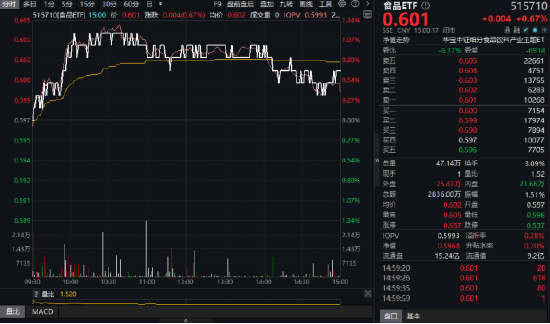
吃喝板块逆市拉升!“茅五泸汾洋”齐涨,食品ETF(515710)摸高1.34%!板块估值触近十年大底
Xin Lang Ji Jin· 2025-07-09 12:22
Group 1 - The food and beverage sector continues to show upward momentum, with the Food ETF (515710) experiencing a peak intraday increase of 1.34% before closing up 0.67% [1][3] - The Food ETF (515710) exhibited a notable premium at the close, with a closing premium rate of 0.28%, indicating strong buying interest [3] - Key stocks in the sector, such as Yanjing Beer, Shanxi Fenjiu, and Wuliangye, showed significant gains, with Yanjing Beer rising by 2.22% and several others increasing by over 1% [3] Group 2 - After a significant prior correction, the food and beverage sector is stabilizing, with Guangfa Securities suggesting that the liquor industry may see a "valuation-earnings" double bottom by 2025, indicating a potential mid-cycle buying point [3][4] - The current dividend yield of the sector compared to the ten-year government bond yield suggests attractive value for investors, especially as the sector's valuation has reached a near 10-year low [3][4] - As of July 8, the price-to-earnings ratio of the Food ETF's underlying index was 19.83, placing it in the 2.94% percentile of the past decade, highlighting its long-term investment appeal [3] Group 3 - Looking ahead, Guosen Securities notes that since September 24, 2024, macro policies have increasingly focused on boosting consumption, with a special action plan aimed at expanding domestic demand [4] - The food and beverage sector is expected to benefit from these consumption-boosting policies, with a gradual recovery in consumer demand anticipated [4] - Hu Long Securities predicts that the revenue and net profit growth rates for the food and beverage industry will slow in the first quarter of 2025, with significant performance differentiation among sub-sectors [4] Group 4 - The Food ETF (515710) tracks the CSI segmented food and beverage industry theme index, with approximately 60% of its holdings in leading high-end and mid-range liquor stocks, and nearly 40% in beverages, dairy, and seasoning stocks [5] - The top ten weighted stocks in the ETF include major brands such as Moutai, Wuliangye, and Yili, indicating a strong focus on core assets within the sector [5]




提振消费再发力 服务消费潜力足
Zhong Guo Qing Nian Bao· 2025-07-07 20:45
Core Insights - The article emphasizes the significant potential for service consumption growth in China, contrasting it with the limitations of durable goods consumption due to their longer lifespan and lower replacement frequency [1][3][4]. Group 1: Service Consumption Growth - The Chinese economy is witnessing a shift towards service consumption, driven by policy support and the release of pent-up demand, particularly in sectors like elderly care and healthcare due to an aging population [2][4]. - From January to May this year, service retail sales increased by 5.2% year-on-year, outpacing the growth of goods retail sales by 0.1 percentage points [2]. - The report highlights that service consumption is expected to continue to support economic growth, especially with more holidays this year compared to last [2]. Group 2: Employment and Economic Impact - Service consumption is crucial for job creation, with nearly 70 million people employed in service sectors like dining, entertainment, and tourism, surpassing the 60 million in manufacturing [3]. - The increase in service consumption frequency can significantly boost economic activity, as consumers may shift from dining out once a month to weekly, tripling their spending frequency [3]. - The positive cycle of increased service consumption leading to more jobs and higher consumer spending capacity is emphasized as a key economic driver [3]. Group 3: Policy Support and Financial Initiatives - Recent government policies, including the issuance of consumption vouchers and financial support for service sectors, aim to stimulate service consumption [2][6]. - The central bank and six departments have prioritized service consumption in their financial support initiatives, encouraging loans to various service sectors [6]. - A total of 500 billion yuan is allocated for service consumption loans, with a focus on enhancing the quality and efficiency of service supply [6].

二季度北京购物中心存量升至1686万平方米
Bei Jing Ri Bao Ke Hu Duan· 2025-07-07 08:03
Group 1: Office Market Insights - In Q2, Beijing's office market saw a continued narrowing of rental declines, with no new supply entering the market, maintaining a total stock of 13.68 million square meters of Grade A office space [1] - Lease renewals accounted for 29.2% of total leasing transactions in the quarter, with the TMT sector leading new leases at 55%, followed by professional services at 13.1%, and finance at 10.9% [1] - The vacancy rate is expected to continue decreasing in the second half of the year due to ongoing market absorption, with no new supply anticipated until 2026-2028, when approximately 1.8 million square meters will be introduced [1] Group 2: Retail Market Developments - The retail market in Beijing added 200,000 square meters of quality retail space from three new projects, bringing the total shopping center stock to 16.86 million square meters [2] - Ongoing renovations and upgrades are being supported by government policies, with several projects like the Beijing Huadong New Chenhui and Beijing Shuang'an Mall completing regional upgrades [2] - Five new quality retail projects are expected to add over 500,000 square meters of retail space in the second half of the year, focusing on suburban developments and traditional shopping area upgrades [2]
“书记带头消费”引爆流量,荣昌再续泼天富贵
2 1 Shi Ji Jing Ji Bao Dao· 2025-07-04 11:35
Core Insights - The article highlights the recent surge in consumer activity and tourism in Rongchang, driven by local government initiatives and the popularity of local businesses, particularly restaurants and traditional food products [2][4][10]. Group 1: Economic Growth and Consumer Behavior - Rongchang's GDP is projected to grow by 6.6% in 2023 and 5.8% in 2024, surpassing the average growth rates of Chongqing and the national level [4]. - The area has seen a significant increase in consumer spending, with a 40% year-on-year growth in housing sales and a 27% increase in automobile consumption from early April to mid-May [8]. - The local government has actively encouraged consumption, leading to a notable increase in deposits, which rose by 5.8 billion yuan in the first four months of the year [8][9]. Group 2: Local Business and Tourism - Rongchang has transformed into a "net celebrity" destination, with local eateries gaining popularity after being frequented by high-profile local officials [2][3]. - The local food industry, particularly the Rongchang braised goose, has seen a boom, with over 100 new businesses opening in recent months [7][10]. - The government has implemented strategies to enhance tourism, including opening public canteens and providing free parking during holidays, resulting in over 330 million visitors and 2.6 billion yuan in tourism revenue during recent holidays [2][4]. Group 3: Industry Development and Investment - Rongchang is focusing on industrial upgrades, with significant investments in the electronic information, pharmaceutical, and food processing sectors, which have all shown remarkable growth [4][24]. - The local government is actively promoting the development of the Rongchang braised goose industry, aiming for industrialization and brand recognition, with plans to establish an industrial park for the goose industry [20][23]. - Recent investments from external companies in sectors like automotive components and new materials indicate a growing interest in Rongchang's business environment [23][26].
盛松成:新生、丰富、高层次的消费需求能够引导出高质效的投资,消费需求对供给的促进更有效、更直接 | 宏观经济
清华金融评论· 2025-07-03 11:03
Core Viewpoint - The article emphasizes the importance of boosting consumption not only as a means to adjust total demand and stimulate growth in the short term but also as a way to generate new, diverse, and high-level consumption demands that can guide high-quality investments [1][4]. Group 1: Consumption Potential - China's consumption rate in 2024 is projected to be only 56.6%, significantly lower than the 70%-80% typical in developed countries, indicating substantial room for growth [2]. - The relationship between consumption and economic growth is highlighted, with rising per capita GDP and disposable income correlating with increased consumption rates. China's current per capita GDP is approximately $13,000, suggesting a considerable gap compared to developed nations [2][3]. - Income distribution is a critical factor affecting consumption potential, with data showing that developed countries had an average consumption rate of around 73% when their per capita GDP was similar to China's current level [3]. Group 2: Role of Consumption in Economic Growth - Consumption is expected to play a more significant role in this year's economic growth, especially given the uncertainties in external trade and the diminishing marginal returns of traditional investments [5][6]. - The article argues that consumption and investment are not mutually exclusive but rather mutually reinforcing, with consumption driving production, employment, and investment [5][6]. Group 3: Policy Measures to Boost Consumption - Policies aimed at stimulating consumption have shown positive results, with retail sales growing by 5.0% year-on-year from January to May 2023, and a 6.4% increase in May alone [7]. - To enhance consumer willingness, improving income redistribution is suggested as a key measure, as the current low share of disposable income among residents limits consumption growth [7][8]. - Specific recommendations include lowering tax rates for middle and low-income groups, which could provide a stable cash flow and enhance consumption [8]. Group 4: Service Sector and Foreign Investment - The article discusses the potential for service sector growth through foreign investment, drawing parallels with past manufacturing sector reforms that improved productivity and competitiveness [9][10]. - Encouraging foreign investment in services like education and healthcare could stimulate competition, break monopolies, and enhance service quality, ultimately releasing more consumption potential [9][10]. Group 5: Local Government's Role - Local governments are increasingly important in stimulating consumption, with suggestions to include consumption targets in their performance assessments [12][13]. - Optimizing the value-added tax distribution mechanism is proposed to enhance local governments' incentives to promote consumption, which could lead to more effective consumer policies [12][13].

利率周报:经济的边际变化或在于消费-20250701
Hua Yuan Zheng Quan· 2025-07-01 10:57
1. Report Industry Investment Rating No relevant information provided in the report. 2. Core Viewpoints of the Report - The current economic operation is in a neutral range, and the marginal change in the economy compared to 2024 may lie in consumption [2][104]. - The negative economic cycle of "sharp decline in housing prices, sharp decline in the stock market - wealth shrinkage - consumption downgrade" in the past two years has come to an end [2][104]. - Pay attention to the progress of future China - US trade negotiations and whether the fentanyl tariff can be reduced to 0, as well as possible policy adjustments for weak business reception activities that may affect consumption [2][104]. 3. Summary According to the Table of Contents 3.1 Macro News - On June 24, six departments including the People's Bank of China jointly issued the "Guiding Opinions on Financial Support for Boosting and Expanding Consumption", which aims to activate markets such as automobiles, culture and tourism, and elderly care through various measures [8]. - On June 26, the Financial Regulatory Administration and others issued the "Implementation Plan for the High - Quality Development of Inclusive Finance in the Banking and Insurance Industries", aiming to build a high - quality inclusive finance system and solve the financing problems of small and micro enterprises, "agriculture, rural areas, and farmers", and new citizens [8]. - The second - quarter meeting of the Monetary Policy Committee of the People's Bank of China in 2025 was held on June 23. It was more cautious about the world economic growth momentum and more optimistic about the domestic economy. The probability of a recent reserve requirement ratio cut and interest rate cut is low [8]. - From January to May 2025, the total profit of industrial enterprises above designated size was 2.72 trillion yuan, a year - on - year slight decrease of 1.1%. However, the profit structure had highlights, with the profit of the equipment manufacturing industry increasing by 7.2% [9][10]. - Israel and Iran announced a formal cease - fire, leading to a significant decline in domestic and international oil prices recently [13]. 3.2 Medium - term High - Frequency: Consumption and Production Show Differentiated Recovery Characteristics 3.2.1 Consumption: Policy Stimulus Shows Remarkable Results - As of the week of June 22, the average daily retail volume of passenger car manufacturers increased by 30.0% year - on - year, and the average daily wholesale volume increased by 1.4% year - on - year [16][19]. - As of the week of June 13, the retail volume and retail amount of three major household appliances increased by 24.6% and 13.5% year - on - year respectively [16][25]. 3.2.2 Transportation: Supply Chain Resilience is Prominent - As of the week of June 22, the container throughput of ports increased by 5.3% year - on - year, railway freight volume increased by 2.4% year - on - year, and highway truck traffic volume increased by 0.7% year - on - year [17][27]. - As of the week of June 22, the number of civil aviation flights guaranteed increased by 1.7% year - on - year, and as of June 27, the average passenger volume of subways in first - tier cities in the past 7 days increased by 2.3% year - on - year [17][36]. 3.2.3 Capacity Utilization: Infrastructure Chain is Stronger than Chemical Chain - As of June 25, the blast furnace capacity utilization rate of major steel enterprises nationwide was 77.6%, a year - on - year increase of 2.2 pct, and as of June 26, the average asphalt capacity utilization rate was 25.0%, a year - on - year increase of 1.0 pct [17][49]. - As of June 26, the soda ash capacity utilization rate was 85.7%, a year - on - year decrease of 1.6 pct, and the PVC capacity utilization rate was 74.9%, a year - on - year decrease of 1.5 pct [17][53]. 3.2.4 Real Estate: Continuously Under Pressure - As of June 27, the transaction area of commercial housing in 30 large and medium - sized cities in the past 7 days increased by 0.5% year - on - year, and the number of transactions decreased by 2.0% year - on - year [18][62]. - As of June 22, the listing price index of second - hand houses in national cities decreased by 7.5% year - on - year [18][67]. 3.2.5 Price: Commodity Prices are Under Pressure - As of June 27, the average wholesale price of pork decreased by 16.8% year - on - year, and the average wholesale price of vegetables decreased by 0.8% year - on - year [18][75]. - As of June 27, the average spot price of WTI crude oil was 67.4 US dollars per barrel, a year - on - year decrease of 17.0% [18][81]. 3.3 Bond Market and Foreign Exchange Market: Structural Easing Coexists with Cross - Month Pressure - On June 27, the yields of 1 - year, 5 - year, 10 - year, and 30 - year treasury bonds were 1.35%, 1.51%, 1.65%, and 1.85% respectively, with changes of - 1.0BP, + 0.3BP, + 0.6BP, and + 1.3BP compared to June 20 [2][89]. - On June 27, the central parity rate and spot exchange rate of the US dollar against the Chinese yuan were 7.16/7.17, down 68/147 pips compared to June 20 [94]. 3.4 Institutional Behavior: The Duration of Credit Bond Funds has Decreased - As of June 29, the net - breaking rate of public wealth management products of wealth management companies was about 0.81%, a decrease of 1.16 pct compared to the beginning of the year, and the current net - breaking rate's percentile within the year was below 5% [96]. - As of June 27, the median and average duration of medium - and long - term pure bond funds for interest - rate bonds were about 4.7 years and 5.1 years respectively, an increase of about 0.12 years compared to the previous week; the median and average duration of medium - and long - term pure bond funds for credit bonds were about 1.9 years and 2.1 years respectively, a decrease of about 0.19 years compared to the previous week [97][98]. 3.5 Investment Suggestions - Be bullish on long - duration urban investment bonds and bank capital bonds with a yield of over 2%. Currently, the yield of 10Y treasury bonds is close to a historical low, and the cost - effectiveness of investing in interest - rate bonds is low. Among interest - rate bonds, local bonds have a higher cost - effectiveness than treasury bonds [104]. - Continue to pay attention to Hong Kong - listed banks. The low interest rates in the domestic market may drive up the valuations of high - dividend stocks [104].