
美元走势

Search documents
若美联储今年降息,如此罕见的“通胀与降息”组合,上一次是在2007年下半年
Hua Er Jie Jian Wen· 2025-08-14 08:21
Core Viewpoint - The market anticipates a rare scenario where the Federal Reserve may cut interest rates while inflation rises, with a near 100% probability of a 25 basis point cut in September and at least two cuts expected for the remainder of the year [1][3] Group 1: Inflation and Interest Rate Dynamics - The report indicates that even with a modest month-on-month CPI increase of 0.1%, the year-on-year CPI could rise to approximately 2.9% by the end of the year, up from 2.3%-2.4% in the first half [1][3] - Historically, the combination of rising inflation and falling interest rates is rare, occurring only 16% of the time since 1973 [1][7] - The analysis suggests that the core PCE price index may show an upward trend in year-on-year metrics even earlier than the CPI [5] Group 2: Historical Context and Market Reactions - The last occurrence of the Fed cutting rates amid rising inflation was from late 2007 to early 2008, driven by rising energy and food prices impacting overall inflation [7] - In scenarios where inflation rises while rates fall, the dollar typically depreciates, with an average decline of 1.6% over six months [8] - The dollar's performance in 2025 is expected to correlate closely with the trends observed in 2007, potentially leading to the largest annual decline since 1999 [8] Group 3: Currency Pair Sensitivity - The USD/JPY currency pair, which is highly sensitive to U.S. interest rates, is likely to experience the most significant declines in this scenario [10]

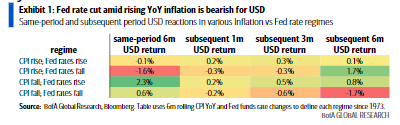
荷兰国际:即使通胀超预期 美元亦不可能持续上涨
Sou Hu Cai Jing· 2025-08-12 11:00
Core Viewpoint - The report by ING analyst Francesco Pesole suggests that the upcoming US inflation data may exceed expectations, but any potential rise in the dollar is likely to be temporary [1] Group 1: Inflation Data - ING anticipates that the core inflation rate for July will rise by 0.4% month-on-month, surpassing the general expectation of 0.3% among economists [1] Group 2: Labor Market Impact - Labor market data is considered more influential than inflation data, as there is a belief that price shocks caused by tariffs are temporary [1] - The latest non-farm payroll report has been significantly revised downward, indicating potential weakness in the labor market [1] Group 3: Federal Reserve Expectations - If inflation exceeds expectations but is accompanied by further deterioration in the labor market, it may still align with expectations for a rate cut by the Federal Reserve in September [1] - This suggests that higher-than-expected inflation is unlikely to lead to a sustained increase in the dollar [1]

汇丰:对美联储政治倾向的解读可能决定美元走势
Xin Hua Cai Jing· 2025-08-12 06:28
Core Viewpoint - The movement of the US dollar may depend on market interpretations of the Federal Reserve's political leanings, with uncertainties surrounding the next monetary policy actions and the selection of the next Fed chair [1] Group 1: Federal Reserve Policy - If the Federal Reserve is able to gradually lower interest rates, it will support HSBC's core view that the dollar will weaken against multiple currencies [1] - Concerns about political interference in the Federal Reserve could lead to different outcomes for the dollar's movement, influenced by changes in cross-asset volatility and the trajectory of US long-term bond yields [1] Group 2: Currency Implications - In adverse scenarios, the dollar may initially weaken against key currencies such as the euro, yen, Swiss franc, and renminbi [1]

美元、英镑、新元:美债需求与通胀左右汇率走向
Sou Hu Cai Jing· 2025-08-11 13:53
Core Viewpoint - Deutsche Bank indicates that fluctuating U.S. policies may lead to a weaker dollar, as overseas investors might reduce their allocation to U.S. Treasuries due to concerns over returns [1] Group 1: U.S. Dollar Outlook - The dollar is currently trading within a narrow range, awaiting the U.S. July CPI report on Tuesday [1] - Recent employment data has weakened, raising near-term rate cut expectations, which contributed to the dollar's decline last week [1] - The impact of import taxes on inflation is being closely monitored, as it may influence the dollar's trajectory [1] Group 2: Foreign Investment and Treasury Demand - A reduction in foreign investment appetite could pressure both U.S. Treasury financing costs and the dollar [1] - If this week's CPI indicates limited transmission of import taxes, expectations for rate cuts may rise, further weakening the dollar [1] Group 3: Currency Movements and Market Sentiment - The British pound's short-term performance may be influenced by data revisions and guidance from the Bank of England [1] - The Singapore dollar is expected to experience range-bound trading, with market sentiment and the dollar's direction being key drivers [1] - Overall, policy uncertainty is amplifying, with "data + policy communication" dominating the rhythm of the currency market this week [1]
高盛:人民币中间价显升值倾向,人民币汇率将继续逐步向7迈进!美国数据疲软和美联储降息或引发美元进一步下跌
Sou Hu Cai Jing· 2025-08-11 05:58
格隆汇8月11日|高盛表示,中国人民设定的人民币中间价显示出升值倾向,人民币汇率将继续逐步向7 迈进。 【免责声明】本文仅代表作者本人观点,与和讯网无关。和讯网站对文中陈述、观点判断保持中立,不 对所包含内容的准确性、可靠性或完整性提供任何明示或暗示的保证。请读者仅作参考,并请自行承担 全部责任。邮箱:news_center@staff.hexun.com 高盛指出,自5月以来,人民币中间价每月逐步调强,显示出稳步且可控的升值倾向。无论美元近期走 势如何,中国央行保持着对人民币走强的异常倾向。这表明在市场普遍预期美元中期走弱的背景下,中 国央行正在进行前瞻性的外汇管理。 高盛认为中国央行将继续执行人民币兑美元的逐步升值路径,即期汇率未来6个月有望达到7的观点。美 国数据疲软和或美联储降息可能会引发美元兑人民币进一步下跌。高盛称,美元兑人民币实际波动率下 降,部分反映市场对中美关系显著再度升级的可能性预期降低,同时也突显央行明确倾向于避免人民币 出现剧烈波动。 ...


荷兰国际银行:特朗普提名美联储临时理事对美元的影响较小
Sou Hu Cai Jing· 2025-08-08 09:39
Core Viewpoint - The appointment of Stephen Moore to fill the vacancy on the Federal Reserve Board has led to only a slight weakening of the US dollar, despite his previous criticisms of the Fed regarding interest rate cuts and calls for comprehensive reform [1] Group 1: Federal Reserve Board Changes - Stephen Moore has been nominated to temporarily fill a vacancy on the Federal Reserve Board until his term ends in January next year [1] - Reports suggest that Fed Governor Christopher Waller is a strong candidate to succeed current Fed Chair Jerome Powell, which has mitigated the impact of Moore's appointment [1] Group 2: Interest Rate Perspectives - Moore has previously criticized the Federal Reserve on the issue of interest rate cuts, indicating a more aggressive stance compared to other candidates [1] - In contrast, Waller's position on interest rate cuts is described as more moderate compared to another potential candidate, Kevin Hassett [1]
GS亚洲宏观 亚洲,NFP后,关税等 与Hui Shan和Arjun Nagpal
2025-08-05 15:42
Summary of Conference Call Records Industry Overview - Global economic growth is slowing, with an expected growth rate of approximately 1% in the second half of the year [1][2] - The U.S. is anticipated to begin cutting interest rates three times starting in September [1][2] - Trade agreements have led to slight GDP forecast increases for Europe, Japan, and South Korea, while the European Central Bank's rate remains unchanged at 2% [2] - The U.S.-China trade relationship remains stable, with both sides agreeing to extend a 90-day period without increasing tariffs [1][2] Key Points and Arguments - U.S. labor market data has shown signs of a downturn, with a revised growth forecast of 1.2% for the first half of the year and a similar expectation for the second half [2] - India's GDP forecast has been slightly downgraded due to a 25% retaliatory tariff, with revisions for Q4 GDP also noted [2] - Inflation is expected to rise in the coming months, with a need to closely monitor oil prices as supply constraints could have significant impacts [3][8] - The Indian central bank's upcoming meeting is under scrutiny due to domestic economic challenges and potential interest rate hikes [3][9] Market Dynamics - Following the release of Non-Farm Payroll (NFP) data, the U.S. dollar surged, but market conditions have since stabilized, leading to increased volatility against Asian currencies [4] - The U.S. labor market's turning point has led to a reassessment of growth prospects and interest rate expectations, reigniting predictions of a weaker dollar [5] - Selective trading strategies are favored in the current environment, particularly in Hong Kong and India, where managing front-end inflation is crucial [6] Additional Insights - The Indian central bank's intervention strategies have evolved, focusing on smoothing market fluctuations rather than directly preventing volatility [11] - India's current economic status includes approximately $695 billion in reserves, with a trade deficit of about $18 billion last month, primarily influenced by oil prices [12] - Upcoming data releases from China and the Bank of England's meeting are critical points of interest, alongside potential nominations for the new governor of the Federal Reserve [13]
全球宏观论坛 - 解读行情:宏观数据、央行与利率变动-Global Macro Forum-Reading the Tape Macro Data, Central Banks, and Rates Moves
2025-08-05 08:17
Summary of Morgan Stanley Global Macro Forum Call Industry Overview - **Focus**: Global macroeconomic trends, particularly in the US economy and interest rates - **Key Participants**: Vishwanath Tirupattur, Michael Gapen, Seth Carpenter, Matthew Hornbach, Martin Tobias, James Lord Key Points Economic Indicators - **2Q GDP Performance**: Domestic demand has softened significantly, slowing to a 1.2% pace from 2.7% in the previous year [5] - **Labor Market Trends**: There is a sharp drop-off in labor demand, with downward revisions to May and June employment figures totaling 258,000 [40][7] - **Recession Signals**: A deceleration in nonfarm payrolls is more closely correlated with recession risk than revisions to prior data [11] Central Bank Policies - **Federal Reserve Outlook**: The expectation is that the Fed will maintain its current policy stance, with no rate cuts projected until March 2026 despite rising inflation [40] - **Global Central Banks**: The Fed and the Bank of Japan are expected to remain on hold, while the European Central Bank and the Bank of England may ease policies this year [40] Interest Rates and Market Dynamics - **Market-Implied Rates**: The market is pricing the Fed's policy trough rate to move well below 3.00% [15][40] - **Term Premiums**: Concerns regarding the quality of US economic data and a dovish bias from the FOMC are expected to keep term premiums elevated [40] - **USD Outlook**: Continued weakness in the USD is anticipated, with expectations that the bear market for the currency is not over [40] Treasury Issuance - **Composition of Treasury Issuance**: Bills have been crucial in financing Treasury's borrowing needs, and this trend is expected to continue, leading to a lower weighted average maturity (WAM) of marketable debt [28][31][40] Investment Strategies - **Recommended Positions**: - Long UST 5-year notes and FVU5 futures - Short 10-year TIPS breakevens - Long January 2026 fed funds futures - Stay short USD [40][41] Additional Insights - **Tariff Impact**: Evidence of tariff pass-through is becoming clearer, with prices of goods exposed to tariffs showing sharper increases [40] - **Inflation Concerns**: Inflation remains a significant concern for the Fed, with expectations of price pressures in heavily tariffed goods [40] Conclusion The call highlighted a cooling US economy with significant implications for labor demand and central bank policies. The anticipated trajectory of interest rates and the ongoing weakness of the USD present both risks and opportunities for investors. The focus on Treasury issuance and the impact of tariffs on inflation further complicate the macroeconomic landscape.
摩根士丹利:美元熊市已经结束了吗
摩根· 2025-08-05 03:16
Investment Rating - The report does not explicitly provide an investment rating for the industry Core Insights - The report discusses the end of the dollar bear market and highlights significant impacts from trade agreements involving over $600 billion in investments and $750 billion in U.S. energy procurement, which have notably influenced the foreign exchange market [1][3] - The Federal Reserve's cautious stance on inflation and its focus on labor market reports suggest a potential rebound risk for the dollar if unemployment rates do not rise as expected [1][4] - Trade policy uncertainty is currently showing a positive change rate, indicating that if uncertainty decreases, the dollar may rise to levels suggested by yield differentials [6] - A reduction in oil imports from Russia could pressure the global oil market, raising oil prices and negatively impacting emerging market currencies, while potentially delaying Federal Reserve interest rate hikes, thus providing some support for the dollar [1][7] Summary by Sections Federal Reserve Policy - The Federal Reserve is adopting a cautious approach, awaiting more evidence on inflation to assess potential price level adjustments and their ripple effects [4] - If the unemployment rate does not rise as anticipated, the risk of a dollar rebound increases [4] - The Fed may need to implement two to three rate cuts by the end of 2026 to maintain a neutral policy stance [5] Trade Policy Uncertainty - The current positive change rate in trade policy uncertainty suggests that the worst may be over, and a reduction in uncertainty could lead to a dollar increase [6] - The negative impacts of tariffs are expected to manifest in the fourth quarter, potentially necessitating significant rate cuts by the Fed in 2026 to address economic slowdowns [6] Oil Price Movements - A decrease in oil imports from Russia could lead to higher global oil prices, adversely affecting emerging market currencies that are oil importers [7] - Recent increases in Brent crude oil prices from $68-69 per barrel to over $72 have contributed to the underperformance of currencies like the yen [7] - Typically, a strengthening dollar index results in corresponding depreciation of emerging market currencies, with the potential for further weakening if oil prices rise due to reduced imports from Russia [8]