
金融监管

Search documents
证监会:约7000家僵尸私募机构完成出清
FOFWEEKLY· 2025-09-22 13:45
Group 1 - The core viewpoint of the article highlights the achievements in the financial sector during the "14th Five-Year Plan" period, emphasizing the importance of risk management and regulatory measures taken by the China Securities Regulatory Commission (CSRC) [1] - The CSRC has maintained a low bond default rate of around 1%, indicating effective risk control in the trading market [1] - Approximately 7,000 zombie institutions have been cleared out as part of the private fund risk rectification efforts, demonstrating a significant reduction in potential risks from "pseudo-private funds" [1] Group 2 - The closure of problematic financial institutions, including 27 gold exchanges that were deemed unnecessary, has been successfully completed, contributing to a more stable financial environment [1] - The comprehensive cleanup of over a hundred identified "pseudo-gold exchanges" further underscores the commitment to maintaining market integrity and protecting investors [1]


帮主郑重解读!潘功胜、李云泽等四位大佬重磅发声,A股投资者最该拎清的干货都在这
Sou Hu Cai Jing· 2025-09-22 12:11
Group 1 - The four key figures in the financial sector collectively emphasized the importance of stability in the market, funding, and risk control, indicating a unified approach from various departments to support the market [3][6] - Pan Gongsheng highlighted that the monetary policy will focus on stability while providing support to the real economy, particularly manufacturing and small enterprises, which will ultimately strengthen the earnings of listed companies [3][4] - Li Yunzhe stressed the need to tighten financial regulations to prevent risks from entering the stock market and to ensure that funds are directed towards reliable sectors, rather than speculative investments [4][6] Group 2 - Wu Qing discussed the importance of maintaining market liquidity and balancing IPOs with market capacity, ensuring that underperforming companies are removed to preserve market resources [4][5] - Zhu Hexiong addressed the significance of stabilizing the exchange rate to prevent foreign capital from withdrawing due to currency fluctuations, which would help maintain stability in the A-share market [5][6] - The collective message from these financial leaders is aimed at long-term investors, encouraging them to focus on sectors that align with the stability of the real economy and the clean-up of the market [6]
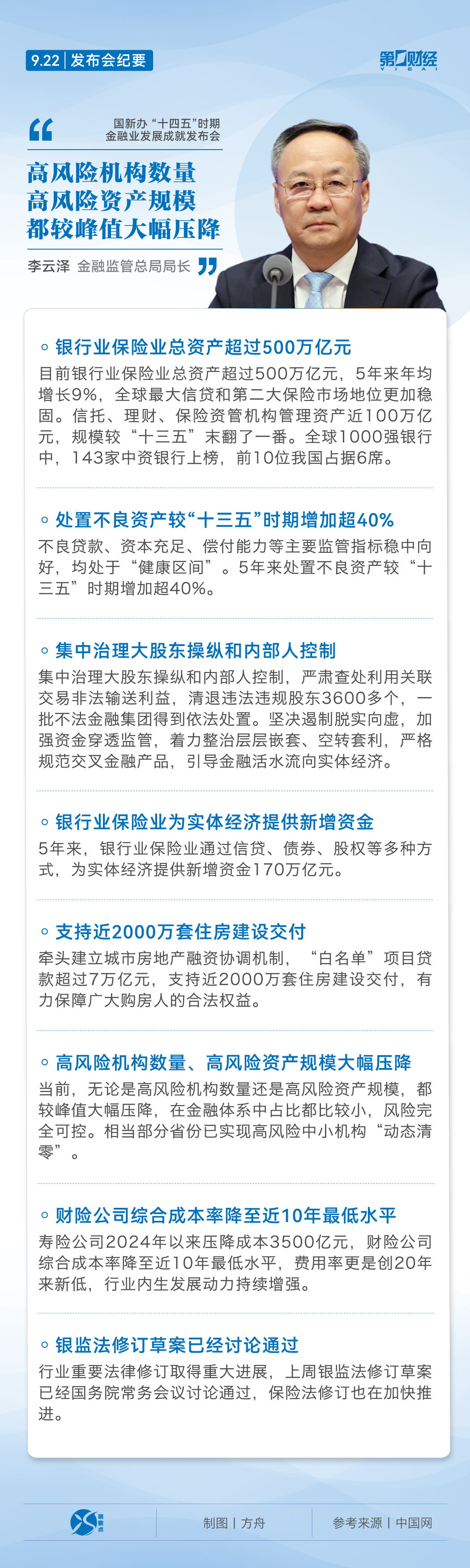
发布会纪要丨高风险机构数量、高风险资产规模大幅压降,李云泽最新发声
Di Yi Cai Jing· 2025-09-22 11:49
Core Insights - The financial industry has achieved significant growth, with total assets of the banking and insurance sectors exceeding 500 trillion yuan, reflecting an average annual growth of 9% over the past five years [2] - The number of high-risk institutions and the scale of high-risk assets have been significantly reduced from their peak levels, indicating a more stable financial environment [8] Group 1: Financial Industry Growth - The banking and insurance sectors have total assets exceeding 500 trillion yuan, solidifying their position as the largest credit market and the second-largest insurance market globally [2] - The management assets of trust, wealth management, and insurance asset management institutions have nearly doubled compared to the end of the 13th Five-Year Plan, reaching approximately 100 trillion yuan [2] Group 2: Asset Management and Risk Control - The disposal of non-performing assets has increased by over 40% compared to the 13th Five-Year Plan period, with key regulatory indicators such as non-performing loans and capital adequacy remaining stable and within a healthy range [3] - The number of illegal shareholders has been reduced by over 3,600 through strict governance against major shareholder manipulation and insider control [5] Group 3: Support for the Real Economy - The banking and insurance sectors have provided an additional 170 trillion yuan in funding to the real economy through various means such as credit, bonds, and equity over the past five years [6] - A financing coordination mechanism for urban real estate has been established, with over 7 trillion yuan in loans supporting the construction and delivery of nearly 20 million housing units [7] Group 4: Regulatory Developments - The comprehensive cost ratio of property insurance companies has dropped to its lowest level in nearly a decade, while life insurance companies have reduced costs by 350 billion yuan since 2024 [9] - Significant progress has been made in the revision of important industry laws, with the draft of the banking regulatory law having been discussed and approved by the State Council [10]
金融监管总局:坚持防风险、强监管、促高质量发展的金融工作主线
Di Yi Cai Jing· 2025-09-22 11:23
Core Viewpoint - The article emphasizes the importance of enhancing financial regulation quality and effectiveness while maintaining a focus on risk prevention, strong regulation, and promoting high-quality development in the financial sector [1] Group 1: Financial Regulation - The financial regulatory authority aims to improve the quality and effectiveness of financial supervision [1] - The focus is on risk prevention, strong regulation, and promoting high-quality development as the main line of financial work [1] - There is a commitment to deepen the reform of small and medium-sized financial institutions to mitigate risks [1] Group 2: Risk Management - The authority plans to effectively respond to various financial risk challenges [1] - A comprehensive strengthening of the "five major regulations" is proposed to enhance the foresight, precision, effectiveness, and coordination of supervision [1] - There is a strong emphasis on safeguarding the legitimate rights and interests of financial consumers and rigorously preventing and combating illegal financial activities [1] Group 3: Economic Support - The financial sector is tasked with supporting high-quality economic and social development through the implementation of five major financial initiatives [1]
潘功胜:今日发布会不涉及短期政策调整,下一步金融改革内容将在中央统一部署后做进一步沟通
Sou Hu Cai Jing· 2025-09-22 11:15
Group 1 - The core theme of the press conference was to introduce the achievements of the financial industry during the "14th Five-Year Plan" period, focusing on medium to long-term perspectives without discussing short-term policy adjustments [19] - The overall financial system in China is stable, with healthy financial institutions and smooth market operations [4][18] - The banking and insurance sectors have seen total assets exceed 500 trillion yuan, with an annual growth rate of 9% over the past five years [21] Group 2 - The A-share market has shown significant resilience and risk resistance, with the proportion of technology companies in the top 50 by market capitalization increasing from 18 to 24 during the "14th Five-Year Plan" [2][26] - A total of 10.6 trillion yuan has been distributed to shareholders through dividends and buybacks, representing an increase of over 80% compared to the "13th Five-Year Plan" [2][26] - The annualized volatility of the Shanghai Composite Index decreased by 2.8 percentage points to 15.9% during the "14th Five-Year Plan" [2][27] Group 3 - The financial regulatory authority has taken strict measures against financial irregularities, including the dismissal of over 3,600 illegal shareholders and the resolution of several illegal financial groups [3][36] - The regulatory framework has been significantly restructured, with over 60 supporting rules introduced following the new "National Nine Articles" [2][25] - The financial regulatory authority has imposed penalties on 20,000 institutions and 36,000 individuals, with fines totaling 21 billion yuan [23][28] Group 4 - The stock issuance registration system has transitioned from a pilot program to full implementation, with various measures introduced to optimize the listing and financing processes [5][42] - The total market capitalization of the A-share market surpassed 100 trillion yuan for the first time in August [26] - The proportion of direct financing in the capital market has increased by 2.8 percentage points to 31.6% compared to the end of the "13th Five-Year Plan" [26] Group 5 - The foreign capital holding in A-shares is currently 3.4 trillion yuan, with 269 companies listed overseas [6] - The central bank's monetary policy stance is supportive, implementing moderately loose monetary policies to stabilize the economy [7][8] - The modern monetary policy framework in China has been initially formed and continuously improved, effectively promoting reasonable growth in financial totals and optimizing credit structures [9][33]
中美元首通话;北京、上海同日宣布调整住房公积金缴存基数上下限|每周金融评论(2025.9.15-2025.9.21)
清华金融评论· 2025-09-22 11:08
Core Viewpoint - The article discusses recent developments in China-US relations, regulatory changes in the banking sector, adjustments in housing policies, and economic measures aimed at supporting families and the real estate market, highlighting the importance of cooperation between the two largest economies and the implications of domestic policies on economic stability and growth [4][6][8][12]. Group 1: China-US Relations - On September 19, Chinese President Xi Jinping and US President Trump held a phone call to discuss the current state of China-US relations, emphasizing the importance of cooperation for mutual prosperity and global stability [4]. - This call followed four rounds of economic talks, indicating a commitment to addressing outstanding issues and fostering a constructive relationship [5]. Group 2: Banking Sector Regulation - The State Council, led by Premier Li Qiang, approved the draft revision of the "Banking Supervision Law of the People's Republic of China," aimed at enhancing the regulatory framework for the banking sector [6]. - The revision is intended to address market irregularities and financial risks, ensuring the healthy development of the banking industry [6]. Group 3: Housing Policies - On September 18, new regulations for housing provident fund contributions were announced in Beijing and Shanghai, adjusting the contribution limits to support housing affordability [9][11]. - The adjustments include a maximum contribution base of 35,811 yuan in Beijing and 37,302 yuan in Shanghai, with minimums set at 2,540 yuan and 2,690 yuan respectively [9]. Group 4: Economic Measures - The introduction of a new childcare subsidy management regulation aims to streamline the application process and enhance support for families, indicating a shift towards a more structured national policy [7][8]. - The Federal Reserve's decision to lower interest rates by 25 basis points to a range of 4.00%-4.25% is seen as a response to economic concerns, potentially benefiting the Chinese market through increased foreign investment [12]. Group 5: Market Developments - Four A-share companies were flagged for financial misconduct, reflecting a stringent regulatory stance against fraud in the capital markets [13]. - The latest Loan Prime Rate (LPR) remains unchanged at 3.0% for one year and 3.5% for five years, indicating stability in lending rates amidst market expectations for potential future adjustments [14].



金融监管总局:坚持防风险、强监管、促高质量发展的金融工作主线,深化中小金融机构改革化险
Zheng Quan Shi Bao Wang· 2025-09-22 11:00
Core Viewpoint - The report from the Central Financial Supervision Administration emphasizes the importance of continuous rectification and improvement in financial regulation, aiming to enhance the quality and effectiveness of financial supervision [1] Group 1: Rectification Progress - The administration will maintain its goals, standards, and efforts in rectification, ensuring accountability and addressing key tasks [1] - Completed rectification tasks will be reviewed to prevent issues from resurfacing, while ongoing tasks will be closely monitored until resolved [1] Group 2: Financial Regulation Enhancement - The focus is on risk prevention, strong regulation, and promoting high-quality financial development, particularly in small and medium-sized financial institutions [1] - The administration aims to strengthen the five major regulatory areas, enhancing the foresight, precision, effectiveness, and coordination of supervision [1] Group 3: Consumer Protection and Illegal Activities - There is a commitment to safeguarding the legitimate rights of financial consumers and rigorously preventing and combating illegal financial activities [1] - The administration will support high-quality economic and social development through comprehensive financial strategies [1]
速览!一行两局一会最新发声
Wind万得· 2025-09-22 10:09
9月22日,国务院新闻办公室举行"高质量完成'十四五'规划"系列主题新闻发布会,中国人民银行行长 潘功胜,金融监管总局局长李云泽,中国证监会主席吴清,中国人民银行副行长、国家外汇局局长朱鹤 新介绍"十四五"时期金融业发展成就,并答记者问。以下为要点汇总: // 中国人民银行行长潘功胜 // ①今天新闻发布会的主题是介绍"十四五"时期金融业发展成就,主要是从中长期视角回顾和总结"十四 五",不涉及短期政策的调整。关于"十五五"及下一步金融改革内容,将在中央统一部署后与大家进一 步沟通。 ②十四五"以来,金融运行总体稳健,不良贷款、资本充足、偿付能力等主要监管指标稳中向好,均处 于健康区间。五年来,处置不良资产较"十三五"时期增加超过40%,行业抵御风险的资本和拨备总规模 超过50万亿元,应对各类挑战的基础更牢、韧性更强、底气更足。 ③十四五"时期,我们始终把防范化解金融风险作为监管部门的首位主责,把稳妥处置中小金融机构风 险作为重中之重。稳妥处置高风险机构。当前,不论是高风险机构数量还是高风险资产规模,都较峰值 大幅压降,在金融体系中占比较小,风险完全可控,相当一部分省份已经实现高风险中小机构动态清 零。 ④十 ...

潘功胜回应美联储降息:中国货币政策坚持以为我主、兼顾内外平衡,适度宽松
Sou Hu Cai Jing· 2025-09-22 09:48
潘功胜表示,往前看,中国人民银行将根据宏观经济运行的情况和形势变化,综合运用多种货币政策工具,保证流动性充裕,促进社会综合融资成本下降, 支持提振消费、扩大有效投资,巩固和增强经济回升向好态势,维护金融市场的稳定运行,保持人民币汇率在合理均衡水平上的基本稳定。 记者 辛圆 国务院新闻办公室周一举行"高质量完成'十四五'规划"系列主题新闻发布会,介绍"十四五"时期金融业发展成就。 谈及美联储降息25个基点,中国人民银行行长潘功胜表示,全球金融市场对美联储这次降息有充分预期,市场反应相对平稳。美元指数基本维持在97的区间 附近,国际资本市场总体上行,大宗商品市场振荡下行。我国的股、债、汇等主要金融市场也保持平稳运行。 对于下一步货币政策的考虑,潘功胜指出,在货币政策的确定上,中国人民银行在宏观层面的原则是非常清晰的,坚持以我为主,兼顾内外均衡。 "就当前中国的货币政策立场,我们多次与市场进行沟通,市场也是非常清楚的,当前中国的货币政策立场是支持性的,实施适度宽松的货币政策,这一政 策立场为我国经济的持续回升向好和金融市场的稳定运行创造了良好的货币金融环境。"他说。 四是全面加强金融监管,严厉打击金融腐败。潘功胜提 ...
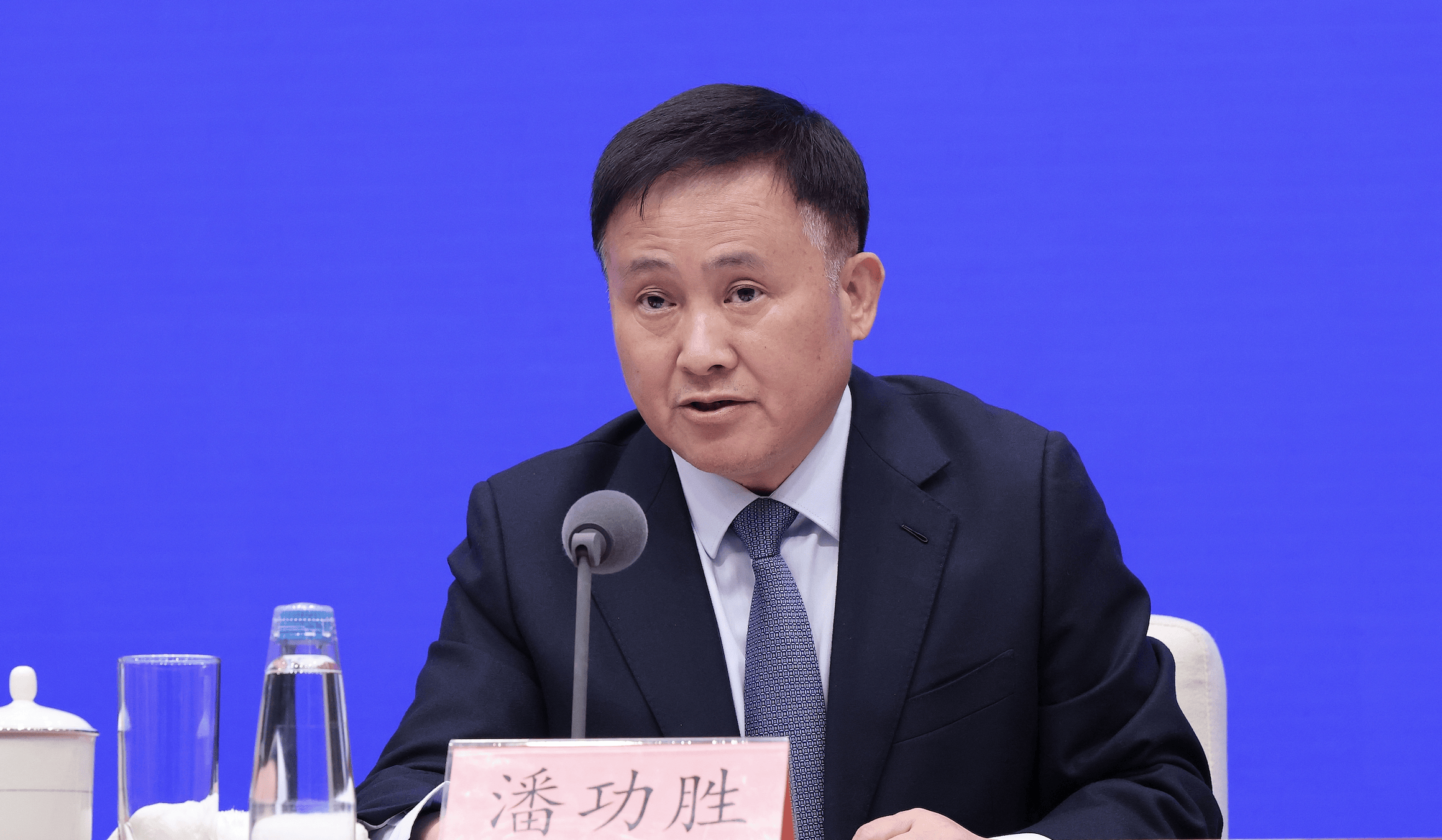
潘功胜、李云泽、吴清、朱鹤新发声,信息量很大→
Zheng Quan Shi Bao· 2025-09-22 09:06
Core Viewpoint - The press conference highlighted the achievements of China's financial sector during the "14th Five-Year Plan" period, emphasizing the stability and growth of the financial system, the effectiveness of monetary policy, and the ongoing reforms in financial governance and regulation. Group 1: Financial System Stability and Growth - The overall financial system in China is stable, with financial institutions remaining healthy and the market operating smoothly [3] - The total assets of the banking and insurance sectors have exceeded 500 trillion yuan, with an average growth of nearly 9% over the past five years [10] - The banking and insurance sectors have provided an additional 170 trillion yuan in funding to the real economy over the past five years, with significant growth in loans for key sectors such as technology and infrastructure [11] Group 2: Monetary Policy and Support for the Economy - The People's Bank of China has established a modern monetary policy framework that effectively supports the real economy, with annual growth rates for loans to technology SMEs, inclusive microloans, and green loans exceeding 20% [2][4] - The current monetary policy stance is supportive, implementing moderately loose monetary policies to stabilize market expectations and boost confidence [7][8] Group 3: Financial Regulation and Risk Management - Comprehensive financial regulation has been strengthened, with a focus on preventing financial risks and combating corruption within the financial sector [6] - The number of high-risk institutions and the scale of high-risk assets have been significantly reduced, ensuring that financial risks are fully controllable [14] - The financial regulatory authority has issued 171 regulations over the past five years, enhancing the regulatory framework across various financial sectors [22] Group 4: International Financial Cooperation and Currency Use - China's participation, influence, and voice in international financial governance have significantly increased, reflecting the country's commitment to structural reforms in the financial supply side [4] - The renminbi has become the third-largest currency for trade financing and payments globally, with its weight in the IMF's Special Drawing Rights basket ranking third [9] Group 5: Capital Market Developments - The capital market has seen a total financing of 57.5 trillion yuan through stock and bond markets over the past five years, with a steady increase in the proportion of direct financing [27] - The number of companies that have been smoothly delisted during the "14th Five-Year Plan" period reached 207, indicating a more robust exit mechanism for underperforming firms [35] - The A-share market's resilience and risk resistance have improved, with the annualized volatility of the Shanghai Composite Index decreasing by 2.8 percentage points compared to the previous five years [26]