中国资产配置

Search documents
观点汇总 | 2025金融街论坛年会今日开幕!吴清作主题演讲
Xin Lang Zheng Quan· 2025-10-27 10:12
Group 1: Key Points from the Financial Street Forum - The China Securities Regulatory Commission (CSRC) will initiate reforms to the Growth Enterprise Market, establishing listing standards that better align with the characteristics of innovative enterprises in emerging fields [1] - The value of asset allocation in Chinese assets, including A-shares and H-shares, is becoming more apparent amid risk repricing and asset rebalancing, with a focus on stability and balance [1][5] - The CSRC has officially launched the "Qualified Foreign Investor System Optimization Work Plan," which includes optimizing access management, improving investment operation efficiency, and expanding investment scope [2] Group 2: Regulatory and Market Developments - A refinancing framework will be introduced to broaden support channels for mergers and acquisitions, while urging listed companies to enhance governance and increase shareholder returns through dividends and buybacks [3] - The CSRC aims to promote the high-quality development of the Beijing Stock Exchange and improve the connection mechanisms between the third and fourth boards, reinforcing the multi-tiered capital market [4] - New measures to strengthen the protection of small investors in the capital market will be released, focusing on enhancing investor protection during the issuance and delisting processes [6] Group 3: Enforcement and Policy Initiatives - The CSRC will adopt a "zero tolerance" approach to financial fraud and other illegal activities, aiming to enhance investor trust and confidence through strict enforcement [7] - Beijing will continue to serve as a key window for capital market reform and opening up, facilitating the implementation of pioneering policies [8] - The effects of the Sci-Tech Innovation Board reforms are accelerating, with the first batch of newly registered companies set to be listed [9][10]

中国证监会主席吴清:中国资产配置价值更加显现 持续深化投融资综合改革
Xin Hua Cai Jing· 2025-10-27 10:11
Group 1 - The core theme of the 2025 Financial Street Forum is "Innovation, Transformation, and Reshaping of Global Financial Development" [1] - The Chairman of the China Securities Regulatory Commission (CSRC), Wu Qing, emphasized the importance of stability and balance in asset allocation, highlighting the growing consensus among international investors to diversify their investments [1] - The CSRC plans to deepen comprehensive reforms in investment and financing, enhancing the inclusiveness, adaptability, attractiveness, and competitiveness of China's capital markets to better serve economic and social development [1] Group 2 - Wu Qing announced the launch of the "Qualified Foreign Investor System Optimization Work Plan" to provide a more transparent, convenient, and efficient institutional environment for foreign investors [2] - The CSRC aims to strengthen risk prevention and regulatory measures, enhancing the protection of investors' rights and interests through the introduction of 23 practical measures [2] - Beijing is positioned as a key window for capital market reform and opening up, encouraging high-quality industry institutions and long-term capital to gather and develop in the capital [2]
证监会将启动实施深化创业板改革
财联社· 2025-10-27 10:10
Group 1 - The core viewpoint is the initiation of reforms in the ChiNext board to establish listing standards that better align with the characteristics of innovative and entrepreneurial enterprises in emerging fields and future industries, providing more precise and inclusive financial services [1] Group 2 - The value of asset allocation in Chinese assets, such as A-shares and H-shares, is becoming more apparent during the process of risk repricing and asset rebalancing, with a growing emphasis on stability and balance in asset allocation [2] Group 3 - The introduction of a refinancing framework issuance system is planned to further solidify the internal foundation for market stability, broaden support channels for mergers and acquisitions, and encourage listed companies to enhance governance and increase shareholder returns through dividends and buybacks [3]


刚刚!中国股票突传利好!
天天基金网· 2025-10-22 01:02
Group 1 - The core viewpoint is that foreign investors are increasingly optimistic about the value of Chinese assets, with a recommendation to increase allocations in A-shares and H-shares to outperform MSCI emerging market indices [3][4][6] - Morgan Stanley's chief China equity strategist, Wang Ying, highlighted that global investors' allocation to Chinese stocks remains relatively low, indicating a long-term trend towards increased investment in Chinese assets [4][6] - The A-share and Hong Kong markets showed strong performance on October 21, with the Shanghai Composite Index rising by 1.36% and the ChiNext Index increasing by over 3% [3][9] Group 2 - Morgan Stanley suggests focusing on high-tech sectors such as artificial intelligence, automation, robotics, biotechnology, and high-end manufacturing for long-term investments in China [4][6] - The report indicates that foreign capital inflow into the Chinese stock market rebounded to $4.6 billion in September, the highest monthly figure since November 2024 [7] - Analysts believe that the Federal Reserve's potential interest rate cuts could improve liquidity in the Chinese stock market, supporting foreign capital inflows and enhancing the demand for A-shares and H-shares [7][10] Group 3 - The Hong Kong market is expected to benefit from the current industry trends, particularly in the technology sector, with potential for significant gains as foreign capital returns [10] - The report emphasizes that the AI-driven market remains a key theme, with technology stocks likely to continue their upward trajectory due to ongoing demand and positive earnings forecasts [10] - Analysts predict that the market's bullish sentiment will persist into the fourth quarter, supported by favorable policies and low interest rates [10]

中国股票,突传利好
Zheng Quan Shi Bao· 2025-10-21 11:48
Core Viewpoint - Foreign investors are optimistic about the asset allocation value of Chinese stocks, with expectations for increased investment in the long term as current allocations remain relatively low [1][2]. Group 1: Market Insights - The A-share and Hong Kong markets showed strong performance, with the Shanghai Composite Index rising by 1.36% to surpass 3900 points, and the ChiNext Index increasing by over 3% [1][6]. - The total trading volume in the Shanghai and Shenzhen markets reached 1.87 trillion yuan, an increase of 136.3 billion yuan from the previous trading day, with over 4600 stocks rising [6]. Group 2: Investment Strategies - Morgan Stanley recommends focusing on high-tech sectors such as artificial intelligence, automation, robotics, biotechnology, and high-end manufacturing for long-term investments in China [2]. - Investors are advised to maintain positions in high-quality dividend stocks to mitigate short-term market volatility [2]. Group 3: Economic Factors - The recent rebound in foreign capital inflow into the Chinese stock market reached 4.6 billion USD in September, the highest monthly figure since November 2024 [4]. - The expectation of a Federal Reserve interest rate cut is anticipated to improve liquidity in the Chinese stock market, historically leading to upward trends in A-shares and H-shares [4][5]. Group 4: Future Market Outlook - Analysts believe that the ongoing capital market reforms and structural economic recovery will support the upward trend in A-shares and H-shares [1][7]. - The technology sector is expected to remain a key driver of market performance, particularly in the context of AI developments and the anticipated return of foreign capital [7][8].
成立近1年基金份额与规模增长831.30%与1045.41% 同类规模居首A500ETF华泰柏瑞(563360)最新规模再创新高!
Xin Lang Ji Jin· 2025-09-25 08:31
Group 1 - The A-share market is entering a new upward cycle supported by policies, the rise of technology growth sectors, and improved liquidity, with key market sentiment indicators reaching new highs [1] - The CSI A500 index has reached a new high since March 2, 2022, with a cumulative increase of 48.21% over the past year, outperforming other core broad-based indices like CSI A50 and CSI A100 [2] - The A500 ETF by Huatai-PB has seen significant growth, with fund shares and scale increasing by 831.30% and 1045.41% respectively since its establishment, reaching 18.626 billion shares and 22.908 billion yuan [2][3] Group 2 - The A500 ETF has attracted a net inflow of 1.221 billion yuan over 9 out of 13 trading days since September 8, 2025, indicating its potential as a tool for investors to capture core asset opportunities in the A-share market [3] - The A500 ETF has a cumulative unit net value of 1.2299 yuan, making it one of the few ETFs tracking the CSI A500 index to exceed 1.22 yuan [4] - The A500 ETF features a low fee structure, with management and custody fees at 0.15% and 0.05% per year, respectively, which are among the lowest in the A-share market [5][7] Group 3 - Huatai-PB, the manager of the A500 ETF, is one of the first ETF managers in China with over 18 years of experience, managing the largest ETF in the A-share market, the CSI 300 ETF, with a scale of 582.4 billion yuan [6]
加仓中国资产
Shang Hai Zheng Quan Bao· 2025-09-17 19:28
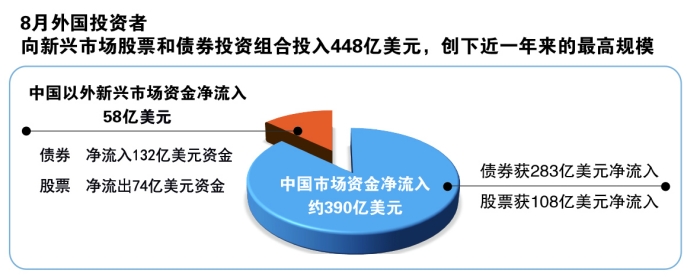
Group 1 - Foreign capital has shown increasing interest in the Chinese market, with a net inflow of 1.1 billion yuan from actively managed foreign investments for four consecutive weeks, marking the highest duration of net inflow since 2024 [3][4] - In August, foreign investors allocated approximately 39 billion USD to Chinese stocks and bonds, with 28.3 billion USD flowing into Chinese bonds and 10.8 billion USD into Chinese stocks, contributing to a total net inflow of around 39 billion USD [4] - International investment banks, such as Morgan Stanley and UBS, have noted a significant rise in overseas investors' interest in Chinese assets, with over 90% of U.S. investors expressing willingness to increase their allocation to the Chinese market, the highest level since early 2021 [4][5] Group 2 - The investment interest is extending towards the A-share market, with U.S. investors beginning to focus on A-shares rather than just American Depositary Receipts (ADRs) and internet sectors [6] - Factors driving this investment interest include China's leading position in sectors like humanoid robotics and biotechnology, ongoing policy support for economic stability, improved market liquidity, and a growing need for portfolio diversification away from the U.S. market [6][7] - Despite the heightened interest, the inflow of U.S. funds into the Chinese market is still in its early stages, with many investors needing time to familiarize themselves with specific stocks, particularly in sectors lacking U.S. counterparts [7]
香港交易所集团行政总裁陈翊庭: 港股市场IPO热度仍将持续 中国资产已变成“不能不投资”
Zheng Quan Shi Bao· 2025-09-07 18:24
Group 1 - The Hong Kong stock market has shown significant recovery since September last year, with IPO activity returning to the top globally in the first half of this year, and daily trading volume doubling [1] - The interest from foreign investors in Chinese assets has increased, shifting from "not investable" to "must invest" [2][3] - There are currently over 200 companies queued for IPOs, with a significant portion being technology firms, indicating a healthy supply of potential listings [3] Group 2 - The total financing amount for new stock issuance in Hong Kong reached HKD 137.5 billion by the end of August, a nearly sixfold increase compared to the same period in 2024 [4] - The trend of "A first, then H" listings has emerged due to companies' expansion needs and the demand for overseas financing platforms [5] - The Hong Kong Stock Exchange (HKEX) has a unique advantage in accommodating both large and small companies, enhancing its market inclusivity [6] Group 3 - Despite the strong performance of the Hong Kong market, there are still areas for improvement, particularly in the bond and commodity markets [7] - HKEX aims to diversify its product offerings beyond equities to remain competitive and meet the needs of foreign investors [7][8] - The inclusion of REITs in the Stock Connect program is being prepared, which will further enrich the trading options available [7]

外资巨头借道ETF增配中国资产
Shang Hai Zheng Quan Bao· 2025-09-02 18:34
Group 1 - Foreign investment giants are significantly increasing their holdings in ETFs, with Barclays Bank and UBS showing notable growth in the number of ETFs held compared to the end of last year [1][2] - Barclays Bank holds 200 ETFs as of mid-year, up from 135 at the end of 2024, with the highest valued ETFs being 华夏恒生互联网科技业 ETF, 易方达中证海外互联 ETF, and 华泰柏瑞恒生科技 ETF, valued at 1.19 billion, 1.15 billion, and 790 million respectively [1] - UBS ranks second in ETF holdings, with 141 ETFs as of mid-year, a significant increase from 57 at the end of 2024, with the highest valued ETF being 华泰柏瑞中证A500 ETF at 1.057 billion [2] Group 2 - There is a noticeable increase in overseas interest in Chinese assets, with Allianz Fund's CIO indicating that the Chinese market is increasingly viewed as an independent asset class [3] - Foreign investors are focusing on long-term factors when allocating to Chinese assets, emphasizing the importance of "predictability" and the sustainable development capability of China's entire system [3] - UBS's China head noted that investor confidence in the Chinese market has been steadily increasing this year, with a growing willingness among overseas investors to allocate to non-USD assets, particularly Chinese assets [3]


中国资产,超配!
证券时报· 2025-08-31 12:26
Core Viewpoint - Multiple international investment banks have raised their forecasts for China's economic growth for the year, shifting their asset allocation recommendations for China from neutral to "overweight" [1][3]. Group 1: Positive Outlook on Chinese Assets - Several foreign financial institutions have expressed optimism about the Chinese market, with Goldman Sachs maintaining an "overweight" stance on Chinese stocks [1]. - Standard Chartered Bank has also kept its "overweight" rating on Chinese stocks in its "2025 Global Market Outlook" report [1]. Group 2: Factors Supporting High Allocation to Chinese Assets - Chief Investment Officer of Standard Chartered Bank for North Asia, Zheng Zifeng, highlighted both external and domestic factors supporting high allocation to Chinese assets, including China's effective response to trade tensions and recent domestic policies aimed at stabilizing economic growth, such as new birth subsidies [3]. - The expectation of more policy support as the fourth quarter approaches is also noted [3]. Group 3: Foreign Investment Trends - International investment banks are actively investing in the A-share market, with Goldman Sachs reporting that hedge funds have net bought Chinese stocks at the fastest pace in seven weeks [5]. - Data from the State Administration of Foreign Exchange indicates that foreign capital net increased holdings of domestic stocks and funds by $10.1 billion in the first half of the year, with significant net purchases of $18.8 billion in May and June [5]. Group 4: Credit Ratings and Economic Resilience - S&P Global Ratings has maintained China's sovereign credit rating at "A+" with a stable outlook, reflecting confidence in the country's economic fundamentals [7]. - Foreign investors view China's economic foundation as stable, with strong advantages, resilience, and significant potential, which supports the accumulation of positive factors for high-quality development [7].