
储能需求

Search documents
崔东树:2026年年初新能源电池需求将环比大幅下降,电池生产企业预计将减产休假对应波动
Xin Lang Cai Jing· 2025-12-28 04:58
Core Insights - The automotive market performance at the end of the "14th Five-Year Plan" is in line with expectations, with a strong growth rate in the first three quarters of the year, leading to a noticeable deceleration in the fourth quarter [1] - Demand for new energy lithium batteries is expected to be significantly weak in the fourth quarter, resulting in reduced production plans and increased holiday breaks for upstream suppliers in early 2026 [2] Group 1 - The profit margin for non-ferrous mining in the upstream materials sector reached 30% from January to November, which is seven times that of the automotive industry, indicating a significant profit imbalance within the industry [1] - A stable price and a reasonable supply-demand balance are crucial for the development of the industry, as profit imbalances can negatively impact growth [1] Group 2 - In early 2026, domestic demand for new energy lithium batteries is expected to decline significantly compared to the fourth quarter, with battery manufacturers planning to reduce production in response to demand fluctuations [2] - The decline in demand is attributed to several factors, including a policy adjustment on vehicle purchase tax affecting new energy passenger vehicles, which is expected to see a decrease in sales of at least 30% compared to the fourth quarter [2] - The commercial vehicle segment is also anticipated to face a significant drop in demand after a year-end rush for subsidies and tax exemptions [2] - Exports of new energy passenger vehicles are expected to remain strong, but this will not significantly boost demand for batteries from independent suppliers [2] - The U.S. energy storage demand is not expected to provide a noticeable boost to domestic battery exports, with a sharp decline in battery exports to the U.S. anticipated in 2025 [2] - Domestic energy storage bidding prices are significantly below 300 yuan per kilowatt-hour, leading to weak demand for price increases, and automotive batteries cannot absorb the cost losses from energy storage [2]
逆势做空碳酸锂,江特电机亏掉上千万
Zhong Guo Ji Jin Bao· 2025-12-27 23:32
Core Viewpoint - A well-known company in the lithium battery sector, Jiangte Electric, has reported significant losses exceeding 10% of its net profit due to short-selling in lithium carbonate futures, amounting to over 10 million RMB [1][5]. Group 1: Company Performance - Jiangte Electric's commodity futures and derivatives trading has resulted in confirmed losses and floating losses that exceed 10% of the company's audited net profit attributable to shareholders for the last year, with an absolute amount surpassing 10 million RMB [1][5]. - For the first three quarters of this year, Jiangte Electric reported operating revenue of 1.432 billion RMB, a year-on-year increase of 14.62%, while the net profit attributable to shareholders was -113 million RMB, reflecting a year-on-year decline of 37.31% [6]. Group 2: Market Conditions - The recent surge in lithium carbonate futures prices has led to losses in the company's futures accounts, as the company engaged in futures trading to mitigate operational risks from price fluctuations in raw materials and products [5]. - As of December 26, lithium prices have continued to rise, with the main contract on the Guangxi Futures Exchange surpassing 130,000 RMB per ton, reaching a new high of 130,800 RMB per ton, marking a year-to-date increase of 68.72% [7]. - The growth in lithium demand is primarily driven by the energy storage systems (ESS) and electric commercial vehicles (CV), with demand growth exceeding market expectations [7].


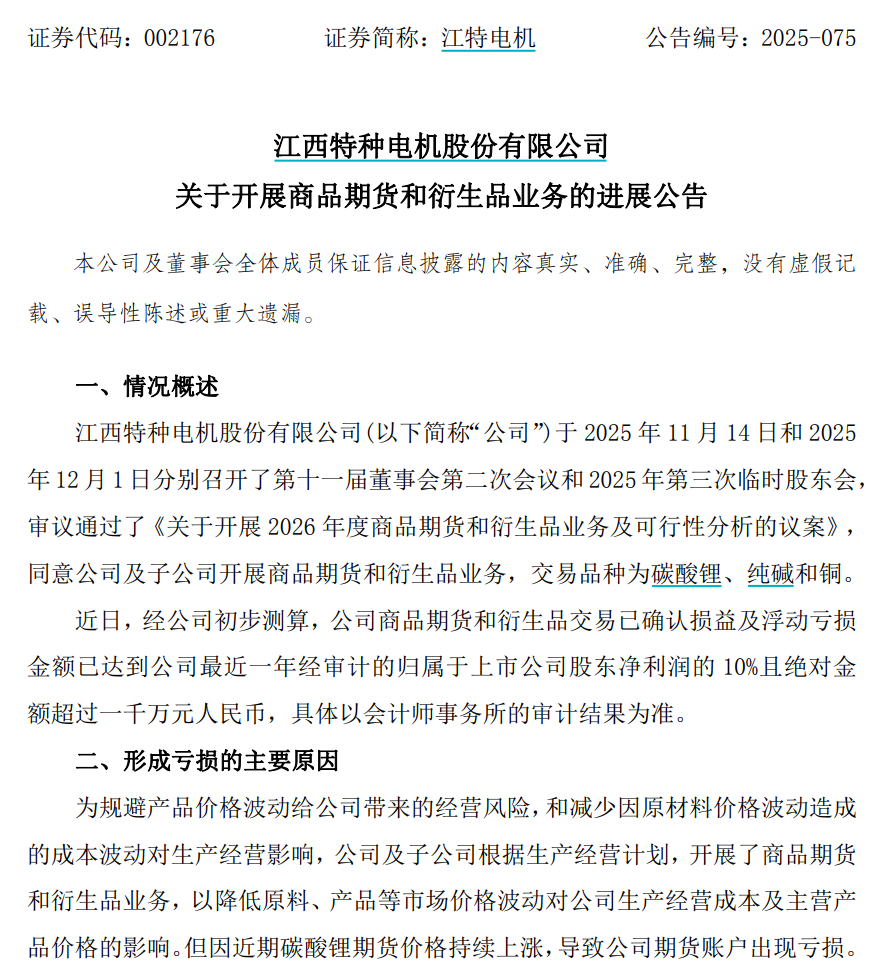
碳酸锂期货尾盘加速上涨!盘中一度涨超8%创两年新高
Shang Hai Zheng Quan Bao· 2025-12-24 07:43
Core Viewpoint - Lithium carbonate futures have surged, reaching a new high for the year, driven by supply-demand dynamics and market sentiment [1][4] Group 1: Price Movement - On December 24, lithium carbonate futures rose sharply, hitting a peak of 127,880 yuan/ton, marking a new high since November 2023 [1] - The price has doubled from a low of 59,000 yuan/ton in June 2023, indicating significant market recovery [1] Group 2: Market Analysis - Analysts attribute the current price increase to delayed production recovery, structural demand support, and positive market sentiment [4] - The supply-demand balance remains tight, providing ongoing support for prices in the short term [4] Group 3: Future Projections - Guotai Junan Securities forecasts that by 2026, the average price of lithium carbonate could reach 150,000 yuan/ton, with potential peaks driven by market sentiment reaching up to 200,000 yuan/ton [4] - The demand for energy storage and power batteries is expected to drive a supply-demand imbalance, particularly with a focus on energy storage needs [4] - Analyst Zhao Xinyi anticipates that lithium prices will trend higher in 2026 compared to 2025, with seasonal fluctuations based on supply and demand cycles [4]

加速上涨!创两年新高
Shang Hai Zheng Quan Bao· 2025-12-24 07:18
Group 1 - The core viewpoint of the article highlights the significant rise in lithium carbonate futures, reaching a new high for the year, driven by various market factors [1] - On December 24, lithium carbonate futures surged, with the main contract peaking at 127,880 yuan/ton, marking an increase of over 8% during the trading session [1] - The price of lithium carbonate has doubled in just six months, recovering from a low of 59,000 yuan/ton in June [1] Group 2 - Analysts attribute the current price increase to delayed production recovery, structural support from demand, and market sentiment, indicating a tight supply-demand balance that supports prices [1] - Looking ahead to 2026, Guotou Securities forecasts that the average price of lithium carbonate could reach 150,000 yuan/ton, with potential peaks driven by emotional premiums reaching 200,000 yuan/ton [1] - The anticipated demand for lithium carbonate is primarily driven by the growth in energy storage and power battery sectors, with a particular emphasis on energy storage demand [1]
商品日报(12月23日):贵金属大涨铂金再度涨停 碳酸锂收盘站上12万元/吨关口
Xin Hua Cai Jing· 2025-12-23 12:37
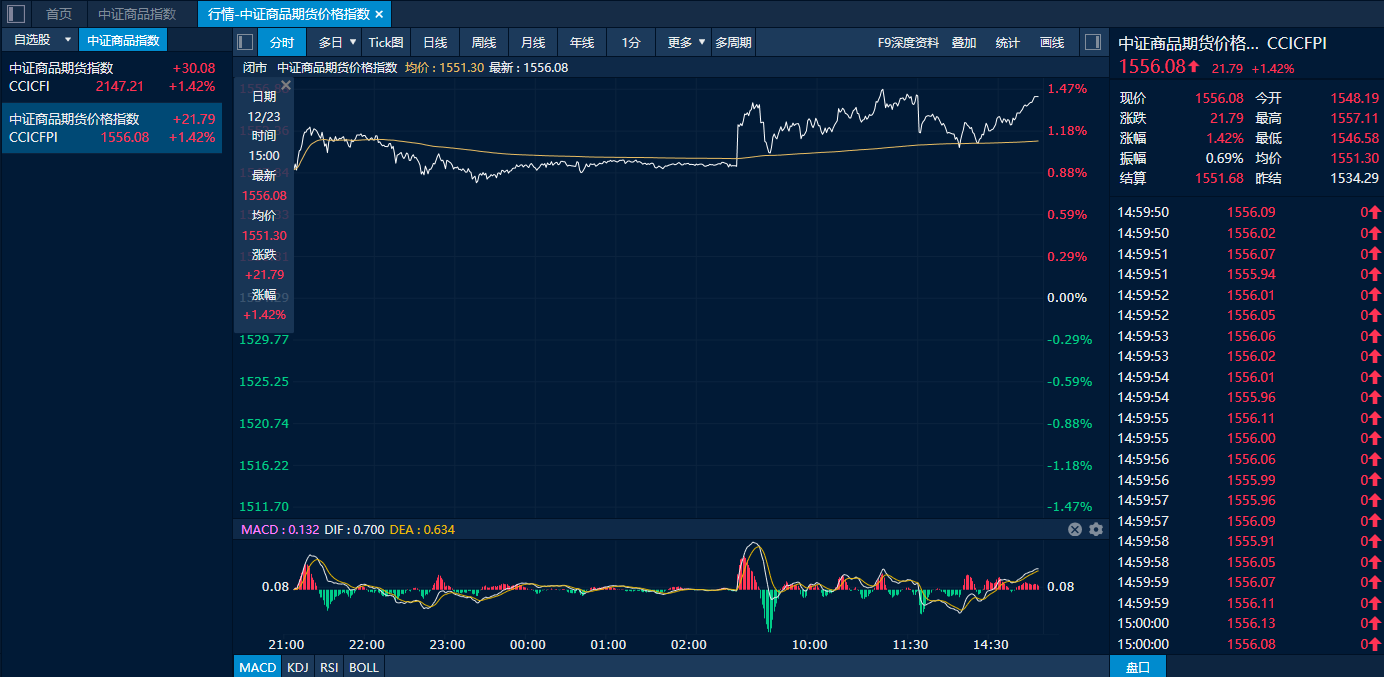
Group 1: Market Overview - The domestic commodity futures market on December 23 saw more gains than losses, with platinum futures hitting the limit up with a 10.00% increase [1] - The China Securities Commodity Futures Price Index closed at 1556.08 points, up 21.79 points or 1.42% from the previous trading day [1] Group 2: Lithium Carbonate - Lithium carbonate closed above 120,000 yuan/ton, nearing the high from March 4, 2024, driven by a tight supply-demand balance [2] - Strong demand from energy storage is offsetting seasonal declines in demand for lithium carbonate, leading to a reduction in domestic inventory [2] - Despite the bullish sentiment, caution is advised regarding potential changes in supply-demand dynamics, as imports may increase in December [2] Group 3: Nickel Market - Nickel prices have risen over 11% in the last five trading days due to Indonesia's tightening of nickel ore supply policies [3] - Indonesia's planned reduction in nickel ore production by 2026 is expected to alleviate the long-standing oversupply in the nickel market [3] - However, demand may face seasonal pressures, and domestic nickel inventory is still increasing, indicating a cautious outlook for price support [3] Group 4: Ethylene Glycol and Liquefied Gas - Ethylene glycol futures fell over 3%, marking the fifth consecutive day of decline due to high domestic production and seasonal demand weakness [4] - Liquefied gas ended a six-day rising streak with a 1.68% drop, as market expectations for supply growth increased amid limited demand [4]
12月18日每日研选丨供需收紧 这个板块的缺口仍在路上
Shang Hai Zheng Quan Bao· 2025-12-18 14:33
Group 1 - The energy metal sector is experiencing a surge in demand driven by a dual catalyst of supply restructuring and explosive demand, particularly in the context of energy storage [1][2] - Major resource countries are actively managing supply through policies such as quotas and licenses, aiming to gain control over resource pricing [1][2] - The demand for carbonated lithium in the energy storage sector is projected to reach approximately 345,000 tons by 2025 and is expected to exceed 500,000 tons by 2026, marking a tenfold increase from 2021 [2] Group 2 - In the lithium sector, the industry is undergoing a deep clearing with a slowdown in capital expenditure, indicating clear bottom signals. The sustained demand for energy storage is expected to drive a tight balance in global carbonated lithium supply and demand by 2026, making lithium prices more likely to rise [2][3] - Cobalt prices are entering an upward channel due to supply management, while nickel prices, despite being suppressed by high inventory, have dropped to deep cost curve levels, with Indonesia's supply management laying the groundwork for future price recovery [2][3] - The domestic production index control for rare earth materials is tightening supply, while resilient demand from downstream sectors such as new energy vehicles and wind power supports a strong price environment [2][3] Group 3 - Recommended companies in the lithium sector include Ganfeng Lithium, Tianqi Lithium, Zhongjin Lingnan Nonfemet Company, Yongxing Materials, and Shengxin Lithium Energy [3][4] - For cobalt and nickel, Huayou Cobalt is highlighted as a potential beneficiary due to strengthened supply-side policies and the industry being at a long-term bottom [3][4] - In the rare earth magnetic materials sector, companies such as Ningbo Yunsheng and Jieli Permanent Magnet are suggested as beneficiaries due to supply tightening and stable high-end demand [3][4]




供需收紧,这个板块的缺口仍在路上丨每日研选
Shang Hai Zheng Quan Bao· 2025-12-18 01:21
Core Insights - The energy metal sector is experiencing a surge in demand driven by the explosive growth in energy storage needs and a tightening supply from major resource countries [1][2] - Key metals such as lithium, cobalt, and nickel are at the beginning of a new cycle, with supply management policies from resource-rich countries reshaping the global supply landscape [1][2] Supply Dynamics - Major resource countries like the Democratic Republic of Congo (for cobalt) and Indonesia (for nickel) are actively managing supply through quotas and licensing, aiming to gain control over resource pricing [1][2] - The tightening of supply is a strategic focus for countries amid a backdrop of de-globalization, with the DRC limiting cobalt supply and Indonesia adjusting nickel production quotas [1][2] Demand Trends - Energy storage demand is set to redefine the long-term demand curve for energy metals, with projections indicating that lithium carbonate demand in the energy storage sector could reach approximately 345,000 tons by 2025 and exceed 500,000 tons by 2026, a tenfold increase from 2021 [2][3] - The shift in demand dynamics, coupled with supply constraints, is expected to lead to a pivotal supply-demand balance in the energy metal sector by 2026 [2] Investment Opportunities - Lithium: The sector is poised for a recovery in supply-demand balance by 2026, with companies like Ganfeng Lithium, Tianqi Lithium, and others expected to benefit due to their resource and cost advantages [2][3] - Cobalt/Nickel: Cobalt prices are on an upward trajectory due to supply management, while nickel prices are positioned for recovery as they have reached a low point in the cost curve [2][3] - Rare Earth Materials: Supply constraints from domestic production controls are supporting strong prices, with companies like Ningbo Yunsheng and Jinchuan Group positioned to benefit [2][3]

“十五五”末新能源发电装机占比将超50%,资金大幅流入光伏ETF华夏(515370)
Mei Ri Jing Ji Xin Wen· 2025-12-16 07:05
Core Viewpoint - The photovoltaic ETF Huaxia (515370) experienced a decline of 2.97% on December 16, 2025, despite significant capital inflow exceeding 1.2 billion yuan yesterday and a net inflow of over 4.2 billion yuan in the past 10 days [1] Industry Summary - China's energy investment is showing strong growth, focusing on green and new energy, with a significant leap in the quality of development in the renewable sector [1] - The first batch of wind and photovoltaic power bases has been completed and put into operation, with the second and third batches totaling approximately 50 million kilowatts. It is expected that the total new installed capacity for wind and photovoltaic power will reach about 370 million kilowatts this year, maintaining a utilization rate of over 94%. Wind and photovoltaic power generation is projected to account for 22% of the total electricity consumption [1] - By the end of the 14th Five-Year Plan in 2030, the proportion of renewable energy generation capacity in China is expected to exceed 50%, making it the main component of power generation capacity [1] Market Dynamics - According to Zhongtai Securities, the demand logic for energy storage has been reshaped, shifting from policy-driven to market profit-driven, highlighting the potential for independent and commercial energy storage, with a compound annual growth rate of 30% during the 14th Five-Year Plan [1] - Internationally, the AI industry in the United States is generating substantial demand for energy storage, while markets in Europe and Australia are also experiencing strong demand. Emerging markets are facing electricity shortages, leading to robust demand for household and commercial energy storage solutions [1] ETF Overview - The photovoltaic ETF Huaxia (515370) tracks the CSI Photovoltaic Industry Index, encompassing upstream, midstream, and downstream enterprises in the photovoltaic industry, including silicon wafers, polysilicon, battery cells, cables, photovoltaic glass, battery modules, inverters, photovoltaic brackets, and power stations, providing a comprehensive reflection of the overall performance of the photovoltaic industry [1]
中国储能行业:上游材料成本上涨对储能需求影响温和-China Energy Storage Industry _ Upstream material cost rise to have mild impact on BESS demand
2025-12-16 03:27
Summary of the Conference Call Transcript Industry Overview - **Industry**: China Energy Storage Industry - **Focus**: Battery Energy Storage Systems (BESS) Key Points and Arguments Impact of Raw Material Costs - Recent increases in battery material costs have raised concerns about their impact on BESS demand and margins for manufacturers - Suzhou Deegares announced a 15% increase in battery prices to offset higher material costs - Core raw materials (LiCO3, LiPF6, VC) constitute only 26% of battery costs and 8% of total EPC costs, suggesting a mild impact on demand despite rising costs [2][3][4] Project IRR Analysis - Typical BESS project IRR is estimated at around 8% considering capacity compensation pricing - A 10% increase in battery costs could lead to a 3% increase in EPC costs, reducing project IRR by 0.66 percentage points to 7.4%, which remains attractive [3][4] - A Rmb0.1/kWh increase in battery costs would likely result in an IRR of 6%, still meeting the investment hurdle rate for most operators [3][4] Revenue Diversification - More diversified revenue streams for standalone BESS projects (e.g., spot market arbitrage, capacity compensation) could help offset cost inflation - An expansion of the peak-trough pricing spread by Rmb0.1/kWh could increase BESS project IRR by 3.6 percentage points [4][5] Demand Forecast - Positive outlook on BESS demand, with unchanged installation forecasts for 2026/27 at 231GWh (54% YoY growth) for China and 324GWh (40% YoY growth) globally [5][20] - Global forecasts for 2026/27 are 412GWh (49% YoY growth) and 544GWh (32% YoY growth) [5][20] Manufacturer Positioning - Companies with higher overseas exposure, such as Sungrow, may be better positioned to raise prices in response to cost increases [5] Risks to the Industry - Major downside risks include slower-than-expected growth in domestic renewable energy capacity, smaller peak-trough electricity price spreads, limited market accessibility for energy storage systems, and potential tariffs on Chinese products [22] Additional Important Information - The ability of BESS manufacturers to pass through cost inflation varies, with leading suppliers likely having an easier time compared to others [4] - The ramp-up of larger-capacity battery cells (587Ah) could also contribute to cost reductions [4] This summary encapsulates the essential insights from the conference call regarding the China Energy Storage Industry, focusing on BESS, its financial implications, demand forecasts, and associated risks.
铝产业链年报:向阳而行,不忘风雨
Tong Guan Jin Yuan Qi Huo· 2025-12-15 02:05
Group 1: Report Industry Investment Rating - Not provided in the content Group 2: Core Views of the Report - In 2026, the global alumina supply is expected to be in surplus, with prices under long - term pressure and the futures trading range likely to drop to 2400 - 3000 yuan/ton [2][59][170] - The global aluminum supply in 2026 is expected to grow at a rate of 1.4%, with overseas becoming an important growth point. Aluminum prices are expected to be strong in the medium - to - long term, especially in the first half of 2026, with the upper limit to be watched at 25000 yuan/ton [2][171] - The supply and demand of cast aluminum are in a delicate balance. Its price follows cost fluctuations and there are seasonal and macro - event - based arbitrage opportunities [2][120][172] Group 3: Summary by Relevant Catalogs 1. Market Review - In 2025, alumina showed a weak and volatile pattern, with prices falling from around 4000 yuan/ton at the beginning of the year to a low of 2665 yuan/ton, then rebounding and finally fluctuating weakly near the cost line [9] - In 2025, the electrolytic aluminum price generally showed an upward trend, with some fluctuations due to tariff policies. There were also opportunities for intra - month spread arbitrage and cross - market arbitrage [10] - Cast aluminum futures were launched on June 10, 2025. Its price showed an upward trend, and the spread with Shanghai aluminum changed during the year [11][12] 2. Macroeconomic Situation Overseas - The Fed may be hesitant to cut interest rates in the first quarter of 2026. The US economy may continue to expand in the third quarter, but inflation concerns may rise at the end of the year. The eurozone's inflation is approaching the target, and its monetary policy will remain stable [29][33][34] Domestic - China is expected to achieve its 2025 GDP growth target of 5%. In 2026, the GDP target is expected to be set at 5%. Fiscal policy will be proactive, and monetary policy will remain loose [35] 3. Alumina Adequate Imported Ore in 2026 - In 2025, the supply of bauxite was abundant, and the price of imported bauxite decreased. In 2026, the supply of bauxite is expected to be sufficient, with domestic and imported ore totaling about 280 million tons, and the price of imported ore may decline slightly [51][53][55] High Unreleased Alumina Capacity at Home and Abroad - In 2025, the alumina capacity was in surplus, and the price decreased. In 2026, the new domestic and overseas alumina capacity is expected to exceed 20 million tons, and the demand growth is lower than the supply growth [56][57] Overseas Alumina with Cost Advantage Flows into China - In 2025, China changed from a net importer to a net exporter of alumina. In 2026, China is expected to return to a net - importing pattern because of the cost advantage of overseas alumina [58] Increased Surplus Pressure and Cost - Based Price Competition - In 2026, the supply of alumina is expected to be in surplus, and the price will be under long - term pressure, with the futures trading range likely to drop [59] 4. Electrolytic Aluminum Limited Domestic Capacity Growth Space - In 2025, China's electrolytic aluminum capacity approached the ceiling. In 2026, the domestic capacity growth is limited, and the supply (production + net import) is expected to be about 46.78 million tons, with a growth rate of about 1.01% [87][88][89] Indonesia Contributes Main Incremental Space, but Power Situation Needs Attention - In 2025, the overseas electrolytic aluminum capacity increased by 1 million tons. In 2026, the overseas capacity is expected to increase by 1.2 million tons, and the production is expected to be about 30.6 million tons, with a growth rate of 2% [90][91][92] 5. Cast Aluminum Tight Scrap Aluminum Provides Long - Term Cost Support for Cast Aluminum - In 2025, the supply of domestic scrap aluminum was tight. In 2026, the domestic scrap aluminum supply is expected to be about 16.4 million tons, with a growth rate of 21% [112][114][115] Low Operating Rate of Cast Aluminum Alloy and Limited Capacity Expansion - In 2025, the operating rate of the cast aluminum alloy industry was low, and the capacity expansion slowed down. In 2026, the aluminum alloy is expected to maintain a net inflow [116][117][118] Cost and Profit of Cast Aluminum Alloy - The cost of ADC12 is mainly composed of scrap aluminum, silicon, copper, natural gas, and other expenses. In 2026, the cost of cast aluminum is expected to remain firm [119] Consumption Balance and Views of Cast Aluminum Alloy - The supply of cast aluminum has excess built - in capacity, but the tight scrap aluminum and low profit limit the capacity expansion. The consumption of each segment is growing. The price of cast aluminum follows cost fluctuations, and there are arbitrage opportunities [120][121][172] 6. Consumption End Challenges Remain in Aluminum Product Exports in 2026 - In 2025, China's aluminum product exports decreased. In 2026, there are still challenges, but efforts are being made to diversify the market [136] Real Estate - In 2025, the real estate market was at the bottom. In 2026, it is expected to continue to adjust, with the decline in new construction area narrowing slightly and the decline in completion area narrowing [137] Power - In 2025, the investment in the power grid increased. In 2026 - 2030, the annual investment in the power grid is expected to be about 75 billion yuan, and the aluminum consumption in the power sector will increase by about 650,000 tons [138][139] New Energy Sector - In 2025, the new - energy installation increased. In 2026, the photovoltaic installation is expected to decline, but the wind - power installation is expected to increase, offsetting part of the reduction in aluminum consumption [141][142][143] Automobile - In 2025, the automobile market developed well. In 2026, the domestic automobile sales are expected to increase slightly, and the aluminum consumption of new - energy vehicles is expected to increase by about 576,000 tons [144] Energy Storage - In 2025, the global energy - storage installation increased significantly. In 2026, the domestic and global energy - storage new - installation is expected to reach 17.2GW and 39.9GW respectively, with the aluminum consumption increasing [145][147] Data Center - In 2026, many large - scale data - center projects are planned to be built, which will drive the demand for aluminum [149] 7. Global Aluminum Supply Still in Shortage in 2026 - In 2026, the global electrolytic aluminum supply is expected to be 74.98 million tons, with a growth rate of 1.4%, and the consumption is expected to be 75.5 million tons, still in shortage [170] 8. Market Outlook - Alumina prices are expected to be under long - term pressure, with the futures trading range at 2400 - 3000 yuan/ton. Electrolytic aluminum prices are expected to be strong in the medium - to - long term, especially in the first half of 2026. Cast aluminum prices follow cost fluctuations [170][171][172]