分散配置

Search documents
3个步骤,搭建自己的投资体系|投资小知识
银行螺丝钉· 2025-09-22 13:51
Core Viewpoint - The article emphasizes the importance of value investing principles applied to index funds, highlighting their lower risk due to diversification and the potential for long-term gains [3][4]. Group 1: Investment Philosophy - The investment philosophy is based on the equation: good variety + good price + long-term holding = good returns [4]. - Value investing, when applied to index funds, mitigates the risk of individual stock failures, as index funds consist of a diversified basket of stocks [3]. Group 2: Market Trends - The number of index fund options in the A-share market has increased, allowing for the application of the same investment principles to excellent industries and active funds [5]. Group 3: Framework and Detail - A solid investment framework is likened to a skeleton; it requires additional details and inputs to be effective. The method of "output driving input" is used to enhance understanding through various forms of content [6]. Group 4: Psychological Resilience - Understanding investment knowledge is one aspect, but the ability to remain steadfast during market fluctuations is crucial for success [7].


让我看看,今年大家都赚了多少钱?
Sou Hu Cai Jing· 2025-09-22 10:41
Core Insights - The overall performance of investors has improved significantly this year, with many reporting substantial profits after employing strategies like regular investment and averaging down [1][5][22] - The "偏股基金指数" (Equity Fund Index) has rebounded to levels seen in February 2022, indicating that most investments made since then have turned profitable [4][9] - Data from Alipay shows that 215 million investors have positive cumulative returns on their fund investments, excluding money market funds like Yu'ebao [5][6] Market Performance - Major indices such as the Shanghai Composite Index and CSI 300 have risen over 14%, while the "偏股基金指数" has surged by 29.81%, outperforming the broader market [9][10] - As of September 18, 2025, only 70 out of 4,136 selected funds reported losses, representing just 1.69% of the total [11] - Approximately 79.35% of funds have returned over 15%, indicating that around 80% of active funds have outperformed the market this year [12][13] Fund Analysis - The "偏股基金指数" has consistently achieved new highs during bull markets, while the broader indices have not reached their previous peaks [17][20] - The active fund managers have demonstrated the ability to generate alpha returns, which are not consistently replicated by passive indices [20] - The average return of selected funds from Alipay's "蚂蚁理财金选" (Ant Financial's Gold Selection) has been 29.75%, outperforming the "偏股基金指数" [31] Investment Behavior - Good investment practices, such as regular contributions and averaging down, have been crucial for many investors to recover from previous losses [22][26] - Diversification and selecting quality funds are emphasized as effective strategies to mitigate risks and enhance returns [28][30] - The cultivation of sound investment habits is deemed essential for long-term success in fund investments [36]
蚂蚁基金2.1亿基民盈利数据来了
Zhong Guo Jing Ji Wang· 2025-09-22 01:29
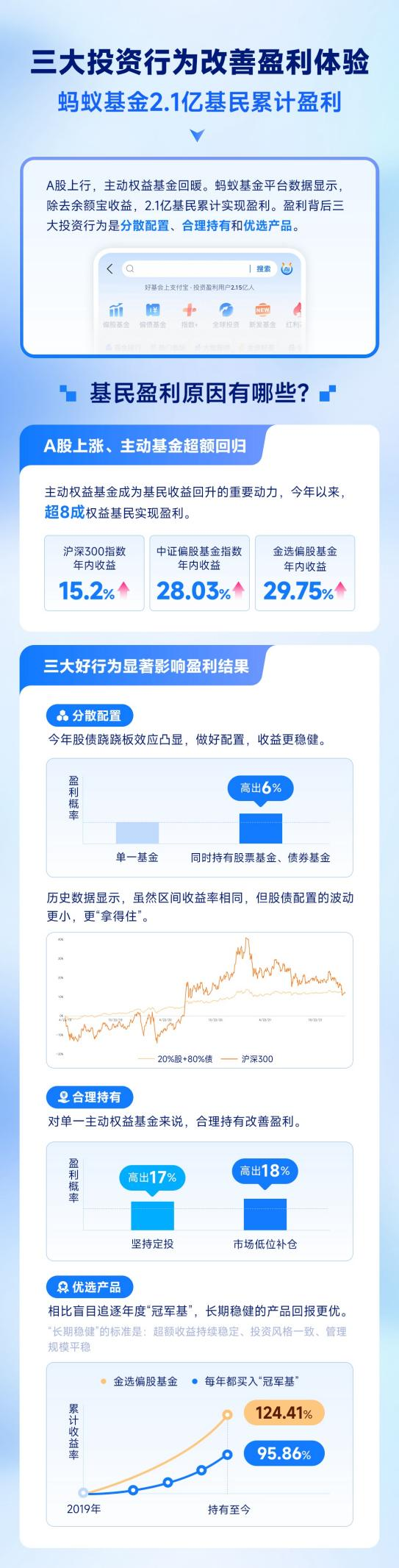
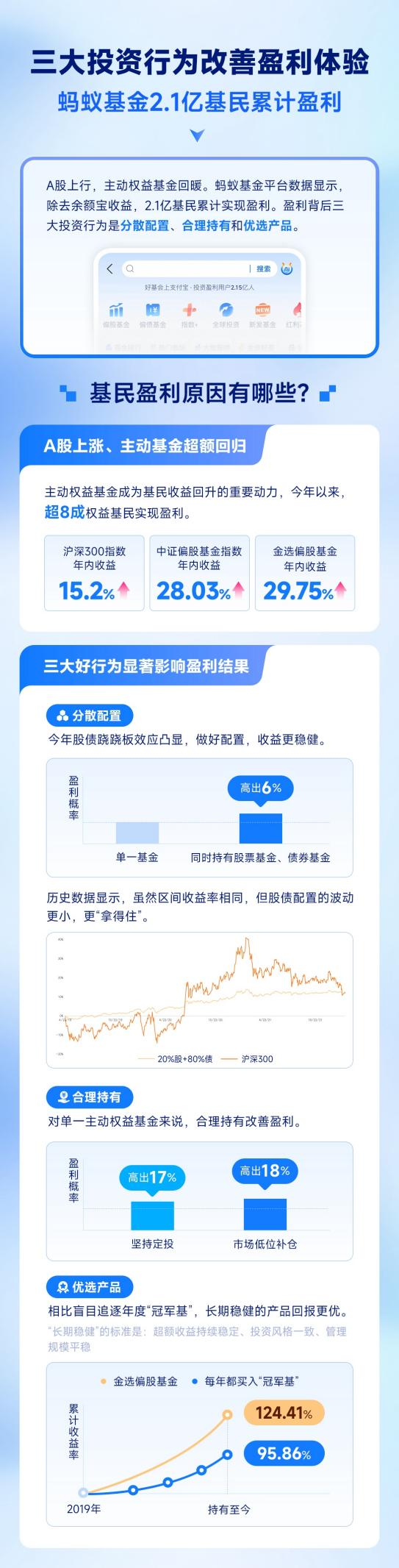
Group 1 - The core viewpoint is that the A-share market's upward trend has led to a significant recovery in the performance of actively managed equity funds, with over 90% of funds exceeding their previous year's net value [1][2] - As of September 12, the CSI 300 index has risen by 15.2% year-to-date, with over 80% of actively managed equity funds outperforming the market, achieving an average return of 28.03% [2] - The "Ant Financial Gold Selection" equity fund has an average return of 29.75% year-to-date, surpassing the performance of the benchmark index [2] Group 2 - More than 80% of investors in equity funds on the Ant Financial platform have achieved profitability, with an average return of 12% for their holdings [2] - The probability of positive returns for investors holding the Gold Selection equity fund is 17% higher than for those holding non-Gold Selection funds, with a return rate that is 7.8% higher [2] - The performance of actively managed equity funds is attributed to both the overall market recovery and the ability of fund managers to generate excess returns [2] Group 3 - Three key investment behaviors have been identified that significantly enhance profitability: diversified allocation, reasonable holding periods, and product selection [4] - Investors who effectively manage their stock-bond allocation have a 6% higher probability of profitability compared to those holding a single asset [5] - Historical data shows that a classic stock-bond combination of 20% stock funds and 80% bond funds yielded an 11.85% cumulative return with a maximum drawdown of only 5.04% during market transitions [5] Group 4 - Investors focusing on long-term stable products tend to achieve better returns than those chasing annual "champion funds," with the Gold Selection equity fund yielding 124.41% since 2019 compared to 95.86% for champion funds [6] - The stability of excess returns, consistency in investment style, and stable management scale are crucial factors for investors when selecting products [6] - Healthy and rational investment behaviors are emphasized as essential for smoothing out the volatility associated with high-risk investments, thereby increasing overall profitability [6]
三大行为改善投资体验,今年超八成基民投资权益基金盈利
Guo Ji Jin Rong Bao· 2025-09-21 08:11
Core Insights - The A-share market's upward trend has led to a significant recovery in the performance of active equity funds, with 90% of funds exceeding last year's net value [1] - Over 2.15 billion investors have achieved cumulative profits, excluding the returns from Yu'ebao, covering both active equity and passive index funds [1] Group 1: Fund Performance - More than 80% of equity fund investors have made profits this year, driven by the rise in the A-share market, with an average return of 28.03% for active equity funds [3] - As of September 12, the CSI 300 index has increased by 15.2% this year, with 80% of active equity funds outperforming the market [3] - The "Ant Financial Gold Selection" equity fund has an average return of 29.75%, surpassing the performance of the benchmark index [3] Group 2: Investment Behavior - Three key investment behaviors have significantly improved profitability for investors: diversified allocation, reasonable holding, and product selection [6] - Investors who effectively manage stock-bond allocation have a 6% higher probability of profit compared to those holding single assets [6] - Historical data shows that a classic stock-bond combination of 20% stock funds and 80% bond funds yielded an 11.85% return with a maximum drawdown of -5.04% from April 2019 to February 2022 [6] Group 3: Product Selection - The choice of investment products directly impacts the holding experience, with long-term stable products generally providing better returns than chasing annual "champion funds" [7] - Since 2019, the "Gold Selection" equity fund has achieved a return of 124.41%, compared to 95.86% for those who bought "champion funds" annually [7] - Investors should focus on the stability of excess returns, consistency in investment style, and stable management scale when selecting products [7]

蚂蚁基金2.1亿基民实现盈利,定投策略显著提升收益体验
Nan Fang Du Shi Bao· 2025-09-19 10:32
Core Insights - The A-share market has shown a significant recovery, leading to impressive performance from actively managed equity funds, resulting in increased profits for investors [2][3] - As of September 19, 2023, 215 million investors on the Ant Fund platform have achieved profitability, with over 80% of equity fund investors making gains this year [2][3] Fund Performance - Since March 2023, actively managed equity funds have demonstrated substantial excess returns, becoming the main driver of investor profits [3] - The CSI 300 Index has risen by 15.2% year-to-date, while actively managed equity funds have outperformed this benchmark, with an average return of 28.03% [3] - The "Ant Financial Selected" equity funds have achieved an average return of 29.75%, surpassing both the CSI 300 Index and the CSI Equity Index [3] Investor Behavior - Investor behavior significantly impacts profitability, with strategies such as diversification, reasonable holding periods, and product selection enhancing profit probabilities [4][5] - Investors who diversified their portfolios experienced a 6% higher probability of profitability compared to those holding single assets [5] - Consistent investment strategies, such as dollar-cost averaging and buying during market dips, increased profitability probabilities by 17% and 18%, respectively [5] Market Outlook - Analysts suggest that structural opportunities in the A-share market remain significant, particularly in sectors like consumer upgrades, technological innovation, and green energy [6] - The market's cyclical nature necessitates investor rationality and patience, as the recovery phase presents both opportunities and challenges [6]

2.1亿基民盈利数据来了
Zhong Guo Ji Jin Bao· 2025-09-19 07:55
Core Insights - The article highlights that 80% of equity fund investors on the Ant Fund platform have achieved profits this year, driven by the overall recovery of the A-share market and the performance of active equity funds [2][4]. Group 1: Market Performance - The A-share market has seen a significant rise, with the CSI 300 Index increasing by 15.2% year-to-date, and over 80% of active equity funds outperforming the market, with an average return of 28.03% [2]. - The "Ant Financial Gold Selection" equity fund has an average return of 29.75% this year, surpassing the performance of similar index funds [2]. Group 2: Investor Behavior - Three key investment behaviors have been identified that improve profitability for investors: diversification, reasonable holding, and product selection [4]. - Investors who maintain a balanced stock-bond allocation have a 6% higher probability of profitability compared to those holding a single asset [4]. - Historical data shows that a classic stock-bond combination of 20% stocks and 80% bonds yielded a cumulative return of 11.85% with a maximum drawdown of only 5.04% during market transitions from April 2019 to February 2022 [4]. Group 3: Investment Strategies - Regular investment strategies, such as dollar-cost averaging, significantly enhance profitability, with those who consistently invest during market dips having a 17% higher probability of profit [4]. - The article emphasizes the importance of selecting long-term stable products over chasing annual "champion funds," with the "Gold Selection" equity fund yielding 124.41% since 2019, compared to 95.86% for those who pursued "champion funds" [5].
2.1亿基民盈利!三大行为改善盈利体验:分散配置、合理持有、优选产品
Xin Lang Ji Jin· 2025-09-19 02:43
Group 1 - The core viewpoint is that the A-share market's upward trend has led to a significant recovery in the performance of active equity funds, with 90% of funds exceeding last year's net value [1][3] - As of September 12, the CSI 300 index has risen by 15.2% this year, with over 80% of active equity funds outperforming the market, achieving an average return of 28.03% [3] - The "Ant Financial Gold Selection" equity fund has an average return of 29.75% this year, outperforming the benchmark index for similar funds [3] Group 2 - More than 80% of investors in equity funds on the Ant Financial platform have achieved profitability, with an average return of 12% for their holdings [3] - The probability of positive returns for the Gold Selection equity fund holders is 17% higher than that of non-Gold Selection fund holders, with a 7.8% higher holding return rate [3] - The performance of active equity funds is attributed to both the overall market recovery and the ability of fund managers to generate excess returns [3] Group 3 - Three investment behaviors have significantly improved profitability for investors: diversified allocation, reasonable holding, and product selection [4] - Investors who effectively manage stock-bond allocation have better overall experiences and more stable long-term returns compared to those holding single products [4] - Historical data shows that a classic stock-bond combination of 20% stock funds and 80% bond funds yielded an 11.85% return with a maximum drawdown of -5.04% from April 2019 to February 2022 [5] Group 4 - Regular investment strategies like dollar-cost averaging can effectively smooth out market volatility, with users who adhere to these strategies having a 17% higher probability of profitability [5] - The choice of investment products directly impacts the holding experience, with long-term stable products generally providing better returns than chasing annual "champion funds" [6] - Since 2019, the Gold Selection equity fund has achieved a return of 124.41%, compared to 95.86% for those who consistently bought "champion funds" [6]

“股市721定律”永不过时?背后是资金、信息、认知的全面碾压,普通人生存法则只有一个!
Sou Hu Cai Jing· 2025-09-16 01:17
Core Insights - The "721 Law" in the stock market indicates that out of 10 individual investors, 7 lose money, 2 break even, and only 1 makes a profit, highlighting the significant disparity between retail and institutional investors [1][10] - In 2024, individual investors accounted for 82% of trading volume in the A-share market but only realized less than 15% of profits, while institutional investors, making up 18% of trading volume, captured 85% of the profits [1][4] - The market operates as a resource redistribution platform, where differences in capital, information, and cognition place retail investors at a disadvantage from the outset [1][8] Trading Dynamics - A case study of a leading new energy stock showed that a private equity fund and three institutions used 12 accounts to buy 2 billion shares over three months, driving the price from 50 to 80 yuan, while retail investors increased their buying from an average of 500 million to 2 billion yuan daily [1] - When the stock reached 85 yuan, institutions began to sell off their holdings, resulting in retail investors absorbing 73% of the total buying during that period, leading to a significant loss when the price fell back to 60 yuan [1][2] Information Disparity - Institutions leverage their advantages through coordinated trading strategies, allowing them to manipulate stock prices and profit from retail investors' reactions [2][5] - Research indicates that institutions are typically 42 days ahead of retail investors in knowing about significant positive developments and 28 days ahead regarding negative news, allowing them to act before retail investors are informed [5][7] Cognitive Differences - Institutions utilize comprehensive investment frameworks based on quantitative metrics, while retail investors often rely on emotional responses and short-term price movements [7][8] - A study revealed that 65% of retail investors' buying decisions are influenced by short-term price increases, while 72% of institutional decisions are based on long-term industry outlooks [7][8] Survival Strategies for Retail Investors - Retail investors are advised to adopt a long-term perspective to counteract short-term market fluctuations, focusing on stable companies with strong cash flows [10] - Implementing contrarian strategies during market extremes can help retail investors avoid losses, as institutions often reduce positions during market highs and accumulate during lows [10] - Diversification across sectors and stocks is crucial for managing risk, contrasting with the tendency of retail investors to concentrate their investments [10][11]

控制波动风险的三个方法|投资小知识
银行螺丝钉· 2025-09-13 14:03
Group 1 - The article emphasizes the importance of diversification in investment portfolios to mitigate risk, suggesting that different types of stock assets have varying levels of volatility risk, with individual stocks being the most volatile, followed by sectors, broad indices, and fund combinations [2] - It is recommended to invest in a basket of undervalued fund combinations for further risk reduction, and for convenience, investors can follow the "Screw Nut" advisory combinations which offer diversified styles and sectors [2] - The article mentions that there are five advisory combinations available, including index enhancement and active selection, which can help investors manage their investments more easily [5] Group 2 - The article discusses the relationship between stock and bond ratios, indicating that a higher proportion of stocks generally leads to higher long-term annualized returns, but also increases volatility risk [3] - It suggests that for household funds that are not needed for the long term, the allocation to stock funds should not exceed "100 minus age" for individuals in the 4 to 4.9-star rating range, with a recommendation to reduce investment amounts compared to a 5-star rating [4] - For those who find stock fund volatility challenging, it is advised to consider lower stock allocation options such as fixed income plus products, like the 365-day and monthly salary advisory combinations [4]

每日钉一下(投资,如何获得估值回归的收益?)
银行螺丝钉· 2025-09-12 13:51
Group 1 - The article emphasizes the importance of diversifying investments across different asset classes, including both RMB and foreign currency assets, as well as stocks and bonds [2] - It highlights the significance of USD bond funds as a crucial component in investment strategies [2] - A free course is offered to provide systematic knowledge on investing in USD bond funds, along with supplementary materials like course notes and mind maps for efficient learning [2] Group 2 - The article discusses the concept of "valuation reversion," where different investment styles (large, mid, small caps, growth/value) exhibit tendencies to revert to their historical valuation levels [5] - It notes that styles previously at high valuation levels tend to decline, while those at low levels are likely to experience future increases [5] - The article suggests that while predicting the exact timing of these reversals is challenging, investors can still make informed decisions based on valuation levels [5][6] Group 3 - Recommendations for investment strategies include diversifying across different styles of undervalued assets to benefit from potential future increases in any of these styles [6] - Adjusting the proportion of different styles based on their valuation levels is also advised to optimize investment returns [6]