
创新药出海

Search documents
四大证券报头版头条内容精华摘要_2026年2月27日_财经新闻
Xin Lang Cai Jing· 2026-02-27 00:33
Group 1 - The demand for gold investment is increasing, driven by expectations of price hikes and promotional activities ahead of the Spring Festival, leading to a surge in purchases and a "golden feast" in the capital market [1][1] - The China Gold Association predicts that by 2025, the consumption of gold bars and coins in China will surpass that of gold jewelry for the first time [1] - In February, nearly 240 listed companies have been surveyed by various institutions, with over half of them achieving positive returns during the same period, and some stocks seeing cumulative gains exceeding 80% [1][1] Group 2 - In January 2026, domestic automobile sales reached 2.346 million units, with the top ten companies accounting for 1.962 million units, representing 83.6% of total sales, indicating a high concentration in the market [2][18] - The brain-computer interface sector is gaining attention, with 80 pharmaceutical and biotechnology companies undergoing institutional surveys, focusing on product development and commercialization [3][19][20] Group 3 - The Shanghai housing market shows signs of recovery, with second-hand home transactions exceeding 20,000 units for three consecutive months, and a year-on-year increase of 26.69% in January [4][21] - The People's Bank of China has issued a notice to support domestic banks in conducting cross-border RMB interbank financing, aiming to enhance the offshore RMB market [5][22][30] Group 4 - The lithium market is experiencing supply concerns due to Zimbabwe's adjustments in lithium export policies, leading to a significant increase in lithium carbonate futures prices [8][24][26] - The A-share merger and acquisition market remains active, with 507 transactions reported since the beginning of the year, totaling approximately 130 billion yuan, reflecting a robust market environment [11][27] - The popularity of rights-containing wealth management products has surged, with 32 new products launched in February, marking a significant increase compared to previous months [12][28][29] Group 5 - NIO's chip subsidiary has completed its first round of financing, raising 2.257 billion yuan, with a post-financing valuation nearing 10 billion yuan [15][32] - The price of battery-grade lithium carbonate has risen sharply post-Spring Festival, reaching 173,100 yuan per ton, a 20.38% increase from the previous price [16][33]
机构密集调研 脑机接口赛道升温
Zhong Guo Zheng Quan Bao· 2026-02-26 20:28
Core Insights - The pharmaceutical and biotechnology sector is experiencing increased institutional interest, particularly in brain-computer interface (BCI) stocks, driven by advancements in technology and commercialization efforts [1][2][3] Group 1: Brain-Computer Interface (BCI) Stocks - BCI stocks such as Xiangyu Medical, Aipeng Medical, and Meihao Medical have attracted significant institutional attention, with Xiangyu Medical receiving 208 institutional inquiries, Aipeng Medical 177, and Meihao Medical 125 [1] - Xiangyu Medical plans to upgrade 27 core products by mid-2026 and aims to launch nearly 100 BCI products by the end of 2026, focusing on multi-modal and multi-paradigm applications [2] - Aipeng Medical emphasizes the rapid growth of the BCI industry, particularly in non-invasive applications, and is prioritizing commercialization strategies based on existing technologies and channels [2] - Meihao Medical aims to be a key supplier in the BCI field, enhancing its competitive edge in invasive BCI implants through increased R&D investment and collaboration with clients [2][3] Group 2: Globalization of Pharmaceutical Companies - Domestic pharmaceutical companies are focusing on global strategies, with an emphasis on the commercialization of innovative drugs abroad [4][5] - MediXis has established a 2,000 square meter R&D office in Boston to support its global strategy, with overseas revenue expected to account for approximately 47% of total income by 2025 [4] - Huayuan Pharmaceutical has set up multiple business and R&D centers globally, with overseas revenue reaching 43% of total income in the first half of 2025 [4][5] - The "innovation + internationalization" strategy remains a core focus for the sector, with increasing participation of Chinese companies in global pharmaceutical collaborations [6]

先声药业发布盈喜公告,股价竟跌超5%
Xin Lang Cai Jing· 2026-02-26 10:21
Group 1 - The company expects to achieve an annual revenue of approximately 7.7 billion to 7.8 billion RMB, representing a year-on-year growth of 16.0% to 17.6% [2][6] - The projected net profit attributable to shareholders is between 1.3 billion to 1.4 billion RMB, showing a significant year-on-year increase of 80.1% to 93.9% [2][6] - Adjusted net profit is estimated to be between 1.25 billion to 1.35 billion RMB, with a year-on-year growth of 24.1% to 34.1% [2][6] Group 2 - The growth in performance is primarily attributed to increased revenue from innovative drugs, licensing income, and net gains from the fair value of the investment portfolio [2][6] - Despite the positive earnings forecast, the company's stock price declined by 5.31% to 12.31 HKD per share, with a market capitalization of 31.95 billion HKD as of February 26 [7] - Industry insiders remain optimistic about the company's development, highlighting its focus on neuroscience and oncology, as well as significant achievements in innovative drug research and commercialization [7] Group 3 - Since 2025, the company has established multiple licensing agreements with pharmaceutical firms such as AbbVie, NextCure, and Boehringer Ingelheim, contributing to accelerated growth [3][7] - In February 2026, the company announced a payment of 40 million USD from AbbVie for the SIM0500 project, along with potential milestone payments of up to 1.055 billion USD [3][7] - A report from Guotai Junan Securities indicates that the company's ongoing innovation transformation and international expansion of its product pipeline have led to an upward revision of revenue and profit forecasts for 2026 [3][7]


盈喜预告接连发布:BD成估值新锚,药企加速跨越生死线
2 1 Shi Ji Jing Ji Bao Dao· 2026-02-26 06:32
Core Insights - The pharmaceutical industry in China is witnessing a significant shift, with companies like Xiansheng Pharmaceutical and Sanofi Health achieving remarkable profit growth, indicating a collective move towards profitability among innovative drug companies in 2025 [1][2][9] Company Performance - Xiansheng Pharmaceutical expects revenue of approximately RMB 77 billion to 78 billion for the fiscal year 2025, representing a year-on-year growth of 16.0% to 17.6%, with net profit projected to reach RMB 13 billion to 14 billion, marking an increase of 80.1% to 93.9% [1] - Sanofi Health reported an estimated revenue of approximately RMB 41.99 billion for 2025, a staggering increase of 251.81%, with net profit expected to rise by 317.09% to around RMB 29.39 billion [1] - The growth for both companies is attributed to increased revenues from innovative drugs, licensing income, and net gains from the fair value of investment portfolios [1] Industry Trends - The year 2025 is marked as a "breakout year" for business development (BD) in China's innovative drug sector, with total BD transactions reaching $135.65 billion, surpassing the U.S. for the first time [3][4] - The number of BD projects increased significantly, with 165 projects reported, and upfront payments exceeding $7.03 billion, reflecting a year-on-year growth of over 226.8% [3][4] - The trend indicates a shift from being a technology-importing country to a technology-exporting one, highlighting China's evolving role in the global pharmaceutical landscape [3] Financial Models - BD transactions are becoming a predictable and sustainable source of income for companies, transforming their financial structures from high-risk, high-investment models to those with multi-stage returns [5][6] - Companies like Heng Rui Pharmaceutical are seeing substantial growth in overseas licensing deals, with overseas revenue reaching RMB 1.93 billion, a 45.2% increase [5] Market Dynamics - There is a stark contrast in performance among companies, with leading firms like Xiansheng Pharmaceutical and Sanofi Health experiencing profit surges, while others like Baili Tianheng face significant revenue declines due to high R&D costs and reduced licensing income [7][8] - The industry is witnessing a clear divide, where companies with strong BD capabilities and innovative pipelines thrive, while those reliant on traditional models struggle [7][8] Future Outlook - The innovative drug sector is expected to continue its upward trajectory into 2026, with ongoing BD transactions indicating a robust market environment [4][9] - Investors are advised to evaluate companies not only on their R&D pipeline density but also on the global recognition of their products, as evidenced by the substantial profit increases seen in leading firms [9]
生物医药异动,长春高新涨停,新药获批临床!生物医药ETF汇添富涨超1%,获净申购1200万份!CXO或迎复苏拐点,恒生生物科技ETF汇添富受关注
Sou Hu Cai Jing· 2026-02-25 08:15
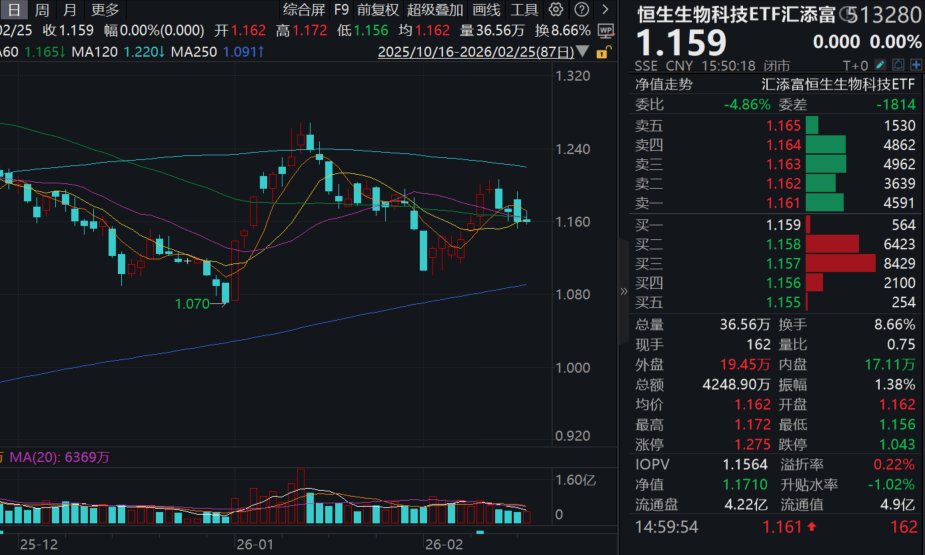
Group 1: Market Performance - The A-share biopharmaceutical ETF Huatai Fuhua (159839) rose by 1.1%, with a total trading volume exceeding 22 million yuan, marking the fourth consecutive day of inflows totaling over 20 million yuan [2] - The Hong Kong biopharmaceutical ETF Huatai Fuhua (513280) fluctuated and closed flat, with a trading volume exceeding 42 million yuan, and a net inflow of over 17 million yuan in the last 60 days [3] - The majority of the popular component stocks in the biopharmaceutical ETF Huatai Fuhua (159839) showed positive performance, with Changchun High-tech hitting the daily limit and its subsidiary GenSci141 ointment receiving clinical trial approval [5] Group 2: Company Performance - WuXi AppTec (药明康德) reported a significant performance increase, with a projected net profit growth of 41.3% in 2025, driven by the TIDES business, which saw revenue growth exceeding 90% [8] - WuXi Biologics (药明生物) achieved a record total of 945 projects, with a 30% growth in dual monoclonal antibodies and ADC projects, indicating strong future revenue potential [8] - The domestic clinical CRO market is expected to return to a growth trajectory in 2025, benefiting companies like Tigermed (泰格医药) from improved order prices and increased clinical pipeline numbers [8] Group 3: Industry Trends - The global CXO industry is expected to continue its strong recovery, with significant investment and transaction demand in the biotech and pharmaceutical sectors anticipated to rebound in 2025 [7] - The Chinese innovative drug market is showing robust activity, with a 19% year-on-year increase in IND numbers and a substantial rise in BD transaction amounts, indicating a vibrant domestic market [7] - The Chinese innovative drug sector is transitioning from pipeline expectations to revenue realization, with over 70% of companies projected to achieve positive revenue growth in 2025 [11]




中国创新药产业加速迈向全球价值链核心
Jing Ji Guan Cha Wang· 2026-02-18 03:24
Core Insights - The Chinese innovative pharmaceutical industry is transitioning from "importing and imitating" to "innovating and exporting," enhancing its global influence and authority in the innovative drug sector [1] - In early 2026, the market for outbound licensing transactions in China's innovative drugs continued its strong growth, with the first quarter's transaction amount exceeding $33.28 billion, setting a historical record [1][2] - By 2025, the total value of China's innovative drug license-out transactions reached $140.27 billion, a significant increase from $2.56 billion in 2017, making China the global leader in this sector [2] Transaction Growth - The growth in China's innovative drug licensing transactions is driven by the dual pressures of a "patent cliff" and "innovation demand" in the global pharmaceutical industry [1] - In 2026, the upfront payment scale in just one month approached half of the total for the entire year of 2025, indicating a rapid increase in transaction volume and quality [2] - The structure of transactions is evolving, with a shift from simple rights transfers to deep binding models based on technology platform sharing and global R&D collaboration [2][3] Strategic Partnerships - Notable collaborations include partnerships between Innovent Biologics and Eli Lilly, as well as between 3SBio and Pfizer, showcasing the trend of comprehensive capability partnerships rather than mere product supply [3] - Leading pharmaceutical companies are adopting a dual strategy of "independent R&D + global licensing," creating a sustainable innovation cycle [3] Financial Performance - Over 70% of innovative pharmaceutical companies reported positive revenue growth in 2025, with cash flow from outbound licensing contributing to a virtuous cycle with capital market financing [4] - The evolving payment system in China, which combines basic medical insurance with commercial insurance, supports a stable cash flow from the domestic market while enhancing long-term corporate value through global collaborations [4] Global Impact - The trend of outbound licensing is reshaping cooperation rules and competitive dynamics in the global pharmaceutical industry, with Chinese companies increasingly playing a proactive and critical role [4][6] - The collaboration between companies like Innovent and Takeda exemplifies a mutually beneficial partnership that leverages global channels and local clinical capabilities [4] Market Sentiment - Despite market fluctuations, analysts generally view high-quality innovative pharmaceutical companies as attractive long-term investments, reflecting a dual recognition of explosive innovative potential and structural growth resilience in the Chinese pharmaceutical industry [5] Industry Dynamics - The surge in outbound licensing is prompting local companies to balance "bringing in" and "going out," with the latter gaining prominence and indicating international market recognition of China's innovative drug quality [6] - There is a need for rational and cautious approaches in the face of rising transaction prices and potential market uncertainties, emphasizing the importance of thorough scientific and commercial due diligence [6]

创新药出海开年跑出“加速度”:产业迈入2.0时代
Jing Ji Guan Cha Wang· 2026-02-18 02:45
Core Insights - The Chinese innovative pharmaceutical industry has entered the 2.0 era, shifting from "import imitation" to "innovation output," with new forms like license-out and new co indicating a transformation in internationalization [1] - In the first quarter of 2026, the total transaction amount for Chinese innovative drug licensing (BD) exceeded $33.28 billion, surpassing the highest quarterly level of 2025, marking a shift from a "follower" to a core driver in the global innovation value chain [1][2] - The explosive growth in BD transactions is attributed to multiple factors, including the global pharmaceutical industry's "patent cliff" and "innovation demand," alongside China's recognized R&D efficiency and clinical capabilities [1] Transaction Growth - In 2025, the total value of China's innovative drug license-out transactions reached $140.27 billion, a significant increase from $2.56 billion in 2017, accounting for 49% of global innovative drug licensing transactions, surpassing the U.S. for the first time [2] - In January 2026, the upfront payment scale approached half of the total for 2025, with total transaction amounts reaching 22% of 2025's total [2] - The quality of transactions is also improving, with frequent occurrences of upfront payments exceeding $100 million and 37 transactions exceeding $1 billion, second only to the U.S. [2] Transaction Structure - The upgrade in transaction structure is a core feature of China's innovative drug internationalization, with traditional "selling seedlings" models being replaced by "technology platform output" and "global R&D collaboration" [2][3] - Notable collaborations include Innovent Biologics and Eli Lilly, where the partnership is based on a new molecule, demonstrating deep trust in China's R&D capabilities [2] Strategic Transformation - Leading pharmaceutical companies are adopting a dual strategy of "independent R&D + global licensing," creating a sustainable innovation ecosystem [3] - Examples include BeiGene's revenue surpassing 36 billion yuan in 2025, showcasing strong commercialization capabilities, and other companies achieving breakeven for the first time [3] Financial Performance - Over 70% of innovative pharmaceutical companies achieved revenue growth in 2025, with cash flow from BD transactions and IPO funding providing substantial resources for the industry [4] - The combination of domestic market cash flow and global licensing is creating a dual-driven model that reduces financial risks and accelerates the conversion of innovative results [4] Industry Ecosystem - The internationalization of innovative drugs is reshaping the global pharmaceutical landscape, with predictions of the emergence of global Chinese pharmaceutical giants [4] - Collaborations like that between Innovent Biologics and Takeda illustrate the strategic partnerships that enhance project advancement efficiency [4] Investment Trends - The innovative drug sector has seen a correction over the past two quarters, but long-term prospects for quality targets remain favorable, suggesting increased allocation [5] - The "dumbbell strategy" proposed by CICC highlights the dual characteristics of "innovation output" and "steady growth" in the Chinese innovative drug industry [5][6] Market Dynamics - An increasing number of Chinese innovative pharmaceutical companies are transitioning from "license-in" to proactive "license-out," achieving record high transaction amounts and gaining recognition in international markets [6] - Horizontal cooperation and integration among domestic pharmaceutical companies are accelerating to optimize resource allocation and address market competition and regulatory challenges [6]
中国创新药出海交易额暴涨10倍破千亿美元!信达生物88.5亿美元合作震撼全球
Jin Rong Jie· 2026-02-16 13:56
Core Insights - The IBI EXPO 2026 Biopharmaceutical Innovation Conference will provide a high-level platform for communication and collaboration in the innovative drug industry [1] - Recent favorable news in the innovative drug sector includes a significant increase in licensing agreements, with Chinese companies signing $137.7 billion in deals in 2025, nearly a tenfold increase from 2021 [1][2] - The trend of Chinese biopharmaceutical companies entering international licensing agreements is accelerating, with major collaborations such as the $8.85 billion deal between Innovent Biologics and Eli Lilly [1][5] Market Focus - The IBI EXPO 2026 conference serves as a catalyst for the innovative drug sector, highlighting the substantial growth in licensing agreements and the transition from research investment to commercial realization [2] - The number of licensing agreements reached 186 in 2025, with a total transaction value of $137.7 billion, marking a record high for the past decade [3][5] - Companies like Innovent Biologics and Rongchang Biopharma are transitioning from loss to profit, indicating a clear improvement in the overall profitability of the industry [2][3] Broker Insights - Open Source Securities notes that the period from 2017 to 2026 is a "golden decade" for Chinese pharmaceutical companies, with licensing agreements skyrocketing from $2.562 billion in 2017 to $137.7 billion in 2025 [3] - The overall revenue growth in innovative drugs is evident, with over 70% of companies reporting positive revenue growth in 2025, showcasing strong commercial capabilities [3] - The innovative drug sector has seen a price correction over the past two quarters, but long-term prospects remain positive, suggesting an increase in sector allocation [3] Related Industries - The innovative drug sector is transitioning from a research investment phase to a commercialization phase, with significant implications for the CXO (Contract Research Organization) industry, which is expected to benefit from increased orders [5] - The new business model of external licensing is expected to enhance the early-stage research pipeline, benefiting companies involved in drug discovery and clinical trials [4][5] - The trend of Chinese innovative drugs "going global" is becoming systematic, with major collaborations indicating a shift towards international development [5] Industry Chain Companies - Heng Rui Medicine is a representative company in the domestic chemical innovative drug sector, with a diverse pipeline and ongoing internationalization efforts [7] - Sanofi Biopharma has received approval for its self-developed monoclonal antibody, further enriching its commercial product pipeline [7] - Companies like Rongchang Biopharma and Ailis are demonstrating strong revenue growth and successful international collaborations, indicating a positive trend in the innovative drug sector [7][8]
大健康风向标〡跨越千亿美元门槛:中国分子站在全球化起点
Jing Ji Guan Cha Wang· 2026-02-13 07:06
Core Viewpoint - The keyword for the stock market in 2025 is expected to be "innovative drugs," with significant stock price increases driven by the potential of in-development innovative drugs and BD (business development) transactions rather than traditional revenue from already marketed drugs [1] Group 1: BD Transactions - In 2025, China's innovative drug BD transaction total exceeded $100 billion, with notable orders reaching $10 billion, and upfront payments from multinational pharmaceutical companies reaching a new high of $1.25 billion [1] - Landmark transactions include a $13 billion collaboration between Qihuang Dejian and Biohaven/AimedBio in January, marking a milestone for China's ADC technology [2] - In May, 3SBio's deal with Pfizer exceeded $6 billion, setting a record for upfront payments in China at $1.25 billion, highlighting the value of both first-in-class and fast-follow drugs [2] - In July, a $12 billion strategic partnership between Hengrui Medicine and GlaxoSmithKline showcased the depth of early-stage pipelines in leading Chinese pharmaceutical companies [2] - In October, Innovent Biologics and Takeda's collaboration worth $11.4 billion included a cost-sharing model for global R&D, enhancing operational capabilities for future international ventures [2] Group 2: Milestone Payments and Emerging Fields - Several past BD transactions reached milestone payments in 2025, including a $300 million payment to China National Pharmaceutical's subsidiary from Merck and a $250 million payment to Bairui Tianheng from Bristol-Myers Squibb [3] - The focus of BD transactions is shifting from oncology to other therapeutic areas, with autoimmune diseases, metabolism, and central nervous system disorders emerging as new hot fields [3] - Notable deals include the global rights licensing of BTK inhibitor Orelabrutinib for multiple sclerosis by Nocera Biopharma, with a potential total transaction value exceeding $2 billion [3] - The metabolic field is gaining traction, driven by global weight loss trends, with several companies entering into licensing agreements for GLP-1 targeted drugs [3] Group 3: Independent Clinical Trials and Regulatory Approvals - Numerous innovative drug companies in China are advancing their own overseas clinical trials, achieving significant progress [4] - In early 2025, Dize Pharmaceutical's lung cancer targeted drug received priority review from the FDA and was approved in July, becoming the first globally innovative drug independently developed in China to gain approval in the U.S. [4] - Other advancements include breakthrough therapy designations for CS0159 by Kexi Kedi and a Phase III trial approval for a recombinant human albumin injection by Heyuan Biopharma [4] - These developments indicate that the Chinese innovative drug industry is becoming a significant force in global innovation, transitioning from fast-following to original innovation and integrating deeply into the global value chain [4]


君实生物总经理邹建军:向打造本土跨国药企进阶
Jing Ji Guan Cha Wang· 2026-02-13 05:08
Core Insights - The Chinese innovative drug industry has entered a critical stage of high-quality development, focusing on quality and core value rather than rapid scale expansion [1] - By 2026, the industry will emphasize core strengths and practical outcomes, with a focus on producing valuable innovative results and achieving efficient transformation [1] Group 1 - The industry has transitioned from "barbaric growth" to "rational maturity," with a clearer development direction [1] - Chinese innovative drug companies are increasingly engaging in license-out collaborations with multinational corporations (MNCs), reflecting global recognition of their R&D capabilities [1][2] - There is a need for companies to move beyond short-term gains from selling pipelines and focus on independent commercialization to build a sustainable local MNC [1] Group 2 - Companies should maintain their original intent by focusing on unmet clinical needs rather than merely catering to business development transactions [1] - Junshi Bioscience aims to deepen its research in cutting-edge fields like tumor immunotherapy and advance high-potential pipelines such as JS207 and JS212 to create globally competitive innovative products [1][2] - Companies must strengthen their global capabilities by establishing a comprehensive self-operated system for R&D, production, commercialization, and regulatory compliance [2] Group 3 - The integration of medical insurance and commercial insurance is essential to boost confidence in sustained investment in true innovation [2] - The new medical insurance directory and the first commercial insurance innovative drug directory are expected to improve accessibility to high-priced drugs and stabilize market expectations [2] - Embracing digitalization and AI can help companies overcome innovation bottlenecks, enhancing efficiency and reducing costs across various stages of drug development [2] Group 4 - By 2026, the innovative drug industry will face both opportunities and challenges, with an increasing concentration of the market favoring leading companies and niche leaders [3] - Junshi Bioscience is committed to a patient-centered approach, aligning with innovation trends, ensuring compliance, and expanding its collaborative landscape [3] - The company believes that collective efforts will drive the high-quality development of China's innovative drugs, benefiting patients globally [3]
