成交量

Search documents
沥青早报-20251031
Yong An Qi Huo· 2025-10-31 01:00
Group 1: Report Industry Investment Rating - No relevant content provided Group 2: Core Viewpoints of the Report - No clear core viewpoints are presented in the given content Group 3: Summary by Related Catalogs 1. Basis and Spread - The Shandong basis (+80) (Hongrun) was 6 on 10/30 with a daily change of 10; the East China basis (Zhenjiang warehouse) was 106 with no daily change; the South China basis (Foshan warehouse) was 126 with a daily change of 20 [3]. - The 12 - 01 spread was 15 on 10/30 with a daily change of -2; the 12 - 03 spread was -6 with a daily change of -7; the 01 - 02 spread was -5 with a daily change of -1 [3]. - The BU main contract (01) was 3254 on 10/30, down 20 from the previous day [3]. 2. Trading Volume, Open Interest, and Warehouse Receipts - The trading volume on 10/30 was 212,219, a decrease of 21,636 (-9%) compared to the previous day; the open interest was 338,671, a decrease of 1,392; the warehouse receipts were 9,120, a decrease of 800 [3]. 3. Spot Prices - Brent crude oil was $64.9 on 10/30, up $0.5 from the previous day [3]. - Jingbo's spot price was 3,260 on 10/30, down 20 from the previous day; Hongrun's was 3,180, down 10; Zhenjiang warehouse's was 3,360, down 20; Foshan warehouse's remained at 3,380 [3]. 4. Profits - The asphalt - Ma Rui profit was 251 on 10/30, down 33 from the previous day; the Ma Rui - type refinery comprehensive profit was 693, down 26 [3].
这轮行情能否延续?关键看这4个信号!
大胡子说房· 2025-10-14 11:58
Core Viewpoint - The article discusses the current volatility in the A-share market, particularly after the index reached 3800 points, indicating uncertainty in market trends and the need for investors to assess various indicators to determine the sustainability of the bull market [2][3][6]. Group 1: Market Indicators - The first indicator to assess is the market leverage ratio, specifically the ratio of margin financing to market capitalization, which currently stands at approximately 6.8%, slightly up from 6.5% at the end of July but still below the 7%-9.8% range seen during the 2015 bull market [12][13]. - The second leverage indicator is the proportion of trading volume from margin financing, which is currently around 12%. Historical data suggests that if this ratio exceeds 12%-13%, regulatory measures may be implemented to cool down the market [17][18]. Group 2: Trading Volume - A significant trading volume exceeding 2 trillion yuan is a crucial indicator for sustaining a bull market. Recently, the A-share market has seen trading volumes surpassing this threshold for five consecutive days, suggesting potential for continued market momentum [20][21]. - The margin financing balance has reached 2.17 trillion yuan, nearing the peak of 2.27 trillion yuan observed in 2015, indicating a strong presence of leveraged funds in the market [23]. Group 3: Fundraising and New Accounts - The scale of newly issued public funds is another critical indicator. Currently, the average weekly fundraising for public funds is 11 billion yuan, which is significantly lower than the peak seen during the 2021 bull market, indicating that retail investor enthusiasm is not yet at a high level [24][26]. - The number of new trading accounts opened is also a vital metric. In July, 1.96 million new accounts were opened, which is considerably lower than the peaks of previous bull markets, suggesting that the current market is still in its early stages [33][34]. Group 4: Market Stage Assessment - Based on the four indicators discussed, the A-share market is still in the initial phase of the bull market, with no signs of entering the acceleration or terminal phases yet. This suggests that investors can hold their positions but should be cautious about entering the market at current levels [37][39].


沥青早报-20251013
Yong An Qi Huo· 2025-10-13 01:11
Group 1: Report Information - Report Title: "Asphalt Morning Report" [2] - Research Team: Research Center Energy and Chemicals Team [3] - Report Date: October 13, 2025 [3] Group 2: Market Data Summary Futures Contracts - The closing prices of BU contracts on October 10, 2025, showed varying degrees of decline compared to previous days, with the BU01 contract dropping by 57 to 3248, and the BU11 contract down 47 to 3328 [4]. - The trading volume on October 10 was 323,321, an increase of 107,262 from the previous day and 47,323 from the previous week [4]. - The open interest on October 10 was 322,594, an increase of 2,486 from the previous day but a decrease of 71,983 from the previous week [4]. Spot Market - The market prices of asphalt in different regions showed different trends, with the Shandong market price remaining unchanged at 3490, the North China market price dropping by 30 to 3560, and the Northeast market price falling by 10 to 3800 [4]. - The basis and monthly spreads of asphalt also changed, with the Shandong basis (+80) increasing by 17 to 172, and the 10 - 11 monthly spread rising by 56 to 112 [4]. Crack Spreads and Profits - The asphalt - Brent crack spread on October 10 was 98, an increase of 51 from the previous day but a decrease of 42 from the previous week [4]. - The asphalt - Marrow profit on October 10 was 22, an increase of 46 from the previous day but a decrease of 38 from the previous week [4]. - The comprehensive profit of ordinary refineries on October 10 was 449, an increase of 36 from the previous day but a decrease of 88 from the previous week [4]. - The comprehensive profit of Marrow - type refineries on October 10 was 833, an increase of 39 from the previous day but a decrease of 25 from the previous week [4]. - The import profit from South Korea to East China on October 10 was - 225, a decrease of 2 from the previous day and 49 from the previous week [4]. - The import profit from Singapore to South China on October 10 was - 960, a decrease of 3 from the previous day and 13 from the previous week [4]. Related Commodity Prices - The price of Brent crude oil on October 10 was 65.2, a decrease of 1.0 from the previous day but an increase of 0.7 from the previous week [4]. - The market price of gasoline in Shandong on October 10 was 7433, a decrease of 25 from the previous day and 84 from the previous week [4]. - The market price of diesel in Shandong on October 10 was 3803, an increase of 60 from the previous day and 50 from the previous week [4]. - The market price of residue oil in Shandong on October 10 was 3743, a decrease of 10 from the previous day and 10 from the previous week [4].
行情能否持续?关键看这几个信号!
大胡子说房· 2025-10-11 05:38
Core Viewpoint - The article discusses the current volatility in the A-share market, particularly after the index reached 3800 points, indicating uncertainty in market trends and the need for investors to assess various indicators to determine the sustainability of the bull market [2][3][4]. Group 1: Market Indicators - The first indicator to monitor is the market leverage ratio, specifically the ratio of margin financing to market capitalization, which currently stands at 6.8%, slightly up from 6.5% at the end of July but still below the 7%-9.8% range seen during the 2015 bull market [12][13]. A breach of 7.5% could signal potential market risks [14]. - The second indicator is the proportion of trading volume from margin financing, which is currently about 12%. Historical data suggests that if this ratio exceeds 12%-13%, regulatory measures may be implemented to cool down the market [17][18]. Group 2: Trading Volume and Fundraising - The third indicator is the overall trading volume, with a threshold of 20 trillion yuan typically indicating the potential for a sustained bull market. Recently, the A-share market has seen trading volumes exceed this level for five consecutive days, suggesting a possibility for continued upward momentum [20][21]. - Additionally, the balance of margin financing has reached 2.17 trillion yuan, nearing the peak of 2.27 trillion yuan from 2015, indicating significant market activity [23]. Group 3: Fundraising and New Accounts - The fourth indicator is the scale of newly issued public funds. Currently, the average weekly fundraising for public funds is 11 billion yuan, which is not as high as during the previous bull market in 2022, indicating that retail investor enthusiasm is still relatively low [24][26]. - The number of new accounts opened is also a critical metric. In July, 1.96 million new accounts were opened, significantly lower than the peak of 6.8 million in October of the previous year and the average of 3.6 million during the 2015 bull market [33][34]. This suggests that the current bull market is still in its early stages [37]. Group 4: Investment Strategy - Based on the analysis of these indicators, the current bull market is still in the initial phase, and investors should be cautious about entering the market at this stage, especially around the 3800-3900 point range [39][42]. - Investors who have already entered the market should hold their positions, while those who have not should wait for more favorable conditions before investing [46][48].

不负所望,盯住量能
Sou Hu Cai Jing· 2025-10-09 08:14
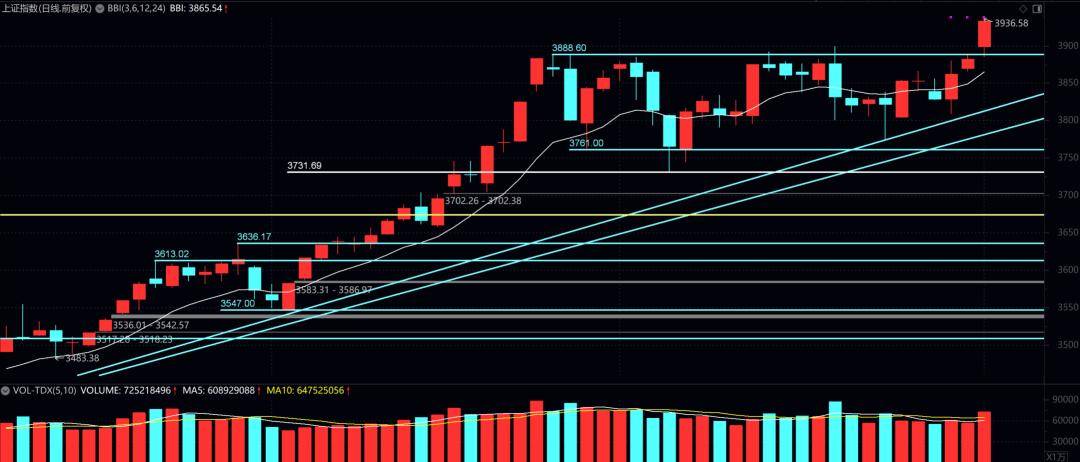
Core Viewpoint - The market showed strong performance with major indices reaching new highs for the year, indicating a bullish sentiment in the short to medium term [1][15]. Market Performance - The market opened at 3898, with a low of 3885 and a high of 3936, closing at 3933. The ratio of advancing to declining stocks was 3115 to 2186, showing more stocks gained than lost [1]. - The closing above 3920 is seen as a strong result, reinforcing the bullish control in the mid to short term [1][15]. Technical Analysis - Technical indicators are currently high, suggesting that further upward movement will require increased trading volume. A lack of volume could lead to potential adjustments in the market [2][15]. - The key focus for the upcoming trading day is whether the market can maintain a position above 3900, which is critical for sustaining bullish momentum [3][15]. Key Levels - The major indices have established critical support and resistance levels: - For the main index, strong support is at 3872-3767, with a key resistance point at 3936 [7][15]. - The ChiNext index has support at 2835-3173, with a strong point at 3322 [8][15]. - The 50 index has support at 2901-2970, with a strong point at 3030 [9][15]. Volume and Momentum - The market closed with a significant bullish candlestick pattern, indicating a strong upward trend. The volume increased, suggesting that the bullish momentum may continue [12][15]. - The short-term technical outlook indicates that the market is currently above its daily life line, which is a positive sign for further gains [15]. Conclusion - The market's ability to hold above key levels and the need for sufficient trading volume are crucial for maintaining the current bullish trend. The focus remains on the ability to sustain above 3900 in the upcoming trading sessions [13][15].
午评:主要指数都已再创了年内新高,此时成交量能否放出就成关键了
Sou Hu Cai Jing· 2025-10-09 04:11
Group 1 - The market has shown a rare five consecutive bullish monthly candles, indicating a potential for further upward movement towards previous highs, with a critical support level at 3860 that must not be breached [2] - Major indices have reached new highs for the year, with the market currently challenging resistance levels between 3907 and 4006, making trading volume a key factor for continued upward momentum [2] - The market is advised to maintain positions above 3890-3860 for short-term trading, with a recommendation to reduce positions if unable to break through resistance levels between 3943 and 4006 [2] Group 2 - The daily critical support level is around 3864, and the market must stay above this level to maintain a bullish outlook, with the upper range of 3860-3760 being crucial for strength [3] - For the afternoon session, closing above 3900 is acceptable, while closing above 3910 and 3920 is considered strong, with a minimum requirement to close above 3890 [3] - The mid to long-term outlook indicates that the weekly strength threshold is between 3855 and 3895, and the monthly threshold is between 3730 and 3810, with the market needing to stay above the 60-day and 250-day moving averages to avoid a bearish trend [3]

A股何时上攻3900点?今天市场给出了明确信号!
Sou Hu Cai Jing· 2025-09-22 11:24
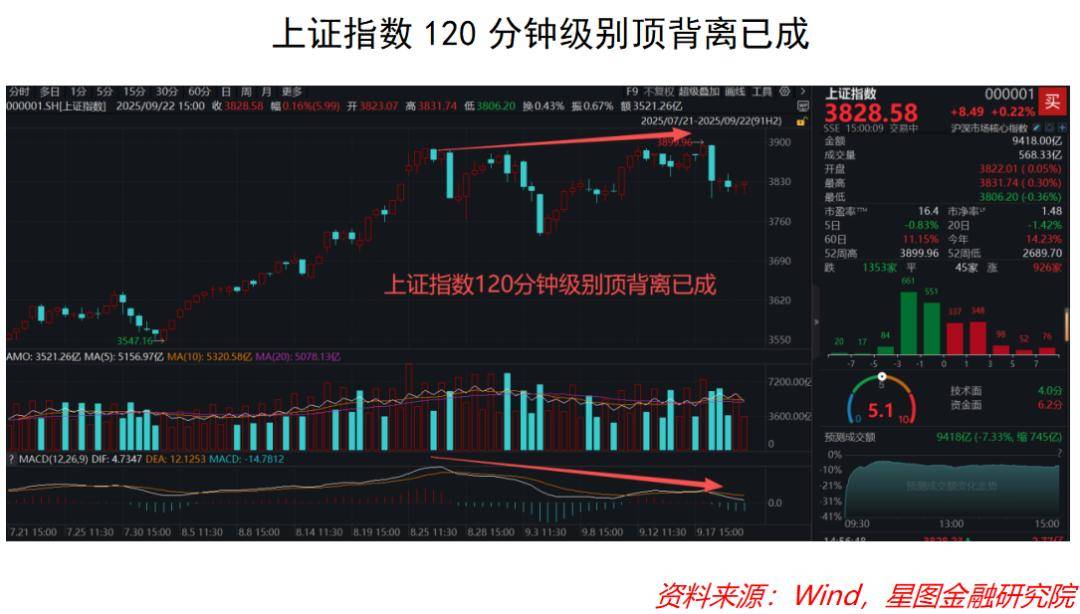
Market Overview - The A-share market saw all three major indices rise today, with the Shanghai Composite Index up 0.22%, Shenzhen Component Index up 0.67%, and ChiNext Index up 0.55% [1] - The total trading volume was 21,425 billion yuan, a decrease of 2,069 billion yuan from the previous day, with over 2,100 stocks in the green [1] - Key sectors that performed well included precious metals, consumer electronics, semiconductors, and liquid-cooled servers, while sectors like film and television, tourism and hotels, paper, energy metals, liquor, and pesticides underperformed [1] Market Sentiment - Following the Federal Reserve's interest rate cut last Thursday, the market briefly reached a new high of 3,899.96 points, just shy of the 3,900-point mark, but faced a sharp decline due to weakness in the financial sector [1] - The market has shown signs of temporary stabilization over the past two days, despite the reduced trading volume [1] Trading Volume Analysis - The core observation indicator for market momentum is the trading volume, which is essential for sustaining a bull market [3] - Continuous high trading volume indicates strong market participation and bullish sentiment, while declining volume suggests a lack of interest and potential downward pressure [3] Reasons for Low Trading Volume - The "pre-holiday effect" is influencing market activity, as investors tend to reduce holdings before holidays to avoid systemic risks, leading to decreased trading volume [5] - There is a lack of new major news catalysts in the short term, which has contributed to the market's inability to rally [6] - Technical indicators suggest a potential top formation in the market, which may further dampen buying interest and reinforce a cautious sentiment among investors [7] Market Outlook - The market is expected to remain in a consolidation phase before the National Day holiday, with limited upward movement anticipated [9] - Investors are advised to lower positions and wait for clearer signals before increasing exposure, while those looking to trade can consider buying near the lower end of the trading range and selling near the upper end [10] - Long-term bullish sentiment remains intact, with significant policy signals expected from the upcoming 20th Central Committee meeting in October, which could provide new direction for the market [14]
这轮大A行情能否持续?关键看这几个信号!
大胡子说房· 2025-09-20 05:49
Core Viewpoint - The article discusses the current volatility in the A-share market, particularly after the index reached 3800 points, indicating uncertainty in market trends and the need for investors to assess various indicators to determine the sustainability of the bull market [2][3][4]. Group 1: Market Indicators - The first indicator to assess is the market leverage ratio, specifically the ratio of margin financing to market capitalization, which currently stands at 6.8%, slightly up from 6.5% in late July but still below the 7%-9.8% range seen during the 2015 bull market. A breach of 7.5% could signal potential risks [12][13][14]. - The second indicator is the proportion of trading volume from margin financing, which is currently at 12%. Historical data suggests that if this ratio exceeds 12%-13%, regulatory measures may be implemented to cool down the market [17][18]. - The third indicator is market trading volume, with a sustained volume above 2 trillion yuan typically supporting a bull market. Recently, the A-share market has seen trading volumes exceed this threshold for five consecutive days, indicating potential for continued upward movement [20][21]. - The fourth indicator is the scale of newly issued public funds. Currently, the average weekly fundraising for public funds is 11 billion yuan, which is significantly lower than the peak seen in 2022, suggesting that retail investor enthusiasm is not yet at a high level [24][26]. Group 2: New Investor Activity - The fifth indicator is the number of new brokerage accounts opened, which serves as a gauge for retail investor participation. In July, 1.96 million new accounts were opened, significantly lower than the peak of 6.8 million in October of the previous year, indicating that the current bull market is still in its early stages [33][34]. - The analysis concludes that as of late August or early September, the A-share market is still in the initial phase of the bull market, with no signs of entering the acceleration or terminal phases yet [37]. Group 3: Investment Strategy - The article suggests that investors, particularly retail investors, should consider holding onto their stocks while being cautious about entering the market at current levels, especially around the 3800-3900 point range, due to the risk of potential downturns [39][42]. - It emphasizes that this bull market is characterized by structural trends where stronger stocks outperform, and investors should be selective to avoid long-term losses [43][44]. Group 4: Educational Offerings - The article promotes a live course designed to help investors understand market dynamics and identify investment opportunities, offering insights into capital market trends and asset allocation strategies [50][56].

中指研究院:8月百城二手住宅均价环比下跌0.76% 一线城市跌幅收窄
智通财经网· 2025-09-18 23:58
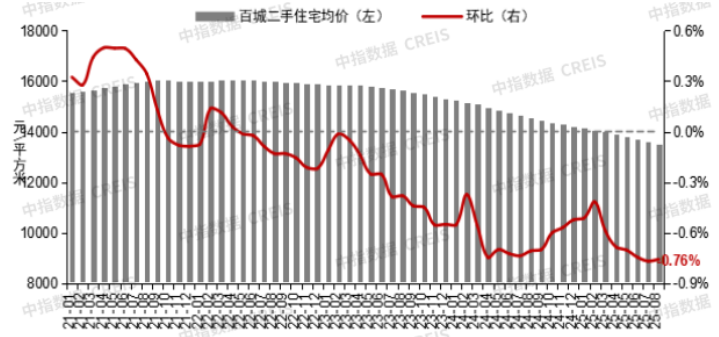
Core Insights - The average price of newly built residential properties in 100 cities reached 16,910 yuan per square meter in August 2025, showing a month-on-month increase of 0.20% and a year-on-year increase of 2.73% [1] - The average price of second-hand residential properties in 100 cities was 13,481 yuan per square meter in August 2025, reflecting a month-on-month decrease of 0.76% and a year-on-year decrease of 7.34% [1] - The average rent for residential properties in 50 key cities was 34.88 yuan per square meter per month in August 2025, with a month-on-month decline of 0.15% and a year-on-year decline of 3.76% [1] New Residential Market - The new residential market is experiencing structural growth driven by the introduction of improvement projects in certain cities [1] - The average price increase in new residential properties indicates a potential recovery in demand in specific urban areas [1] Second-hand Residential Market - The second-hand residential market continues to exhibit a "price-for-volume" phenomenon, with prices declining in most cities [1] - In August 2025, second-hand residential prices in first-tier cities fell by 0.55% month-on-month and 4.17% year-on-year, while second-tier and third/fourth-tier cities saw declines of 0.85% and 0.78% respectively [1][3] Rental Market - The rental market is experiencing a slowdown in demand as the graduation season effect diminishes, leading to a slight increase in the decline of average rents in key cities [1] - The average rent decline in 50 cities suggests a cooling rental market, which may impact rental yields for investors [1] City-Specific Trends - In August 2025, major cities like Wuhan and Nanjing experienced significant month-on-month declines in second-hand housing prices, with decreases of 1.20% and 0.97% respectively [3] - Year-on-year, Wuhan and Nanjing saw declines of 9.67% and 9.50% in second-hand housing prices, indicating a challenging market environment [3][5] Transaction Volume - Certain cities such as Huizhou and Nanchang reported substantial year-on-year increases in transaction volumes, with growth rates of 56.9% and 28.4% respectively [6][7] - Conversely, cities like Nanjing and Dalian faced significant declines in transaction volumes, with decreases of 22.1% and 61.0% respectively [8]
这轮大A行情能否新高?关键看这几个信号!
大胡子说房· 2025-09-13 04:48
Core Viewpoint - The article discusses the current volatility in the A-share market, particularly after the index reached 3800 points, indicating uncertainty in market trends and the need for investors to assess various indicators to gauge the sustainability of the bull market [2][3][4][6]. Group 1: Market Indicators - The first indicator to assess is the market leverage ratio, specifically the ratio of margin financing to market capitalization, which currently stands at approximately 6.8%, slightly up from 6.5% at the end of July but still below the 7%-9.8% range seen during the 2015 bull market [12][13]. - The second leverage indicator is the proportion of trading volume from margin financing, which is currently around 12%. Historical data suggests that if this ratio exceeds 12%-13%, regulatory measures may be implemented to cool down the market [17][18]. - The second key indicator is market trading volume, with a sustained volume above 2 trillion yuan typically supporting a bull market. Recently, the A-share market has seen trading volumes exceed this threshold for five consecutive days [20][21]. Group 2: Fundraising and New Accounts - The third indicator is the scale of newly issued public funds. Currently, the average weekly fundraising for public funds is 11 billion yuan, which is significantly lower than the peak seen during the 2021 bull market, indicating that retail investor enthusiasm is not yet at a high level [24][26]. - The fourth indicator is the number of new brokerage accounts opened. In July, 1.96 million new accounts were opened, which is considerably lower than the peak of 6.8 million in October last year and the average of 3.6 million during the 2015 bull market [33][34]. Group 3: Market Stage Assessment - Based on the four indicators, the current bull market is still in its initial stage, with no signs of entering the acceleration phase or nearing the end phase. This suggests that investors can hold onto their stocks for now [36][37]. - The article advises caution for new investors considering entering the market at the current index levels, as significant downturns could lead to substantial losses [42][43].