投资理念

Search documents
读《风和投资随笔》
猛兽派选股· 2025-11-22 04:02
Core Viewpoint - The article emphasizes the importance of risk management and a bottom-up approach in investment strategies, focusing on identifying high-quality companies rather than following market trends or macroeconomic indicators [1][2]. Group 1: Investment Philosophy - The core investment philosophy of Fenghe Fund prioritizes risk management, asserting that understanding one's own risk profile is essential for successful investing. The focus is on managing drawdowns and maintaining a diversified portfolio with low correlation among assets [1]. - The fund has achieved an average annual return of over 18% since its inception in 2009, with a maximum historical drawdown of only -6.5% [1]. Group 2: Company Focus - The investment strategy is centered on a bottom-up analysis of companies, disregarding macroeconomic trends and focusing instead on a company's innovation and competitiveness. The evaluation of a company's value is based on cash flow, realizable assets, and its ability to generate future cash [1]. - The fund seeks to identify high-quality companies ("eagles") that can dominate their markets, while also being willing to short companies with deteriorating fundamentals, avoiding mediocre companies altogether [1]. Group 3: Market Perspective - The article advocates for a cyclical understanding of the market, encouraging a contrarian investment approach that aligns with long-term fundamentals rather than short-term performance fluctuations. This philosophy allows for strategic investments in companies with strong future prospects during periods of market pessimism [2]. - Key insights include the importance of observation and analysis over prediction, emphasizing that survival in volatile markets relies on solid fundamentals rather than speculative forecasts [2].


投资人都不鸡娃啊?
集思录· 2025-11-19 13:47
Group 1 - The article discusses a shift in mindset regarding children's education, emphasizing the importance of finding personal passion over societal success [1][2] - It highlights the contrast between wealthy families who invest heavily in children's education and those who adopt a more relaxed approach, leading to feelings of inadequacy among some parents [2][3] - The narrative reflects on the pressures of modern education, with parents feeling compelled to push their children towards high academic achievements despite the potential for limited outcomes [4][11] Group 2 - The text outlines three main barriers to children's success: innate talent, personal ambition, and the prevailing societal trends [7][8][9] - It suggests that the pursuit of elite education may not guarantee success, as many factors, including luck and timing, play significant roles in a child's future [10][11] - The article concludes that a balanced approach to parenting, focusing on well-being rather than solely on academic success, may lead to healthier outcomes for children [13][20]

段永平的采访,值得每个普通人看3遍
大胡子说房· 2025-11-19 11:33
Group 1 - The article discusses two significant events in the investment world: an interview with Duan Yongping and Warren Buffett's retirement announcement [2][3] - Duan Yongping emphasizes the importance of accepting one's limitations and the value of being an ordinary person, which can lead to happiness [4][6] - A key takeaway from Duan Yongping's interview is the idea that admitting ignorance in investment can prevent significant losses, as many investors often pretend to understand complex topics [7][10] Group 2 - Duan Yongping's investment philosophy includes recognizing when to cut losses quickly, as demonstrated by his past experience of losing over $10 million on a $100 million investment [13][14] - He advocates for a mindset of correcting mistakes promptly and sticking to sound investments, which is crucial for ordinary investors to understand [16][19] - The concept of opportunity cost is highlighted, with Duan Yongping explaining that decisions should be based on potential returns from alternative investments [20][22] Group 3 - Long-term holding does not mean one should never sell; if a better investment opportunity arises, it is wise to make the switch [32][34] - The decision to invest should be based on future cash flows rather than just price-to-earnings ratios, emphasizing the need for understanding the underlying business [36] Group 4 - Duan Yongping shares insights on parenting, stating that parents should focus on providing security for their children, which influences their future success [39][41] - The article discusses the psychological aspects of investing, noting that a lack of security can lead to irrational decisions in the stock market [43][45] Group 5 - The article concludes with a reflection on the current economic landscape, suggesting that there are new turning points in the market that require careful consideration and preparation for future investments [64][65]

段永平劝退股民实录,炒股堪比渡劫,普通人别硬闯!
Sou Hu Cai Jing· 2025-11-17 11:17
退休20多年的传奇大佬段永平一露面,直接给散户们泼了盆冰水,炒股这活儿,80%的人牛熊都亏钱, 别觉得自己是天选之子能例外! 这话听着扎心,但句句都是大实话,翻译过来就是,韭菜别总想逆袭,能保住本金就赢了! 核心暗号,买股票就是买公司,懂的人不到1% 段永平在访谈里把这句话念得跟咒语似的,还补刀,雪 球上的球友们,能真懂这话的1%都不到,做到的更是凤毛麟角。 这话啥意思呢?说白了就是你买股票不是买涨跌的筹码,是当公司小老板,得知道这公司靠啥赚钱、以 后能不能一直赚。 很多散户倒好,看股价便宜就冲,以为捡了宝,结果越套越深。大佬早就看穿一切,便宜的东西能更便 宜,盲目抄底纯属送人头! 这就跟找对象似的,光看颜值低就动心,不了解人品家底,迟早得翻车。 持仓密码,三巨头躺赢,特斯拉再牛也不碰 别人炒股搞广撒网,段永平直接极简风,我就三只股票, 苹果、腾讯、茅台。这配置堪称神仙三件套,共同点就是看得懂、壁垒高。 苹果的生态闭环、茅台的文化buff、腾讯的社交底盘,都是别人抄不来的硬实力。 最搞笑的是他不投特斯拉的理由,马斯克确实牛,但我不喜欢他的品行。 投资就是跟人做朋友,这种朋友给我钱我也不处! 顺便还吐槽电动车行 ...
段永平罕见发声:假如五年前看懂英伟达,愿意拿茅台换
2 1 Shi Ji Jing Ji Bao Dao· 2025-11-16 02:20
Core Insights - Renowned investor Duan Yongping, after over 20 years of retirement, shared his investment philosophy and experiences in a recent interview, emphasizing the importance of understanding a company's intrinsic value and future cash flows rather than focusing solely on market price fluctuations [1][3]. Investment Philosophy - Duan Yongping currently holds only Kweichow Moutai in the A-share market, indicating it is one of his few major investments. He stated that his investment decisions are primarily based on the company's future cash flow rather than a single metric like the price-to-earnings ratio [2][3]. - He expressed that even during significant price declines, such as Kweichow Moutai's stock price halving, he remained calm and continued to hold and even increase his position, reflecting his deep understanding of the company's intrinsic value [2][3]. Decision-Making Process - Duan emphasized that investment is about making comparisons and choices based on a deep understanding of the business, anchoring on intrinsic value and future cash flows rather than short-term market volatility [3][4]. - He clarified that "long-term holding" should not be equated with "never selling," and investors must continuously evaluate opportunity costs during the holding period [4]. Understanding Companies - Duan agreed with the notion that "buying stocks means buying companies," but stressed the importance of truly understanding the company, which he believes is quite challenging. He noted that many companies are difficult to comprehend fully [6][7]. - He highlighted that even if one does not fully understand a company, it does not guarantee profitability, as success in such cases often relies on luck rather than skill [6]. Cultural and Strategic Insights - Duan criticized Nokia's decline, attributing it to a corporate culture that prioritized market share over user experience and a failure to adapt to changing trends. He noted that strategic direction and cultural foundations are crucial for a company's success [7][8]. - He emphasized that understanding a company requires looking beyond its business and trends to examine its internal culture and strategic consistency [7]. Talent Selection - Duan asserted that selecting the right people is essential for organizational success, emphasizing that shared values and cultural alignment are critical for long-term collaboration [8][9]. - He categorized individuals in organizations as "like-minded" or "co-workers," stressing that those who share deep value recognition contribute significantly to organizational cohesion [8][9].


如何找到对的人?段永平谈企业经营秘诀:核心是选择而非培养
2 1 Shi Ji Jing Ji Bao Dao· 2025-11-15 14:52
Core Insights - Renowned investor Duan Yongping, who has been "retired" for over 20 years, recently shared his investment philosophy and views on talent selection in an interview, emphasizing the importance of shared values in organizations [1][2] Group 1: Talent Selection and Organizational Culture - Duan Yongping firmly believes that talent is primarily "chosen" rather than "cultivated," highlighting that individuals within the BBK system are mostly "ordinary people" whose growth comes from shared experiences and learning [1] - He stresses that a deep recognition of shared values is essential for organizational success, stating that if individuals within an organization pursue their own interests, it will inevitably lead to problems [1] - The strong organizational cohesion observed among long-term colleagues is attributed to a solid foundation of shared values, which allows them to work together for decades [1] Group 2: Types of People in Organizations - Duan categorizes individuals in organizations into two groups: "like-minded people" and "fellow travelers," where the former deeply resonate with the organization's philosophy, while the latter may initially not fully understand it but are willing to trust and follow the cultural guidance [1] - He notes that even if "fellow travelers" occasionally make mistakes, they can become reliable members of the organization over time if they are immersed in a culture of recognition [1][2] Group 3: Investment Philosophy - The core logic that underpins Duan Yongping's approach to both investment and business operations is the alignment of values and cultural recognition, whether selecting a company for investment or a partner for collaboration [2]
段永平最新千亿持仓来了!新进阿斯麦
Xin Lang Cai Jing· 2025-11-15 03:41
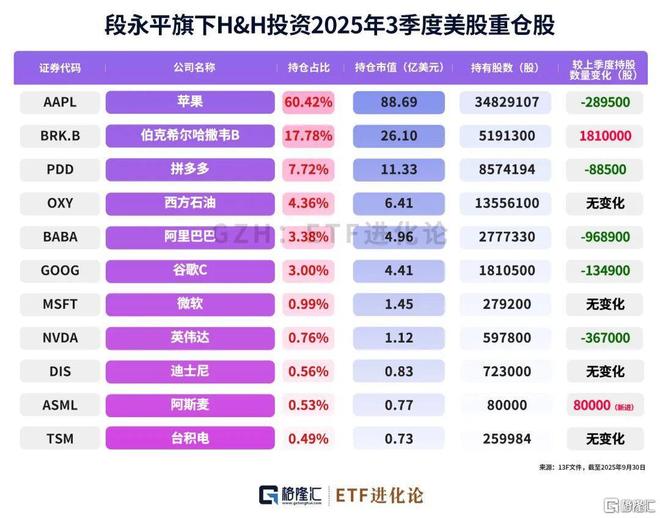
Core Insights - The article discusses the latest investment moves of prominent investor Duan Yongping, revealing his portfolio management through the H&H investment account, which holds 11 U.S. stocks valued at approximately $14.68 billion [1]. Group 1: Investment Portfolio - As of Q3 2025, Duan Yongping's H&H account has a total market value of $14.68 billion, equivalent to about 104.2 billion RMB [1]. - The largest holding is Apple, with a market value of $8.869 billion, accounting for 60.42% of the portfolio [2]. - Berkshire Hathaway B shares are the second-largest holding, valued at $2.610 billion, representing 17.78% of the portfolio [2]. - Other notable holdings include Pinduoduo, Occidental Petroleum, Alibaba, Google C, Microsoft, NVIDIA, Disney, ASML, and TSMC [1][2]. Group 2: Recent Trading Activity - In Q3, Duan Yongping initiated a new position in ASML, acquiring 80,000 shares valued at $77.45 million, which is a relatively small allocation at 0.53% of the portfolio [1]. - He increased his stake in Berkshire Hathaway B while reducing positions in Apple, Pinduoduo, Alibaba, Google C, and NVIDIA, while maintaining his holdings in Occidental Petroleum, Microsoft, Disney, and TSMC [1]. Group 3: Investment Philosophy - Duan Yongping emphasizes the importance of understanding the business and future cash flows when investing, stating that buying stocks equates to buying companies [6]. - He has previously invested in companies like NetEase, Yahoo, and Tencent, highlighting a focus on companies he understands well [6].

伯克希尔最新调仓动向曝光!首次建仓谷歌母公司
Ge Long Hui· 2025-11-15 03:41
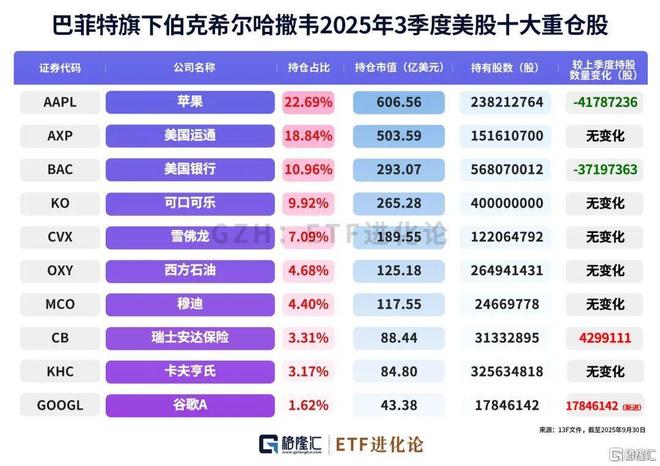
Group 1 - Berkshire Hathaway's latest investment strategy reveals a total of 41 stocks held in the U.S. market, with a combined market value of $267 billion as of the end of Q3 [1] - In Q3, Berkshire purchased 17.85 million shares of Alphabet, with a holding value of approximately $4.34 billion, making it the 10th largest position in the portfolio [1] - Berkshire has reduced its stake in Apple by selling 41.79 million shares in Q3, more than doubling the amount sold compared to Q2, yet still holds over 238 million shares valued at approximately $60.66 billion, maintaining Apple as its largest holding [1][2] Group 2 - The top ten holdings of Berkshire Hathaway account for 87% of its portfolio, including Apple, American Express, Bank of America, Coca-Cola, Chevron, Occidental Petroleum, Moody's, Chubb, Kraft Heinz, and Alphabet [2][3] - Chubb is the only stock among the top ten that saw an increase in holdings, with an additional 4.29 million shares acquired, raising its holding percentage to 3.31% [3] Group 3 - Warren Buffett's annual letter to shareholders reflects on his life and investment philosophy, emphasizing the importance of kindness and philanthropy, while also announcing plans to convert more Berkshire A shares into B shares for charitable donations [4][5] - Buffett reassures shareholders of his confidence in the U.S. economy and Berkshire's resilience, stating that volatility is not risk, but panic is [5]



段永平方略访谈:我之所以成为我,很大原因是因为我不做的那些事情
雪球· 2025-11-14 13:00
Group 1: Personal Growth - The importance of parental trust in childhood, which lays the foundation for rational decision-making [3][5] - Setting boundaries is crucial for providing children with a sense of security, which is essential for rationality [5][6] - The significance of leaving uncomfortable environments for better career choices [7][8] Group 2: Corporate Management - The lesson from Xiaobawang emphasizes the importance of trust and commitment in organizational culture [20] - The success of BBK is attributed to its focus on integrity and user-oriented culture [21][22] - The evolution of corporate culture is a continuous process influenced by experiences and lessons learned [23][24] Group 3: Investment Logic - The core principle of investing is to view stock purchases as buying into a company [40][41] - Understanding a company's business model and future cash flows is essential for successful investing [44][45] - Real-world examples, such as investments in NetEase, Apple, and Moutai, illustrate the importance of understanding company value and consumer recognition [48][69]



段永平,最神奇一笔投资
投资界· 2025-11-14 08:01
Core Viewpoint - The article highlights the investment journey of Duan Yongping, emphasizing his successful investment in NetEase during the internet bubble burst and his philosophy of investing in companies rather than just stocks [4][15]. Investment in NetEase - In 2001, Duan Yongping made a significant investment in NetEase when its stock price was below $1, despite the company facing severe challenges and a potential delisting risk [6][7]. - He recognized that NetEase had over $2 in cash per share, which indicated it was undervalued, leading him to invest $2 million for 152,000 shares, later increasing his stake to 205,000 shares, approximately 6.8% of the total shares [7][8]. - Within six months, the stock price surged to $70, resulting in a 20-fold return on investment, and ultimately, he earned over $200 million from this investment by holding until around 2010 [8][9]. Investment in Pinduoduo - Duan Yongping's investment in Pinduoduo was characterized as somewhat impulsive, as he admitted to investing without fully understanding the e-commerce sector [11][12]. - Despite initial hesitations, he chose to increase his stake in Pinduoduo due to his trust in the company's culture and team, even though he acknowledged the risks involved [11][12]. Investment Philosophy - Duan Yongping's investment philosophy revolves around the principle of "buying companies," focusing on understanding the business model and corporate culture rather than timing the market [15][16]. - He emphasizes three key criteria for investments: the right business model, the right people, and the right price, which guide his investment decisions [15][16]. - His long-term holdings primarily include Apple, Moutai, and Tencent, reflecting his strategy of focusing on a few high-quality investments [15][16].