
投资结构优化

Search documents
广东各城经济三季报:东莞佛山GDP差距缩至近年最小
Sou Hu Cai Jing· 2025-11-07 09:51
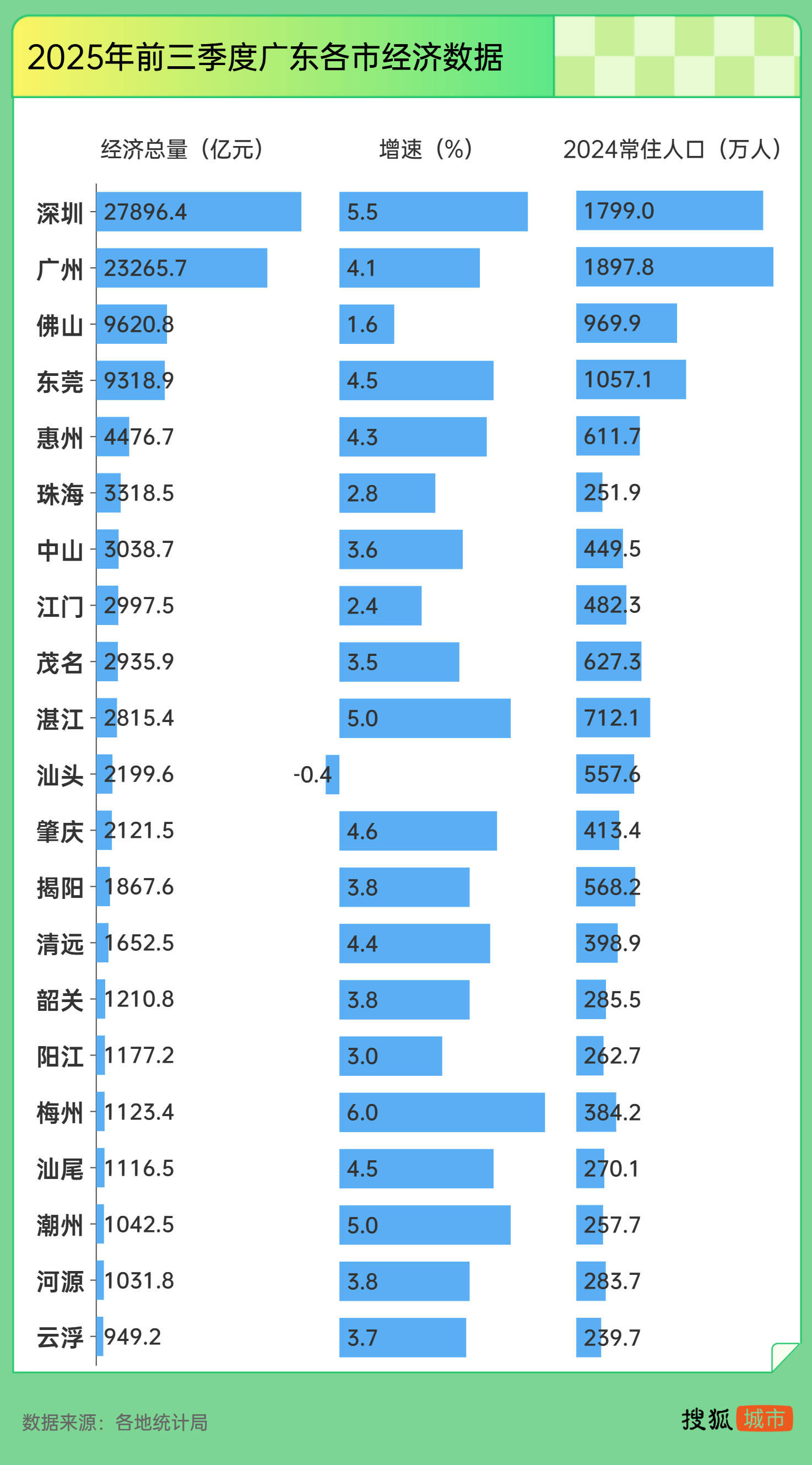
Economic Overview - Guangdong's GDP reached 10,517.698 billion yuan in the first three quarters, with a year-on-year growth of 4.1%, maintaining its position as the top province, but the lead over Jiangsu has narrowed to the smallest margin in recent years [1] - Since 2021, Guangdong has underperformed the national average for four consecutive years [1] City Performance - The top four cities by economic output are Shenzhen, Guangzhou, Foshan, and Dongguan, contributing 66.7% to the province's total economy [1] - Guangzhou's GDP totaled 2.33 trillion yuan with a growth rate of 4.1%, while Shenzhen's GDP was 2.79 trillion yuan with a growth rate of 5.5% [4] - Guangzhou's automotive industry has faced significant challenges, leading to a decline in production and economic growth, with a projected 18.2% decrease in automotive manufacturing value added in 2024 [4][5] Export and Consumption - Guangzhou led the province in consumption and export growth, with retail sales reaching 815.751 billion yuan and exports totaling 612.14 billion yuan, growing by 4.1% and 21.2% respectively [5] - In contrast, Shenzhen's exports fell by 4.7% in the same period, attributed to external uncertainties [6] Competition for Third City - Foshan and Dongguan are in a close competition for the title of Guangdong's third city, with GDP totals of 962.08 billion yuan and 931.89 billion yuan respectively, and growth rates of 1.6% and 4.5% [8] - The GDP gap between Foshan and Dongguan has narrowed to approximately 30 billion yuan, the smallest in recent years [8][11] Industrial and Investment Trends - Foshan's industrial and consumption sectors are experiencing stagnation, with significant reliance on traditional industries linked to real estate [10] - Dongguan is focusing on strategic emerging industries and has initiated a large-scale investment program to enhance its economic structure [11] Regional Disparities - Shantou's GDP fell by 0.4% in the first three quarters, continuing a trend of negative growth, primarily due to declines in the secondary industry [12][15] - Conversely, Meizhou's GDP grew by 6.0%, driven by a robust industrial sector, particularly in electronic information [12][15]

黑龙江省:前三季度地区生产总值同比增长4.8%,文旅市场消费活力持续释放
Zheng Quan Shi Bao Wang· 2025-10-29 06:25
Economic Overview - Heilongjiang Province's GDP for the first three quarters reached 11,489.0 billion yuan, with a year-on-year growth of 4.8% [1] - The primary industry added value was 1,186.0 billion yuan, growing by 4.3%; the secondary industry added value was 3,014.2 billion yuan, increasing by 3.8%; the tertiary industry added value was 7,288.8 billion yuan, rising by 5.2% [1] Agricultural Sector - The total output value of agriculture, forestry, animal husbandry, and fishery in Heilongjiang Province was 2,275.3 billion yuan, with a year-on-year increase of 4.4% [3] - Vegetable and edible fungus production reached 7.549 million tons, growing by 5.1%; fruit production was 1.704 million tons, increasing by 4.6% [3] - Livestock production saw 18.397 million pigs and 228.091 million live poultry, with growth rates of 4.9% and 7.1%, respectively [3] - Aquaculture produced 710,000 tons of aquatic products, marking a 10.7% increase [3] Industrial Sector - The added value of large-scale industrial enterprises grew by 4.8%, an increase of 7.5 percentage points compared to the previous year [4] - Mining industry added value increased by 5.5%, manufacturing by 4.4%, and electricity, heat, gas, and water production and supply by 3.3% [4] - Key industries such as equipment manufacturing saw a 15.8% increase in added value, with electrical machinery and equipment manufacturing growing by 43.0% [4] Service Sector - The added value of the service industry grew by 5.2%, an increase of 1.1 percentage points year-on-year [5] - The tourism sector welcomed 206.711 million visitors, a growth of 11.2%, with tourism spending reaching 276.99 billion yuan, up by 19.5% [5] - The revenue from cultural, sports, and entertainment industries increased by 6.2%, with sports and entertainment sectors growing by 12.9% and 10.2%, respectively [5] Consumer Market - The total retail sales of consumer goods reached 4,024.6 billion yuan, with a year-on-year growth of 4.5% [6] - Retail sales of communication equipment and home appliances grew significantly by 60.8% and 56.8%, respectively [6] - Online retail sales increased by 16.0%, with physical goods online retail growing by 11.3% [6] Investment Trends - Fixed asset investment decreased by 7.6%, with first industry investment down by 24.0% and third industry investment down by 9.7% [7] - Industrial investment grew by 0.7%, with manufacturing investment increasing by 14.7% [7] - Private investment rose by 12.5%, accounting for 30.6% of total investment, an increase of 5.0 percentage points [7] Income and Price Trends - Per capita disposable income reached 22,810 yuan, growing by 5.0% [7] - The Consumer Price Index (CPI) fell by 0.3% in September, with six categories of goods and services increasing in price [8]
77115亿元!山东前三季度GDP增长5.6%
Qi Lu Wan Bao· 2025-10-28 07:36
Economic Overview - Shandong's GDP for the first three quarters reached 77,115 billion yuan, growing by 5.6% year-on-year, surpassing the national average, indicating strong economic resilience [1] - The primary industry added value was 4,825 billion yuan, growing by 3.9%; the secondary industry added value was 30,150 billion yuan, growing by 5.3%; and the tertiary industry added value was 42,140 billion yuan, growing by 6.1%, becoming the main driver of economic growth [1] Agriculture Sector - The total output value of agriculture, forestry, animal husbandry, and fishery grew by 4.3%, maintaining the same growth rate as the first half of the year [2] - Vegetable production increased by 3.1%, and fruit production grew by 2.6% [2] - Livestock production showed positive trends, with major livestock and poultry products increasing by 4.0%, and pig slaughtering up by 4.4% [2] Industrial Sector - The added value of large-scale industries in Shandong grew by 7.8%, indicating a sustained positive trend in industrial economy [3] - Equipment manufacturing saw a remarkable increase of 12.0%, significantly higher than the overall industrial growth [3] - The automotive industry grew by 17.0%, while the electronics sector increased by 16.6%, showcasing the rapid development of high-end manufacturing [3] Service Sector - The revenue of large-scale service industries grew by 5.4%, with 87.5% of industries experiencing revenue growth [4] - Consumer upgrade sectors performed well, with entertainment growing by 19.4% and business services by 16.9% [4] - Retail sales of consumer goods totaled 30,386.1 billion yuan, growing by 5.6%, with online retail sales increasing by 17.1% [4] Investment Trends - Despite a 3.7% decline in overall fixed asset investment, industrial investment grew by 7.7%, highlighting a shift towards high-quality development [6] - High-end manufacturing investment surged, with general equipment manufacturing up by 29.5% [6] Foreign Trade - Shandong's total import and export value reached 2.62 trillion yuan, growing by 5.5%, with exports at 1.60 trillion yuan and imports at 1.02 trillion yuan [7] - Private enterprises played a crucial role, with their import and export growth at 6.8%, accounting for 75.7% of total trade [7] Social Welfare - The employment situation remained stable, with 1.059 million new urban jobs created, reflecting resilience amid economic pressures [8] - Per capita disposable income reached 33,826 yuan, with urban and rural incomes growing by 4.4% and 5.1% respectively [8]
吉林省前三季度地区生产总值同比增长5.3%,经济运行总体平稳
Zheng Quan Shi Bao Wang· 2025-10-27 09:55
Economic Performance - Jilin Province's GDP for the first three quarters of 2025 reached 1,083.2 billion yuan, with a year-on-year growth of 5.3%, accelerating by 1.0 percentage points compared to the previous year and exceeding the national average by 0.1 percentage points [1] - The agricultural sector in Jilin showed steady growth, with total output value in agriculture, forestry, animal husbandry, and fishery reaching 139.08 billion yuan, a year-on-year increase of 4.4% [1] - Livestock production contributed significantly to agricultural growth, with cattle and sheep output increasing by 7.6% and 5.8% respectively [1] Industrial Growth - The added value of Jilin's industrial enterprises above designated size grew by 8.4% year-on-year, an increase of 6.3 percentage points compared to the previous year, and outpacing the national average by 2.2 percentage points [1] - Key industries in Jilin maintained growth, with the pharmaceutical and information industries achieving double-digit growth rates of 17.1% and 15.0% respectively [1] - Notable increases in specific products included a 9.5% rise in new energy vehicles and a 54.7% increase in urban rail vehicles [1] Investment and Consumption - Jilin's investment structure improved, with industrial investment growing by 2.7% year-on-year, accounting for 33.4% of total investment, an increase of 3.4 percentage points from the previous year [2] - The retail sales of consumer goods in Jilin reached 313.83 billion yuan, with a year-on-year growth of 4.0%, accelerating by 0.5 percentage points compared to the previous year [2] - Retail sales in specific categories showed growth, with food, clothing, and daily necessities increasing by 2.7%, 5.3%, and 4.9% respectively [2]
“十五五”规划前瞻:历史篇+内需篇
2025-10-16 15:11
Summary of the Conference Call on the 15th Five-Year Plan Industry or Company Involved - The conference call discusses the upcoming 15th Five-Year Plan (2026-2030) in China, focusing on strategic directions in technology innovation, domestic demand, and emerging industries. Core Points and Arguments 1. **Continuation of Strategic Directions**: The 15th Five-Year Plan will extend and deepen the strategic directions of the 14th Five-Year Plan, particularly in technology innovation and new productive forces, aiming for a target of at least 20% of GDP from strategic emerging industries [1][11]. 2. **Focus on Domestic Demand**: Policies will emphasize consumption upgrades and investment structure optimization, aiming to release consumption potential through improved supply quality and international standards [1][4]. 3. **Support for Emerging Industries**: The plan will promote cluster development in new-generation information technology, high-end equipment, and biotechnology, with special funding and financing channels to support specialized and innovative enterprises [1][12]. 4. **Capacity Governance**: The plan will address overcapacity issues in industries like new energy vehicles and photovoltaics by enforcing strict environmental and energy consumption standards [1][13]. 5. **Public Service and Income Distribution Reform**: The plan aims to equalize basic public services and reform income distribution to reduce preventive savings in education, healthcare, and elderly care, thereby releasing more consumption capacity [1][16]. 6. **Investment Focus**: Short-term policies may lead to sector rotation effects, with funds potentially shifting from infrastructure to tourism and hospitality sectors, while long-term investments will focus on digital economy, high-end manufacturing, new energy, and the silver economy [3][17]. 7. **Challenges in Consumption**: Despite significant progress in cultivating new consumption drivers, consumption contribution to economic growth has weakened, dropping from 80% to 52% by Q2 2025 [3][9]. 8. **Investment Targets**: Most investment indicators are on track, but some energy security and social welfare targets have not met expectations, such as the nuclear power generation capacity completion rate of 68.8% [3][10]. 9. **Technological Innovation and R&D**: The plan will increase the proportion of basic research in R&D funding and enhance support for national laboratories and high-level universities [1][11]. 10. **Quality Supply and Consumption Upgrade**: The plan aims to improve supply quality to meet consumption upgrade demands, establishing a quality grading certification system [1][14]. Other Important but Possibly Overlooked Content 1. **Historical Context of Five-Year Plans**: The evolution of China's Five-Year Plans from 1953 to the present reflects a shift from rapid economic growth to a focus on quality and efficiency [5][6]. 2. **Impact on Capital Markets**: Historical data suggests that while immediate impacts on stock markets may be limited, long-term policy implementations can significantly drive market performance, particularly in technology sectors [8]. 3. **Social Welfare Opportunities**: There are notable opportunities in social welfare sectors, particularly in elderly care and health management, which may see increased investment and development [3][17].
泰嘉股份:转让金浦科创基金份额1500万元,转让价格1438.27万元
Ge Long Hui· 2025-10-14 13:41
Core Viewpoint - The company has signed a contract to transfer its 2.50% stake in the Shanghai Jinpu Technology Venture Capital Partnership, valued at 14.38 million yuan, to enhance asset liquidity and optimize its investment structure [1] Group 1 - The company aims to optimize its investment structure and layout through this transaction [1] - The partnership interest being transferred corresponds to 15 million yuan [1] - The transfer price for the stake is 14.38 million yuan, including tax [1] Group 2 - After the completion of this transaction, the company will no longer hold any shares in the Jinpu Technology Venture Capital Partnership [1] - This transaction aligns with the company's investment strategy and development goals [1] - The move is expected to improve the efficiency of fund utilization [1]

坚决抵制“内卷式”竞争、着力优化投资结构,国资委最新发声
Sou Hu Cai Jing· 2025-09-26 10:10
Group 1 - The State-owned Assets Supervision and Administration Commission (SASAC) is focusing on stabilizing electricity and coal prices, preventing "involution" competition, and enhancing high-quality development policies for state-owned enterprises [1] - SASAC aims to support stable employment, businesses, markets, and expectations, emphasizing the importance of steady operations and optimizing business strategies to reduce costs and improve efficiency [1] - Investment structure optimization is a priority, with a focus on strengthening industrial chains, infrastructure construction, and energy resource security, while promoting digital and green upgrades [1][2] Group 2 - SASAC has repeatedly emphasized the need for layout optimization and structural adjustment to foster strategic emerging industries and enhance the strategic function of state-owned enterprises [2][4] - The recent discussions highlighted the importance of resisting "involution" competition and promoting differentiated development and brand competition to ensure healthy and sustainable industry growth [4] - The chief economist of Caixin Financial Holdings pointed out that "involution" competition has evolved into a systemic issue across industries, necessitating strong measures to curb its spread and prevent endless consumption among market entities [5][6]
国务院国资委召开国有企业经济运行座谈会 聚焦稳电价、稳煤价、防止“内卷式”恶性竞争等听取意见建议
Mei Ri Jing Ji Xin Wen· 2025-09-26 09:44
Core Viewpoint - The State-owned Assets Supervision and Administration Commission (SASAC) is focusing on stabilizing electricity and coal prices, preventing "involution" competition, and enhancing the foundation for high-quality development of state-owned enterprises [1] Group 1: Economic Operation and Challenges - A meeting was held to understand the economic operation status and challenges faced by state-owned enterprises [1] - SASAC will optimize the regular communication mechanism regarding the economic operation of state-owned enterprises [1] Group 2: Policy Measures and Strategic Focus - SASAC emphasizes maintaining strategic determination and improving "five values" to support stable employment, enterprises, markets, and expectations [1] - The focus is on steady operations, targeting "one increase, one stability, and four enhancements" [1] Group 3: Investment Structure and Risk Management - There is a push to optimize investment structure, focusing on key areas such as industrial chain strengthening, infrastructure construction, and energy resource security [1] - SASAC aims to enhance risk prevention by establishing a regular risk monitoring and early warning mechanism [1]
不断优化投资结构,有效释放消费潜力
2 1 Shi Ji Jing Ji Bao Dao· 2025-09-18 13:03
Core Viewpoint - The Chinese government is focusing on enhancing community embedded service facilities to stimulate investment and improve the community service system, particularly in the areas of elderly care and childcare, to meet the growing demand for high-quality living standards [1][2][3]. Group 1: Investment in Community Services - The National Development and Reform Commission (NDRC) is promoting the construction of community embedded service facilities, with a focus on providing one-stop services for elderly care, childcare, and other community needs [2][3]. - The proportion of nursing care beds in elderly care facilities has increased to 64.6%, and the number of childcare places for children under three has surpassed 5.7 million [2]. - Local governments, such as Beijing, are implementing measures to enhance fertility support policies, including community resources for childcare services [2][4]. Group 2: Economic Growth and Consumption - In the first half of the year, domestic demand contributed 68.8% to GDP growth, with final consumption accounting for 52%, highlighting the increasing importance of consumption in driving economic growth [4]. - The government is focusing on optimizing investment structures to align with the rising demands in education, healthcare, elderly care, and childcare, indicating significant investment potential in these areas [4][5]. - The construction of complete communities is being promoted to address gaps in public services, allowing residents to access essential services close to home [4]. Group 3: Policy Support for Consumption - A series of policies have been introduced to support the silver economy and enhance consumer spending, including personal consumption loan interest subsidies [5][6]. - The government is committed to sustaining policies that stimulate domestic demand and consumption, especially in light of external economic uncertainties [6].
【省统计局】前7月陕西经济运行平稳向好
Shan Xi Ri Bao· 2025-08-20 00:32
Economic Overview - The economic operation in Shaanxi province shows a stable and positive trend, with industrial production growing rapidly and investment structure continuously optimizing [1][2] Industrial Production - The industrial added value of large-scale enterprises in Shaanxi increased by 8.9% year-on-year in the first seven months [1] - The mining industry saw a 10.2% increase, manufacturing increased by 8.0%, and the production and supply of electricity, heat, gas, and water increased by 4.7% [1] - Key sectors such as energy and non-energy industries grew by 8.4% and 9.7% respectively, while equipment manufacturing surged by 12.8% [1] - Notable increases in specific products include a 25.5% rise in new energy vehicle production, a 40.4% increase in solar cell production, and a 38.5% rise in engine production [1] Investment Structure - Fixed asset investment in Shaanxi increased by 4.6% year-on-year, with industrial technological transformation investment rising by 24.8% [1] - Manufacturing investment grew by 24.1%, and high-tech manufacturing investment increased by 24.9% [1] - Private investment also showed strong growth, increasing by 12.3% and accounting for 43.3% of total investment, up 1.6 percentage points from the previous year [1] Consumer Market - The retail sales of consumer goods in enterprises above designated size increased by 8.2% year-on-year [2] - Retail sales of new energy vehicles grew by 30.2%, and household appliances and audio-visual equipment saw a 32.3% increase, with energy-efficient products growing by 45.4% [2] - Online consumption remained active, with sales through public networks increasing by 20.5%, representing 22.8% of total retail sales, up 2.1 percentage points from the previous year [2] Foreign Trade - The total import and export volume in Shaanxi reached 2894.79 billion yuan, a year-on-year increase of 9.6% [2] - Exports amounted to 2013.73 billion yuan, growing by 13.0%, while imports increased by 2.4% [2] - Key product exports, particularly electromechanical products, grew by 14.8%, accounting for 85.9% of total exports, up 1 percentage point from the previous year [2] - The export of "new three samples" products increased by 31.5%, with electric vehicles and lithium-ion batteries growing by 92.0% and 60.0% respectively [2]