
新能源汽车购置税政策调整

Search documents
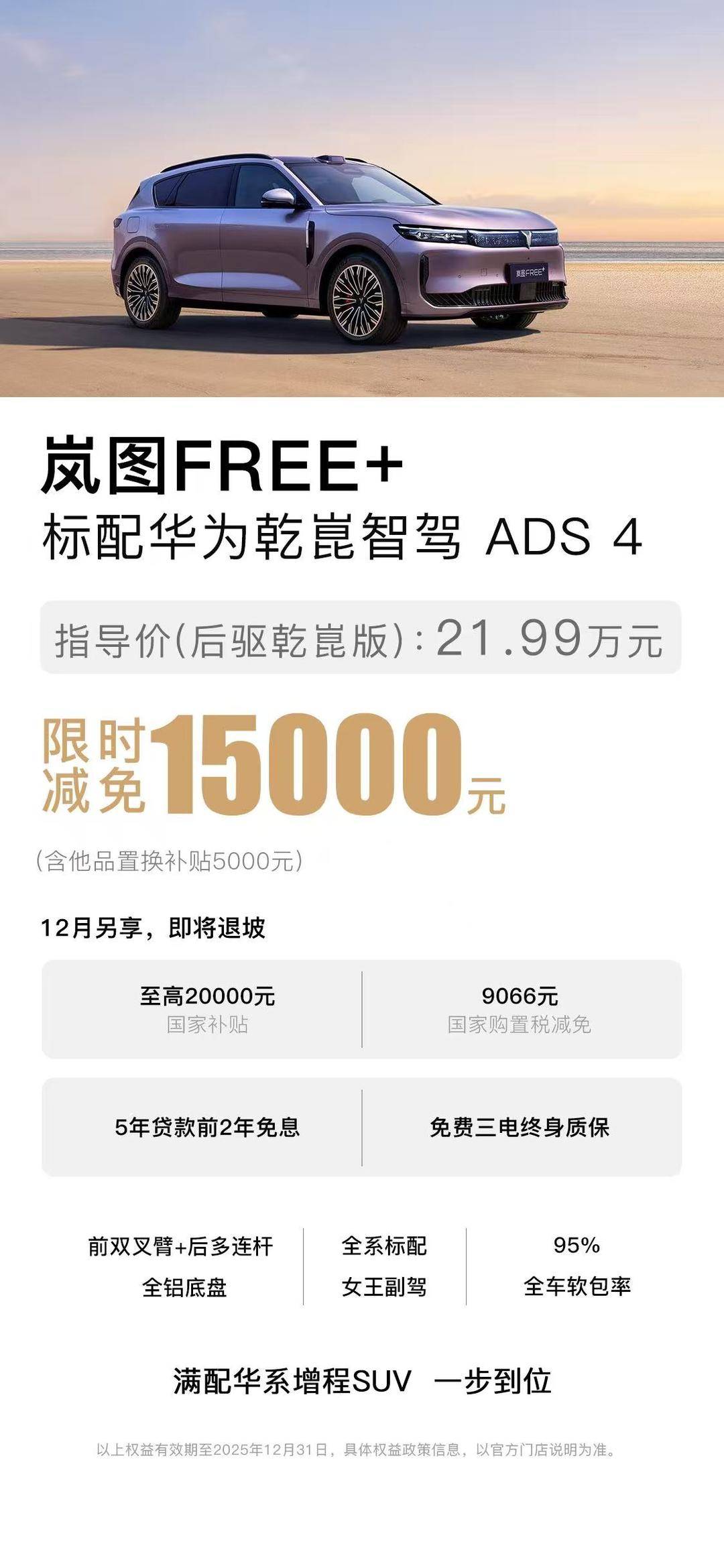
年底购车拒绝套路 岚图FREE+直减1.5万叠加0息金融方案
Yang Zi Wan Bao Wang· 2025-12-11 09:28
Group 1 - Lantu Motors has launched a year-end promotion for the Lantu FREE+, offering a cash discount of 15,000 yuan upon purchase, including trade-in [1] - The Lantu FREE+ is equipped with Huawei's advanced driving system ADS4 and HarmonyOS cockpit 5, enhancing user experience while lowering the entry barrier [1][12] - The promotion includes a limited-time free upgrade of a 38,000 yuan value configuration package, which features a 20,000 yuan voucher for Huawei's advanced driving functions and an 18,000 yuan upgrade for additional hardware [5] Group 2 - Starting January 1, 2026, the purchase tax for new energy vehicles will shift from full exemption to a 50% reduction, with a maximum rebate of 15,000 yuan per vehicle, leading to increased costs for consumers [5] - The current promotional period is seen as an excellent opportunity to purchase fully equipped Huawei SUVs before the policy change, allowing consumers to lock in full tax exemption [5][12] - The base price for the rear-wheel drive version of the Lantu FREE+ is set at 219,900 yuan [8]

年末车市订单遭“疯抢”
Feng Huang Wang· 2025-12-04 06:55
Group 1 - The domestic automotive market is experiencing a surge in orders due to the adjustment of vehicle purchase tax policies and the early release of orders for the upcoming year [1][2] - Several automakers, including Deep Blue Automotive and GAC Group, have introduced purchase tax "safety net" policies to encourage consumers to place orders before the end of 2025, with subsidies of up to 15,000 yuan [1][2] - Nearly 20 brands are offering purchase tax subsidies to consumers who place orders this year, including Chery, Zeekr, NIO, and Li Auto, in anticipation of the upcoming changes in tax policy [2] Group 2 - The vehicle purchase tax policy is set to change in 2026, transitioning from full exemption to a 50% reduction, which is expected to pressure the domestic automotive market in the first quarter of 2026 [2] - Analysts predict that the automotive market will face challenges in 2026, leading to a significant number of orders being released in the fourth quarter of this year [2] - The China Automobile Dealers Association noted that the market is expected to see stable growth in the fourth quarter, driven by policy guidance and high growth foundations, despite the upcoming tax changes [3]
行业产能“饥荒”背后的供需博弈 动力电池再陷“抢货潮”
Zhong Guo Jing Ying Bao· 2025-11-21 21:13
Core Insights - The current supply tightness in the battery industry is prompting leading automotive companies to secure orders from top battery manufacturers, indicating a competitive landscape for battery procurement [3][4] - The domestic power battery installation volume reached 578.0 GWh from January to October, reflecting a year-on-year growth of 42.4% [4][6] - The upcoming adjustment in the new energy vehicle purchase tax policy is expected to influence battery demand, with companies implementing strategies to mitigate the impact [5][7] Industry Overview - The Chinese new energy vehicle market continues to grow rapidly, with production and sales reaching 1,301.5 million and 1,294.3 million units respectively from January to October, marking a year-on-year increase of 33.1% and 32.7% [6] - In October alone, the installation volume of domestic power batteries was 84.1 GWh, a month-on-month increase of 10.7% and a year-on-year increase of 42.1% [6] - The market is witnessing a structural competition between power batteries and energy storage batteries, with both sectors driving the growth of the battery industry [9][10] Company Strategies - Companies like Chery are implementing policies to ensure customers are not adversely affected by the upcoming tax changes, offering subsidies to cover potential tax increases [5] - Guoxuan High-Tech has reported a strong order volume and high capacity utilization, indicating confidence in continued growth [7] - Many battery manufacturers are diversifying into energy storage solutions, with companies like Funeng Technology developing innovative products to capture market share [9][10] Future Outlook - The global battery production capacity is projected to reach 7.5 TWh by 2030, with a demand of 5 TWh, suggesting a balanced supply-demand scenario [8] - The competition among second and third-tier battery manufacturers is intensifying, with differentiation and strong customer relationships becoming critical for sustainable growth [10]


今年以来 乘用车累计零售2014.2万辆
Zhong Guo Zheng Quan Bao· 2025-11-19 21:42
Core Insights - The retail sales of passenger cars in China from November 1 to 16 reached 886,000 units, representing a year-on-year decline of 14% and a month-on-month decrease of 6%. However, the cumulative retail sales for the year have reached 20.142 million units, showing a year-on-year growth of 7% [1] Group 1: Market Performance - The retail sales of new energy vehicles (NEVs) from November 1 to 16 totaled 554,000 units, marking a year-on-year increase of 2% and a month-on-month increase of 7%. Cumulatively, NEV retail sales for the year have reached 10.703 million units, reflecting a year-on-year growth of 21% [1] - The penetration rate of NEVs in the passenger car market stands at 62.5% [1] Group 2: Economic Context - The overall retail performance in November is described as weak, but there is still a slight growth of 7% compared to the same period in 2023, attributed to the stable macroeconomic environment and consumer confidence [1] - The tightening of trade-in and scrapping subsidy policies in certain regions has contributed to a negative month-on-month growth in October [1] Group 3: Future Outlook - The current policy regarding the exemption of purchase tax for NEVs is set to change in 2026 to a "half tax" policy, prompting manufacturers to accelerate production and supply in anticipation of this transition [1] - The industry is expected to maintain a positive development trend due to the continuous launch of new products and steady progress in comprehensive industry governance [1]
今年以来乘用车累计零售2014.2万辆
Zhong Guo Zheng Quan Bao· 2025-11-19 20:13
Core Viewpoint - The retail performance of the passenger car market in China showed a decline in early November, but there is still a year-on-year growth for the year 2023, indicating a mixed outlook for the industry [1] Group 1: Market Performance - From November 1 to 16, the national passenger car market retail reached 886,000 units, a year-on-year decrease of 14% and a month-on-month decrease of 6% [1] - Cumulatively, retail sales for the year reached 20.142 million units, reflecting a year-on-year growth of 7% [1] - In the same period, the retail of new energy vehicles (NEVs) reached 554,000 units, showing a year-on-year increase of 2% and a month-on-month increase of 7% [1] - Year-to-date, NEV retail sales totaled 10.703 million units, with a year-on-year growth of 21% [1] - The penetration rate of NEV retail in the passenger car market stands at 62.5% [1] Group 2: Economic and Policy Context - The analysis from the Passenger Car Market Information Joint Conference indicates that while retail trends are weak, there is still a 7% year-on-year growth compared to the same period in 2023, supported by a stable macroeconomic environment and consumer confidence [1] - The tightening of trade-in and scrapping subsidy policies in certain regions has contributed to a negative month-on-month growth in October [1] - The industry anticipates a shift in the policy regarding the exemption of purchase tax for NEVs, which will change to a "half exemption" by 2026 [1] - Industry insiders suggest that automakers will seize the year-end policy transition window to maintain a rapid production pace, with new products being launched and comprehensive industry governance progressing steadily [1]
小鹏、零跑业绩不及预期引发股价下行,汽车行业格局生变?
Di Yi Cai Jing· 2025-11-19 08:22
Core Insights - The recent performance of electric vehicle manufacturers, particularly Xiaopeng and Li Auto, has raised concerns in the market, leading to significant stock price declines following their earnings reports [1][2][4] - The automotive industry is expected to undergo changes due to the reintroduction of vehicle purchase tax for electric vehicles starting in 2026, which may affect consumer choices and market dynamics [5][6][7] Company Performance - Xiaopeng Motors reported a revenue of 20.38 billion yuan for Q3, a year-on-year increase of nearly 100%, but incurred a net loss of 380 million yuan, although this loss narrowed compared to previous periods [2][3] - Li Auto achieved a revenue of 19.45 billion yuan in Q3, nearly doubling year-on-year, with a net profit of 150 million yuan, but experienced an 8% decline in net profit compared to the previous quarter [2][3] - Geely's Q3 revenue reached 89.2 billion yuan, a 27% increase year-on-year, with a net profit of 3.82 billion yuan, up 59% year-on-year, and total sales of 761,000 units, a 43% increase [3] Market Dynamics - Xiaopeng's stock price fell by 10.47% to 85.85 HKD, marking a cumulative decline of over 20% since November 12, while Geely's stock fell by 1.16% to 17 HKD, resulting in a market capitalization of 172 billion HKD [2] - The average selling price of Xiaopeng vehicles decreased by 0.8 million yuan to 156,000 yuan, with a gross margin of 13.1%, slightly below market expectations [3] - The automotive sector is experiencing a weak performance overall, with concerns about declining sales data and the impact of upcoming policy changes on growth rates [4][6] Future Outlook - The reintroduction of the vehicle purchase tax in 2026 is expected to slow down the growth of the passenger vehicle market, potentially leading to increased promotional activities among electric vehicle manufacturers [6][7] - Analysts suggest that the automotive industry will see a differentiation among companies, with stronger competitors likely to emerge as the market adjusts to the new tax environment [6][7]


汽车视点丨购置税影响几何、AI“新物种”何时落地?三家上市车企回应市场关切
Xin Hua Cai Jing· 2025-11-18 10:34
Core Insights - Three major automotive companies, Geely, Leapmotor, and Xpeng, reported record-high revenues, gross profits, and delivery volumes for Q3, while addressing market changes due to adjustments in vehicle purchase tax policies [1][2][3] Financial Performance - Geely achieved a record revenue of 89.2 billion yuan in Q3, a 15% increase quarter-on-quarter and a 27% increase year-on-year, with a net profit of 3.96 billion yuan, up 19% year-on-year [1] - Leapmotor reported Q3 revenue of 19.45 billion yuan, a 97.3% year-on-year increase, with a net profit of 150 million yuan and a gross margin of 14.5% [2] - Xpeng's Q3 revenue reached 20.38 billion yuan, a 102% year-on-year increase, with a net loss of 380 million yuan, significantly narrowing from a loss of 1.81 billion yuan in the same period last year [2] Market Outlook - The automotive market is expected to face challenges in 2026 due to the reduction of purchase tax incentives for new energy vehicles, transitioning from exemption to a 50% reduction [3] - Geely's CEO expressed confidence in the company's ability to adapt, highlighting that the market is maturing and that companies with strong strategic foundations will have advantages [3][4] - Leapmotor's management believes the tax policy changes will not significantly impact overall vehicle sales, as evidenced by the continued growth in new energy vehicle penetration [4] Strategic Initiatives - Geely plans to launch multiple new and updated models in Q4 to meet its annual sales target of 3 million vehicles, having achieved 2.477 million units by the end of October [1][4] - Leapmotor aims for a combined domestic and overseas sales target of 1 million vehicles by 2026, with a focus on expanding into new markets [4] - Xpeng is transitioning towards becoming a technology company, with plans to develop flying cars, humanoid robots, and Robotaxi services, aiming for significant advancements in AI applications [5][6] Future Innovations - Xpeng's CEO outlined plans for the launch of three Robotaxi models and humanoid robots by 2026, with initial deployments in commercial settings [5][6] - Leapmotor has completed strategic planning for its new product lines, with expectations to launch new products by 2027-2028 [6] - Geely is set to unveil a new five-year plan focused on AI and technology on January 1, 2026, emphasizing the importance of strong manufacturing capabilities in the automotive sector [6]
明年起购置税将减半征收,17家汽车品牌承诺兜底
Di Yi Cai Jing· 2025-11-13 08:07
Core Viewpoint - The end of the full exemption policy for new energy vehicle (NEV) purchase tax in 2025 has triggered a competitive order-seizing battle among car manufacturers, with many offering tax subsidy schemes to lock in consumers before the policy change [2][3]. Group 1: Policy Changes and Impacts - From January 1, 2026, the NEV purchase tax will be halved, with a maximum tax reduction of 15,000 yuan per vehicle [2]. - The current exemption policy allows for a maximum tax exemption of 30,000 yuan for NEVs purchased between January 1, 2024, and December 31, 2025 [2]. - The urgency among consumers to purchase vehicles has increased due to the impending policy changes, influencing their choice of models based on delivery timelines [3]. Group 2: Manufacturer Responses - 17 mainstream automotive brands have introduced purchase tax subsidy schemes to cover the tax difference for consumers whose vehicles are delivered after the policy change [2][3]. - The subsidy schemes include various forms such as tax difference vouchers, cash reductions on final payments, and direct cash subsidies, with a maximum subsidy of 15,000 yuan [3]. - The competition among manufacturers is expected to intensify as they aim to capture market share amid the changing tax policies [4]. Group 3: Market Trends and Performance - In October, NEV production and sales reached 1.772 million and 1.715 million units, respectively, both showing over 20% year-on-year growth, with a market penetration rate surpassing 50% [3]. - The cumulative production and sales of NEVs in the first ten months of the year exceeded 13 million units, marking a year-on-year increase of approximately 33% [3]. - The automotive market continues to show strong growth, with new models being launched and production rates maintained to meet demand [4]. Group 4: Future Outlook - The technical threshold for NEV purchase tax exemptions will increase starting in 2026, as plug-in hybrid vehicles with an electric range of less than 100 kilometers will no longer qualify for tax reductions [4]. - This change is expected to lead to a clearer market differentiation, with companies possessing core technological competitiveness likely to gain a larger market share [4].





明年起购置税将减半征收,17家汽车品牌承诺兜底
第一财经· 2025-11-13 07:49
Core Viewpoint - The article discusses the impending end of the full exemption from purchase tax for new energy vehicles (NEVs) in China, leading to a competitive order-seizing battle among car manufacturers as they introduce tax subsidy plans to attract consumers before the policy changes take effect [3][4]. Group 1: Policy Changes and Impacts - Starting January 1, 2026, the purchase tax for NEVs will be halved, with a maximum tax reduction of 15,000 yuan per vehicle [3]. - From January 1, 2024, to December 31, 2025, NEVs will continue to be exempt from purchase tax, with a maximum exemption of 30,000 yuan per vehicle [3][4]. - The adjustment in tax policy has intensified consumer urgency to purchase vehicles, influencing their choice of models based on delivery timelines [4]. Group 2: Manufacturer Responses - 17 major automotive brands, including Li Auto, NIO, and BYD, have introduced purchase tax subsidy plans to cover the tax difference for consumers whose vehicles are delivered after the policy change [3][4]. - The subsidy methods include tax difference vouchers, cash reductions on final payments, and direct cash subsidies, with a maximum subsidy of 15,000 yuan [4]. - The competition among manufacturers is expected to increase as they strive to maintain market share amid changing tax incentives [5]. Group 3: Market Trends and Performance - In October, NEV production and sales reached 1.772 million and 1.715 million units, respectively, with year-on-year growth exceeding 20% and a market penetration rate surpassing 50% [4][5]. - Cumulative NEV production and sales for the first ten months of the year exceeded 13 million units, reflecting a year-on-year growth of approximately 33% [4]. - The market is witnessing a shift as consumers, influenced by the availability of popular models, are increasingly opting for less popular models, contributing to sustained sales growth [4].


明年起购置税将减半征收 已有17家主流汽车品牌承诺兜底
Di Yi Cai Jing· 2025-11-13 07:00
Core Insights - The full exemption of purchase tax for new energy vehicles (NEVs) will end in 2025, prompting a competitive order acquisition battle among car manufacturers [1] - Major automotive brands have introduced purchase tax subsidy plans to secure orders before the policy change, with subsidies covering all or part of their models [2] - The market is experiencing heightened consumer urgency to purchase vehicles due to the impending policy adjustments, leading to increased sales and a shift in consumer preferences towards models with shorter delivery times [2][3] Group 1 - As of November 13, 17 mainstream automotive brands have launched purchase tax subsidy plans, with a maximum subsidy of 15,000 yuan per vehicle [1] - From January 1, 2026, the purchase tax for NEVs will be halved, with a maximum reduction of 15,000 yuan per vehicle [1] - In October, NEV production and sales reached 1.772 million and 1.715 million units respectively, both showing over 20% year-on-year growth, with a penetration rate surpassing 50% [2] Group 2 - The automotive market is maintaining a strong development trend, with monthly production and sales hitting record highs amid a competitive environment [3] - The technical threshold for NEV purchase tax exemptions will increase starting in 2026, affecting plug-in hybrid models with electric ranges below 100 kilometers [3] - The ongoing competition will likely lead to a clearer industry differentiation, with companies possessing core technological advantages expected to gain market share [3]