
春季躁动

Search documents
历史数据复盘!本轮春季行情走到什么阶段了?
天天基金网· 2026-02-11 09:28
Core Viewpoint - The article discusses the current stage of the spring market rally in A-shares, highlighting the historical calendar effect that typically leads to a "spring surge" around the New Year and the "Two Sessions" period, with most years experiencing this phenomenon except for 2022 and 2015 [1][7]. Historical Data Analysis - Historical data shows that the spring market rally has an average duration of about 40 trading days, with an average increase of approximately 13.97% in the Shanghai Composite Index [7]. - The starting points of past spring rallies are somewhat dispersed, primarily occurring in December (5 times), January (7 times), and February (3 times) since 2010 [7]. Current Market Outlook - The current policy environment, fundamental expectations, and liquidity conditions supporting the spring rally have not fundamentally changed, suggesting a high probability of market recovery post-Spring Festival [7][8]. - Historical trends indicate that the spring rally could provide around 20% upside potential, with the current market still having room for further development [4][8]. Investment Strategy - The article suggests a short-term holding strategy during the holiday period, emphasizing the importance of focusing on high-probability stocks, particularly in sectors like power equipment, storage and semiconductor equipment, chemicals, engineering machinery, agriculture, and personal care [5][8]. - It is recommended to consider consumer and travel chains that benefit from the long holiday for potential low-cost investments [5]. Future Market Conditions - The next 1-2 months are expected to present favorable conditions for A-shares, with February and the period around the Spring Festival being historically the strongest for the "spring surge" effect, favoring small-cap stocks [4][8].


历史数据复盘!本轮春季行情走到什么阶段了?
天天基金网· 2026-02-11 08:06
Core Viewpoint - The article discusses the historical "spring market rally" in A-shares, highlighting its typical occurrence around the New Year and the Spring Festival, with a strong emphasis on the potential for further market growth in the upcoming months [1][7]. Historical Data Analysis - Historical data shows that the spring market rally has been a consistent phenomenon, with the exception of 2022 and an atypical performance in 2015. The average duration of these rallies is about 40 trading days, with an average increase of approximately 13.97% in the Shanghai Composite Index [7]. - The starting points for these rallies have been somewhat dispersed, primarily occurring in December (5 times), January (7 times), and February (3 times) since 2010 [7]. Current Market Outlook - Current market conditions suggest that the supporting factors for the spring rally, including policy environment, fundamental expectations, and liquidity, have not fundamentally changed. Analysts predict a high probability of market recovery post-Spring Festival [7][8]. - Historical trends indicate that the spring rally could provide around a 20% increase in the index, with the current market still having significant room for growth compared to historical performance [4][8]. Investment Strategy Recommendations - Analysts recommend a "hold through the holiday" strategy, focusing on high-probability sectors such as power equipment, storage and semiconductor equipment, chemicals, engineering machinery, agriculture, and personal care products. Additionally, sectors benefiting from holiday consumption and travel should be considered for low-cost entry [5][8]. - The article emphasizes the importance of maintaining a rational approach to investment, suggesting that while historical patterns provide a reference, they should not be viewed as absolute rules. Investors are advised to observe market conditions before acting and to avoid chasing high prices [9].

A股“春节效应”引关注 机构建议持股过节
Jin Rong Shi Bao· 2026-02-11 01:43
Group 1 - The core viewpoint of the articles suggests that investors are advised to "hold stocks during the festival" based on historical patterns, improving fundamentals, and potential recovery in risk appetite [1][2][3] - Historical data indicates a significant "Spring Festival effect" in the A-share market, with an 81% probability of the Shanghai Composite Index rising in the week before the festival and a 76% probability in the week after [2][6] - Multiple securities firms, including Dongwu Securities and Huajin Securities, believe that the current market conditions, characterized by a gradual reduction of suppressive factors, will create space for a post-festival rally [2][3] Group 2 - The market style typically shifts significantly before and after the Spring Festival, with a preference for defensive sectors like banks and food and beverage before the festival, and a transition to cyclical and growth stocks afterward [4][6] - Historical quantitative data shows that the CSI 300 Index (representing large caps) outperforms the CSI 2000 Index (representing small caps) in the week before the festival, while the reverse is true in the week after [4] - Analysts from Galaxy Securities note that the market is currently exhibiting typical "pre-festival risk aversion," with funds moving away from high-valuation technology and cyclical sectors towards value and consumption themes [4][8] Group 3 - Despite the optimistic outlook for the Spring Festival market, potential risks remain, particularly from external uncertainties that could impact post-festival market sentiment [5][6] - The upcoming long holiday may lead to a short-term market fluctuation as some funds may choose to exit the market to avoid overseas volatility [6][8] - Analysts emphasize the need to monitor two main areas: uncertainties in overseas markets, including fluctuations in Federal Reserve policy and geopolitical tensions, and potential short-term liquidity shocks from pre-festival fund exits [8]
多数机构建议持股过节
21世纪经济报道· 2026-02-11 00:55
Core Viewpoint - The prevailing consensus among institutions is to "hold stocks during the festival," driven by historical data analysis and current market conditions, with a focus on a "stable before the festival, aggressive after" strategy [1][5][9]. Historical Data Support - Historical data from the past decade indicates a clear pattern in the A-share market of "weak before the festival, strong after," with an average return of -2.20% in the second week before the festival and a recovery to 0.53% in the last week before the festival [3][4]. - The first week after the festival shows an average return of 2.03%, with an 80% probability of an increase, while the second and third weeks yield average returns of 0.86% and 0.83%, respectively [3]. - Smaller market caps and growth styles exhibit a more pronounced reversal effect around the festival, with industries such as computer, electronics, communication, non-ferrous metals, and machinery showing the strongest post-festival rebound [3][4]. Institutional Consensus - A survey indicates that 62.16% of private equity firms prefer to hold significant positions during the festival, with 69.23% optimistic about post-festival market performance [6]. - The favored investment strategy is a "low-valuation blue-chip + technology growth" combination, with 41.18% of firms supporting this approach [6]. Market Trends and Strategies - Institutions emphasize a balanced and defensive approach before the festival, adopting a "dumbbell strategy" that combines defensive and aggressive investments [9]. - Post-festival, the focus shifts to technology growth and industry trends, with recommendations for sectors like AI, semiconductors, and high-end manufacturing [10][11]. - The "resource + manufacturing" combination is highlighted as an important foundational investment, with a focus on commodities like oil, copper, and aluminum, as well as traditional manufacturing sectors [11]. Investment Recommendations - Institutions suggest maintaining a balanced portfolio that includes defensive sectors such as banking and utilities, alongside growth sectors like technology and consumer goods [11]. - For different types of funds, strategies vary, with long-term investors encouraged to maintain equity positions, while those needing liquidity may consider money market funds [11].

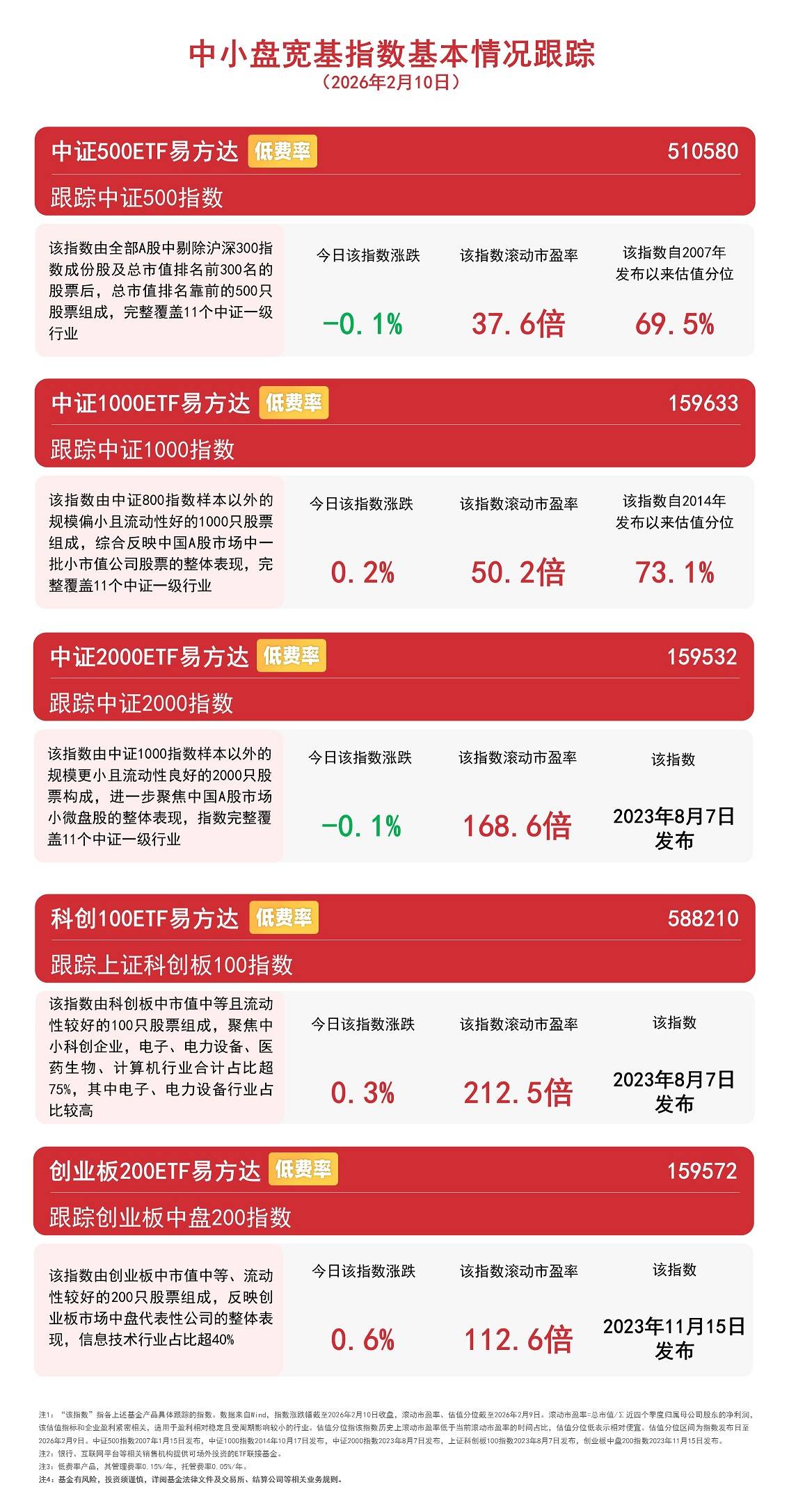
中小盘宽基指数涨跌不一,关注中证2000ETF易方达(159532)、中证500ETF易方达(510580)后续表现
Sou Hu Cai Jing· 2026-02-10 10:36
Group 1 - The ChiNext Mid-cap 200 Index rose by 0.6%, the Sci-Tech 100 Index increased by 0.3%, while the CSI 1000 Index saw a 0.2% rise. Conversely, the CSI 500 and CSI 2000 Indices both declined by 0.1% [1] - GF Securities anticipates that the A-share market may experience a favorable upward opportunity in the next 1-2 months, particularly noting that February and the period around the Spring Festival historically exhibit strong seasonal effects for market rallies [1] - Historical data indicates that small-cap stocks tend to outperform during this spring season, suggesting a potential shift in market dynamics favoring smaller companies [1] Group 2 - The CSI 500 ETF by E Fund tracks the CSI 500 Index, which excludes stocks from the CSI 300 Index and the top 300 by market capitalization, and it has a rolling P/E ratio of 37.6 times with a valuation percentile of 69.5% since its inception in 2007 [3] - The CSI 1000 ETF by E Fund tracks the CSI 1000 Index, while the CSI 2000 ETF focuses on 2000 smaller stocks outside the CSI 1000 Index, with a rolling P/E ratio of 168.6 times [3]

AI芯片及存储扩产催生细分材料供需缺口,这家公司产品进入3nm供应链
摩尔投研精选· 2026-02-10 10:34
Group 1 - The current A-share market is likely to enter a favorable upward cycle, with the Shanghai Composite Index returning to around 4000 points, indicating a potential "timing, location, and human factors" opportunity for growth in the next 1-2 months [1] - The "spring market" period starting in February has historically shown high probabilities of upward movement, with small-cap indices having a 100% chance of rising between the Spring Festival and the Two Sessions, and an 87.5% chance of rising in February [1][2] - The annual report forecasts suggest that negative disturbances in the fundamentals are coming to an end, providing a more stable environment for investment [2] Group 2 - In a bullish market trend, every time the All A Index falls below the 20-day moving average, it often presents a good opportunity for accumulation [3] - The correlation between the "spring market" gains and the growth rate of the first quarter reports is strengthening, with key investment themes including the Byte industry chain and space photovoltaics [3][4] Group 3 - The perovskite solar industry is transitioning from megawatt-level research to gigawatt-level production, with leading companies like JinkoSolar and GCL-Poly Energy ramping up capacity [7] - Recent data shows that the laboratory efficiency of single-junction perovskite cells has reached 27.3%, and perovskite-silicon tandem cells have surpassed 35.0%, significantly exceeding the efficiency limits of crystalline silicon cells [7] - The global perovskite production capacity is expected to exceed 5GW by 2027 and potentially surpass 30GW by 2030, with the investment cost for a single GW production line decreasing from 1.5 billion yuan to around 1 billion yuan [7]

持股过节!十大券商集体喊话,布局节后“红包”行情
Bei Ke Cai Jing· 2026-02-10 04:16
Core Viewpoint - As the Spring Festival approaches, the choice between "holding stocks or holding cash" has become a focal point for investors, with a consensus emerging among major brokerages favoring "holding stocks" as the better option this year [1][2]. Group 1: Market Sentiment and Predictions - Major brokerages, including Guotai Junan and GF Securities, express optimism about the market's potential for recovery post-holiday, suggesting that the A-share market may experience a favorable "timing, location, and human factors" for an upward trend [2][17]. - Despite a general consensus on holding stocks, several brokerages caution that market performance may still be influenced by multiple risks, including slower-than-expected economic recovery and geopolitical uncertainties [3]. Group 2: Investment Strategies and Sector Focus - Guotai Junan recommends focusing on emerging technology and value sectors, highlighting themes such as commercial aerospace, robotics, urban renewal, and domestic consumption [4]. - Dongwu Securities suggests three main investment directions: overvalued technology sectors, booming industries like energy storage and lithium batteries, and themes related to the 14th Five-Year Plan, including commercial aerospace and 6G technology [5]. - Galaxy Securities advocates for a cautious approach with "light positions," emphasizing the importance of the upcoming "Two Sessions" and the shift towards "new productive forces" in sectors like semiconductors and artificial intelligence [6][7]. - Huaxia Securities emphasizes the importance of preparing for the post-holiday "red envelope" market, noting that technology sectors typically show better elasticity after the holiday [13]. - The investment focus should also include sectors that have underperformed but are expected to recover, such as food and beverage, agriculture, and healthcare [12]. Group 3: Market Dynamics and Historical Trends - Historical data indicates that the market tends to perform better after the Spring Festival, with a common pattern of "lower before the holiday and higher after" across various style indices [11]. - The current market environment is characterized by a high trading volume, with brokerages maintaining a cautious yet optimistic stance, suggesting that the market is not likely to turn bearish easily [8][9]. - The upcoming Spring Festival is seen as a critical period for potential market recovery, with many brokerages encouraging investors to remain confident and prepared for the first wave of the new year's upward cycle [17].


这个春节,应该持股过节还是持币过节?
Sou Hu Cai Jing· 2026-02-10 02:58
Core Viewpoint - The article discusses the dilemma of whether to hold stocks or cash during the upcoming Chinese New Year holiday, highlighting historical trends that suggest a tendency for positive market performance after the holiday [1]. Group 1: Historical Market Trends - From 2006 to 2025, the Shanghai Composite Index has shown an 80% probability of rising in the five days before the Spring Festival, with a maximum increase of 9.82% and a minimum decrease of 4.57% [1]. - The probabilities of the index rising in the five, ten, twenty, and thirty days after the Spring Festival are 75%, 70%, 80%, and 60%, respectively, indicating a generally positive trend post-holiday [1]. Group 2: Factors Influencing Post-Holiday Market Performance - **Capital Flow**: There is a cyclical return of capital post-holiday, as funds that left the market for risk aversion during the holiday return, leading to increased trading volume [2]. - **Policy Support**: The period around the Spring Festival often sees a surge in macroeconomic policies aimed at stabilizing growth and boosting consumption, which supports market confidence and directs funds towards beneficial sectors [3]. - **Market Sentiment**: Investor sentiment tends to recover after the holiday, with a shift from caution to optimism, driven by improved consumption data and a deeper understanding of the "Spring Festival effect" [4]. - **Fundamentals**: The post-holiday period typically sees a seasonal improvement in economic activity, particularly in sectors like consumer goods and manufacturing, which supports earnings expectations for listed companies [5][6]. Group 3: Investment Strategies - **Aggressive Investors**: Recommended to maintain over 70% equity exposure, focusing on high-growth sectors such as technology and renewable energy [8]. - **Moderate Investors**: Suggested to adopt a balanced approach with a mix of defensive assets and growth opportunities, maintaining a half-position in equities [9]. - **Conservative Investors**: Advised to keep cash positions below 30%, with options for reverse repos and money market funds, while considering broad index funds for market participation [10].
集体大涨,超4600股飘红!长假将至,加仓还是减仓?
Qi Huo Ri Bao· 2026-02-09 23:25
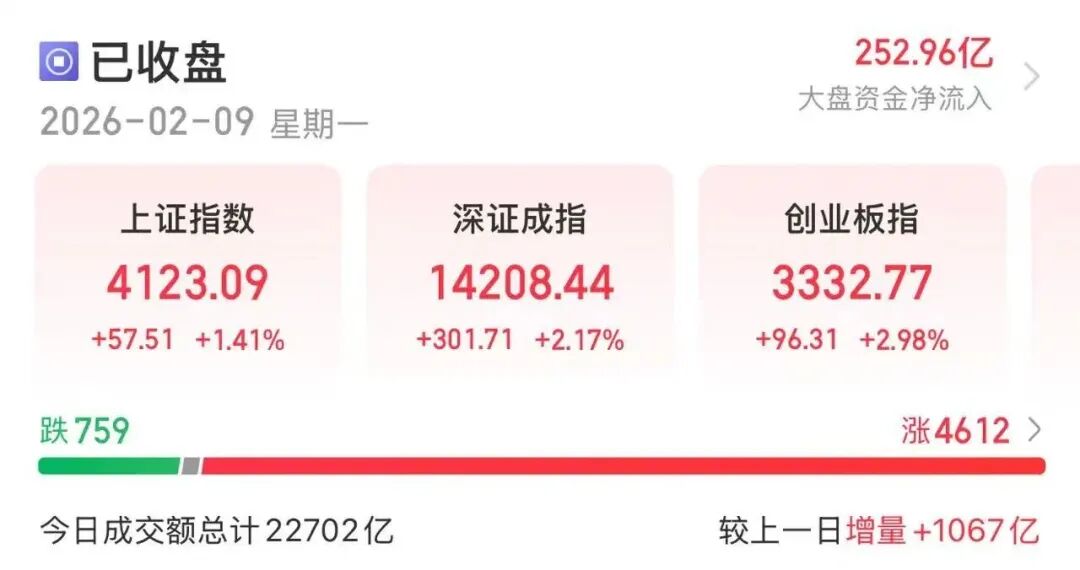
本周一A股强势拉升,截至收盘,上证综指涨1.41%(重回4100点上方),深证成指涨2.17%,创业板指涨2.98%,科创50指数涨2.51%。沪深北三市合计 成交约2.27万亿元,较此前一日增加逾1000亿元。 同日,亚太主要股指也集体走高。其中,日经225指数收盘上涨3.89%,韩国综合指数涨超4%,澳洲标普200指数涨1.85%。 在海外流动性预期复杂、市场波动较大的情况下,A股三大指数反弹的持续性以及"持币还是持股过节"的选择,成为投资者关注的焦点。 永安期货(600927)股指高级分析师华翔告诉期货日报记者,近期股市大幅波动的主要原因有三个:一是融资保证金比例上调抑制了部分概念炒作,当前 市场杠杆风险已明显降低;二是市场对美联储潜在政策转向的担忧引发大宗商品及周期股显著回调,目前相关风险资产的估值更加合理;三是美国科技巨 头的巨额资本开支计划引发盈利忧虑,打击了AI相关板块。华翔认为,在经历了这三重考验后,市场表现出较强的韧性,2月初A股三大指数回调反而 为"春季躁动"行情创造了更有利的条件。 A股市场超4600股飘红。其中,半导体板块拉升,芯原股份涨近15%,国芯科技涨近13%,复旦微电涨近10% ...
公募基金指数跟踪周报(2026.02.02-2026.02.06):节前震荡下行,风格短期切换-20260209
HWABAO SECURITIES· 2026-02-09 12:57
Report Overview - The report is a weekly update on public - offering funds from February 2, 2026, to February 6, 2026, analyzing the performance of the equity and fixed - income markets and various fund indices [1][3]. 1. Investment Rating - The report does not mention the industry investment rating. 2. Core Views - In the equity market, last week (2026.02.02 - 2026.02.06), major indices like the Shanghai Composite Index, CSI 300, and ChiNext Index declined. The A - share market's downward volatility increased due to global resource futures fluctuations and US tech giants' earnings announcements. The tech sector may face more pressure after the Two Sessions, while mid - stream industries with profitability repair and ROE improvement are worth attention [3][12]. - In the fixed - income market, the bond yield curve flattened last week. Short - term negative factors have been eliminated, so the bond market may not experience significant fluctuations. However, after the Spring Festival, the bond market's volatility may increase due to the active stock market and policy expectations [4][14]. 3. Summary by Directory 3.1 Weekly Market Observation 3.1.1 Equity Market - Last week, the Shanghai Composite Index fell 1.27%, the CSI 300 dropped 1.33%, and the ChiNext Index declined 3.28%. The A - share market's volatility increased, and the overall market sentiment cooled. The daily average trading volume of the whole A - shares was 24032 billion, a decrease from the previous week. Industry rotation was rapid, with resource - cycle sectors and power equipment being active. The tech - growth sector faced adjustment pressure [12]. - The value style strengthened due to low - level price rebounds and high - dividend defensive needs. The market is trading "event - driven prosperity improvement" and "assets with clear price signals." The tech sector may face more pressure after the Two Sessions, and mid - stream industries with profitability repair and ROE improvement should be focused on [13]. 3.1.2 Pan - Fixed - Income Market - Last week, the bond yield curve flattened. The 1 - year Treasury yield rose 1.80BP to 1.32%, the 10 - year yield fell 0.1BP to 1.81%, and the 30 - year yield dropped 3.8BP to 2.25%. The long - end yield continued to decline, and the term spread narrowed. The bond market was oscillating strongly. Some risk - averse funds may have flowed into the bond market due to stock market fluctuations, and the central bank actively provided liquidity. The local bond issuance was well - received, eliminating previous market concerns. However, after the Spring Festival, the bond market's volatility may increase [4][14]. - US Treasury yields declined last week. The 1 - year yield dropped 3BP to 3.45%, the 2 - year yield fell 2BP to 3.50%, and the 10 - year yield decreased 4BP to 4.22%. The employment market data showed a cooling trend, which led to the decline of the US Treasury yield curve. The CSI REITs Total Return Index fell 0.91% last week, and most sectors declined. Four new public - offering REITs made progress in the primary market [15]. 3.2 Fund Index Performance Tracking 3.2.1 Equity Fund Index Performance | Index Classification | Last Week | Last Month | Since the Beginning of this Year | Since Strategy Implementation | | --- | --- | --- | --- | --- | | Active Stock Fund Selection | - 2.20% | 3.82% | 7.86% | 55.05% | | Value Stock Fund Selection | - 0.24% | 3.64% | 6.91% | 29.34% | | Balanced Stock Fund Selection | - 1.81% | 2.25% | 6.04% | 37.83% | | Growth Stock Fund Selection | - 2.65% | 3.40% | 8.12% | 56.09% | | Pharmaceutical Stock Fund Selection | - 0.85% | - 5.45% | 3.27% | 15.22% | | Consumption Stock Fund Selection | - 0.57% | 1.17% | 4.13% | 9.11% | | Technology Stock Fund Selection | - 1.98% | 1.83% | 6.27% | 62.66% | | High - end Manufacturing Stock Fund Selection | - 3.30% | 1.58% | 7.39% | 42.12% | | Cyclical Stock Fund Selection | - 3.76% | 4.70% | 9.95% | 43.97% | [17] 3.2.2 Pan - Fixed - Income Fund Index Performance | Index Classification | Last Week | Last Month | Since the Beginning of this Year | Since Strategy Implementation | | --- | --- | --- | --- | --- | | Money - enhancing Index | 0.03% | 0.12% | 0.14% | 4.63% | | Short - term Bond Fund Selection | 0.04% | 0.15% | 0.17% | 4.79% | | Medium - and Long - term Bond Fund Selection | 0.09% | 0.45% | 0.42% | 7.25% | | Low - volatility Fixed - income + Fund Selection | - 0.04% | 0.51% | 0.95% | 5.56% | | Medium - volatility Fixed - income + Fund Selection | - 0.63% | 0.42% | 1.15% | 7.54% | | High - volatility Fixed - income + Fund Selection | - 0.23% | 0.69% | 1.65% | 9.98% | | Convertible Bond Fund Selection | - 0.20% | 3.63% | 6.68% | 32.56% | | QDII Bond Fund Selection | - 0.26% | - 0.13% | - 0.18% | 9.82% | | REITs Fund Selection | - 1.86% | 2.19% | 3.77% | 35.61% | [18] 3.3 Index Positioning and Benchmarks 3.3.1 Equity Strategy Theme Index - Active Stock Fund Selection Index: Selects 15 funds each period, with equal - weight allocation. The core position selects active equity funds based on performance competitiveness and style stability, and the style distribution is balanced according to the CSI Equity - oriented Fund Index. The benchmark is the CSI Equity - oriented Fund Index [19]. 3.3.2 Investment Style Index - Value Stock Fund Selection Index: Selects 10 funds with deep - value, quality - value, and balanced - value styles. The benchmark is the CSI 800 Value Index [19]. - Balanced Stock Fund Selection Index: Selects 10 funds with relatively balanced and value - growth styles. The benchmark is the CSI 800 [21]. - Growth Stock Fund Selection Index: Selects 10 funds with active - growth, quality - growth, and balanced - growth styles. The benchmark is the 800 Growth Index [25]. 3.3.3 Industry Theme Index - Pharmaceutical Stock Fund Selection Index: Selects 15 funds based on the intersection market value ratio of fund equity holdings and the representative index (CITIC Pharmaceutical). The benchmark is the pharmaceutical theme fund index [27]. - Consumption Stock Fund Selection Index: Selects 10 funds based on the intersection market value ratio of fund equity holdings and representative indices (CITIC Automobile, Home Appliances, etc.). The benchmark is the consumption theme fund index [31]. - Technology Stock Fund Selection Index: Selects 10 funds based on the intersection market value ratio of fund equity holdings and representative indices (CITIC Electronics, etc.). The benchmark is the technology theme fund index [34]. - High - end Manufacturing Stock Fund Selection Index: Selects 10 funds based on the intersection market value ratio of fund equity holdings and representative indices (CITIC Construction, etc.). The benchmark is the high - end manufacturing theme fund index [35]. - Cyclical Stock Fund Selection Index: Selects 5 funds based on the intersection market value ratio of fund equity holdings and representative indices (CITIC Petrochemical, etc.). The benchmark is the cyclical theme fund index [39]. 3.3.4 Money - enhancing Index - Money - enhancing Strategy Index: Aims for liquidity management, pursues a curve that exceeds money - market funds. It mainly allocates money - market funds and inter - bank certificate of deposit index funds. The benchmark is the CSI Money - market Fund Index [42]. 3.3.5 Pure - Bond Index - Short - term Bond Fund Selection Index: Aims for liquidity management, ensures drawdown control, and pursues a smooth - upward curve. It selects 5 funds with stable long - term returns, strict drawdown control, and significant absolute - return ability. The benchmark is 50% * Short - term Pure - Bond Fund Index+50% * Ordinary Money - market Fund Index [44]. - Medium - and Long - term Bond Fund Selection Index: Invests in medium - and long - term pure - bond funds, pursues stable returns while controlling drawdowns. It selects 5 funds each period, balancing coupon strategies and band - trading operations, and adjusts the ratio of credit - bond funds and interest - rate - bond funds according to market conditions [47]. 3.3.6 Fixed - income + Index - Low - volatility Fixed - income + Fund Selection Index: The equity central position is 10%, selects 10 funds with an equity central position within 15% in the past three years and recently. The benchmark is 10% CSI 800 Index+90% ChinaBond New Composite Full - price Index [51]. - Medium - volatility Fixed - income + Fund Selection Index: The equity central position is 20%, selects 5 funds with an equity central position between 15% - 25% in the past three years and recently. The benchmark is 20% CSI 800 Index+80% ChinaBond New Composite Full - price Index [51]. - High - volatility Fixed - income + Fund Selection Index: The equity central position is 30%, selects 5 funds with an equity central position between 25% - 35% in the past three years and recently. The benchmark is 30% CSI 800 Index+70% ChinaBond New Composite Full - price Index [55]. 3.3.7 Other Pan - Fixed - Income Index - Convertible Bond Fund Selection Index: Selects 5 funds from a sample space of bond - type funds with a convertible - bond investment ratio of at least 60% in the latest period and at least 80% in the past four quarters, based on an evaluation system [58]. - QDII Bond Fund Selection Index: Selects 6 funds with stable returns and good risk control based on credit and duration conditions [60]. - REITs Fund Selection Index: Selects 10 funds with stable operation, reasonable valuation, and certain elasticity based on the underlying asset type [61].