杠杆资金

Search documents
爆量第三日:巨额资金,甩卖?
Ge Long Hui A P P· 2026-01-16 09:10
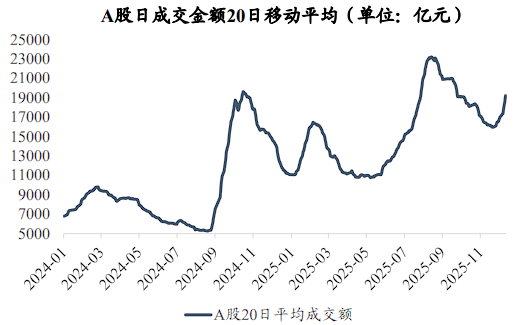
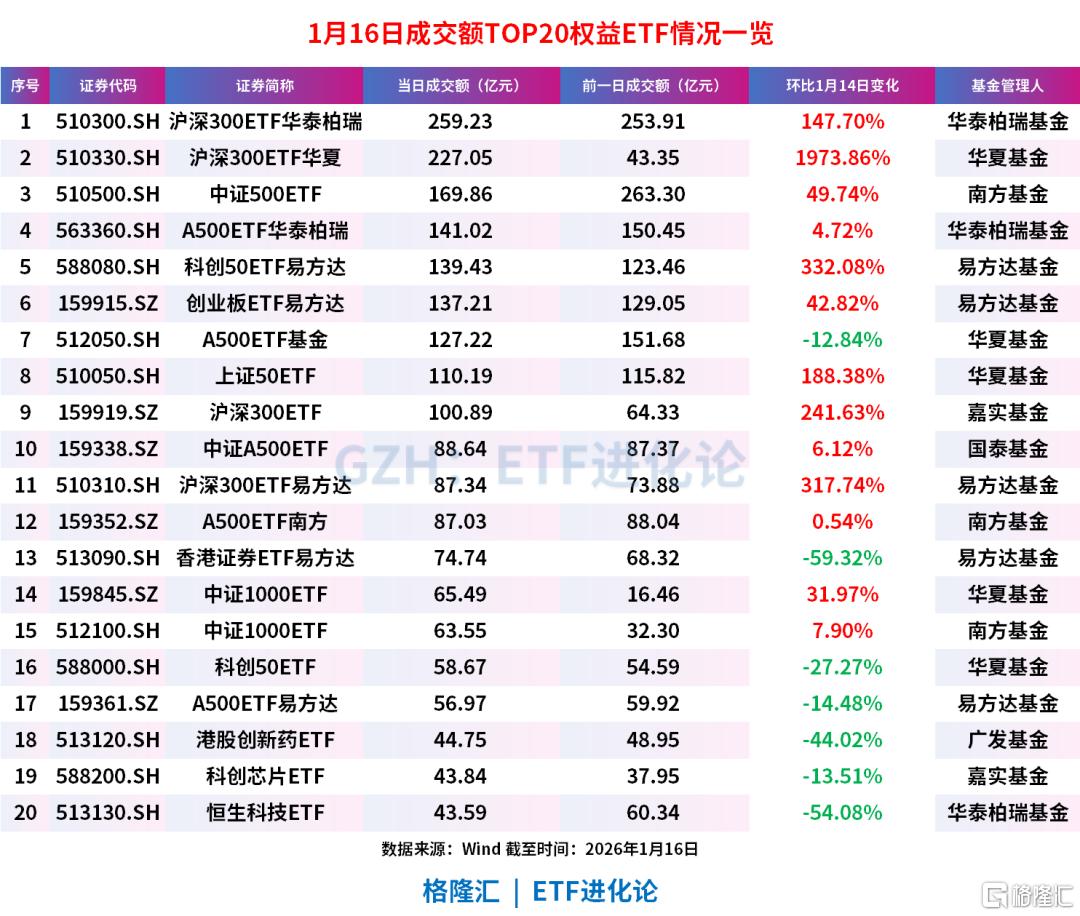
Core Viewpoint - The A-share market is experiencing an unprecedented tug-of-war between bulls and bears, highlighted by significant net outflows from major ETFs and a surge in leveraged funds [1][9][11]. Group 1: ETF Market Activity - Major broad-based ETFs saw a net outflow of 700 billion, with the total margin balance exceeding 2.7 trillion for the first time in history [1]. - The trading volume of ETFs reached a record high of 752.25 billion, marking the third consecutive day of record-breaking activity [1]. - Multiple broad-based ETFs, including the Huatai-PineBridge CSI 300 ETF and the Huaxia CSI 300 ETF, recorded transaction volumes exceeding 20 billion, with the latter seeing a nearly 20-fold increase compared to January 14 [2][4]. Group 2: Institutional Fund Flows - The top ten ETFs with the highest net outflows were all broad-based ETFs, totaling 715 billion in outflows, with the Huatai-PineBridge CSI 300 ETF alone experiencing a net outflow of 200 billion [9][10]. - Institutional funds showed a net outflow across nearly all major ETFs, indicating a trend of selling pressure despite high trading volumes [4][5]. Group 3: Leverage and Margin Trading - Leveraged funds have been aggressively buying, with net purchases of 206 billion on January 15, contributing to a total of 1.77 trillion in net purchases over the first nine trading days of the year [13][15]. - The current pace of leveraged fund inflows suggests that they could match last year's total net purchases in just over 25 trading days [15]. Group 4: Market Sentiment and Regulatory Environment - The market is showing signs of cooling, with regulatory measures aimed at tempering excessive speculation following a period of high trading volumes and bullish sentiment [11][19]. - The shift in regulatory stance is seen as a response to the rapid increase in trading activity, particularly after three consecutive days of trading volumes exceeding 3 trillion [19][20]. Group 5: Wealth Transfer and Investment Trends - A significant portion of the 160 trillion in household savings is being reallocated, which could have profound implications for the capital markets [21][30]. - The upcoming maturity of long-term deposits, estimated at 32 trillion, coincides with a bullish market environment, potentially leading to increased equity market participation [25][26].

重阳投资:提高融资保证金比例,有助于为A股慢牛护航
Jin Rong Jie· 2026-01-16 08:06
Core Viewpoint - The adjustment of the financing margin ratio from 80% to 100% aims to cool down market sentiment amid a rapid rise in A-share market activity and leverage levels [1][2]. Group 1: Market Conditions - The A-share market has seen a significant increase in trading volume, rising from approximately 2 trillion to nearly 4 trillion in just eight trading days, marking a historical high [2]. - The balance of margin financing has surged to nearly 2.7 trillion, also setting a new record [2]. - The rapid increase in market activity has raised concerns about potential speculative bubbles similar to those seen in 2009 and 2015, particularly given the high proportion of retail investors in the market [2][3]. Group 2: Regulatory Response - The increase in the financing margin ratio is a regulatory measure to signal caution against excessive speculation and to manage the pace of leverage entering the market [2][3]. - The current market conditions differ from those in 2015, as the average maintenance margin ratio is around 288%, indicating a relatively healthy leverage level [3]. - Regulatory actions have been timely, preventing significant increases in implied volatility across major indices, and the proportion of financing transactions remains below historical extremes [3]. Group 3: Long-term Outlook - Despite short-term cooling measures, the long-term outlook for the A-share market remains positive, supported by a mature regulatory framework and increasing global competitiveness of Chinese companies [4]. - The logic of A-shares as a reservoir for household funds is gaining recognition among investors, reinforcing confidence in the market's medium to long-term performance [4].
开年杠杆资金加速入场 两融余额再创历史新高 8个交易日融资余额大增1565亿元
Shen Zhen Shang Bao· 2026-01-16 00:39
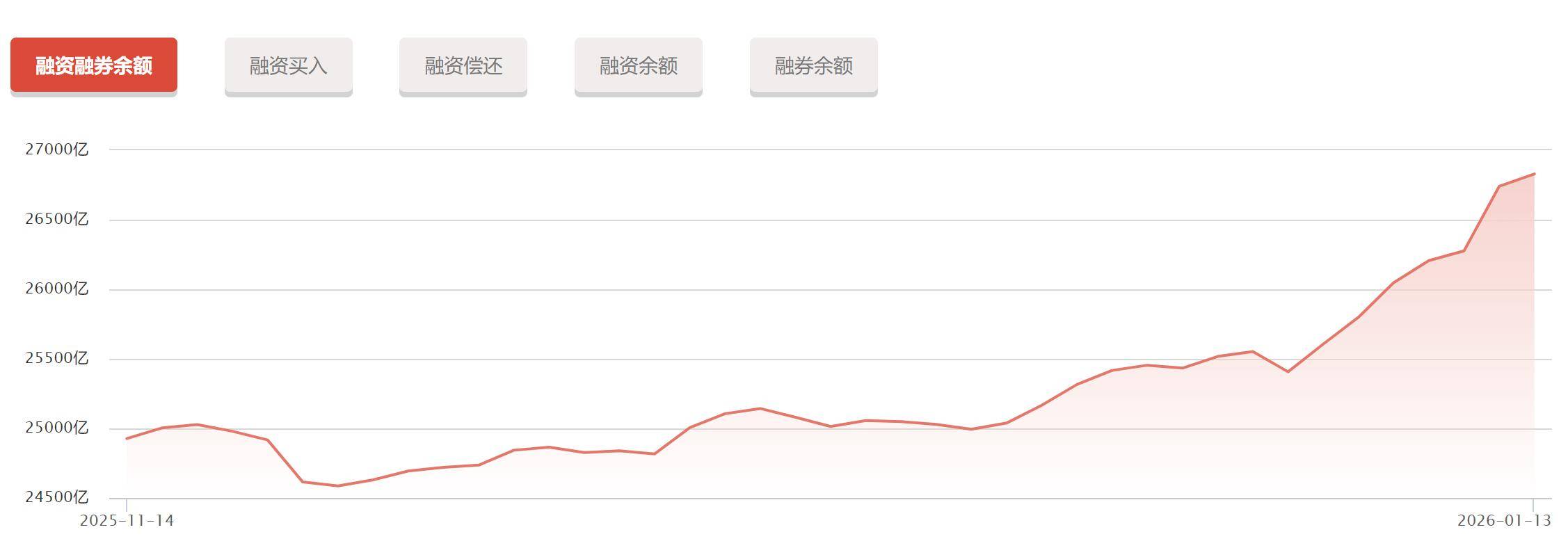
Group 1 - As of January 14, the A-share financing balance reached 2.68 trillion yuan, marking a historical high with an increase of 156.47 billion yuan over just eight trading days [1] - The total number of margin trading accounts exceeded 15.64 million by the end of 2025, with 96 securities firms and 11,600 business outlets participating in margin trading [1] - The new account openings for margin trading in 2025 reached 1.542 million, a significant increase of 52.9% compared to 1.0085 million in 2024 [1][3] Group 2 - By the end of 2025, the total market financing balance rose from 1.85 trillion yuan at the end of 2024 to 2.52 trillion yuan, an increase of over 36% [2] - The electronics industry led the financing net purchases with 31.78 billion yuan, followed by defense and military industry and computer sectors with 23.41 billion yuan and 19.27 billion yuan respectively [2] - The AI industry chain and leading new energy companies attracted significant leverage funds, with Zhongji Xuchuang topping the list with a net financing purchase of 16.19 billion yuan [2] Group 3 - The expansion of margin trading scale is seen as a "bull market accelerator," enhancing market liquidity and activity [3] - In September 2025, new account openings reached a monthly high of 205,400, with several months seeing new accounts exceeding 140,000 [3] - From 2023 to 2025, new margin trading account openings showed a continuous increase, with 780,200 in 2023, 1,008,500 in 2024, and 1,542,000 in 2025 [3] Group 4 - The margin trading balance has closely followed the A-share market trends since the "9.24" event in 2024, starting from 1.54 trillion yuan and reaching 2.5 trillion yuan by mid-2025 [4] - The margin trading balance fluctuated between 1.75 trillion yuan and 1.95 trillion yuan from February to July 2025 before resuming an upward trend [4] - Analysts predict that the margin trading market will transition from a "high-speed expansion period" in 2025 to a "high-quality growth period" in 2026, with expected balances between 2.6 trillion yuan and 3.2 trillion yuan [4]
融资保证金比例回归100%,释放什么信号?
Guo Ji Jin Rong Bao· 2026-01-15 14:15
Core Viewpoint - The recent increase in the financing margin ratio from 80% to 100% aims to moderate market sentiment, curb excessive speculation, and reduce overall market volatility, while not affecting existing financing contracts [1][4][5] Group 1: Financing Margin Adjustment - The financing margin ratio has undergone three adjustments since 2015, with the latest change returning it to 100% [2] - The adjustment is expected to decrease the maximum financing amount from 125,000 to 100,000 for every 100,000 in margin, indicating a 25% reduction in leverage [3] - The adjustment is seen as a proactive measure to prevent credit risks associated with concentrated margin calls [3] Group 2: Market Impact and Fund Flow - The increase in the financing margin ratio is anticipated to lead to a shift in fund flows, with a contraction in new financing scale and a decrease in speculative demand due to higher costs [6] - Funds are likely to move from speculative stocks to those with stable performance and reasonable valuations, promoting a more sustainable market environment [6] - The adjustment may enhance international investors' confidence in the A-share market, signaling a commitment to stable market development [6] Group 3: Regulatory Perspective - The adjustment is part of a broader strategy to manage market risks and ensure the healthy operation of the capital market, especially in light of recent trading activity and liquidity [4][5] - Future regulatory measures may include enhanced risk monitoring, differentiated margin requirements based on risk levels, and incentives for long-term funds to participate in margin trading [9]
股市面面观丨市场“降温”背后:融资余额开年八连涨 一个月2000亿杠杆资金进场
Zhong Guo Jin Rong Xin Xi Wang· 2026-01-15 07:55
转自:新华财经 新华财经上海1月15日电(林郑宏)火热的A股市场近期出现降温,沪指在创纪录的日线十七连阳后出现两连阴。1月15日,沪指盘中一度跌破4100点,虽尾 盘收回这一整数关口,但仍收跌0.33%,已连续3个交易日下跌。两市成交额亦较前期下降超万亿元。 消息面上,1月14日,经中国证监会批准,沪深北交易所发布通知调整融资保证金比例,将投资者融资买入证券时的融资保证金最低比例从80%提高至 100%。上述通知自1月19日起施行。这一措施被认为是监管层引导市场"降温"。 沪深北交易所表示,近期融资交易明显活跃,市场流动性相对充裕,根据法定的逆周期调节安排,适度提高融资保证金比例回归100%,有助于适当降低杠 杆水平,保护投资者合法权益。 如果从月度数据来看,2026年开年以来,融资净买入额已超1500亿元,自"9.24行情"以来,已仅次于2025年8月和2024年10月。另有数据显示,1月14日参与 融资融券交易的投资者数量为72.35万名,创2024年10月09日以来新高。各方面数据显示出,近期杠杆资金入市的步伐大幅加快。 | 日期 | 沪深京合计 期间净买入额 | | | --- | --- | --- ...

两融余额站上2.6万亿,券商额度告急监管出手降温
Huan Qiu Wang· 2026-01-15 03:30
Core Viewpoint - The continuous increase in margin financing and securities lending (two-in-one) balance in the Shanghai and Shenzhen markets has reached a historical high, prompting regulatory adjustments to prevent overheating in the market [1][3]. Group 1: Market Performance - The two-in-one balance has remained above 2.6 trillion yuan for six consecutive trading days, marking a new historical peak [1]. - The market has seen a significant increase in trading volume, with transaction amounts exceeding 3.5 trillion yuan for three consecutive days at the beginning of 2026 [1]. - The number of new accounts opened in the two-in-one market reached 1.542 million in 2025, a substantial increase of 52.9% compared to 2024, continuing a three-year growth trend [1]. Group 2: Regulatory Adjustments - On January 14, the Shanghai and Shenzhen Stock Exchanges announced an increase in the minimum margin ratio for new financing contracts from 80% to 100%, signaling a regulatory intent to guide the market towards a "slow bull" rather than a "crazy bull" [1][3]. - This adjustment is the first reversal since the margin ratio was lowered from 100% to 80% in August 2023 to stimulate market activity [3]. Group 3: Brokerages and Risk Management - Some large and medium-sized brokerages are experiencing a shortage of two-in-one quotas, attributed to the rapid growth of financing scale outpacing the speed of net capital replenishment [1]. - The tightening of quotas may also reflect brokerages' risk control strategies, aiming to manage the release of quotas in line with regulatory efforts to cool the market [1][3]. - Analysts believe that the current leverage risk is manageable, with the proportion of two-in-one balances to the circulating market value remaining stable at 2.59%, significantly lower than the levels seen in 2015 [3][4].
独家|个别券商,两融额度告急!
券商中国· 2026-01-14 23:18
Core Viewpoint - The balance of margin financing and securities lending (two-in-one) has reached a new high, but some brokerages are facing a shortage of financing quotas, indicating a potential slowdown in the pace of leveraged funds entering the market [1][4]. Group 1: Margin Financing and Market Conditions - As of January 14, 2026, the margin financing balance has exceeded 2.6 trillion yuan, marking a historical high, with market sentiment also surging, leading to trading volumes surpassing 3.5 trillion yuan for three consecutive days [3][4]. - The China Securities Regulatory Commission (CSRC) has raised the minimum margin ratio for financing from 80% to 100%, signaling a regulatory intent to cool down the market and promote a "slow bull" rather than a "crazy bull" market [8][9]. Group 2: Brokerages' Adjustments and Quotas - Several major brokerages have adjusted their margin financing limits, with some increasing their quotas to three times their net capital. For instance, Huatai Securities set its limit at approximately 286.5 billion yuan based on its net capital as of the third quarter of last year [4][5]. - Despite the increase in financing quotas, some brokerages are experiencing a rapid growth in financing demand, leading to a situation where their quotas are exhausted [6][7]. Group 3: Investor Behavior and Market Dynamics - The number of new margin financing accounts has increased significantly, with 1.542 million new accounts opened in 2025, a 52.9% increase from 2024 [5]. - The overall leverage level in the market remains controlled, with the margin financing balance accounting for 2.59% of the A-share market's circulating market value, which is still below the levels seen in 2015 [10].

“慢牛”、“长牛”信号明确!融资保证金比例上调至100%,释放哪些深意?
Sou Hu Cai Jing· 2026-01-14 07:38
Core Viewpoint - The adjustment of the financing margin ratio from 80% to 100% aims to reduce leverage levels and protect investors' rights, promoting long-term market stability and health [1][3]. Financing Margin Ratio Adjustment - The minimum financing margin ratio for new financing contracts has been raised from 80% to 100%, meaning investors will need to provide a higher proportion of their own capital when borrowing to invest [1]. - For example, with a margin of 1 million yuan, investors could previously borrow 1.25 million yuan, allowing for a total investment of 2.25 million yuan. After the adjustment, the same margin allows for borrowing only 1 million yuan, reducing total investment to 2 million yuan, a difference of 250,000 yuan [1]. Market Implications - This increase in the financing margin ratio is seen as a regulatory measure to prevent a repeat of the 2015 "leverage frenzy," shifting the market from a "fund-driven" rapid growth model to a "performance-driven" slow growth model [3]. - Short-term market trading volume is expected to decrease, impacting sectors that rely on high leverage and speculative trading, while stable, dividend-paying core assets may attract more investment [3]. Historical Context - Historical adjustments to the financing margin ratio have shown significant market impacts. For instance, in 2015, an increase in the margin ratio led to a noticeable decrease in market leverage and a shift in market focus from speculative trading to defensive strategies [4]. - The current adjustment is considered less severe compared to the 2015 change, which moved directly from 50% to 100%, indicating a more moderate regulatory approach aimed at fostering a higher quality "long bull" market [5]. Recent Market Activity - Recent data indicates that investor participation in margin trading remains high, with net financing inflows reaching 85.78 billion yuan in the first week of January 2026, ranking among the top five weekly inflows in A-share history [6]. - By the end of 2025, the total market financing balance exceeded 2.5 trillion yuan, marking a significant increase and reflecting strong investor enthusiasm for margin trading [6]. Broker Responses - Some securities firms have adjusted their financing business limits while also increasing the financing margin ratio, signaling a cautious approach to managing risk in the current market environment [7]. - Analysts suggest that while leverage levels are rising, they remain manageable compared to historical peaks, indicating a healthy market environment with increased activity [7].
疯牛踩刹车!交易所提高融资保证金比例至100%,半年8000亿杠杆资金杀入,60股买入超流通市值10%,蓝色光标、易点天下、中文在线等“妖股”火爆
Sou Hu Cai Jing· 2026-01-14 06:37
周三午间,A股重磅消息传来,沪深北三大交易所集体发布通知,将投资者融资买入证券时的融资保证金最低比例从80%提高至100%。 通知显示,2023年8月,沪深北交易所将融资保证金比例从100%降低至80%,融资规模和交易额稳步上升。近期,融资交易明显活跃,市场流动性相对充 裕,根据法定的逆周期调节安排,适度提高融资保证金比例回归100%,有助于适当降低杠杆水平,切实保护投资者合法权益,促进市场长期稳定健康发 展。 需要说明的是,此次调整仅限于新开融资合约,调整实施前已存续的融资合约及其展期仍按照调整前的相关规定执行。 最新数据显示,截止1月13日,沪深京三市融资融券余额为2.68万亿元,其中融资余额高达2.67万亿元。自去年下半年以来,融资融券余额稳步攀升,从1.80 万亿元升至2.68万亿元,半年增长约8000亿元,近期有加速迹象。 从个股来看,当前60多家公司融资余额占流通市值比例超过10%,排名前十的个股分别为:美硕科技(19.27%)、福建水泥(15.33%)、嘉曼服饰 (14.62%)、恒兴新材(14.17%)、溯联股份(14.03%)、福达合金(13.93%)、天马科技(13.15%)、华海诚科(1 ...

A股连阳,谁在发力?
Hua Er Jie Jian Wen· 2026-01-13 08:43
Core Viewpoint - The A-share market is experiencing a strong upward trend driven by leveraged funds and retail investors, with significant contributions from speculative and foreign capital, leading to a notable increase in market risk appetite [1][3]. Group 1: Market Performance - During the first week of January 2026, the A-share market saw a substantial increase, with the Wind All A Index rising by 5.1% and the average daily trading volume surging over 700 billion yuan to 2.85 trillion yuan [1]. - The financing balance reached a historical high of 2.61 trillion yuan, accounting for 2.53% of the total A-share market capitalization, placing it in the 96th percentile historically since 2021 [3][10]. Group 2: Investor Sentiment - Retail investor sentiment has significantly improved, with net inflows of 155.7 billion yuan, marking the second-highest level in the past year [3][15]. - The activity of speculative funds has also increased, with an average daily trading volume of 31.4 billion yuan on the Long Hu List, reaching a six-month peak [3][17]. Group 3: Foreign Investment - Foreign capital has shown a renewed interest, with the average daily trading volume of the Stock Connect increasing by 98.6 billion yuan to 327.2 billion yuan, representing an increase of 0.73 percentage points in trading volume share [3][19]. - Passive foreign capital has turned into a slight net inflow of 6.7 million dollars, indicating a stronger attraction towards technology sectors [3][23]. Group 4: Macro Liquidity - The central bank's significant net withdrawal of 166 billion yuan has not tightened market liquidity, as interbank market interest rates have declined, maintaining a loose monetary environment [6][8]. - The RMB exchange rate appreciated to 6.98 against the US dollar, with the 2-year and 10-year China-US interest rate differentials narrowing [9]. Group 5: ETF Market Dynamics - The ETF market has shown structural divergence, with a slight net outflow of 390 million yuan from stock ETFs, while industry-themed ETFs attracted a net inflow of 13.6 billion yuan [25][26]. - Broad-based ETFs faced significant net outflows, particularly from the CSI A500-related ETFs, which saw a redemption of 13.1 billion yuan [25].