
氢能经济

Search documents
瑞达期货铂镍金市场周报-20251212
Rui Da Qi Huo· 2025-12-12 09:30
瑞达期货研究院 「2025.12. 12」 铂钯金市场周报 作者: 研究员 廖宏斌 期货投资咨询证号:Z0020723 助理研究员 徐鼎烽 期货从业资格号:F03144963 取 更 多 资 讯 业务咨询 1、周度要点小结 2、期现市场 3、产业供需情况 4、宏观及期权 「 周度要点小结」 ◆ 本周观点:广期所铂钯金主力合约本周震荡偏强运行,铂2606主力合约周涨2.67%报452.05元/克,钯 2606主力合约周涨2.58%报389.45元/克。在联储降息的利好消息驱动下,铂钯金价格突破前期震荡整 理区间并重拾上行动能。宏观方面,美联储如期展开25个基点的降息操作,鲍威尔强调当前通胀仍高 于目标,但非关税因素导致的核心通胀已明显回落。若无新增关税,商品通胀预计将在2026年第一季 度触顶。目前利率已处于中性区间上沿,政策正从限制性向中性过渡。铂金在美联储宽松预期、供需 结构性赤字格局延续、氢能经济中长期需求预期扩张的支撑下,中长期或继续支撑铂金价格。钯金在 汽车催化剂领域的过度集中化,以及新能源汽车的持续普及,使其需求端预期走弱,钯金市场正逐步 由供不应求转向供应过剩,供需格局预期较为宽松,但降息预期所带 ...
铂钯金期货日报-20251209
Rui Da Qi Huo· 2025-12-09 09:35
1. Report Industry Investment Rating - No information provided 2. Core Viewpoints of the Report - The platinum and palladium futures main contracts fluctuated weakly in intraday trading, with platinum's decline greater than palladium's. In the short - term, the realization of the interest - rate cut expectation may continue the price correction. In the long - term, platinum prices may be supported by the Fed's easing expectation, the continuation of the supply - demand structural deficit, and the long - term expansion of hydrogen economy demand. Palladium's demand is expected to weaken due to over - concentration in the automotive catalyst field and the popularization of electric vehicles, but the bullish sentiment driven by interest - rate cut expectations may support the price. The current low price of palladium may make it a cost - effective choice again, and there may be a follow - up catch - up rally. The London platinum spot is expected to face resistance at $1750 per ounce and support at $1500 per ounce; the London palladium spot may encounter resistance at $1500 per ounce and support at $1350 per ounce [2] 3. Summary by Relevant Catalogs 3.1 Futures Market - The closing price of the platinum main contract was 436.40 yuan/gram, down 5.75 yuan; the closing price of the palladium main contract was 380.45 yuan/gram, down 1.80 yuan. The main contract holding volume of platinum was 10,387.00 hands, down 277.00 hands; the main contract holding volume of palladium was 3,179.00 hands, up 90.00 hands [2] 3.2 Spot Market - The Shanghai Gold Exchange platinum spot price (Pt9995) was 431.08 yuan/gram, down 4.22 yuan; the Yangtze River palladium spot price was 376.50 yuan/gram, up 16.50 yuan. The platinum main contract basis was - 5.32 yuan/gram, up 1.53 yuan; the palladium main contract basis was - 3.95 yuan/gram, up 18.30 yuan [2] 3.3 Supply - Demand Situation - The total annual supply of platinum in 2025 is expected to be 293.00 tons, down 5.00 tons; the total annual supply of palladium in 2025 is expected to be 220.40 tons, down 0.80 tons. The total annual demand for platinum in 2025 is expected to be 287.00 tons, down 27.00 tons; the total annual demand for palladium in 2025 is expected to be 261.60 tons, up 25.60 tons [2] 3.4 Macro Data - The US dollar index was 99.11, up 0.12; the 10 - year US Treasury real yield was 1.91%, up 0.03%. The VIX volatility index was 16.66, up 1.25 [2] 3.5 Industry News - The Fed is scheduled to hold an interest - rate meeting on December 9th and 10th, and the market generally expects a 25 - basis - point rate cut. Japan's Q3 real GDP was revised down to a 0.6% quarterly contraction and a 2.3% annual contraction. Japan's nominal wages rose 2.6% year - on - year in October, but real wages after inflation fell for the tenth consecutive month. The European Central Bank's hawkish Executive Board member Schnabel believes that economic and inflation risks are skewed upwards and is satisfied with the market's bet on the ECB's next rate hike [2] 3.6 Key Points to Watch - On December 9th at 19:00, the US November NFIB Small Business Confidence Index; at 23:00, the US October JOLTs Job Openings (in millions). On December 11th at 03:00, the Fed will announce the December FOMC meeting interest - rate decision [2]
铂钯金期货日报-20251203
Rui Da Qi Huo· 2025-12-03 10:07
Group 1: Report Summary - The platinum 2606 main contract fell 1.02% to 440.55 yuan/gram, and the palladium 2606 main contract rose 1.90% to 381.50 yuan/gram as of December 3 [2]. - The precious metal market may enter a technical consolidation phase after a rapid rise, and the correction may continue. Platinum prices may remain strong in the long - term due to factors like Fed rate - cut expectations, supply - demand deficit, "platinum replacing palladium", and long - term hydrogen economy demand. Palladium's supply is affected by South African power supply and Russian geopolitics in the short - to - medium term, while demand faces downward pressure from "platinum replacing palladium", with the market shifting from shortage to surplus, but rate - cut expectations may support prices [2]. - Resistance and support levels for London platinum spot are 1750 and 1500 US dollars per ounce respectively, and for London palladium spot are 1500 and 1350 US dollars per ounce [2]. Group 2: Market Data Futures Market - Platinum main contract closing price (daily, yuan/gram): 440.55, down 4.55; palladium main contract closing price (daily, yuan/gram): 381.50, up 7.10 [2]. - Platinum main contract open interest (daily, lots): 10664, up 171; palladium main contract open interest (daily, lots): 3089, down 117 [2]. Spot Market - Shanghai Gold Exchange platinum spot price (Pt9995): 427, up 1; Yangtze River palladium spot price: 374.50, up 6.50 [2]. - Platinum main contract basis (daily, yuan/gram): - 13.55, up 5.55; palladium main contract basis (daily, yuan/gram): - 7.00, down 0.60 [2]. Supply - Demand Situation - Estimated total platinum supply in 2025 (annual, tons): 220.40, down 0.80; estimated total palladium supply in 2025 (annual, tons): 293.00, down 5.00 [2]. - Estimated total platinum demand in 2025 (annual, tons): 261.60, up 25.60; estimated total palladium demand in 2025 (annual, tons): 287.00, down 27.00 [2]. Macro Data - US dollar index: 99.41, down 0.03; 10 - year US Treasury real yield (%): 1.85, up 0.06 [2]. - VIX volatility index: 17.24, up 0.89 [2]. Group 3: Industry News - Trump may choose long - term advisor Hassett as Fed chair, and Hassett hopes to get the position [2]. - US November ISM manufacturing PMI dropped 0.5 points to 48.2, below 50 for nine consecutive months, with new orders and backlogs contracting [2]. - Eurozone November CPI preliminary value rose 2.2% year - on - year (expected 2.1%), down 0.3% month - on - month; core CPI rose 2.4% year - on - year (expected 2.5%), down 0.4% month - on - month. Eurozone October unemployment rate was 6.4% (expected 6.3%) [2]. Group 4: Key Data to Watch - December 3, 21:15: US ADP private sector employment data [2]. - December 3, 21:30: US September import price index monthly rate [2]. - December 3, 23:00: US November ISM non - manufacturing PMI [2]. - US September PCE personal consumption expenditure data (time to be determined) [2].
铂钯金期货日报-20251201
Rui Da Qi Huo· 2025-12-01 10:44
Report Summary 1. Investment Rating No investment rating for the industry is provided in the report. 2. Core Viewpoints - Driven by interest - rate cut news, the precious - metal market is generally strong, leading to significant price increases for platinum and palladium futures. The platinum 2606 main contract rose 3.98% to 451.6 yuan/gram, and the palladium 2606 main contract rose 2.44% to 382.35 yuan/gram [2]. - For platinum, in 2025, the global market is expected to have a supply gap of about 692,000 ounces. With the continuous consumption of above - ground inventory, the physical spot market is in a long - term tight situation. In the short term, platinum prices are expected to fluctuate upward; in the medium - to - long term, they may maintain a strong trend, but there may be some profit - taking sentiment [2]. - For palladium, in the medium - to - short term, supply is affected by South Africa's power supply and Russia's geopolitical situation. Demand is under downward pressure due to the "platinum replacing palladium" trend. The market is shifting from supply shortage to surplus, but the warm trading sentiment in precious metals may support prices [2]. 3. Summary by Directory 3.1 Futures Market - Platinum main - contract closing price (daily, yuan/gram): 451.60, up 9.10; palladium main - contract closing price (daily, yuan/gram): 382.35 [2]. - Platinum main - contract position (daily, lots): 10,624.00, up 2,576.00; palladium main - contract position (daily, lots): 3,028.00, up 478.00 [2]. 3.2 Spot Market - Shanghai Gold Exchange platinum spot price (Pt9995): 438.00, up 24.00; Yangtze River palladium spot price: 384.50, up 22.00 [2]. - Platinum main - contract basis (daily, yuan/gram): 6.80, up; palladium main - contract basis (daily, yuan/gram): - 13.60, up 12.90 [2]. - Platinum CFTC non - commercial long positions (weekly, contracts): 9,966.00, down 243.00; palladium CFTC non - commercial long positions (weekly, contracts): 3,003.00, down 342.00 [2]. 3.3 Supply - Demand Situation - Total platinum supply (annual, tons) in 2025 is expected to be 220.40, down 0.80; total palladium supply (annual, tons) in 2025 is expected to be 293.00, down 5.00 [2]. - Total platinum demand (annual, tons) in 2025 is expected to be 261.60, up 25.60; total palladium demand (annual, tons) in 2025 is expected to be 287.00, down 27.00 [2]. 3.4 Macro Data - Dollar index: 99.44, down 0.12; 10 - year US Treasury real yield (%): 0.02, up [2]. - VIX volatility index: 16.35, down 0.86 [2]. 3.5 Industry News - Market expectations are that the Fed will cut interest rates by 25 basis points in December with a probability of about 85% - 86% according to the market pricing, and 87.4% according to CME's "FedWatch". The probability of maintaining the interest rate unchanged is 12.6%. By January next year, the probability of a cumulative 25 - basis - point cut is 67.5%, the probability of maintaining the rate unchanged is 9.2%, and the probability of a cumulative 50 - basis - point cut is 23.2% [2]. 3.6 Key Points to Watch - November 11 US ISM manufacturing PMI on December 1 [2]. - US JOLTS job - opening data on December 2 [2]. - US ADP private - sector employment data on December 3 [2]. - US September PCE personal consumption expenditure data (time to be determined) [2].
铂、钯期货上市首日策略:招期贵金属铂、钯专题
Zhao Shang Qi Huo· 2025-11-26 10:03
Report Industry Investment Rating No relevant content provided. Core Viewpoints of the Report - Platinum is expected to see a price increase in 2025 due to significant supply shortages, with a predicted supply gap of 850,000 ounces. Its price is likely to follow an upward trend [2][35]. - Palladium's outlook in 2025 is bleak, with demand - side pressure. Its price is expected to range between $800 - 1200 per ounce and may experience weak oscillations [3][35]. - For trading strategies, a long - platinum and short - palladium approach is recommended, with a focus on buying platinum at low prices and selling palladium at high prices [4][5][36]. Summary by Relevant Catalogs Contract Details - Platinum futures (PT) and palladium futures (PD) are listed on the Guangzhou Futures Exchange. Contract months are even - numbered months. The trading unit is 1000 grams per lot, the minimum price change is 0.05 yuan per gram, and the maximum single - order quantity is 1000 lots. The expected main contracts are PT2606 and PD2606 [7]. - Trading hours are from 9:00 - 11:30 am and 13:30 - 15:00 pm, Monday to Friday, with possible adjustments by the exchange [7]. - The minimum trading margin is 5% of the contract value, increasing in stages before the delivery month. The daily price limit is ±4% for non - delivery months and ±6% for delivery months [7]. - Contracts use physical delivery with a unit of 1000 grams. The delivery items must have a platinum/palladium content of at least 99.95%. The last trading day is the 10th trading day of the contract month, and the last delivery day is the 3rd trading day after the last trading day [8]. Fundamental Situation Industry Chain Overview - The global platinum and palladium industry chain is characterized by highly concentrated upstream supply, a game of refining and pricing power in the middle, and different downstream demands. South Africa dominates global platinum production, and Russia and South Africa together account for nearly 80% of global palladium production [9]. - China, as the largest consumer, has a low domestic mineral self - sufficiency rate and is highly dependent on imports. The Guangzhou Futures Exchange has launched RMB - denominated platinum and palladium futures contracts to enhance pricing influence [9][11]. Upstream - Global platinum and palladium mining supply is geographically concentrated and faces supply pressure. In Q3 2025, major producers faced supply issues, especially in palladium production [15][21]. - Future new supply prospects are not optimistic, with few new or expanded projects. Most potential projects are in the early stages, and it will take at least five years to reach actual production [22]. Middle Stream - China's platinum and palladium supply is highly dependent on imports. In 2025, platinum imports are expected to decline, while palladium imports from Russia have increased significantly [25][27]. - Recycling is becoming an important growth point. China aims to increase the recycling volume of platinum - group metals to 70 tons by 2027, improving the domestic supply structure [26]. Downstream - Platinum demand is more diversified, with about 45% in the automotive catalyst field, 30% in industrial applications, 18% in jewelry processing, and 4% in investment. Palladium demand is highly concentrated, with 83% in automotive catalysts [30]. - In the automotive catalyst field, palladium demand is under downward pressure due to electrification and platinum substitution, while platinum demand is more resilient [32][33]. - In the industrial application field, platinum has a broader demand base, while palladium's demand is relatively limited [33]. - The hydrogen energy field is a growth area for platinum, while palladium has no obvious application [33]. - In the investment and jewelry fields, platinum is attracting more investment attention, while palladium has little demand and growth potential [34]. Price and Strategy Price Trends - Platinum prices are expected to rise due to supply shortages, with a significant supply gap and decreasing surface inventory. The one - month lease rate has soared [2][35]. - Palladium prices are expected to be weak due to demand - side pressure, with a predicted price range of $800 - 1200 per ounce [3][35]. Strategy Recommendations - For the unilateral strategy, it is recommended to buy platinum at low prices and sell palladium at high prices [4][36]. - For the arbitrage strategy, a long - platinum and short - palladium approach is recommended based on the fundamental differences between the two metals [5][37][38].
从供需格局到战略展望:铂钯金属产业链全景图
Zhao Shang Qi Huo· 2025-11-24 08:04
1. Report Industry Investment Rating No relevant content provided. 2. Core Viewpoints of the Report - The platinum market is expected to face a supply deficit in 2025, with a shortage of 692,000 ounces. Despite a possible balance or slight surplus in 2026 under certain conditions, the supply - side structural tension and long - term demand potential from the hydrogen industry remain. The price is likely to break through $2000 in the medium - term [62]. - The palladium market is facing a double - pressure of supply surplus and structural demand decline. The supply surplus is expected to expand to 245,000 ounces in 2025, and the price will face downward pressure in the future [61][65]. 3. Summary According to the Directory 3.1 Platinum and Palladium Overview - **Physical and Chemical Properties**: Platinum is a silver - white metal with high density, excellent high - temperature resistance, and good ductility. It is chemically stable and an excellent catalyst. Palladium is also a silver - white metal, lighter than platinum, with good high - temperature performance and unique hydrogen - absorption ability. It is also a highly efficient catalyst [8][9][10][11]. - **Industrial Chain**: The upstream of the platinum - palladium industrial chain is highly geographically concentrated, with South Africa and Russia dominating. The mid - stream involves refining and purification, and the downstream demand for platinum is diverse, while palladium is mainly used in the automotive sector. China has a low self - sufficiency rate and is taking measures to ensure supply chain security [12]. - **Futures Contracts**: China lacks platinum and palladium futures pricing power. The Guangzhou Futures Exchange has released a draft for soliciting opinions on platinum and palladium futures contracts, with innovative delivery systems and specific contract parameters [14][15]. 3.2 Supply - **Global Supply Pattern**: In 2024, global platinum supply was 81% from mines and 19% from recycling, while palladium supply was 71.5% from mines and 28.5% from recycling. South Africa dominated platinum production, and Russia was the largest palladium producer. Four major mining giants dominated global platinum and palladium supply [18][20][25]. - **China's Supply Pattern**: China's platinum supply is highly dependent on imports, while palladium supply has stronger self - sufficiency due to a well - established recycling system. China's platinum and palladium imports are geographically concentrated, and the export scale is small. The domestic recycling industry has potential for growth [33][34][36]. 3.3 Demand - **Global Demand Structure**: Platinum demand is relatively diversified, with the automotive catalyst sector being the largest, followed by industrial applications. Palladium demand is highly concentrated in the automotive catalyst sector. Platinum demand is less volatile, while palladium demand is more affected by the automotive industry [39]. - **China's Demand Structure**: China's platinum demand focuses on green energy transformation, while palladium demand is also mainly in the automotive industry but faces more uncertainty due to the impact of new - energy vehicles [42]. - **Application Areas**: In the automotive industry, platinum, palladium, and rhodium play different roles in exhaust catalysts. In glass manufacturing, platinum - rhodium alloys and palladium alloys are used for their high - temperature stability and corrosion resistance. In the jewelry and investment fields, platinum investment demand is strong, and jewelry demand is recovering. In the hydrogen energy industry, platinum and palladium are core catalysts [47][50][51][56]. 3.4 Balance and Outlook - **Global Balance**: The platinum market is facing supply shortages, while the palladium market is facing supply surpluses and demand declines. The supply of platinum is affected by production challenges in South Africa and North America, while demand is supported by the automotive and hydrogen energy industries. The palladium supply surplus is due to reduced demand in the automotive sector and increased recycling [58][61]. - **Price and Outlook**: The platinum price is expected to rise in the medium - term, while the palladium price is under downward pressure. The future price trends of both metals are related to the automotive industry, recycling markets, and policy factors [62][65].
财报前瞻 | 普拉格能源(PLUG.US)Q3每股亏损或同比扩大48% 营收预计达1.7亿美元
智通财经网· 2025-11-10 08:13
Core Viewpoint - Plug Power (PLUG.US), a leading provider of hydrogen economy solutions, is set to announce its Q3 2025 earnings on November 10, with expectations of a significant increase in losses compared to the previous year [1] Financial Performance Expectations - The market predicts a Q3 loss per share of $0.13, which represents a 48% increase in losses year-over-year [1] - Revenue is expected to be $170.02 million, reflecting a 2.1% decline compared to the same period last year [1] - Over the past 30 days, analysts have raised their earnings expectations by 2%, indicating a collective adjustment in performance forecasts [1] Business Segment Insights - Analysts forecast "net revenue (equipment, related infrastructure, and others)" to reach $98.03 million, an 8.5% decrease year-over-year [1] - "Fuel cell systems and related infrastructure services net revenue" is expected to be $15.47 million, showing a 9.3% increase compared to the previous year [1] - "Power purchase agreement net revenue" is projected at $21.20 million, a 3.6% increase year-over-year [1] - "Net revenue (including fuel and related equipment delivered to customers)" is anticipated to be $32.53 million, reflecting a 9.2% increase compared to the same period last year [1] Profitability Metrics - The expected gross profit for "fuel cell systems and related infrastructure services" is only $160,000, a significant drop from $5.06 million in the same quarter last year [2]

发展氢能经济的关键一步
董扬汽车视点· 2025-09-21 10:33
Core Viewpoint - Continued support for fuel cell vehicles is crucial for maintaining China's competitive edge in the global fuel cell industry and hydrogen economy [1][2][3] Group 1: Importance of Continued Support - Continued support can help China achieve a world-leading position in the fuel cell industry, as current technology indicators are already at an advanced level [2] - Without ongoing support, previous advancements may be lost, as many companies are still in the R&D phase and facing financial difficulties [2] - Supporting fuel cell vehicles is not just about the vehicles themselves but also about positioning China at the forefront of the hydrogen economy, which is essential for global carbon neutrality efforts [3] Group 2: Suggestions for Optimizing Phase II Demonstration Projects - The initial phase of the demonstration project was effective in leveraging local government subsidies and attracting enterprise investment [4] - The second phase should focus on medium to long-distance heavy-duty fuel cell trucks, where fuel cell vehicles have clear advantages in range and efficiency [4] - Successful implementation in this area could serve as a significant global example, contrasting with the slower progress seen in other countries [4] Group 3: Importance of Toll Fee Exemptions - Expanding toll fee exemptions for fuel cell vehicles is critical for increasing their application range and market penetration [5] - The potential revenue loss from toll exemptions is minimal given the current limited number of fuel cell vehicles, and such measures should be temporary [5] - Addressing funding gaps for road maintenance should involve tax reforms rather than restricting toll exemptions, as this could hinder the development of the fuel cell industry [6]

从“煤都”到“氢谷”:“风光”内蒙古华丽转身
2 1 Shi Ji Jing Ji Bao Dao· 2025-08-29 09:58
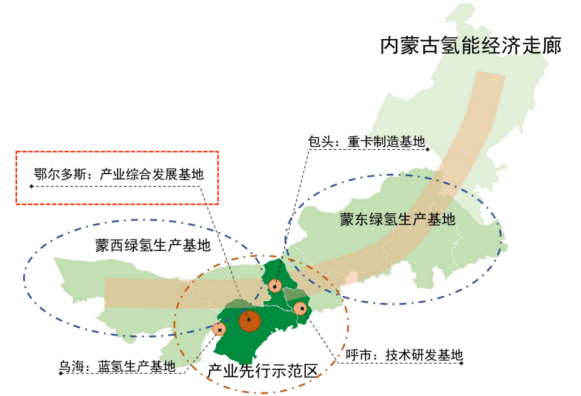
Core Viewpoint - Inner Mongolia is transitioning from a coal-dominated economy to a hydrogen energy hub, driven by a new action plan aimed at high-quality development of the hydrogen equipment manufacturing industry [1][2]. Group 1: Hydrogen Energy Development - The total investment for hydrogen energy equipment projects in Inner Mongolia is projected to be 2.802 billion yuan, with green hydrogen production expected to reach 3,659 tons and green ammonia capacity at 320,000 tons per year by the first half of 2025 [1]. - The "Action Plan" outlines the development positioning of four cities: Hohhot as a research and development base, Baotou as a solid-state hydrogen storage and fuel cell heavy truck production base, Ordos focusing on water electrolysis hydrogen production, and Wuhai purifying hydrogen from coking plant by-products [1][2]. Group 2: Geographical and Resource Advantages - Inner Mongolia has significant renewable energy resources, with wind energy potential of 146 million kilowatts and solar energy potential of 940 million kilowatts, accounting for over half and one-fifth of the national totals, respectively [4]. - The region's renewable energy capacity has surpassed 100 million kilowatts, supporting explosive growth in green hydrogen production [5]. Group 3: Economic Viability and Cost Structure - The cost of green hydrogen production in Inner Mongolia is approximately 21 yuan/kg, among the lowest in the country, but still requires policy support to compete with gray hydrogen [5]. - The region can leverage its abundant coal resources to produce lower-cost gray hydrogen, which can be upgraded to blue hydrogen through carbon capture technologies [5]. Group 4: Industrial Applications and Transportation - Hydrogen energy offers a solution for high-emission industries in Inner Mongolia, such as coal chemical and steel metallurgy, by replacing traditional hydrogen production methods with green hydrogen [6]. - The region is focusing on hydrogen fuel cell heavy trucks for long-distance transportation, with operational costs competitive with diesel trucks, supported by government incentives [7]. Group 5: Comprehensive Industry Layout - Inner Mongolia is constructing a complete hydrogen energy industry chain covering production, storage, transportation, application, and equipment manufacturing [8]. - The planned industrial structure includes a core hydrogen energy demonstration zone in the four cities and six specialized bases for various hydrogen-related functions [9][12]. Group 6: Infrastructure and Technological Development - The "West Hydrogen East Send" pipeline project has been approved, marking a significant step in establishing a long-distance hydrogen transportation network [13]. - Local enterprises are developing hydrogen fuel cell technology and manufacturing capabilities, with notable projects like the production line for high-power hydrogen fuel cell stacks [14].
从“煤都”到“氢谷”:“风光”内蒙古华丽转身|年中能源观察
2 1 Shi Ji Jing Ji Bao Dao· 2025-08-29 09:43
Core Viewpoint - Inner Mongolia is transitioning from a coal-dominated economy to a hydrogen energy hub, leveraging its abundant renewable resources and strategic planning to develop a comprehensive hydrogen industry [1][2][14] Group 1: Hydrogen Industry Development - The total investment for hydrogen equipment projects under construction in Inner Mongolia is 2.802 billion yuan, with green hydrogen production expected to reach 3,659 tons and green ammonia capacity at 320,000 tons per year by mid-2025 [1] - The "Action Plan" for promoting high-quality development of the hydrogen equipment manufacturing industry has been officially launched, outlining the development positioning for four cities: Hohhot, Baotou, Ordos, and Wuhai [1][2] - Inner Mongolia aims to establish a hydrogen industry cluster that covers the entire value chain, including production, storage, transportation, application, and equipment manufacturing [8][12] Group 2: Resource Advantages - Inner Mongolia has significant renewable energy potential, with wind energy capacity estimated at 146 million kilowatts and solar energy capacity at 940 million kilowatts, providing a strong foundation for low-cost green hydrogen production [4] - The region has achieved a historic milestone with over 100 million kilowatts of installed renewable energy capacity, supporting explosive growth in green hydrogen production [5] Group 3: Economic and Environmental Impact - The transition to hydrogen energy is driven by the need to reduce reliance on traditional fossil fuels and meet carbon neutrality goals, with hydrogen seen as a key solution for decarbonizing transportation and industrial sectors [2][6] - Inner Mongolia's hydrogen economy is expected to significantly reduce carbon emissions, with projects like the integration of green hydrogen in chemical processes projected to cut CO2 emissions by approximately 139,000 tons annually [11] Group 4: Infrastructure and Technology - The "West Hydrogen East Send" pipeline project has been approved, marking a significant step in establishing a long-distance hydrogen transportation network [12] - Inner Mongolia is focusing on enhancing its hydrogen equipment manufacturing capabilities, with plans to improve the supply chain and establish a robust industrial ecosystem by 2027 [13]