第四次科技革命

Search documents
杨德龙:科技牛行情仍有望成为2026年重要投资主线之一
Xin Lang Ji Jin· 2025-11-26 10:19
Group 1: Technology Sector Performance - The technology stocks have regained momentum after several weeks of adjustment, with the ChiNext Index rising over 2% this week, driven by strong performances in the computing power and pharmaceutical sectors [1] - The computing power sector continues to lead the market, with significant gains, while the pharmaceutical sector also shows strong performance [1] - The current bull market in technology stocks is expected to continue, with the computing power sector being a key driver due to the ongoing AI revolution and increased investments in AI computing capabilities [2] Group 2: Consumer Sector Insights - A new implementation plan has been released to enhance the adaptability of consumer goods supply and demand, aiming for a significant optimization of the supply structure by 2027 [3] - The retail sales growth rate of social consumer goods has declined to 2.9% in October, primarily due to a slowdown in resident income growth [3] - There is potential for recovery in consumer stocks as the capital market stabilizes, which may enhance residents' property income and boost retail sales growth [3] Group 3: Market Outlook and Investment Strategy - A structural bull market in A-shares is anticipated to transition into a comprehensive bull market, with various sectors expected to rotate, including "small growth stocks" (technology), "mid-growth stocks" (new energy, military, power equipment), and "old growth stocks" (consumer staples) [4] - The total market capitalization of China's top ten technology stocks is approximately $2.5 trillion, significantly lower than the $25 trillion of the top ten U.S. technology stocks, indicating substantial growth potential for Chinese technology stocks [4] - The focus on technological innovation in China's 14th Five-Year Plan highlights key development areas such as AI, semiconductor chips, and computing power, which are expected to be crucial for the ongoing bull market [5]
决胜港股升浪·牛启东方2026——第十届智通财经资本市场年会邀您共赴资本盛宴
智通财经网· 2025-11-18 00:56
Group 1 - The core theme of the upcoming "10th Zhitong Financial Capital Market Annual Conference" is "Winning the Hong Kong Stock Surge: Bullish Outlook for 2026," focusing on the potential of Chinese assets amid a new technology-driven bull market [1] - The Hang Seng Index surged by 28% in a single quarter, while the Hang Seng Tech Index rebounded over 50% year-to-date, indicating a significant capital influx into undervalued Chinese assets [1] - The conference will feature prominent speakers, including economists and fund managers, who will discuss cross-border capital flows and relative valuation opportunities in the Hong Kong stock market [2] Group 2 - The afternoon session will focus on innovative pharmaceuticals, with companies like Deke Pharma and He Yu sharing insights on their latest clinical developments and commercialization strategies [3] - A diverse lineup of over 80 listed companies will participate in roadshows, providing investors with opportunities for in-depth discussions and identifying quality investment targets [4] Group 3 - The "3rd Overseas Fund Summit" will take place on December 4, featuring discussions on global capital allocation strategies and the impact of geopolitical shifts on investment [5] - The event will include four strategic roundtable discussions, addressing topics such as cognitive warfare and the mission of capital in a post-scarcity era [6] - The conference will conclude with the presentation of the New Intelligence Awards, showcasing the evolution of investment strategies from present to future [6] Group 4 - The event will continue in Hong Kong on December 5, maintaining a dual-city format that emphasizes the synergy between technological breakthroughs and global capital trends [6] - The conference aims to explore new patterns, tracks, and dividends arising from the new technological revolution, inviting participants to engage in high-level discussions [6]

杨德龙:本轮慢牛长牛行情形成背后有深刻逻辑
Xin Lang Ji Jin· 2025-11-10 08:28
Group 1 - The A-share market has recently experienced fluctuations after breaking through the 4000-point mark, with differing opinions on whether this is the end or the beginning of a new market trend. The current market valuation and leverage are lower compared to previous peaks, indicating no severe bubble formation [1] - The technology sector has shown outstanding performance this year, with adjustments reflecting profit-taking rather than a trend reversal. The recent pullback in the U.S. "Tech Seven" has also impacted the A-share technology sector [1] - Different sectors have been labeled in the market, with technology stocks referred to as "small rising stocks" and traditional sectors like liquor and traditional Chinese medicine termed "old rising stocks," which have underperformed [2] Group 2 - The 14th Five-Year Plan emphasizes technological innovation as a key policy direction, with significant investment expected in areas like AI, semiconductors, and low-altitude economy, indicating a long-term beneficial trend for these sectors [3] - The current technology stock rally is driven by the fourth technological revolution, particularly the large-scale application of artificial intelligence, which has global implications [3] - Concerns have been raised about potential risks in AI technology stocks, drawing parallels to the 2001 dot-com bubble, as some investors have begun to reduce their positions in U.S. stocks [4] Group 3 - The U.S. technology stock market has been a significant driver of the long-term bull market, with leading tech companies starting to realize earnings, suggesting a more solid growth outlook compared to the 2001 bubble [5] - A potential market rotation is anticipated, with traditional sectors possibly experiencing a resurgence, although their growth may not match that of technology stocks [6] - The current bull market in A-shares and Hong Kong stocks is expected to continue, driven by a shift of household savings into the capital market, with over 25 million new stock accounts opened this year [5][6] Group 4 - Global capital allocation to the Chinese stock market remains low, indicating significant room for growth, especially as trade negotiations between China and the U.S. have yielded positive results [7] - Despite typical year-end market quietness, structural opportunities are expected to arise due to potential policy benefits and industry trends, suggesting that the current market phase is a consolidation rather than an end to the bull market [7]
将来我们能不能出现中国版的英伟达、中国版的特斯拉?杨德龙:是有可能的
Xin Lang Zheng Quan· 2025-11-02 07:05
Core Insights - The current market trend shows that technology stocks are leading the A-share market, with potential for the emergence of Chinese versions of Nvidia and Tesla in the future [1][2] - The ongoing bull market is still in its early stages, characterized by high trading volumes but relatively low new capital inflow, leading investors to focus on high-growth technology stocks [1] - The fourth technological revolution, particularly in artificial intelligence, is driving investment enthusiasm in technology stocks, similar to trends seen in the US market [1] Market Dynamics - The technology sector is experiencing a bull market, with significant interest driven by the success of US tech companies, particularly Nvidia, which recently surpassed a market capitalization of $5 trillion [1] - Investors are currently favoring smaller-cap stocks with high growth potential, as they seek to capitalize on the ongoing technological advancements [1] - Despite the excitement, it is noted that only a small percentage of technology companies (around 10% or less) are likely to achieve significant breakthroughs and success, indicating a high level of risk within the sector [2]

杨德龙:美联储再次降息25个基点,延续本轮降息周期!美股科技牛市与A股市场科技牛行情的逻辑是一致的
Sou Hu Cai Jing· 2025-10-30 02:49
Group 1: Federal Reserve Actions - The Federal Reserve lowered interest rates by 25 basis points, aligning with market expectations due to weak employment and economic data, while inflation remains manageable [1][2] - The target range for the federal funds rate is now between 3.75% and 4% [1] - Two members of the Federal Reserve voted against the rate cut, indicating increasing division within the committee [1] Group 2: Economic Indicators - Employment growth has slowed, and the unemployment rate has increased, but remains low as of August [2] - Economic activity is expanding at a moderate pace, with inflation still at relatively high levels [2] - The Federal Reserve is closely monitoring layoffs, especially following significant job cuts by major companies [2] Group 3: Market Reactions - Following the rate cut, U.S. stock indices showed mixed results, with the Dow Jones reaching a peak of 48,040 points and the Nasdaq hitting 24,012 points, both marking intraday historical highs [3] - Nvidia's stock rose by 2.99%, pushing its market capitalization above $5 trillion, making it the first company to reach this milestone [3] Group 4: Sector Performance - The technology sector is attracting global capital, with rising valuations, although there are concerns about overvaluation risks [3][4] - The clean energy sector, including solar, storage, wind, and lithium battery industries, has seen significant gains, driven by the shift towards alternative energy sources [4] Group 5: U.S.-China Relations - A meeting between the U.S. and Chinese leaders is scheduled for October 30, which could positively impact trade negotiations and improve bilateral relations [5] - Successful trade negotiations would benefit both economies and contribute to global economic growth, providing a significant boost to capital markets [5]


名家视点丨杨德龙:对10月行情应保持信心和耐心
Sou Hu Cai Jing· 2025-10-10 12:40
Core Viewpoint - The current A-share market is characterized by a technology bull market, driven by significant advancements in technology and innovation, particularly in the context of the "14th Five-Year Plan" which emphasizes innovation as a core element of modernization [1][2]. Group 1: Technology Sector Performance - The technology bull market is primarily led by sectors such as humanoid robots, semiconductor chips, intelligent driving, innovative pharmaceuticals, and solid-state batteries [2]. - The ChiNext Index saw a substantial increase in the third quarter, while the Science and Technology Innovation Board (STAR Market) is transitioning from a "testing ground" to a "deep water zone" with the implementation of the "1+6" policy framework [1][2]. - The STAR Market is expected to play a crucial role in fostering new productivity and supporting the strategy of becoming a technology powerhouse [1]. Group 2: Economic Context and Market Trends - Traditional industries are experiencing sluggish growth, with some facing overcapacity and insufficient demand, which is closely related to the ongoing economic transformation in China [1]. - The global market is currently witnessing a technology bull market, with both A-shares and Hong Kong stocks reflecting this trend [3]. - The international gold price has surged significantly, driven by expectations of interest rate cuts by the Federal Reserve, which is also influencing the performance of technology stocks [3]. Group 3: Solid-State Battery Developments - Recent breakthroughs in solid-state battery technology are noteworthy, with Toyota set to mass-produce a solid-state battery for vehicles that can achieve a range of 1200 kilometers [4]. - Solid-state batteries are recognized for their long range, high energy density, and safety, although high production costs remain a challenge [4][5]. - The solid-state battery sector is emerging as a key development direction in the new energy landscape, with potential applications in electric vehicles, humanoid robots, and low-altitude economies [5].
杨德龙:科技股大涨带动下,上证指数突破3900点关口,A股本轮牛市氛围越来越浓!市场赚钱效应非常突出
Sou Hu Cai Jing· 2025-10-09 08:12
Group 1 - The core viewpoint of the articles highlights a significant rise in technology stocks, particularly the STAR 50 Index, which has surged over 50% this year, indicating a strong technology bull market [1][4] - Traditional industries are underperforming, with slow growth and issues such as overcapacity and insufficient demand, closely linked to China's economic transformation [1][4] - The current bull market is characterized by structural differentiation, where technology innovation sectors like humanoid robots, semiconductor chips, intelligent driving, innovative drugs, and solid-state batteries are leading the gains [1][5] Group 2 - The U.S. stock market has reached historical highs, driven by a surge in technology stocks, especially those related to AI, while traditional sectors lag behind [2] - The Federal Reserve is expected to lower interest rates, which could further support the stock market and boost investor confidence during the "Golden September and Silver October" period [2] - The international gold price has risen significantly, surpassing $4000 per ounce, with predictions of continued upward movement due to the Fed's easing policies [3] Group 3 - The STAR Market is positioned as a core capital engine for technological self-reliance, with policies aimed at fostering innovation and economic development [4] - The STAR 50 Index focuses on 50 high-market-cap, liquid hard-tech companies, reflecting the development trends of leading technology firms [5] - Solid-state batteries are making technological breakthroughs, with potential applications in various sectors, including automotive and robotics, marking a significant development direction in the new energy sector [5]
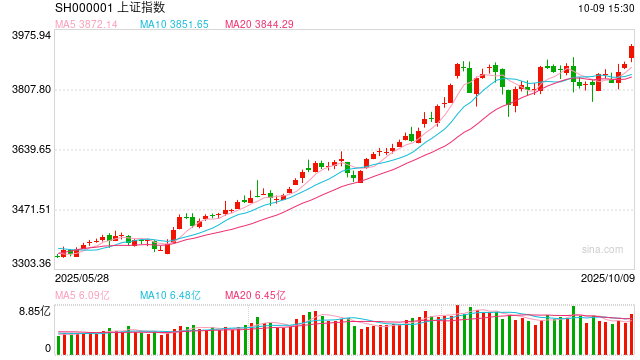
杨德龙:上证指数突破3900点整数关口 本轮牛市氛围越来越浓
Xin Lang Ji Jin· 2025-10-09 08:01
Group 1: Market Overview - The market experienced a significant rise after the National Day holiday, with the Shanghai Composite Index surpassing 3900 points, reaching a ten-year high, driven by a surge in technology stocks [1] - The current market trend is characterized as a "technology bull market," reflecting the ongoing development of technological innovation as a key driver for economic growth in China [1][2] - The ChiNext Index also saw substantial gains in Q3, continuing its upward momentum after the holiday, while traditional industries lagged behind [2] Group 2: Technology Sector Performance - The Sci-Tech Innovation Board (STAR Market) is highlighted as a core capital engine for technological self-reliance, with policies aimed at fostering innovation and economic modernization by 2035 [1] - The Sci-Tech 50 Index has risen over 50% this year, indicating strong performance in the technology sector, particularly in areas such as humanoid robots, semiconductor chips, smart driving, innovative pharmaceuticals, and solid-state batteries [2][5] - The current bull market shows a structural divergence, with technology innovation sectors experiencing significant gains while traditional sectors struggle [2] Group 3: Global Market Influences - International markets, including US stock indices, reached historical highs, largely due to the rise of technology stocks, especially those related to AI [3] - The expectation of further interest rate cuts by the Federal Reserve is influencing market dynamics, with predictions of a 25 basis point cut in October and December [3][4] - Gold prices have surged, breaking the $4000 per ounce mark, driven by increased demand and a weakening dollar, with international investment banks raising their gold price targets [4] Group 4: Future Trends and Innovations - The solid-state battery technology is making significant strides, with Toyota set to mass-produce a battery that offers a range of 1200 kilometers, showcasing the potential for advancements in energy density and safety [5] - The solid-state battery sector is expected to play a crucial role in the future of electric vehicles, humanoid robots, and low-altitude economies, marking it as a key area for investment [5] - The technology bull market is anticipated to continue, with a focus on the integration of artificial intelligence into traditional industries to create new opportunities [2]
打通西藏与广东,又一个超级工程来了
虎嗅APP· 2025-09-18 13:21
Core Viewpoint - The construction of the Tibet-Guangdong direct current project marks a significant step in energy transmission, enabling Tibet to supply 43 billion kilowatt-hours of electricity annually to the Guangdong province, which is crucial for meeting its growing energy demands [4][27]. Group 1: Energy Supply and Demand - Guangdong, as China's largest economy and industrial province, has an electricity consumption forecast of 912.1 billion kilowatt-hours for 2024, comparable to that of Japan [9]. - Despite having a generation capacity exceeding 700 billion kilowatt-hours, Guangdong faces a significant electricity shortfall, necessitating the expansion of nuclear power and reliance on "West-to-East Power Transmission" [10][15]. - The Tibet-Guangdong project will enhance energy supply, with the potential for Tibet to develop its vast hydropower resources, estimated at a theoretical annual generation capacity exceeding 1 trillion kilowatt-hours [19][21]. Group 2: Infrastructure and Economic Impact - The Tibet-Guangdong direct current project will span over 2,600 kilometers, utilizing advanced technology to deliver electricity with minimal latency [25][26]. - The project is expected to create over 100,000 jobs during peak construction, significantly impacting the local economy in Tibet [31]. - The total investment for the project is projected to reach 200 billion yuan, including direct investments and supporting infrastructure [30]. Group 3: Economic Growth and Development - Tibet, historically the weakest province in terms of GDP and population, is experiencing a turnaround with multiple large-scale infrastructure projects, including the 300 billion yuan Sichuan-Tibet Railway and the 1 trillion yuan Yarlung Tsangpo River hydropower project [40][42]. - Recent years have seen Tibet achieving the highest GDP growth rates in the country, indicating a shift in its economic trajectory [38]. - The combination of significant investments and infrastructure development positions Tibet to potentially escape its status as the weakest province economically [43][44].
中国最大支柱产业,要变了
首席商业评论· 2025-09-06 05:08
Core Viewpoint - The article emphasizes the significance of the "Artificial Intelligence +" initiative as a pivotal strategy for China's economic transformation, aiming for AI to become a major growth driver by 2030 and fully integrated into society by 2035 [4][6][8]. Group 1: AI Development Goals - The Chinese government has set a three-step plan for AI development, targeting over 70% application penetration by 2027 and over 90% by 2030, with the goal of establishing a smart economy as a key growth engine [4][6]. - By 2030, the core AI industry is projected to exceed 1 trillion yuan, driving related industries to surpass 10 trillion yuan, indicating a massive economic shift [6][8]. Group 2: Economic Transition - The transition from a real estate-driven economy to a smart economy signifies a comprehensive restructuring of pillar industries, with AI expected to play a crucial role in this transformation [6][7]. - The article highlights that AI represents a new paradigm of production factors, with data being termed the "fourth production factor," contrasting with traditional reliance on land in real estate [7][8]. Group 3: Global AI Competition - The article discusses the global race in AI, with major economies prioritizing AI in their strategic frameworks, including the U.S. and the EU, while China aims to leverage its "Artificial Intelligence +" initiative to gain a competitive edge [10][11]. - China's AI strategy has evolved from being a follower in previous tech revolutions to taking a leading role in the current AI revolution, with significant advancements in core technologies [12][11]. Group 4: Application and Market Potential - The success of the "Artificial Intelligence +" initiative hinges on large-scale applications, with the potential to create a market worth tens of trillions, driven by diverse sectors such as education, healthcare, and urban governance [13][15]. - The article outlines six key action areas for AI application, including enhancing scientific research, industrial development, consumer quality, public welfare, governance capabilities, and global cooperation [14][15]. Group 5: Investment and Economic Impact - AI investments are projected to reach hundreds of billions, with significant capital expenditures from major Chinese tech firms like Alibaba, Tencent, and Huawei, indicating a robust growth trajectory for the AI sector [21][19]. - The article predicts that by 2028, global AI spending will surge from over $200 billion to more than $600 billion, reflecting a compound annual growth rate of 28% [19][21]. Group 6: Future Prospects and Strategic Positioning - The article suggests that companies and regions that position themselves as leaders in AI will be better equipped to convert policy advantages into market success, emphasizing the importance of a complete ecosystem from computing power to application [27][28]. - The focus on self-reliance and core technology development is deemed essential for long-term success in the AI landscape, with companies encouraged to innovate independently to avoid dependency on external technologies [28][27].