红利投资

Search documents
红利板块集体走强,红利ETF易方达(515180)、红利低波ETF易方达(563020)受资金关注
Sou Hu Cai Jing· 2026-01-29 11:03
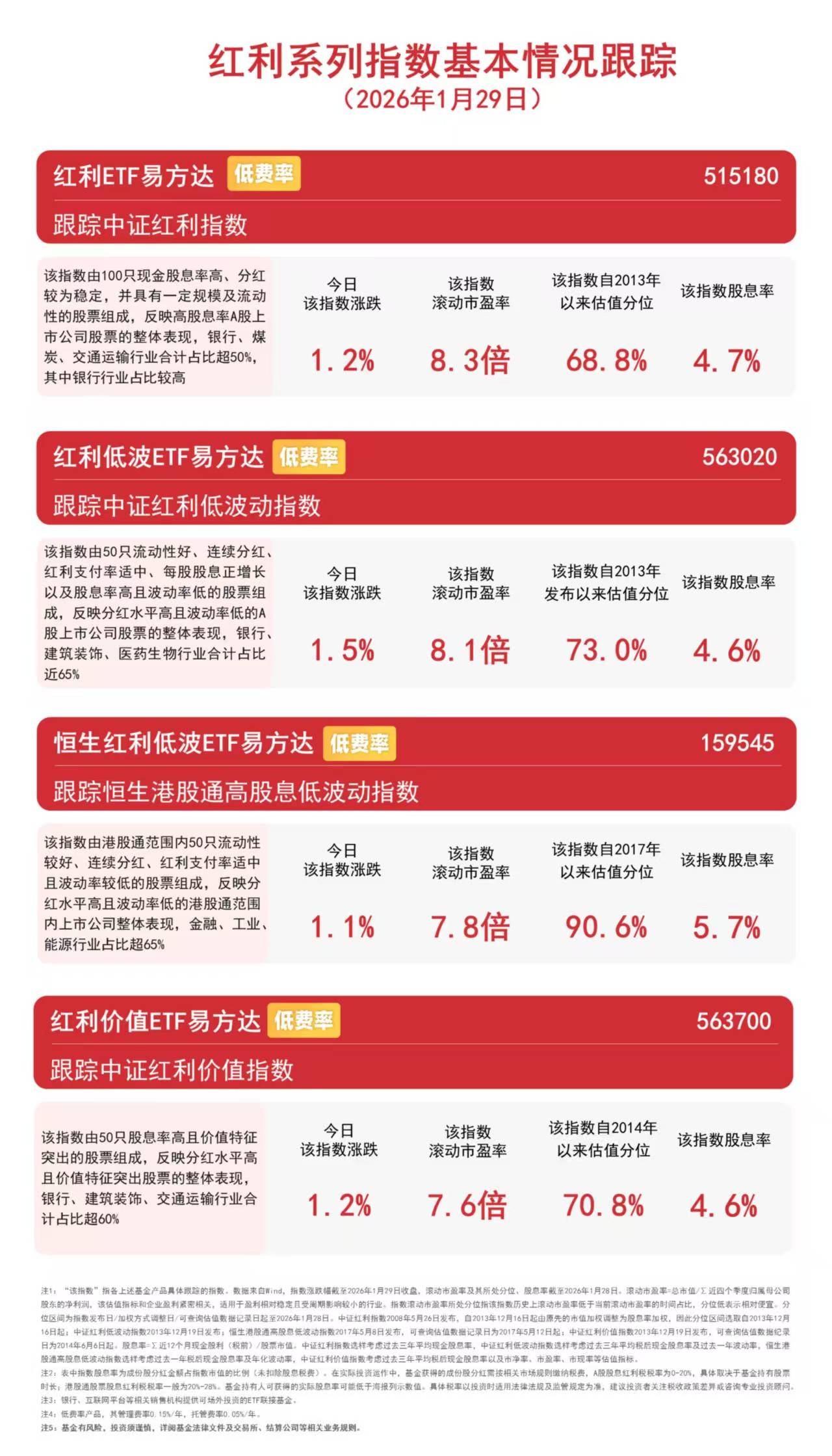
Core Viewpoint - The article highlights the performance of various dividend-focused ETFs managed by E Fund, emphasizing their low fee structure and recent inflows of capital into these funds. Group 1: ETF Performance - The CSI Dividend Low Volatility Index increased by 1.5%, while the CSI Dividend Index and CSI Dividend Value Index both rose by 1.2%. The Hang Seng High Dividend Low Volatility Index saw a gain of 1.1% [1] - E Fund's Dividend ETF (515180) and Dividend Low Volatility ETF (563020) experienced significant capital inflows, totaling 77 million yuan and 46 million yuan respectively over the past two trading days [1] Group 2: Fund Management Fees - E Fund is noted as the only fund company that implements a low fee rate for all its dividend ETFs, with a management fee of 0.15% per year for its products [1] - The low fee structure is designed to assist investors in cost-effective allocation to high dividend assets [1] Group 3: Index Composition - The CSI Dividend Index consists of 100 stocks with high cash dividend yields, primarily from the banking, coal, and transportation sectors, which together account for over 50% of the index [3] - The CSI Dividend Low Volatility Index is composed of 50 stocks characterized by good liquidity, continuous dividends, and low volatility, with significant representation from the banking, construction, and pharmaceutical sectors [3] - The Hang Seng High Dividend Low Volatility Index includes 50 stocks within the Hong Kong Stock Connect that exhibit good liquidity and stable dividends, with major sectors being finance and industry [3] Group 4: Valuation Metrics - The rolling price-to-earnings (P/E) ratio for the CSI Dividend Index is reported at 8.3 times, while the CSI Dividend Low Volatility Index has a P/E ratio of 8.1 times [3] - The rolling P/E ratio for the Hang Seng High Dividend Low Volatility Index stands at 7.8 times [3]

红利ETF华泰柏瑞(510880)新名亮相,近10个交易日累计吸金17亿元!
Xin Lang Cai Jing· 2026-01-28 06:12
Group 1 - The market continues to show a volatile pattern, with funds shifting towards high-dividend sectors as risk-free yields decline and medium to long-term capital steadily enters the market [1][7] - The HuaTai BaiRui Dividend ETF (510880) has attracted a total of 1.77 billion yuan in the last 10 trading days, increasing its scale to 19.9 billion yuan, making it one of the few dividend-themed ETFs nearing 20 billion yuan in size [1][7] - The ETF has been renamed to "HuaTai BaiRui Dividend ETF" for better investor recognition and decision-making efficiency, effective from January 28, 2026 [2][8] Group 2 - Since its inception, the HuaTai BaiRui Dividend ETF has achieved a cumulative return of 261.52%, surpassing its benchmark return of 133.90% [2][8] - The ETF has distributed dividends 19 times since its establishment, with a total dividend payout of 5.183 billion yuan, making it one of the few dividend-themed index funds in the market with over 5 billion yuan in cumulative dividends [2][9] - As of the end of the reporting period, the ETF had 421,800 account holders, also making it one of the few dividend-themed ETFs with over 70,000 account holders [2][9] Group 3 - HuaTai BaiRui Fund has over 19 years of management experience in the dividend-themed index investment sector and has developed a diverse strategy known as the "Dividend Family Bucket" [3][9] - On January 28, 2026, the South China East Ying HuaTai BaiRui CSI A500 ETF will be listed on the Hong Kong Stock Exchange, becoming the first fund tracking the CSI A500 index to be listed there [3][9] - The latest scale of the A500 ETF HuaTai BaiRui is 46.089 billion yuan, currently ranking first among similar ETFs in the market [3][9]
“懒人投资”的进阶法则 拆解红利投资的多元化策略图谱
Xin Lang Cai Jing· 2026-01-27 08:31
Group 1: Core Insights - The focus on dividend yield and sustainable dividend investment has gained popularity among individual investors and institutional funds like insurance companies [1][11] - The 2026 Investment Strategy Summit by Harvest Fund highlighted discussions on dividend investment strategies, asset advantages, and market opportunities for 2026 [1][11] Group 2: Nature of Dividend Investment - Dividend investment centers on the concept of dividend yield, which, while simple, has complex underlying factors [3][13] - Key conditions for quality dividend assets include stable dividend capability, clear intent to distribute dividends, and reasonable valuation levels [3][13] - Companies meeting these criteria typically have strong industry prospects, sustainable business models, and excellent management teams, providing investors with a robust holding experience [3][13] Group 3: Advantages of Dividend Strategies - Historical data shows that over half of the returns from the CSI Dividend Total Return Index come from dividend yield, indicating a stable and predictable return source [4][14] - The unique characteristics of dividend strategies include high dividend yield, low valuation levels, and low drawdown levels, making them particularly valuable in a low-interest-rate environment [4][14] - This strategy allows investors to adopt a "lazy investment method," facilitating a more relaxed long-term holding approach [4][15] Group 4: Diversification of Dividend Strategies - Two main directions for dividend strategies are identified: dividend growth strategy, which balances reasonable dividend yield with growth potential, and low-volatility dividend strategy, which is suitable for conservative investors [5][16] - The "dividend+" concept incorporates additional factors like future growth potential, emphasizing the need for adaptive strategy selection in changing interest rate environments [6][16] Group 5: Outlook for Dividend Investment in 2026 - Four reasons support a positive long-term outlook for dividend assets: increasing demand for wealth allocation, significantly higher dividend yields compared to deposit rates, growing willingness of companies to distribute dividends, and sustained inflow of long-term funds from insurance institutions [7][17] - The current weak performance of dividend assets presents a valuable opportunity for long-term value investors to position themselves [7][17] Group 6: Principles of Dividend Investment - Key principles for successful dividend investment include focusing on long-term value and selecting quality dividend funds [8][18] - Investors are encouraged to adopt a disciplined approach, implementing a strategy of gradual investment at low valuations and maintaining long-term holdings [8][18] - The emphasis is on strategic selection and disciplined execution rather than attempting to predict short-term market fluctuations [8][18]

50万亿定存到期潮!钱怎么投?银行理财、基金配置新答案
Sou Hu Cai Jing· 2026-01-27 07:52
Core Insights - A significant amount of deposits is maturing, with estimates suggesting that the nationwide maturing fixed deposits could reach 50 trillion yuan this year, prompting a shift in investment strategies among residents [2][3] Group 1: Deposit Trends and Investment Shifts - The continuous decline in deposit interest rates has led to a reassessment of investment options, with many conservative investors opting to renew deposits or shift towards insurance products, while risk-tolerant investors are increasingly exploring funds and bank wealth management products [2][3] - The People's Bank of China has indicated that a large volume of long-term deposits will mature by 2026, which will compel depositors to consider alternatives like bank wealth management and funds due to lower interest rates [3][4] Group 2: Performance of Financial Products - In 2025, the capital market is expected to show an upward trend, with median returns for equity and mixed funds reaching 26.42% and 22.92% respectively, while bank wealth management products are projected to yield around 2% [4] - Despite the decline in returns from wealth management products due to bond market fluctuations, they still offer a better yield compared to traditional deposits [4] Group 3: Customer Behavior and Market Dynamics - The transition of funds from deposits to investment products is gradual, with increased interest in funds noted since last year, particularly during the year-end and early-year periods when many customers receive bonuses or have maturing funds [5][6] - Many ordinary depositors remain unaware of the implications of interest rate cuts, often choosing to reinvest in fixed deposits rather than exploring other investment avenues [6] Group 4: Investment Strategies and Recommendations - Financial advisors are increasingly recommending diversified investment strategies, emphasizing the importance of balanced asset allocation to mitigate risks associated with market volatility [8][10] - Investment firms are adapting their product offerings to meet the evolving needs of clients, focusing on multi-strategy and multi-asset solutions to enhance returns while managing risk [8][9]
红利策略投资“里程碑” 520亿“红利全家桶”焕新场内简称
Xin Lang Cai Jing· 2026-01-26 12:33
Group 1 - The core viewpoint is that Huatai-PB's "Dividend Family Bucket" series is undergoing a significant rebranding, reflecting its growth and market recognition in the domestic dividend investment sector [1][2] - Huatai-PB currently manages over 52 billion yuan in assets, holding a market share exceeding 25% in the dividend investment space [1][2] - The rebranding will take effect on January 28, 2026, with the new ETF names incorporating "Huatai-PB" [1][2] - The five ETFs will be renamed as follows: Dividend ETF Huatai-PB (510880), Low Volatility Dividend ETF Huatai-PB (512890), Hong Kong Stock Connect Dividend ETF Huatai-PB (513530), Central State-Owned Enterprise Dividend ETF Huatai-PB (561580), and Hong Kong Stock Connect Low Volatility Dividend ETF Huatai-PB (520890) [1][2] - Over 19 years, the "Dividend Family Bucket" has become a widely recognized investment brand, generating a total profit of 9.879 billion yuan for its holders by the end of 2025 [1][2]
520亿“红利全家桶”焕新场内简称
Mei Ri Jing Ji Xin Wen· 2026-01-26 12:11
Core Viewpoint - The domestic dividend investment sector is experiencing a significant branding milestone with Huatai-PB's "Dividend Family Bucket" series rebranding, reflecting its growth and market recognition [1] Group 1: Company Overview - Huatai-PB currently manages over 52 billion yuan in assets, holding a market share exceeding 25% in the dividend investment space [1] - The rebranding will take effect on January 28, 2026, with the new ETF names incorporating "Huatai-PB" [1] Group 2: Product Details - The five ETFs under the rebranding include: - Dividend ETF Huatai-PB (510880) - Low Volatility Dividend ETF Huatai-PB (512890) - Hong Kong Stock Connect Dividend ETF Huatai-PB (513530) - Central State-Owned Enterprise Dividend ETF Huatai-PB (561580) - Hong Kong Stock Connect Low Volatility Dividend ETF Huatai-PB (520890) [1] Group 3: Performance Metrics - Over 19 years, the "Dividend Family Bucket" has become a widely recognized investment brand, generating a total profit of 9.879 billion yuan for its holders by the end of 2025 [1]
行业研究|行业周报|煤炭与消费用燃料:如何看待年初以来煤炭板块内部行情分化?-20260126
Changjiang Securities· 2026-01-26 11:55
丨证券研究报告丨 行业研究丨行业周报丨煤炭与消费用燃料 [Table_Title] 如何看待年初以来煤炭板块内部行情分化? 报告要点 [Table_Summary] 为何年初至今煤炭板块内部资金从"红利"向"弹性成长"轮动?我们认为,这主要和行业景 气有望筑底回暖、风险偏好提升、资金结构变化有关。考虑到 2026 年煤炭需求改善可期、反 内卷大背景下供给受限,供需改善下煤价中枢仍有望提升。因此一旦后续供给政策明朗化或需 求超预期,行情驱动将从"预期博弈"转向"基本面兑现",弹性煤炭公司或因低估值高赔率获 得较优相对收益。与此同时,依旧需要重视红利投资价值,尤其是红利标的中煤能源 H+A、中 国神华 H+A、陕西煤业有望因稳步改善的绝对股息率的投资性价比而获得增配。 分析师及联系人 请阅读最后评级说明和重要声明 %% %% %% %% research.95579.com 1 [Table_Author] SAC:S0490516080003 SAC:S0490519030001 SAC:S0490517070008 SAC:S0490522090003 SAC:S0490524120007 SFC:BUT91 ...
公募去年四季度亏超千亿终结七连盈,科技周期成加仓核心
第一财经· 2026-01-25 13:23
Core Viewpoint - The A-share market experienced significant fluctuations around the 4000-point mark, leading to a loss of profitability for public funds in the fourth quarter of 2025, marking the first loss after seven consecutive profitable quarters. However, the overall annual profit reached a record 2.6 trillion yuan, recovering losses from previous years [3][6]. Fund Performance - In Q4 2025, public funds reported a total loss of approximately 1.1 billion yuan, ending a streak of profitability. Despite this, the annual profit of 2.6 trillion yuan set a historical record, covering cumulative losses of 1.87 trillion yuan from 2022 to 2023 [6][8]. - Equity funds were the hardest hit in Q4, with a combined loss of 1.81 trillion yuan, while mixed funds also faced losses. In contrast, bond and money market funds continued to perform well, contributing significantly to overall profits [6][9]. Fund Adjustments - Public funds actively adjusted their holdings in response to market conditions, increasing their positions in technology and cyclical sectors. Notably, Zhongji Xuchuang replaced Ningde Times as the top holding among active funds [3][11]. - The top ten heavy stocks saw minimal changes in total market value, but individual rankings shifted significantly, with Zhongji Xuchuang and Xinyi Sheng surpassing Guizhou Moutai in holdings [12][13]. Sector Focus - The electronic sector emerged as the largest area of investment for public funds, with a total market value of 741 billion yuan. The power equipment sector followed closely, while the communication sector became the third-largest focus, overtaking the pharmaceutical sector [17]. - Public funds increased their positions in oil, non-bank financials, and metals, with significant additions in stocks like Industrial Bank and China Petroleum [15][16]. Market Outlook - Analysts suggest that while sectors like new consumption and AI show strong fundamentals, valuation concerns may arise due to market liquidity tightening. Dividend investments are expected to perform better in 2026 compared to the previous year [17].

公募去年四季度亏超千亿终结七连盈,科技周期成加仓核心
Di Yi Cai Jing· 2026-01-25 12:00
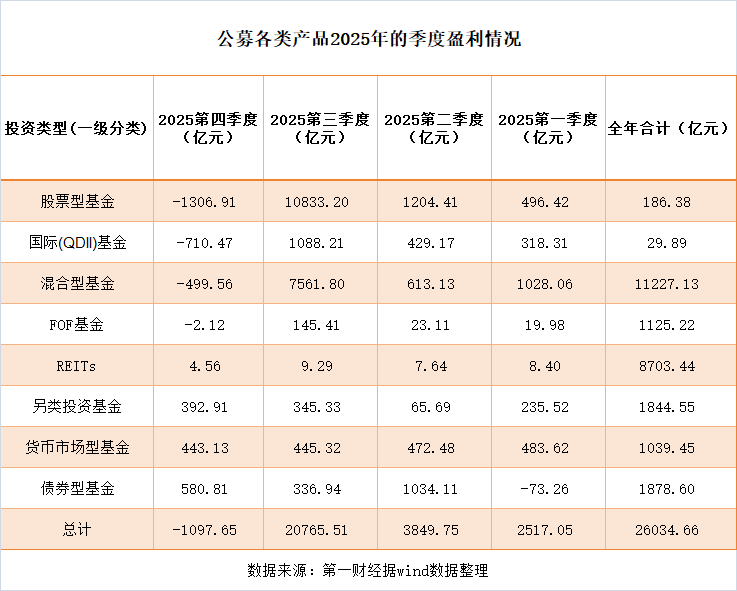
Core Insights - The public fund industry in China achieved a record profit of 2.6 trillion yuan in 2025, recovering from a cumulative loss of 1.87 trillion yuan from 2022 to 2023 [1][2] - Despite a loss of approximately 110 billion yuan in Q4 2025, the overall annual performance marked a significant recovery for the industry [2][3] Fund Performance - In Q4 2025, public funds reported a total loss of 1,097.65 billion yuan, ending a streak of seven consecutive profitable quarters [2][3] - Equity funds were the hardest hit, with a combined loss of 1,306.91 billion yuan in Q4, while mixed funds lost 499.56 billion yuan [3][4] - For the entire year, equity funds still managed to generate a profit of 1.99 trillion yuan, despite the Q4 downturn [4] Product Categories - QDII funds and FOF funds also faced losses in Q4, amounting to 710.47 billion yuan and 2.12 billion yuan respectively, but ended the year with profits of 1,125.22 billion yuan and 186.38 billion yuan [4] - Fixed-income products, including bond and money market funds, contributed significantly to profits, with bond funds earning 580.81 billion yuan and money market funds 443.13 billion yuan [4] Fund Company Performance - Among 167 fund companies, 108 reported positive profits, with over 60% achieving profitability [5] - Notable performers included Guotou Ruijin Fund, which led the industry with a profit of 72.82 billion yuan [5] Stock Holdings Adjustments - Public funds increased their holdings in 83 new stocks by the end of Q4 2025, with a focus on technology and cyclical sectors [7] - Ningde Times remained the top holding stock, despite a reduction of 1,993 million shares, while Zhongji Xuchuang became the most held stock among active funds [10][11] Sector Focus - The communication sector, particularly in optical modules, saw increased institutional investment, with Zhongji Xuchuang and Xinye Technology becoming top holdings [10] - The top three sectors for public fund investments were electronics, power equipment, and communication, with significant capital allocated to these areas [13]



中欧红利智选混合A:2025年第四季度利润367.29万元 净值增长率2.48%
Sou Hu Cai Jing· 2026-01-23 10:14
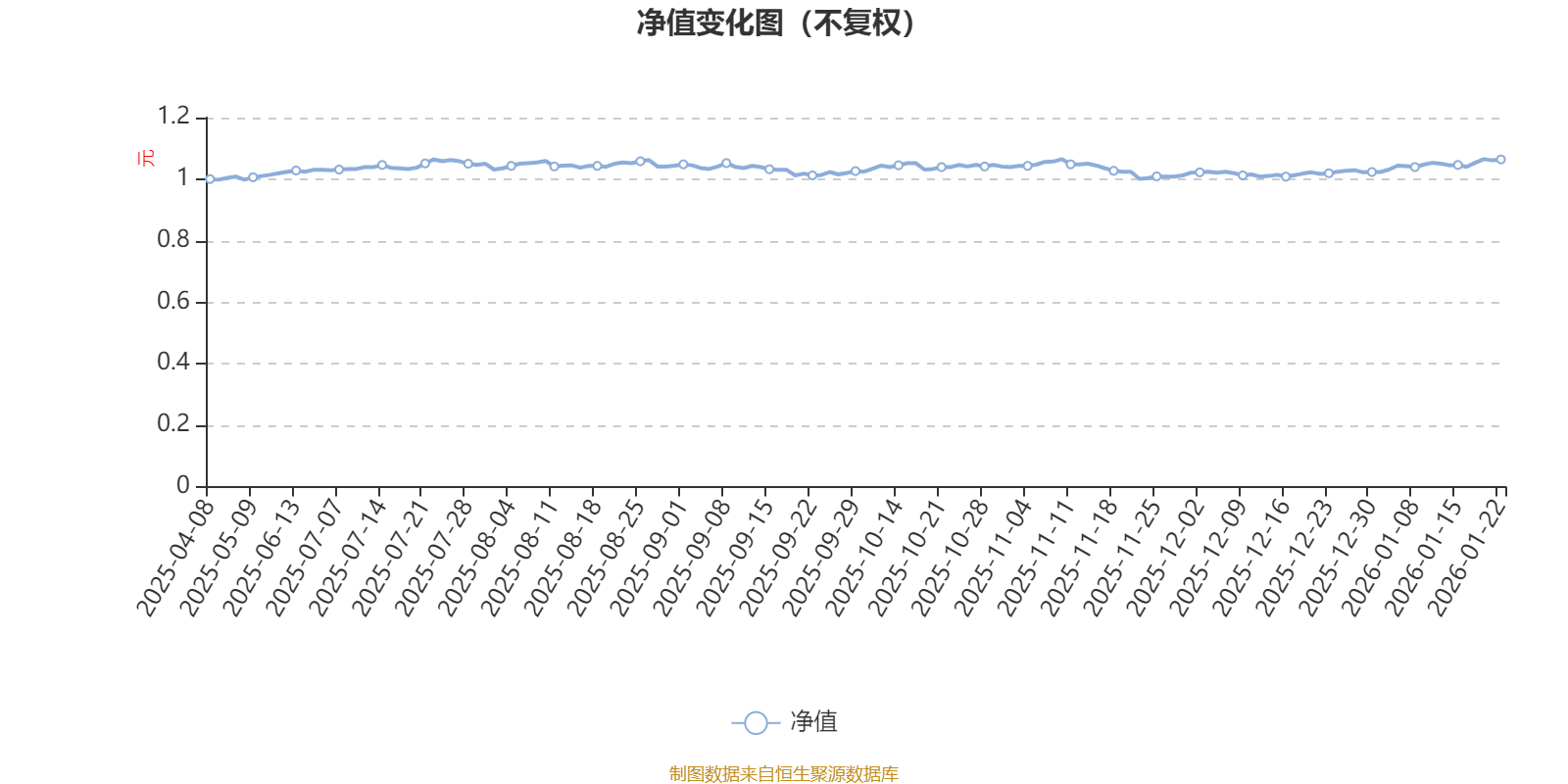
Core Viewpoint - The AI Fund, China Europe Dividend Smart Selection Mixed A (023584), reported a profit of 3.6729 million yuan for Q4 2025, with a net value growth rate of 2.48% for the period [3]. Fund Performance - The fund's scale reached 178 million yuan by the end of Q4 2025 [12]. - As of January 22, the unit net value was 1.064 yuan, with a one-year adjusted net value growth rate of 63.65% for China Europe Prosperity Selected Mixed A, the highest among its peers [3]. - The fund's three-month adjusted net value growth rate was 3.90%, ranking 499 out of 621 comparable funds, while the six-month rate was 5.91%, ranking 560 out of 621 [3]. Investment Strategy - The fund manager indicated that there is still room for further development and exploration in dividend investment in China, with a future focus on "market-oriented" dividends [3]. Risk Metrics - The fund's Sharpe ratio since inception is 0.2125 [4]. - The maximum drawdown since inception is 4.6%, occurring in Q4 2025 [7]. Portfolio Composition - The average stock position since inception is 75.27%, compared to the peer average of 85.83%. The fund reached a peak stock position of 89.95% at the end of Q3 2025 and a low of 45.9% at the end of H1 2025 [11]. - The top ten holdings as of Q4 2025 include Guangzhou Development, Nanjing High-Tech, Ordos, Weifu High-Tech, Huadian International, Nanjing Steel, Wuxi Bank, Shandong Publishing, Luolai Lifestyle, and Zhongchuang Zhiling [15].